What Is
A Capacitor?
A capacitor is a passive two-terminal electrical component used to store energy electro-statically
in an electric field. A capacitor holds a charge, similar to how a bucket holds water.
Named the Leyden jar, it was a glass jar
coated with metal on both the inside as well as
the outside, with the glass acting as the
dielectric.
Invented In
The 18th Century
The lid topped off the jar. A hole in the lid had a metal
rod passing through it, with its other end connected to
the inner coat of metal. The exposed end of the rod
culminated in a metal ball. The metal ball and rod was
used to charge the inner electrode of the jar electrically.
Today's Capacitors
A capacitor has two conductive plates separated by a dielectric.
This helps maintain an electric charge between its plates. Different
materials are used for the dielectric, such as plastic, paper, air,
tantalum, polyester, ceramic, etc. The main purpose of the
dielectric is to prevent the plates from touching each other.
Capacitors Can Be Used
In A Number Of Different Ways
Variable Capacitor
The Telecommunication Industry uses variable
capacitors to adjust the frequency and tuning of their
communications equipment.
You can measure a capacitor in terms of the voltage difference between its plates, as the two plates
hold identical but opposite charge. Unlike the battery, a capacitor does not generate electrons, and
therefore, there is no current flow if the two plates are electrically connected. The electrically
connected plates rearrange the charge between them, effectively neutralizing each other.
Batteries
As there is only a dielectric between the two plates, a capacitor will
block direct current but will allow alternating current to flow within
its design parameters. If you hook up a capacitor across the
terminals of a battery, there will not be any current flow after the
capacitor has charged. However, alternating current or AC signal
will flow through, impeded only by the reactance of the capacitor,
which depends on the frequency of the signal. As the alternating
current fluctuates, it causes the capacitor to charge and discharge,
making it appear as if a current is flowing.
A Capacitor Can
Dump Their
Charge At High
Speed
Eminently suitable for generating a flash for photography.
Used in big lasers to get very bright and instantaneous flashes.
Similar To A Capacitor
"Ligthtning"
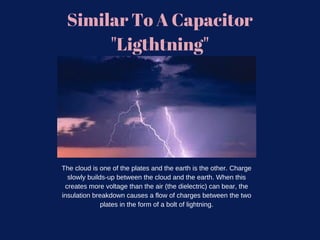
The cloud is one of the plates and the earth is the other. Charge
slowly builds-up between the cloud and the earth. When this
creates more voltage than the air (the dielectric) can bear, the
insulation breakdown causes a flow of charges between the two
plates in the form of a bolt of lightning.
The Many Sizes & Shapes
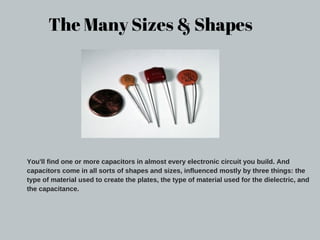
You'll find one or more capacitors in almost every electronic circuit you build. And
capacitors come in all sorts of shapes and sizes, influenced mostly by three things: the
type of material used to create the plates, the type of material used for the dielectric, and
the capacitance.
Ceramic Disk Caps
The plates are made by coating both sides of a small ceramic or porcelain disk with silver solder. The
ceramic or porcelain disk is the dielectric, and the silver solder forms the plates. Leads are soldered to
the plates, and the entire thing is dipped in resin.
Ceramic disk capacitors are small and usually have low capacitance values, ranging from 1 pF to a few
microfarads. Because they're small, their values are usually printed using a three-digit shorthand
notation.
Ceramic disk capacitors aren't polarized, so you don't have to worry about polarity when you use them.
Silver Mica Caps
The dielectric is made from mica, and this capacitor is sometimes referred to simply as a mica capacitor.
As with ceramic capacitors, the plates in a silver mica capacitor are made from silver. Electrodes are
joined to the plates, and then the capacitor is dipped in epoxy.
Silver mica capacitors come in about the same capacitance range as ceramic disk capacitors. However,
they can be made to much higher tolerances — as close as 1% in some cases. Like ceramic disk
capacitors, silver mica capacitors aren't polarized.
Although ceramic disk and mica capacitors are constructed in a similar way, they're easy to tell apart.
Ceramic disk capacitors are thin, flat disks and are nearly always a dull, light-brown color. Silver mica
capacitors are thicker, bulge at the ends where the leads are attached, and are shiny and sometimes
colorful — red, blue, yellow, and green are common colors for silver mica capacitors.
Film Caps
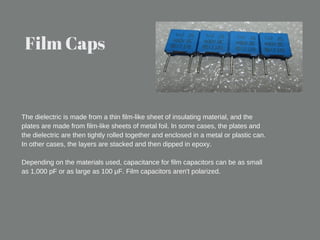
The dielectric is made from a thin film-like sheet of insulating material, and the
plates are made from film-like sheets of metal foil. In some cases, the plates and
the dielectric are then tightly rolled together and enclosed in a metal or plastic can.
In other cases, the layers are stacked and then dipped in epoxy.
Depending on the materials used, capacitance for film capacitors can be as small
as 1,000 pF or as large as 100 μF. Film capacitors aren't polarized.
Electrolytic Caps
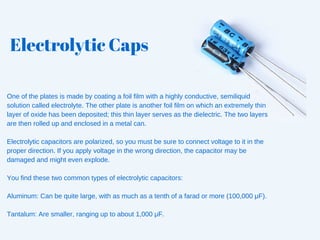
One of the plates is made by coating a foil film with a highly conductive, semiliquid
solution called electrolyte. The other plate is another foil film on which an extremely thin
layer of oxide has been deposited; this thin layer serves as the dielectric. The two layers
are then rolled up and enclosed in a metal can.
Electrolytic capacitors are polarized, so you must be sure to connect voltage to it in the
proper direction. If you apply voltage in the wrong direction, the capacitor may be
damaged and might even explode.
You find these two common types of electrolytic capacitors:
Aluminum: Can be quite large, with as much as a tenth of a farad or more (100,000 μF).
Tantalum: Are smaller, ranging up to about 1,000 μF.
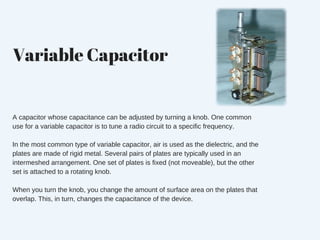
Variable Capacitor
A capacitor whose capacitance can be adjusted by turning a knob. One common
use for a variable capacitor is to tune a radio circuit to a specific frequency.
In the most common type of variable capacitor, air is used as the dielectric, and the
plates are made of rigid metal. Several pairs of plates are typically used in an
intermeshed arrangement. One set of plates is fixed (not moveable), but the other
set is attached to a rotating knob.
When you turn the knob, you change the amount of surface area on the plates that
overlap. This, in turn, changes the capacitance of the device.
More Types,
Shapes & Sizes
A passive two-terminal electrical
component used to store energy
electro-statically in an electric field.
Invented In
The 18th Century
ES Components
108 Pratts Junction Road
Sterling, MA 01564
www.escomponents.com

Capacitors 101

  • 2.
    What Is A Capacitor? Acapacitor is a passive two-terminal electrical component used to store energy electro-statically in an electric field. A capacitor holds a charge, similar to how a bucket holds water.
  • 3.
    Named the Leydenjar, it was a glass jar coated with metal on both the inside as well as the outside, with the glass acting as the dielectric. Invented In The 18th Century The lid topped off the jar. A hole in the lid had a metal rod passing through it, with its other end connected to the inner coat of metal. The exposed end of the rod culminated in a metal ball. The metal ball and rod was used to charge the inner electrode of the jar electrically.
  • 4.
    Today's Capacitors A capacitorhas two conductive plates separated by a dielectric. This helps maintain an electric charge between its plates. Different materials are used for the dielectric, such as plastic, paper, air, tantalum, polyester, ceramic, etc. The main purpose of the dielectric is to prevent the plates from touching each other.
  • 5.
    Capacitors Can BeUsed In A Number Of Different Ways
  • 6.
    Variable Capacitor The TelecommunicationIndustry uses variable capacitors to adjust the frequency and tuning of their communications equipment. You can measure a capacitor in terms of the voltage difference between its plates, as the two plates hold identical but opposite charge. Unlike the battery, a capacitor does not generate electrons, and therefore, there is no current flow if the two plates are electrically connected. The electrically connected plates rearrange the charge between them, effectively neutralizing each other.
  • 7.
    Batteries As there isonly a dielectric between the two plates, a capacitor will block direct current but will allow alternating current to flow within its design parameters. If you hook up a capacitor across the terminals of a battery, there will not be any current flow after the capacitor has charged. However, alternating current or AC signal will flow through, impeded only by the reactance of the capacitor, which depends on the frequency of the signal. As the alternating current fluctuates, it causes the capacitor to charge and discharge, making it appear as if a current is flowing.
  • 8.
    A Capacitor Can DumpTheir Charge At High Speed Eminently suitable for generating a flash for photography. Used in big lasers to get very bright and instantaneous flashes.
  • 9.
    Similar To ACapacitor "Ligthtning" The cloud is one of the plates and the earth is the other. Charge slowly builds-up between the cloud and the earth. When this creates more voltage than the air (the dielectric) can bear, the insulation breakdown causes a flow of charges between the two plates in the form of a bolt of lightning.
  • 10.
    The Many Sizes& Shapes You'll find one or more capacitors in almost every electronic circuit you build. And capacitors come in all sorts of shapes and sizes, influenced mostly by three things: the type of material used to create the plates, the type of material used for the dielectric, and the capacitance.
  • 11.
    Ceramic Disk Caps Theplates are made by coating both sides of a small ceramic or porcelain disk with silver solder. The ceramic or porcelain disk is the dielectric, and the silver solder forms the plates. Leads are soldered to the plates, and the entire thing is dipped in resin. Ceramic disk capacitors are small and usually have low capacitance values, ranging from 1 pF to a few microfarads. Because they're small, their values are usually printed using a three-digit shorthand notation. Ceramic disk capacitors aren't polarized, so you don't have to worry about polarity when you use them.
  • 12.
    Silver Mica Caps Thedielectric is made from mica, and this capacitor is sometimes referred to simply as a mica capacitor. As with ceramic capacitors, the plates in a silver mica capacitor are made from silver. Electrodes are joined to the plates, and then the capacitor is dipped in epoxy. Silver mica capacitors come in about the same capacitance range as ceramic disk capacitors. However, they can be made to much higher tolerances — as close as 1% in some cases. Like ceramic disk capacitors, silver mica capacitors aren't polarized. Although ceramic disk and mica capacitors are constructed in a similar way, they're easy to tell apart. Ceramic disk capacitors are thin, flat disks and are nearly always a dull, light-brown color. Silver mica capacitors are thicker, bulge at the ends where the leads are attached, and are shiny and sometimes colorful — red, blue, yellow, and green are common colors for silver mica capacitors.
  • 13.
    Film Caps The dielectricis made from a thin film-like sheet of insulating material, and the plates are made from film-like sheets of metal foil. In some cases, the plates and the dielectric are then tightly rolled together and enclosed in a metal or plastic can. In other cases, the layers are stacked and then dipped in epoxy. Depending on the materials used, capacitance for film capacitors can be as small as 1,000 pF or as large as 100 μF. Film capacitors aren't polarized.
  • 14.
    Electrolytic Caps One ofthe plates is made by coating a foil film with a highly conductive, semiliquid solution called electrolyte. The other plate is another foil film on which an extremely thin layer of oxide has been deposited; this thin layer serves as the dielectric. The two layers are then rolled up and enclosed in a metal can. Electrolytic capacitors are polarized, so you must be sure to connect voltage to it in the proper direction. If you apply voltage in the wrong direction, the capacitor may be damaged and might even explode. You find these two common types of electrolytic capacitors: Aluminum: Can be quite large, with as much as a tenth of a farad or more (100,000 μF). Tantalum: Are smaller, ranging up to about 1,000 μF.
  • 15.
    Variable Capacitor A capacitorwhose capacitance can be adjusted by turning a knob. One common use for a variable capacitor is to tune a radio circuit to a specific frequency. In the most common type of variable capacitor, air is used as the dielectric, and the plates are made of rigid metal. Several pairs of plates are typically used in an intermeshed arrangement. One set of plates is fixed (not moveable), but the other set is attached to a rotating knob. When you turn the knob, you change the amount of surface area on the plates that overlap. This, in turn, changes the capacitance of the device.
  • 16.
  • 17.
    A passive two-terminalelectrical component used to store energy electro-statically in an electric field. Invented In The 18th Century
  • 18.
    ES Components 108 PrattsJunction Road Sterling, MA 01564 www.escomponents.com