PRESENTED BY,
SABARISH HARIHARAN
BPT-11nd YEAR
REALLY ,
WHAT IS CONDENSER ?
Condenser is nothing ,
We already studied about it
Condenser is just a another name of
…………………………
WHOWILL USE MY INVENTION
• Who benefits from this invention?Why?
CAPACITOR
A device used to store an electric
charge,
consisting of one or more pairs of
conductors separated by an insulator
Capacitor consist of two metal plates separated by a non-conducting
substance, or dielectric.When DC voltage is applied across capacitor then +ve charge
will get accumulated at one plate and –ve charge at another plate. +ve and –ve Charges
are of equal amount.
CAPACITOR
WHOWILL USE MY INVENTION
• Who benefits from this invention?Why?
PRINCIPLE OF THE CAPACITOR
MY INVENTION IN USE!
Talk about how people reacted to your invention
• Did it solve the problem/need you identified?
• Did it work as planned? Did it help whom it needed to help?
<Insert pictures or drawings of your invention being used,
with a description entered here>
*you can insert a new slide for these pictures/drawings if you
need to!
<Insert pictures or drawings of your invention being used,
with a description entered here>
*you can insert a new slide for these pictures/drawings if you
need to!
<Insert pictures or drawings of your invention being used,
with a description entered here>
*you can insert a new slide for these pictures/drawings if you
need to!
TYPES OF CAPACITOR
Different capacitor types are used based on voltage
requirement, capacitance, and other properties.A capacitor
is formerly termed as a condenser. Every capacitor consists
of plates or two electrical conductors and is separated by a
dielectric.They are employed in electrical circuits found in
various electronic devices
TYPES OF CAPCITOR
The capacitors can be
classified into two types:
Polarized
Unpolarized
POLARIZED CAPACITOR
UNPOLARIZED CAPACITORS
Unpolarized capacitors are preferred
over polarized capacitors because it
doesn’t get destroyed by reverse
voltage and can be used in pure AC
circuits.They also find applications in
DC circuits as they don’t have positive
and negative ends.The frequency of the
unpolarized capacitor is high and the
leakage current is low.
Capacitors are mainly divided into two
mechanical groups:
• Fixed capacitors
• Variable capacitors
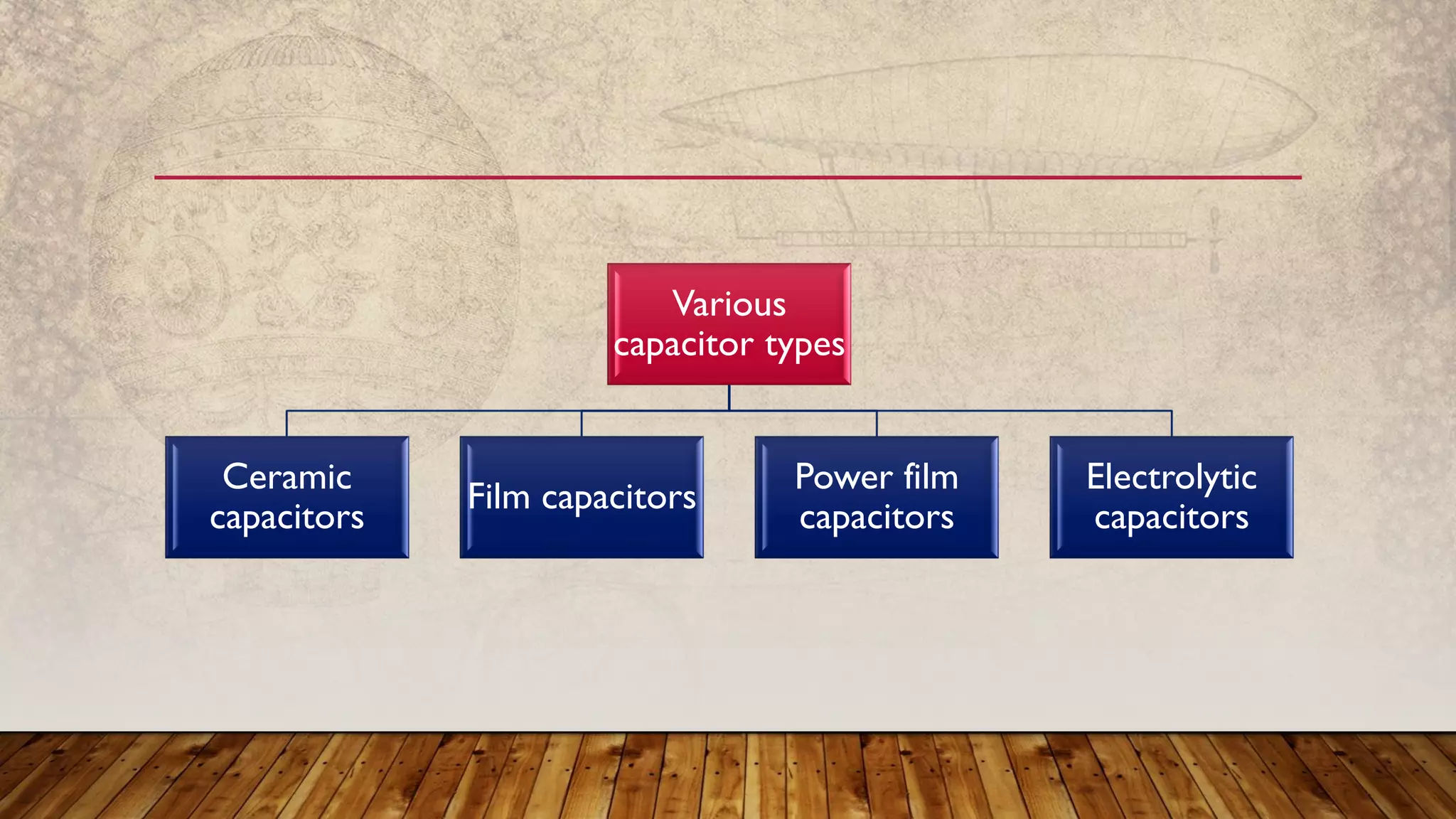
Various
capacitor types
Ceramic
capacitors
Film capacitors
Power film
capacitors
Electrolytic
capacitors
CONSTRUCTION OF CAPACITORS
The basic
construction of
all capacitors is
similar.
The construction
of capacitor is
very simple.
A capacitor is
made of two
electrically
conductive plates
placed close to
each other, but
they do not
touch each other.
These conductive
plates are
normally made of
materials such as
aluminum, brass,
or copper.
CONSTRUCTION OF CAPACITORS
The conductive
plates of a
capacitor is
separated by a
small distance.
The empty space
between these plates
is filled with a non-
conductive material
or electric insulator
or dielectric region.
The non-
conductive
material or region
between the two
plates may be an
air, vacuum, glass,
liquid, or solid.This
non-conductive
material is called
dielectric
CONSTRUCTION OF CAPACITORS
The two conductive
plates of the
capacitor are good
conductors of
electricity.
Therefore, they can
easily pass the
electric current
through them.
The conductive
plates of the
capacitor also hold
the electric charge.
In capacitors, these
plates are mainly
used to hold or
store the electric
charge.
CONSTRUCTION OF CAPACITORS
A dielectric material or medium is the poor conductor of electricity.
They cannot pass electric current through them. In capacitors, the dielectric
medium or material block the flow of charge carriers (especially electrons) between
the conductive plates.
As a result, the electric charges that try to move from one plate to another plate
will be trapped within the plate because of the strong resistance from the dielectric.
CONSTRUCTION OF CAPACITOR
Dielectric material does not
allow the flow of charge carriers,
but they allow the electric force,
electric charge, or electric field
produced by the charged
particles (electrons).
As a result, when charge is build
up on the two plates, a strong
electric field is generated
between the two plates
HOW CAPACITORWORKS?
Capacitor with
no voltage
source
• When no voltage is applied to the capacitor, the total
number of electrons and protons in the left plate of
the capacitor are equal.
• We know that any object, which has equal number of
electrons and protons is said to be electrically
neutral.
HOW CAPACITORWORKS?
❑ Hence, the total charge of the left plate cancels
out and becomes electrically neutral. Therefore,
the left plate of the capacitor is said to be
electrical neutral.
On the other hand, the right plate also has equal number of
electrons and protons.
Therefore, the total charge of the right plate cancels out and
becomes electrically neutral
No electric charge means no electric field.Therefore, the
capacitor does not store charge when no voltage is applied
CAPACITOR CIRCUIT SYMBOL
The circuit symbol of a basic capacitor is
shown in the below figure.The capacitor
symbol is represented by drawing two
parallel lines close to each other, but not
touching. It consists of two terminals.These
terminals are used to connect in the circuit.
RESISTANCE
Resistance is a measure of the opposition to current flow in an electrical
circuit.
Resistance is measured in ohms, symbolized by the Greek letter omega
(Ω). Ohms are named after Georg Simon Ohm (1784-1854), a German
physicist who studied the relationship between voltage, current and
resistance. He is credited for formulating Ohm's Law.
Condenser
Condenser
Condenser
Condenser

Condenser

  • 1.
  • 2.
    REALLY , WHAT ISCONDENSER ? Condenser is nothing , We already studied about it Condenser is just a another name of …………………………
  • 3.
    WHOWILL USE MYINVENTION • Who benefits from this invention?Why?
  • 4.
    CAPACITOR A device usedto store an electric charge, consisting of one or more pairs of conductors separated by an insulator
  • 5.
    Capacitor consist oftwo metal plates separated by a non-conducting substance, or dielectric.When DC voltage is applied across capacitor then +ve charge will get accumulated at one plate and –ve charge at another plate. +ve and –ve Charges are of equal amount. CAPACITOR
  • 6.
    WHOWILL USE MYINVENTION • Who benefits from this invention?Why?
  • 7.
  • 8.
  • 9.
    MY INVENTION INUSE! Talk about how people reacted to your invention • Did it solve the problem/need you identified? • Did it work as planned? Did it help whom it needed to help? <Insert pictures or drawings of your invention being used, with a description entered here> *you can insert a new slide for these pictures/drawings if you need to! <Insert pictures or drawings of your invention being used, with a description entered here> *you can insert a new slide for these pictures/drawings if you need to! <Insert pictures or drawings of your invention being used, with a description entered here> *you can insert a new slide for these pictures/drawings if you need to!
  • 10.
    TYPES OF CAPACITOR Differentcapacitor types are used based on voltage requirement, capacitance, and other properties.A capacitor is formerly termed as a condenser. Every capacitor consists of plates or two electrical conductors and is separated by a dielectric.They are employed in electrical circuits found in various electronic devices
  • 11.
    TYPES OF CAPCITOR Thecapacitors can be classified into two types: Polarized Unpolarized
  • 12.
  • 13.
    UNPOLARIZED CAPACITORS Unpolarized capacitorsare preferred over polarized capacitors because it doesn’t get destroyed by reverse voltage and can be used in pure AC circuits.They also find applications in DC circuits as they don’t have positive and negative ends.The frequency of the unpolarized capacitor is high and the leakage current is low.
  • 14.
    Capacitors are mainlydivided into two mechanical groups: • Fixed capacitors • Variable capacitors
  • 15.
  • 24.
    CONSTRUCTION OF CAPACITORS Thebasic construction of all capacitors is similar. The construction of capacitor is very simple. A capacitor is made of two electrically conductive plates placed close to each other, but they do not touch each other. These conductive plates are normally made of materials such as aluminum, brass, or copper.
  • 25.
    CONSTRUCTION OF CAPACITORS Theconductive plates of a capacitor is separated by a small distance. The empty space between these plates is filled with a non- conductive material or electric insulator or dielectric region. The non- conductive material or region between the two plates may be an air, vacuum, glass, liquid, or solid.This non-conductive material is called dielectric
  • 27.
    CONSTRUCTION OF CAPACITORS Thetwo conductive plates of the capacitor are good conductors of electricity. Therefore, they can easily pass the electric current through them. The conductive plates of the capacitor also hold the electric charge. In capacitors, these plates are mainly used to hold or store the electric charge.
  • 28.
    CONSTRUCTION OF CAPACITORS Adielectric material or medium is the poor conductor of electricity. They cannot pass electric current through them. In capacitors, the dielectric medium or material block the flow of charge carriers (especially electrons) between the conductive plates. As a result, the electric charges that try to move from one plate to another plate will be trapped within the plate because of the strong resistance from the dielectric.
  • 29.
    CONSTRUCTION OF CAPACITOR Dielectricmaterial does not allow the flow of charge carriers, but they allow the electric force, electric charge, or electric field produced by the charged particles (electrons). As a result, when charge is build up on the two plates, a strong electric field is generated between the two plates
  • 30.
    HOW CAPACITORWORKS? Capacitor with novoltage source • When no voltage is applied to the capacitor, the total number of electrons and protons in the left plate of the capacitor are equal. • We know that any object, which has equal number of electrons and protons is said to be electrically neutral.
  • 31.
    HOW CAPACITORWORKS? ❑ Hence,the total charge of the left plate cancels out and becomes electrically neutral. Therefore, the left plate of the capacitor is said to be electrical neutral.
  • 32.
    On the otherhand, the right plate also has equal number of electrons and protons. Therefore, the total charge of the right plate cancels out and becomes electrically neutral No electric charge means no electric field.Therefore, the capacitor does not store charge when no voltage is applied
  • 33.
    CAPACITOR CIRCUIT SYMBOL Thecircuit symbol of a basic capacitor is shown in the below figure.The capacitor symbol is represented by drawing two parallel lines close to each other, but not touching. It consists of two terminals.These terminals are used to connect in the circuit.
  • 38.
    RESISTANCE Resistance is ameasure of the opposition to current flow in an electrical circuit. Resistance is measured in ohms, symbolized by the Greek letter omega (Ω). Ohms are named after Georg Simon Ohm (1784-1854), a German physicist who studied the relationship between voltage, current and resistance. He is credited for formulating Ohm's Law.