Diodes
Presented by Atheena Pandian
Content
Summary
Discussion Overview
What is Diode?
Electronic Symbol
Construction of Diode
Depletion Region and Junction
Volatage
Reverse bias and Forward Bias
Types of Diodes
I-V Characteristic Curve
Application of Diode
1.
2.
3.
4.
5.
6.
7.
8.
What is
diode?
A diode is an
electrical component desi
gned to conduct electric
current in only one
direction.
It has two ends (or
terminals), each with an
electrode of a different
charge.
Symbol
DIODE
A diode is
formed by
joining two
equivalently
doped P-Type
and N-Type
semiconductor.
Constuction
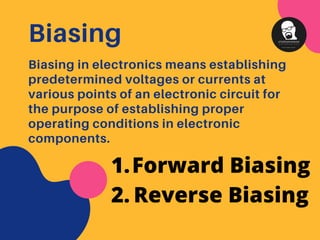
Biasing
Biasing in electronics means establishing
predetermined voltages or currents at
various points of an electronic circuit for
the purpose of establishing proper
operating conditions in electronic
components.
Forward Biasing
Reverse Biasing
1.
2.
Forward and
Reverse Bias
FORWARD BIAS
REVERSE BIAS
FORWARD AND REVERSE
BIAS
Forward biasing means
putting a voltage across a
diode that allows current to
flow easily, while reverse
biasing means putting
a voltage across a diode in the
opposite direction.
V-I Charecteristics
Using V-I
characteristics
of the diode, it
is easy to find
the voltage
and current in
the circuit
which
contains
the diode.
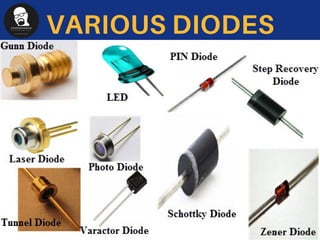
VARIOUS
DIODES
a Backward diode,
BARITT diode,
Gunn Diode,
Laser diode,
Light emitting diodes,
Photodiode,
PIN diode,
PN Junction,
Schottky diodes,
Step recovery diode,
Tunnel diode,
Varactor diode and a
Zener diode.
VARIOUS DIODES
Application of Diodes
Power Diode
Application of Diodes
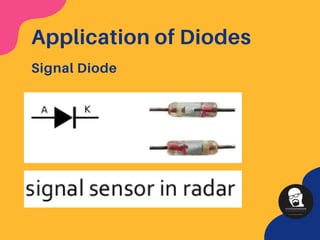
Signal Diode
Application of Diodes
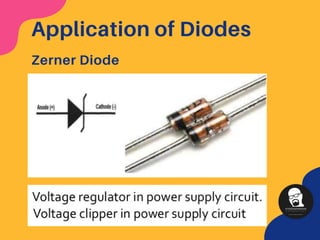
Zerner Diode
Application of Diodes
Light Emitting Diode (LED)
Application of Diodes
Tunnel Diode
Application of Diodes
Varactor Diode
Application of Diodes
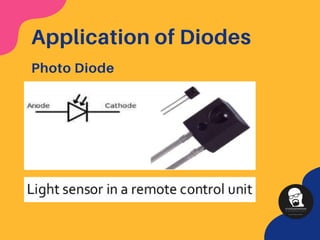
Photo Diode
Application of Diodes
Laser Diode
Thank You

Diodes basics