PHYSICS
INVESTIGATORY
PROJECT
2018
KENDRIYA VIDYALAYA NO.1 AIR FORCE STATION SECTOR-14
GURUGRAM
VISHAL
CLASS: 12-C
ROLL NO: 02
SUBMITTED TO:
MRS. PUNAM SHARMA
CAPACITORS:
DETAIL, TYPES & USES
Contents
Acknowledgement _________________________ 1
Certificate ________________________________ 2
Capacitors _______________________________ 3
Amount of Charge Q A Capacitor Can Store _____ 4
Self-Capacitance __________________________ 6
Charging & Discharging of a Capacitor _________ 7
Energy in a Capacitor_______________________ 8
Type of Capacitors _________________________ 9
Uses of Capacitors________________________ 12
Bibliography _____________________________ 15
Pg. 01 2018-19
Acknowledgement
I would like to sincerely and profusely thank my Physics
teacher Mrs. Puman Sharma, for his able guidance and
support in completing my project.
I would also like to extend my gratitude to the principal for
providing mw with all the facility that was required.
Last but not the least, I would extend my gratitude towards
all teaching and all the non-teaching staff of Kendriya
Vidyalaya No.1 Sector-14 Gurugram and towards my
friends who has supported me to complete this project.
Vishal
Pg. 02 2018-19
Certificate
This is to certify that Vishal of class XII-C has successfully
completed the investigatory project on the topic
“CAPACITORS: DETAIL, TYPES & USES” under my
guidance during the year 2018-19 in the partial fulfillment of
the physics practical examination conducted by CBSE.
Teacher’s Signature
Mrs. Punam Sharma
Pg. 03 2018-19
Capacitors
Introduction
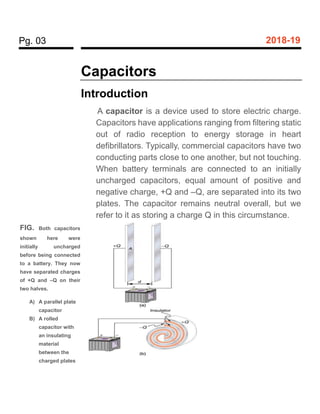
A capacitor is a device used to store electric charge.
Capacitors have applications ranging from filtering static
out of radio reception to energy storage in heart
defibrillators. Typically, commercial capacitors have two
conducting parts close to one another, but not touching.
When battery terminals are connected to an initially
uncharged capacitors, equal amount of positive and
negative charge, +Q and –Q, are separated into its two
plates. The capacitor remains neutral overall, but we
refer to it as storing a charge Q in this circumstance.
FIG. Both capacitors
shown here were
initially uncharged
before being connected
to a battery. They now
have separated charges
of +Q and –Q on their
two halves.
A) A parallel plate
capacitor
B) A rolled
capacitor with
an insulating
material
between the
charged plates
Pg. 04 2018-19
Amount of Charge Q A Capacitor
Can Store
The amount of charge Q a capacitor can store depends on
two major factors- the voltage applied and the capacitor’s
physical characteristics, such as its size. In Figure given
below each electric field line starts on an individual
positive and ends on a negative one, so that there will be
more field lines if there is more charge. The electric field
strength is, thus, directly proportional to Q.
The field is proportional to the
charge: E α Q
We know that,
V = Ed
So, V α E
Hence, V α Q
Removing sign of proportionality
we get,
Q = CV
Where C = capacitance of the
parallel plate capacitor.
FIG. Electric field lines
in the parallel plate
capacitor, as always,
start on positive and end
on negative charges.
Pg. 05 2018-19
The unit of capacitance is the farad (F), named for
Michael Faraday (1791-1867), an English scientist
who contributed to the fields of electromagnetism and
electrochemistry. Since capacitance is charge per
unit voltage, we see that a farad is a coulomb per volt.
1𝐶
1𝑉
= 1f
A 1-farad capacitor would be able to store 1 coulomb with
the application of only 1 volt. One farad is, thus a very
large capacitance. Typical capacitors range from
fractions of a picofarad to millifarads.
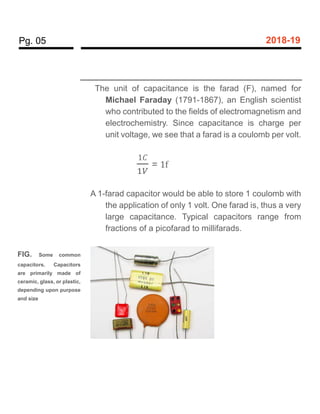
FIG. Some common
capacitors. Capacitors
are primarily made of
ceramic, glass, or plastic,
depending upon purpose
and size
Pg. 06 2018-19
Self-Capacitance
Self-capacitance property is related to the capacitors
especially to the isolated conductor to raise its potential
difference to one volt. Generally normal conductors will have
mutual capacitance. This is also measured in the S.I units
i.e. Farads.
The Self-capacitance of a conducting sphere which has the
radius ‘R’ is given by.
C=4πεoR
Self-capacitance values of some standard devices are given
below.
 For the top plate of a van de Graff generator which is
having radius of 20 cm self-capacitance is 22.24pF.
 For the planet EARTH self-capacitance is 710 µF.
Pg. 07 2018-19
Charging & Discharging of a
Capacitor
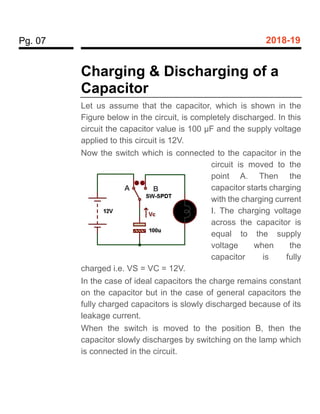
Let us assume that the capacitor, which is shown in the
Figure below in the circuit, is completely discharged. In this
circuit the capacitor value is 100 µF and the supply voltage
applied to this circuit is 12V.
Now the switch which is connected to the capacitor in the
circuit is moved to the
point A. Then the
capacitor starts charging
with the charging current
I. The charging voltage
across the capacitor is
equal to the supply
voltage when the
capacitor is fully
charged i.e. VS = VC = 12V.
In the case of ideal capacitors the charge remains constant
on the capacitor but in the case of general capacitors the
fully charged capacitors is slowly discharged because of its
leakage current.
When the switch is moved to the position B, then the
capacitor slowly discharges by switching on the lamp which
is connected in the circuit.
A B
Pg. 08 2018-19
Energy in a Capacitor
Energy is the amount of some work against the electro-static
field to charge the capacitor fully. In the capacitor at initial
stage of charging, the charge Q transferred between the
plates from one plate to another plate. This charge either +Q
or –Q is interchanged between two plates of a capacitor.
After transformation of some charge an electric field is
formed between the plates, in that case we need some extra
work to charge the capacitor fully. This extra work is called
as the energy stored in a capacitor, the energy is measured
in the units of Joules (J). Now we see the equations for this
energy and work.
dW = V dQ
dW = (Q/C) dQ
After integration of the above equation is
W = Q2
/ 2C
W = (CV)2
/ 2C
W = CV2
/ 2 Joules
Finally we get the energy stored in a capacitor is
Energy (W) = CV2
/ 2 Joules
Now we calculate the energy stored in a capacitor of
capacitance 200 µF which operate with voltage of 12V
W = (200 x 10-6
x 122
) / 2 = 14.4 mJ
Pg. 09 2018-19
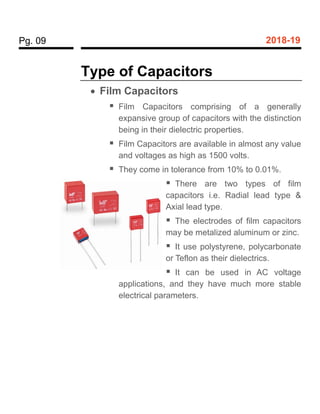
Type of Capacitors
 Film Capacitors
 Film Capacitors comprising of a generally
expansive group of capacitors with the distinction
being in their dielectric properties.
 Film Capacitors are available in almost any value
and voltages as high as 1500 volts.
 They come in tolerance from 10% to 0.01%.
 There are two types of film
capacitors i.e. Radial lead type &
Axial lead type.
 The electrodes of film capacitors
may be metalized aluminum or zinc.
 It use polystyrene, polycarbonate
or Teflon as their dielectrics.
 It can be used in AC voltage
applications, and they have much more stable
electrical parameters.
Pg. 10 2018-19
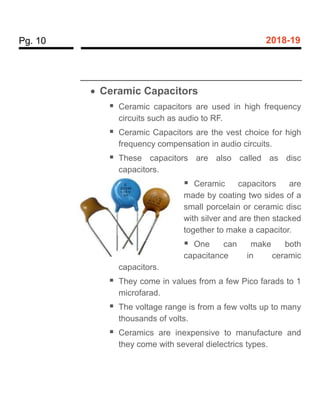
 Ceramic Capacitors
 Ceramic capacitors are used in high frequency
circuits such as audio to RF.
 Ceramic Capacitors are the vest choice for high
frequency compensation in audio circuits.
 These capacitors are also called as disc
capacitors.
 Ceramic capacitors are
made by coating two sides of a
small porcelain or ceramic disc
with silver and are then stacked
together to make a capacitor.
 One can make both
capacitance in ceramic
capacitors.
 They come in values from a few Pico farads to 1
microfarad.
 The voltage range is from a few volts up to many
thousands of volts.
 Ceramics are inexpensive to manufacture and
they come with several dielectrics types.
Pg. 11 2018-19
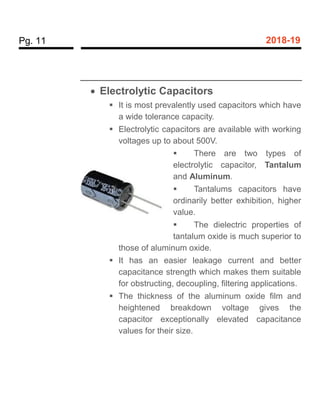
 Electrolytic Capacitors
 It is most prevalently used capacitors which have
a wide tolerance capacity.
 Electrolytic capacitors are available with working
voltages up to about 500V.
 There are two types of
electrolytic capacitor, Tantalum
and Aluminum.
 Tantalums capacitors have
ordinarily better exhibition, higher
value.
 The dielectric properties of
tantalum oxide is much superior to
those of aluminum oxide.
 It has an easier leakage current and better
capacitance strength which makes them suitable
for obstructing, decoupling, filtering applications.
 The thickness of the aluminum oxide film and
heightened breakdown voltage gives the
capacitor exceptionally elevated capacitance
values for their size.
Pg. 12 2018-19
Uses of Capacitors
Capacitors are devices which store electrical charge. They
are a basic component of electronics and have a host of
various applications. The most common use for capacitors
is energy storage. Additional uses include power
conditioning, signal coupling or decoupling, electronic noise
filtering, and remote sensing. Because of its varied
applications, capacitors are used in a wide range of
industries and have become a vital part of everyday life.
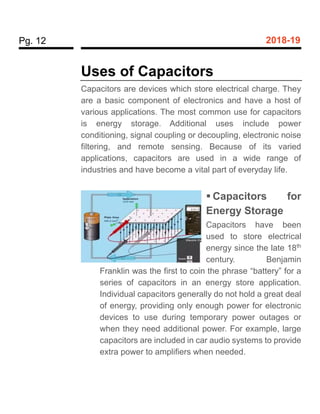
 Capacitors for
Energy Storage
Capacitors have been
used to store electrical
energy since the late 18th
century. Benjamin
Franklin was the first to coin the phrase “battery” for a
series of capacitors in an energy store application.
Individual capacitors generally do not hold a great deal
of energy, providing only enough power for electronic
devices to use during temporary power outages or
when they need additional power. For example, large
capacitors are included in car audio systems to provide
extra power to amplifiers when needed.
Pg. 13 2018-19
 Capacitors for Power Conditioning
One important application of capacitors is the
conditioning of power supplies. Capacitors allow AC
signals to pass but block DC signals when they are
charged. They can effectively split these two signal
types, cleaning the supply of power. This effect has
been exploited to separate or decouple different parts
of electrical circuits to reduce noise which could lead to
reduction of efficiency. Capacitors are also used inutility
substations to counteract inductive loading introduced
by transmission lines.
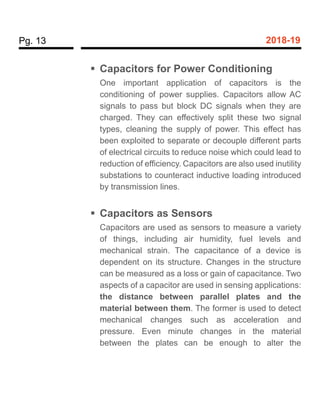
 Capacitors as Sensors
Capacitors are used as sensors to measure a variety
of things, including air humidity, fuel levels and
mechanical strain. The capacitance of a device is
dependent on its structure. Changes in the structure
can be measured as a loss or gain of capacitance. Two
aspects of a capacitor are used in sensing applications:
the distance between parallel plates and the
material between them. The former is used to detect
mechanical changes such as acceleration and
pressure. Even minute changes in the material
between the plates can be enough to alter the
Pg. 14 2018-19
capacitance of the device, an effect exploited when
sensing air humidity.
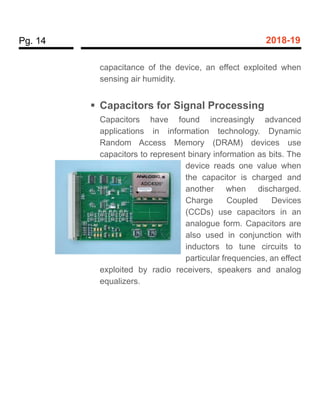
 Capacitors for Signal Processing
Capacitors have found increasingly advanced
applications in information technology. Dynamic
Random Access Memory (DRAM) devices use
capacitors to represent binary information as bits. The
device reads one value when
the capacitor is charged and
another when discharged.
Charge Coupled Devices
(CCDs) use capacitors in an
analogue form. Capacitors are
also used in conjunction with
inductors to tune circuits to
particular frequencies, an effect
exploited by radio receivers, speakers and analog
equalizers.
Pg. 15 2018-19
Bibliography
 www.openstacks.com
 www.slideshare.com
 www.googleimages.com
 www.wikipedia.org
 www.scribd.org
 www.techwalla.com

392875865-Capacitors-Investigatory-Project.pdf

  • 1.
    PHYSICS INVESTIGATORY PROJECT 2018 KENDRIYA VIDYALAYA NO.1AIR FORCE STATION SECTOR-14 GURUGRAM VISHAL CLASS: 12-C ROLL NO: 02 SUBMITTED TO: MRS. PUNAM SHARMA
  • 2.
  • 3.
    Contents Acknowledgement _________________________ 1 Certificate________________________________ 2 Capacitors _______________________________ 3 Amount of Charge Q A Capacitor Can Store _____ 4 Self-Capacitance __________________________ 6 Charging & Discharging of a Capacitor _________ 7 Energy in a Capacitor_______________________ 8 Type of Capacitors _________________________ 9 Uses of Capacitors________________________ 12 Bibliography _____________________________ 15
  • 4.
    Pg. 01 2018-19 Acknowledgement Iwould like to sincerely and profusely thank my Physics teacher Mrs. Puman Sharma, for his able guidance and support in completing my project. I would also like to extend my gratitude to the principal for providing mw with all the facility that was required. Last but not the least, I would extend my gratitude towards all teaching and all the non-teaching staff of Kendriya Vidyalaya No.1 Sector-14 Gurugram and towards my friends who has supported me to complete this project. Vishal
  • 5.
    Pg. 02 2018-19 Certificate Thisis to certify that Vishal of class XII-C has successfully completed the investigatory project on the topic “CAPACITORS: DETAIL, TYPES & USES” under my guidance during the year 2018-19 in the partial fulfillment of the physics practical examination conducted by CBSE. Teacher’s Signature Mrs. Punam Sharma
  • 6.
    Pg. 03 2018-19 Capacitors Introduction Acapacitor is a device used to store electric charge. Capacitors have applications ranging from filtering static out of radio reception to energy storage in heart defibrillators. Typically, commercial capacitors have two conducting parts close to one another, but not touching. When battery terminals are connected to an initially uncharged capacitors, equal amount of positive and negative charge, +Q and –Q, are separated into its two plates. The capacitor remains neutral overall, but we refer to it as storing a charge Q in this circumstance. FIG. Both capacitors shown here were initially uncharged before being connected to a battery. They now have separated charges of +Q and –Q on their two halves. A) A parallel plate capacitor B) A rolled capacitor with an insulating material between the charged plates
  • 7.
    Pg. 04 2018-19 Amountof Charge Q A Capacitor Can Store The amount of charge Q a capacitor can store depends on two major factors- the voltage applied and the capacitor’s physical characteristics, such as its size. In Figure given below each electric field line starts on an individual positive and ends on a negative one, so that there will be more field lines if there is more charge. The electric field strength is, thus, directly proportional to Q. The field is proportional to the charge: E α Q We know that, V = Ed So, V α E Hence, V α Q Removing sign of proportionality we get, Q = CV Where C = capacitance of the parallel plate capacitor. FIG. Electric field lines in the parallel plate capacitor, as always, start on positive and end on negative charges.
  • 8.
    Pg. 05 2018-19 Theunit of capacitance is the farad (F), named for Michael Faraday (1791-1867), an English scientist who contributed to the fields of electromagnetism and electrochemistry. Since capacitance is charge per unit voltage, we see that a farad is a coulomb per volt. 1𝐶 1𝑉 = 1f A 1-farad capacitor would be able to store 1 coulomb with the application of only 1 volt. One farad is, thus a very large capacitance. Typical capacitors range from fractions of a picofarad to millifarads. FIG. Some common capacitors. Capacitors are primarily made of ceramic, glass, or plastic, depending upon purpose and size
  • 9.
    Pg. 06 2018-19 Self-Capacitance Self-capacitanceproperty is related to the capacitors especially to the isolated conductor to raise its potential difference to one volt. Generally normal conductors will have mutual capacitance. This is also measured in the S.I units i.e. Farads. The Self-capacitance of a conducting sphere which has the radius ‘R’ is given by. C=4πεoR Self-capacitance values of some standard devices are given below.  For the top plate of a van de Graff generator which is having radius of 20 cm self-capacitance is 22.24pF.  For the planet EARTH self-capacitance is 710 µF.
  • 10.
    Pg. 07 2018-19 Charging& Discharging of a Capacitor Let us assume that the capacitor, which is shown in the Figure below in the circuit, is completely discharged. In this circuit the capacitor value is 100 µF and the supply voltage applied to this circuit is 12V. Now the switch which is connected to the capacitor in the circuit is moved to the point A. Then the capacitor starts charging with the charging current I. The charging voltage across the capacitor is equal to the supply voltage when the capacitor is fully charged i.e. VS = VC = 12V. In the case of ideal capacitors the charge remains constant on the capacitor but in the case of general capacitors the fully charged capacitors is slowly discharged because of its leakage current. When the switch is moved to the position B, then the capacitor slowly discharges by switching on the lamp which is connected in the circuit. A B
  • 11.
    Pg. 08 2018-19 Energyin a Capacitor Energy is the amount of some work against the electro-static field to charge the capacitor fully. In the capacitor at initial stage of charging, the charge Q transferred between the plates from one plate to another plate. This charge either +Q or –Q is interchanged between two plates of a capacitor. After transformation of some charge an electric field is formed between the plates, in that case we need some extra work to charge the capacitor fully. This extra work is called as the energy stored in a capacitor, the energy is measured in the units of Joules (J). Now we see the equations for this energy and work. dW = V dQ dW = (Q/C) dQ After integration of the above equation is W = Q2 / 2C W = (CV)2 / 2C W = CV2 / 2 Joules Finally we get the energy stored in a capacitor is Energy (W) = CV2 / 2 Joules Now we calculate the energy stored in a capacitor of capacitance 200 µF which operate with voltage of 12V W = (200 x 10-6 x 122 ) / 2 = 14.4 mJ
  • 12.
    Pg. 09 2018-19 Typeof Capacitors  Film Capacitors  Film Capacitors comprising of a generally expansive group of capacitors with the distinction being in their dielectric properties.  Film Capacitors are available in almost any value and voltages as high as 1500 volts.  They come in tolerance from 10% to 0.01%.  There are two types of film capacitors i.e. Radial lead type & Axial lead type.  The electrodes of film capacitors may be metalized aluminum or zinc.  It use polystyrene, polycarbonate or Teflon as their dielectrics.  It can be used in AC voltage applications, and they have much more stable electrical parameters.
  • 13.
    Pg. 10 2018-19 Ceramic Capacitors  Ceramic capacitors are used in high frequency circuits such as audio to RF.  Ceramic Capacitors are the vest choice for high frequency compensation in audio circuits.  These capacitors are also called as disc capacitors.  Ceramic capacitors are made by coating two sides of a small porcelain or ceramic disc with silver and are then stacked together to make a capacitor.  One can make both capacitance in ceramic capacitors.  They come in values from a few Pico farads to 1 microfarad.  The voltage range is from a few volts up to many thousands of volts.  Ceramics are inexpensive to manufacture and they come with several dielectrics types.
  • 14.
    Pg. 11 2018-19 Electrolytic Capacitors  It is most prevalently used capacitors which have a wide tolerance capacity.  Electrolytic capacitors are available with working voltages up to about 500V.  There are two types of electrolytic capacitor, Tantalum and Aluminum.  Tantalums capacitors have ordinarily better exhibition, higher value.  The dielectric properties of tantalum oxide is much superior to those of aluminum oxide.  It has an easier leakage current and better capacitance strength which makes them suitable for obstructing, decoupling, filtering applications.  The thickness of the aluminum oxide film and heightened breakdown voltage gives the capacitor exceptionally elevated capacitance values for their size.
  • 15.
    Pg. 12 2018-19 Usesof Capacitors Capacitors are devices which store electrical charge. They are a basic component of electronics and have a host of various applications. The most common use for capacitors is energy storage. Additional uses include power conditioning, signal coupling or decoupling, electronic noise filtering, and remote sensing. Because of its varied applications, capacitors are used in a wide range of industries and have become a vital part of everyday life.  Capacitors for Energy Storage Capacitors have been used to store electrical energy since the late 18th century. Benjamin Franklin was the first to coin the phrase “battery” for a series of capacitors in an energy store application. Individual capacitors generally do not hold a great deal of energy, providing only enough power for electronic devices to use during temporary power outages or when they need additional power. For example, large capacitors are included in car audio systems to provide extra power to amplifiers when needed.
  • 16.
    Pg. 13 2018-19 Capacitors for Power Conditioning One important application of capacitors is the conditioning of power supplies. Capacitors allow AC signals to pass but block DC signals when they are charged. They can effectively split these two signal types, cleaning the supply of power. This effect has been exploited to separate or decouple different parts of electrical circuits to reduce noise which could lead to reduction of efficiency. Capacitors are also used inutility substations to counteract inductive loading introduced by transmission lines.  Capacitors as Sensors Capacitors are used as sensors to measure a variety of things, including air humidity, fuel levels and mechanical strain. The capacitance of a device is dependent on its structure. Changes in the structure can be measured as a loss or gain of capacitance. Two aspects of a capacitor are used in sensing applications: the distance between parallel plates and the material between them. The former is used to detect mechanical changes such as acceleration and pressure. Even minute changes in the material between the plates can be enough to alter the
  • 17.
    Pg. 14 2018-19 capacitanceof the device, an effect exploited when sensing air humidity.  Capacitors for Signal Processing Capacitors have found increasingly advanced applications in information technology. Dynamic Random Access Memory (DRAM) devices use capacitors to represent binary information as bits. The device reads one value when the capacitor is charged and another when discharged. Charge Coupled Devices (CCDs) use capacitors in an analogue form. Capacitors are also used in conjunction with inductors to tune circuits to particular frequencies, an effect exploited by radio receivers, speakers and analog equalizers.
  • 18.
    Pg. 15 2018-19 Bibliography www.openstacks.com  www.slideshare.com  www.googleimages.com  www.wikipedia.org  www.scribd.org  www.techwalla.com