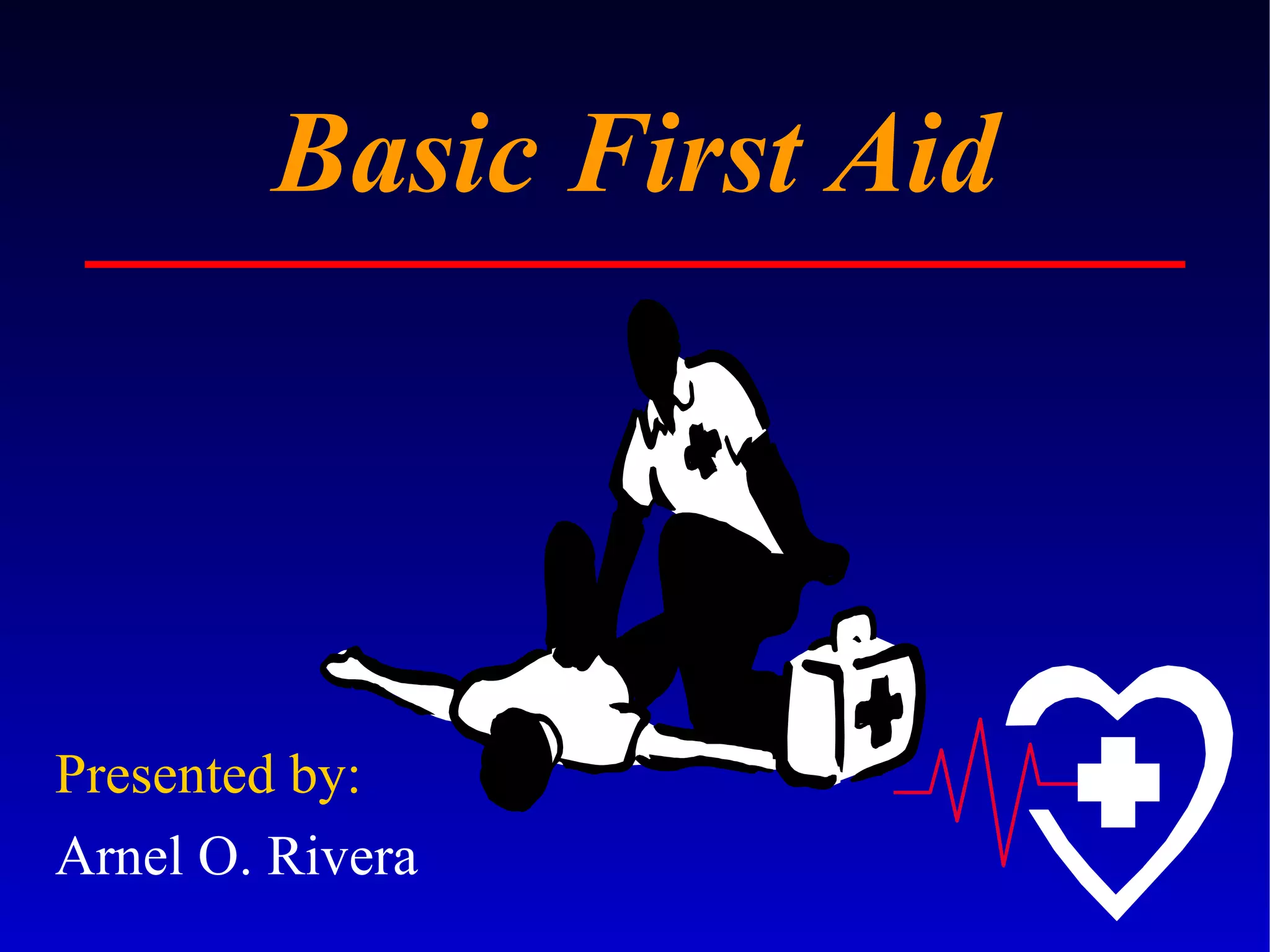
Basic First Aid Presented by: Arnel O. Rivera
What is First Aid FIRST AID   is the immediate care given to a person who have been injured or suddenly taken ill. It includes self – help and home care when medical assistance is not available.
Roles of First Aid It bridges the gap between the victim and the physician. It is not intended to compete with nor take the place of the services of the physician. It ends when the medical assistance begins.
Objectives of First Aid To alleviate suffering To prevent added or further injury or danger To prolong life
Emergency Action Principles (EAP) Survey the scene. Do a primary survey of the victim. Check Vital Body Function A – Airway B – Breathing C – Circulation Activate Medical Assistance (AMA) or Transfer Facility Do a Secondary Survey of the Victim. Record all assessment & time.
FAINTING Fainting occurs when the blood supply to the  brain is momentarily inadequate, causing the patient to lose consciousness. The loss of consciousness is usually brief. Fainting can have no medical significance or the cause can be a serious disorder. Therefore, treat loss of consciousness as a medical emergency until the signs and symptoms are relieved and the cause is known.
If you feel dizzy: Lie down or sit down.  Loosen tight clothing. If you sit down, place your head between your knees. Discuss recurrent fainting spells with your doctor.
If someone else faints: Position the person on his or her back.  Make sure the legs are elevated above the heart level.  Watch the airway carefully.  People who lose consciousness may vomit. Place the person in the recovery position.
If someone else faints: Check for breathing.  Position your ear over the person's mouth to listen for breathing sounds. If breathing has stopped, the problem is more serious than a fainting spell. Initiate  cardiopulmonary resuscitation (CPR).  Get emergency medical care.
If someone else faints: Help restore blood flow.  If the person is breathing, restore blood flow to the brain by raising the person's legs above the level of the head. Loosen belts, collars or other constrictive clothing. The person should revive quickly. If the person doesn't regain consciousness in 1 to 2 minutes, dial  or call for emergency medical assistance.
SHOCK A depressed condition of many of the body functions due to poor circulation following a serious injury. Shock may result from trauma, heatstroke, allergic reactions, severe infection, poisoning or other causes.
Signs and symptoms of shock   The skin is cool and clammy and may appear pale or gray.  The pulse is weak and rapid. Breathing may be slow and shallow, or hyperventilation with rapid breathing may occur. Blood pressure is below normal.
Signs and symptoms of shock   The eyes lack luster and may seem to stare. Sometimes the pupils are dilated.  The person may be conscious or unconscious. If conscious, the person may feel faint or be very weak or confused. Shock sometimes causes a person to become overly excited and anxious.
First Aid to Shock Have the person lie down on his or her back and elevate the feet higher than the head. Keep the person from moving unnecessarily.  Look for the signs of shock as noted above.  Keep the person warm and comfortable. Loosen tight clothing and cover the person with a blanket. Don't give the person anything to drink.
First Aid to Shock If the person vomits or bleeds from the mouth, turn the person on his or her side to prevent choking.  Treat any injuries, such as bleeding or broken bones, appropriately.
Wounds and Bleeding Wounds   refers to the break in the continuity of the tissues in the body. It is classified as: Scrapes Laceration Cuts Puncture  Bleeding  refers to a large discharge of blood from the blood vessels.
Guidelines in treating wounds: Stop the bleeding Clean the wound.  Rinse out the wound with clear water. Use tweezers cleaned with alcohol to remove the particles. There's no need to use hydrogen peroxide, iodine or an iodine-containing cleanser. These substances irritate living cells. If you choose to use them, don't apply them directly on the wound.
Guidelines in treating wounds: Apply a thin layer of an antibiotic cream or ointment to help keep the surface moist  Cover the wound Get stitches for deep wounds  Watch for signs of infection redness, drainage, warmth or swelling.   Get a tetanus shot.
Chocking It is the difficulty in breathing due to obstruction in the airway. Symptoms includes difficulty to speak or cough. First aid for chocking includes  back blows and Heimlich maneuver .

Basic first aid

  • 1.
    Basic First AidPresented by: Arnel O. Rivera
  • 2.
    What is FirstAid FIRST AID is the immediate care given to a person who have been injured or suddenly taken ill. It includes self – help and home care when medical assistance is not available.
  • 3.
    Roles of FirstAid It bridges the gap between the victim and the physician. It is not intended to compete with nor take the place of the services of the physician. It ends when the medical assistance begins.
  • 4.
    Objectives of FirstAid To alleviate suffering To prevent added or further injury or danger To prolong life
  • 5.
    Emergency Action Principles(EAP) Survey the scene. Do a primary survey of the victim. Check Vital Body Function A – Airway B – Breathing C – Circulation Activate Medical Assistance (AMA) or Transfer Facility Do a Secondary Survey of the Victim. Record all assessment & time.
  • 6.
    FAINTING Fainting occurswhen the blood supply to the brain is momentarily inadequate, causing the patient to lose consciousness. The loss of consciousness is usually brief. Fainting can have no medical significance or the cause can be a serious disorder. Therefore, treat loss of consciousness as a medical emergency until the signs and symptoms are relieved and the cause is known.
  • 7.
    If you feeldizzy: Lie down or sit down. Loosen tight clothing. If you sit down, place your head between your knees. Discuss recurrent fainting spells with your doctor.
  • 8.
    If someone elsefaints: Position the person on his or her back. Make sure the legs are elevated above the heart level. Watch the airway carefully. People who lose consciousness may vomit. Place the person in the recovery position.
  • 9.
    If someone elsefaints: Check for breathing. Position your ear over the person's mouth to listen for breathing sounds. If breathing has stopped, the problem is more serious than a fainting spell. Initiate cardiopulmonary resuscitation (CPR). Get emergency medical care.
  • 10.
    If someone elsefaints: Help restore blood flow. If the person is breathing, restore blood flow to the brain by raising the person's legs above the level of the head. Loosen belts, collars or other constrictive clothing. The person should revive quickly. If the person doesn't regain consciousness in 1 to 2 minutes, dial or call for emergency medical assistance.
  • 11.
    SHOCK A depressedcondition of many of the body functions due to poor circulation following a serious injury. Shock may result from trauma, heatstroke, allergic reactions, severe infection, poisoning or other causes.
  • 12.
    Signs and symptomsof shock The skin is cool and clammy and may appear pale or gray. The pulse is weak and rapid. Breathing may be slow and shallow, or hyperventilation with rapid breathing may occur. Blood pressure is below normal.
  • 13.
    Signs and symptomsof shock The eyes lack luster and may seem to stare. Sometimes the pupils are dilated. The person may be conscious or unconscious. If conscious, the person may feel faint or be very weak or confused. Shock sometimes causes a person to become overly excited and anxious.
  • 14.
    First Aid toShock Have the person lie down on his or her back and elevate the feet higher than the head. Keep the person from moving unnecessarily. Look for the signs of shock as noted above. Keep the person warm and comfortable. Loosen tight clothing and cover the person with a blanket. Don't give the person anything to drink.
  • 15.
    First Aid toShock If the person vomits or bleeds from the mouth, turn the person on his or her side to prevent choking. Treat any injuries, such as bleeding or broken bones, appropriately.
  • 16.
    Wounds and BleedingWounds refers to the break in the continuity of the tissues in the body. It is classified as: Scrapes Laceration Cuts Puncture Bleeding refers to a large discharge of blood from the blood vessels.
  • 17.
    Guidelines in treatingwounds: Stop the bleeding Clean the wound. Rinse out the wound with clear water. Use tweezers cleaned with alcohol to remove the particles. There's no need to use hydrogen peroxide, iodine or an iodine-containing cleanser. These substances irritate living cells. If you choose to use them, don't apply them directly on the wound.
  • 18.
    Guidelines in treatingwounds: Apply a thin layer of an antibiotic cream or ointment to help keep the surface moist Cover the wound Get stitches for deep wounds Watch for signs of infection redness, drainage, warmth or swelling. Get a tetanus shot.
  • 19.
    Chocking It isthe difficulty in breathing due to obstruction in the airway. Symptoms includes difficulty to speak or cough. First aid for chocking includes back blows and Heimlich maneuver .