Nivendra Uduman
First Aid Provider
 First Aid: ‘ Emergency care provided for injury or
  sudden illness before professional emergency medical
  treatment becomes available’.
 Initial Responsibilities of A First Aider:
   Recognizing a medical emergency.
   Making the decision to help.
   Identifying hazards and ensuring personal safety.
   Activating the EMS system
   Providing supportive, basic first aid care.
Legal Considerations
 Everyone has the right to refuse help.
 When person is unresponsive, the concept of ‘implied
  consent’ is adapted.
 A parent/guardian should be asked before providing
  care to a child. In their absence consent is legally
  implied.
 It is important to remain with the person once first aid
  care has been initiated.
Personal Safety
 Emergency Scenes often are unsafe.
 Your safety is your highest priority.
 If location is unsafe, GET OUT!
    SETUP:
     STOP
     Environment
     Traffic
     Unknown Hazards
     Personal Safety
Disease Transmission and
Precautions
 When providing first aid care, you can be exposed to
  blood or other potentially infectious fluids.
 Infectious diseases include, Hepatitis B, Hepatitis C
  and HIV.
 Exposure can occur through direct contact with an
  open wound/sore or through mucous membranes.
 Always wear gloves and remove contaminated gloves
  carefully.
 Use a shield or CPR mask if rescue breaths are
  required.
 A face shield can prevent mouth, nose and eye
  exposure when there is splashing or spraying.
 If you don’t have protective equipment, then
  IMPROVISE.
 Skill 1: REMOVING CONTAMINATED GLOVES
Sudden Cardiac Arrest ( SCA)
 Occurs when the normal electrical impulse of the
  heart is disorganized.
 Blood flow to the brain stops and there is loss of
  consciousness.
 Intervention by a bystander with Rescue breaths and
  chest compressions could restore some of the lost
  oxygen.
Chain of Survival
 Immediate recognition and activation of EMS.
 Early CPR with effective chest compressions.
 Rapid Defibrillation.
 Advanced life support.
 Post Cardiac-Arrest Care
Primary Assessment
 Assess- Look at Face and Chest for Breathing
 Alert- Call EMS
 Attend- Start CPR


Skill 2: CARDIOPULMONARY RESUSCITATION
Unresponsive-Breathing


      Skill 3: RECOVERY POSITION
Foreign Body Air Way Obstruction
 Adults: Abdominal Thrusts, if unresponsive start CPR
 Children: Abdominal Thrusts, if unresponsive Start
  CPR
 Infants: 5 Back Blows, 5 chest thrusts. If
  unresponsive, Start CPR
Soft-Tissue Injuries
 Minor Wounds:
   Wash with clean, running water.
   Apply firm,continous pressure
   Cover with gauze pad or adhesive bandage.


   Remember: Wear your gloves.
Amputation
 Complete loss of a body part.
 Amputated parts can be surgically reattached.
    Locate the severed part.
    Wrap it in a sterile/clean cloth.
    Place the part in a tightly sealed plastic bag
    Place the bag or container on ice


   Note: Do not soak severed part in water, and do not
    put it directly on ice.
Impaled Object
 An object that penetrates the body and remains
    embedded.
   NEVER REMOVE AN IMPALED OBJECT.
   Keep the person still, call EMS and use direct pressure
    if bleeding.
   Keep the person calm, treat for shock.
   Reassess until EMS arrives.
Open Chest Injuries
 Activate EMS.
 Cover wound with something airtight.
 Tape three sides and leave one side open, to allow
  trapped air to escape.
 Make person comfortable and treat for shock.
Open Abdominal Injury
 Abdominal organs may protrude through an open
    wound.
   Cover any protruding organs with thick moist
    dressing.
   Do not push organs back into the body.
   Do Not apply direct pressure on the wound or exposed
    internal part.
   Treat for shock.
Shock
 Develops when poor blood flow creates a shortage of
  oxygen to body tissues. If not treated early, can be life
  threatening.
 A person may appear to be uneasy, restless, and
  worried. Skin may appear to be pale, cool and sweaty.
 Must be transported to hospital immediately.
 To reduce effect of shock, ensure an open airway,
  maintain body temperature, give nothing to eat or
  drink.
Injuries to Limbs
 Strains: Stretching or tearing of muscles or tendons.
 Sprains: Tearing injuries to ligaments that holds joints
  together.
 Dislocations: Separation of bone ends at a joint.
 Fractures: Breaks in Bones
 Difficult to separate muscle injuries from fractures, so
  treat them all as possible fractures.
 Minimize movement and prevent additional injury.
 Splinting can reduce pain and prevent further injury.
 Skill 4: SPLINTING
 Skill 5: SPINAL MOTION RESTRICTION
Secondary Assessment
 Determine chief complaint.
 Look around for clues.
 Look at the person, feel for any sign of illness or injury.
    D-Deformities
    O-Open Injuries
    T-Tenderness
    S-Swelling


    Ask Questions ( SAMPLE)
 S- Symptoms?
 A-Allergies?
 M-Medications?
 P-Past medical history?
 L- Last oral intake
 E-Events?
Burns
 Minor Burns: Involves the outer layer of the skin and
 results in redness and pain.
  Cool the area with water.
  Continue cooling until pain is relieved.
  Do not apply ice directly to cool a burn.
  Leave any blisters intact and cover with loose sterile pad.


 Critical Burns: Involves a larger part of the body and
  damages skin tissue and causes excessive blistering.
 Activate EMS.
 Expose the burn area by cutting away any clothing.
 Do not pull any cloth that might be stuck to the burnt
  area.
 Remove Jewellery.
 Separate fingers or toes with dry sterile dressing.
 Give the person nothing to eat or drink .
Sudden Illness
 Fainting: Result of the drop of blood flow to the
 brain, due to sudden stress, lack of food or water,
 prolonged standing in one place.
  Lay the person flat.
  If not injured elevate the legs about 6-12 inches.
  If not possible sit the person down and place his head
   between his knees.

  Stroke: Occurs when blood supply to a portion of the
   brain is suddenly interrupted. Mostly occurs when a
   blood clot gets caught in a blood vessel.
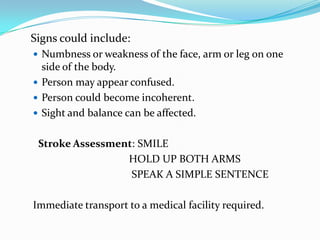
Signs could include:
 Numbness or weakness of the face, arm or leg on one
  side of the body.
 Person may appear confused.
 Person could become incoherent.
 Sight and balance can be affected.


 Stroke Assessment: SMILE
                 HOLD UP BOTH ARMS
                  SPEAK A SIMPLE SENTENCE

Immediate transport to a medical facility required.
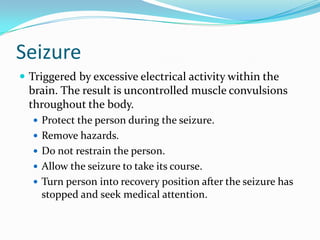
Seizure
 Triggered by excessive electrical activity within the
  brain. The result is uncontrolled muscle convulsions
  throughout the body.
   Protect the person during the seizure.
   Remove hazards.
   Do not restrain the person.
   Allow the seizure to take its course.
   Turn person into recovery position after the seizure has
    stopped and seek medical attention.
Other Important Topics
 Snake Bites
 Drowning
 Fire Emergencies
 Transportation
 Lifting Methods
 Emotional Considerations.
Thank You!!!