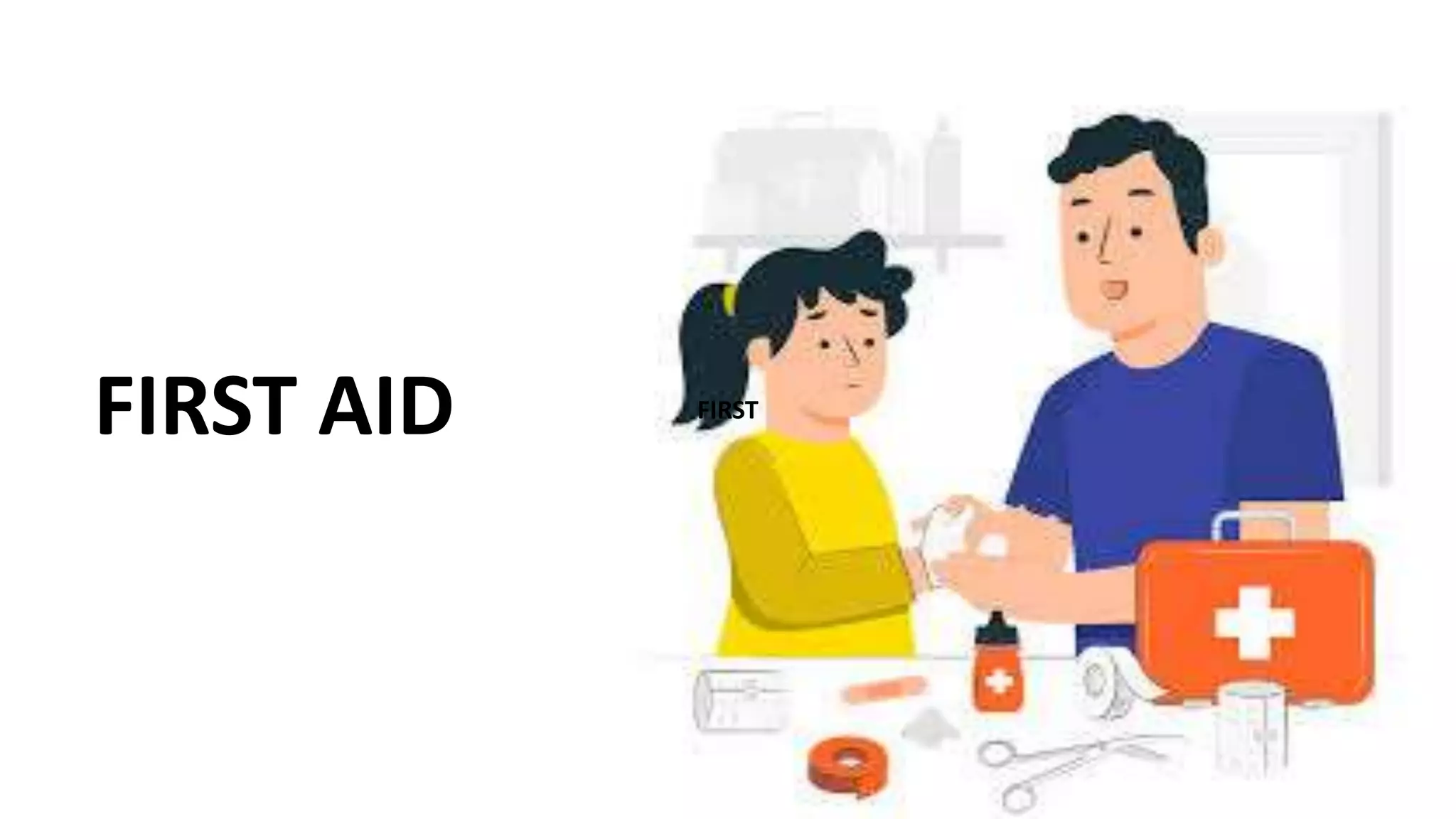
FIRST AID FIRST
UNIT NO 1
FIRST AID
BY: Ms Angelina
Kakhshan
OBJECTIVES
At the end of the lecture the students will be able to:
• Definition of first aid.
• Understand the key steps of first aid.
• To learn about basic skills of first aid.
• Knowledge about types of first aid.
• Guidline of first aid Procedure.
• Knowledge about first aid kit.
• Explain the golden rules of first aid.
• Learn the principles of first aid.
When was the word first aid used?
• The term “first aid” first appeared in 1878 as a combination of “first
treatment” and “National Aid.” In Britain, civilian ambulance crews
were trained specifically for the railways, mines, and the police.
Who coined(Found) the word first aid?
• Friedrich Esmarch, the Founder of Modern First Aid.
WHAT IS FIRST AID
• First aid is emergency care given immediately to an injured person.
• The purpose of first aid is to minimize injury and future disability.
• In serious cases, first aid may be necessary to keep the victim
(PATIENT)alive.
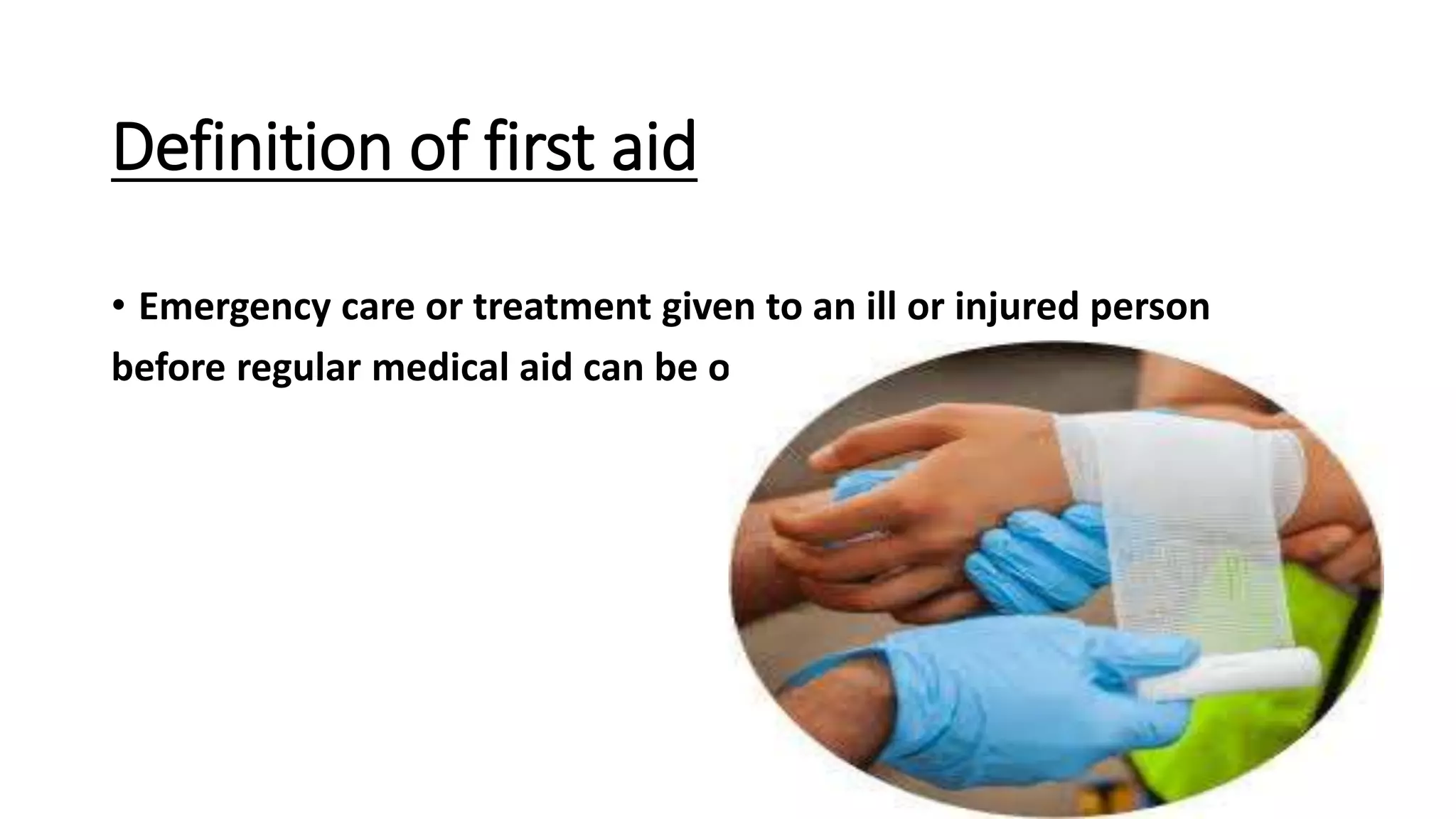
Definition of first aid
• Emergency care or treatment given to an ill or injured person
before regular medical aid can be obtained.
What are the 3 importance of first aid?
• In the time it takes for more advanced care to arrive,
• first aid aims
• to prevent medical conditions from deteriorating,
• help relieve pain,
• provide reassurance
What are the 5 key steps of first aid?
• DRABC is used by first aiders when providing first aid:
• D for Danger – Assess the situation.
• R for Response – Check consciousness, check on vital signs.
• A for Airway – Open airway.
• B for Breathing – Check respiration rates.
• C for Circulation – Give chest compressions.
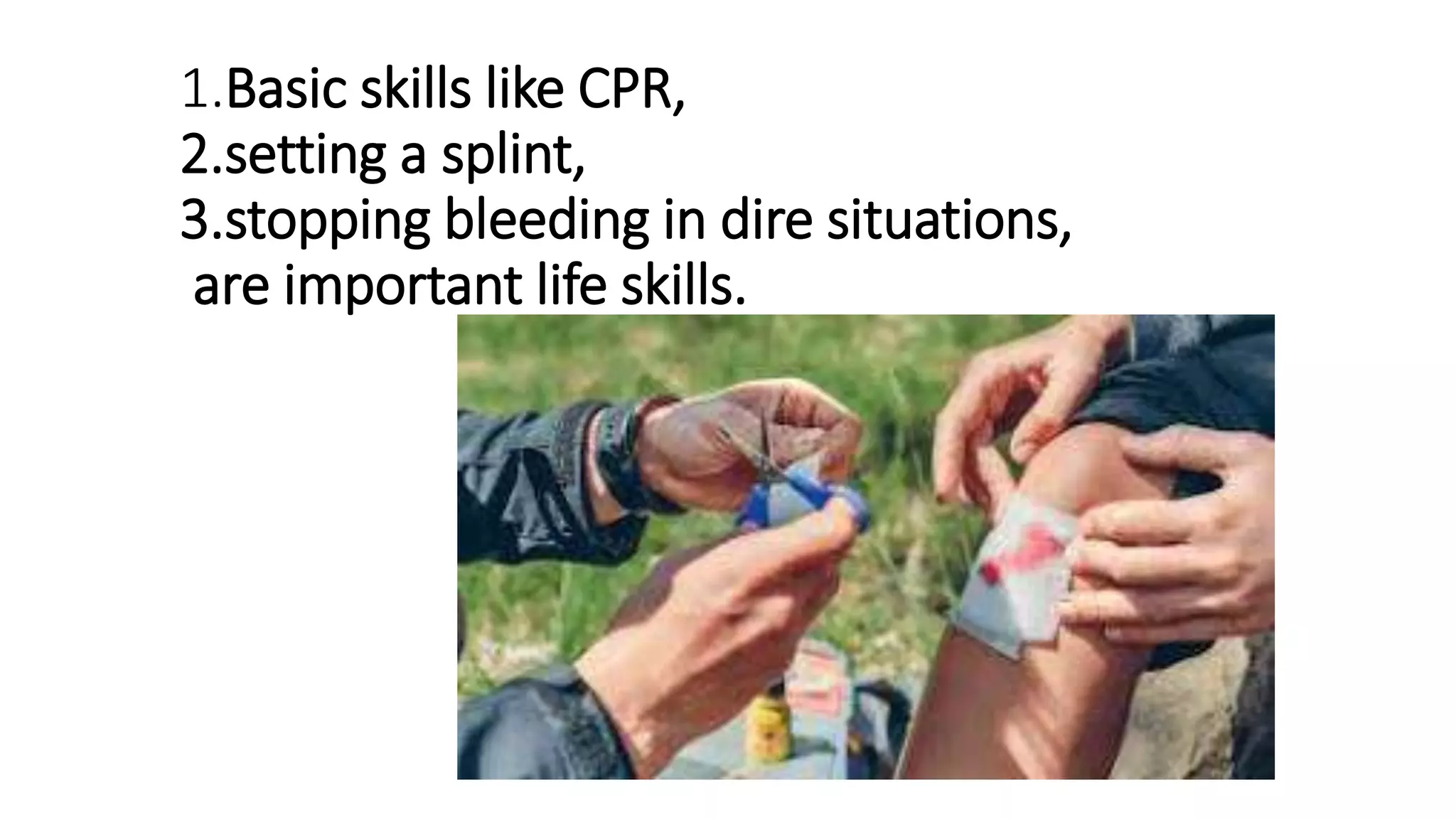
1.Basic skills like CPR,
2.setting a splint,
3.stopping bleeding in dire situations,
are important life skills.
•.
What are types of first aid
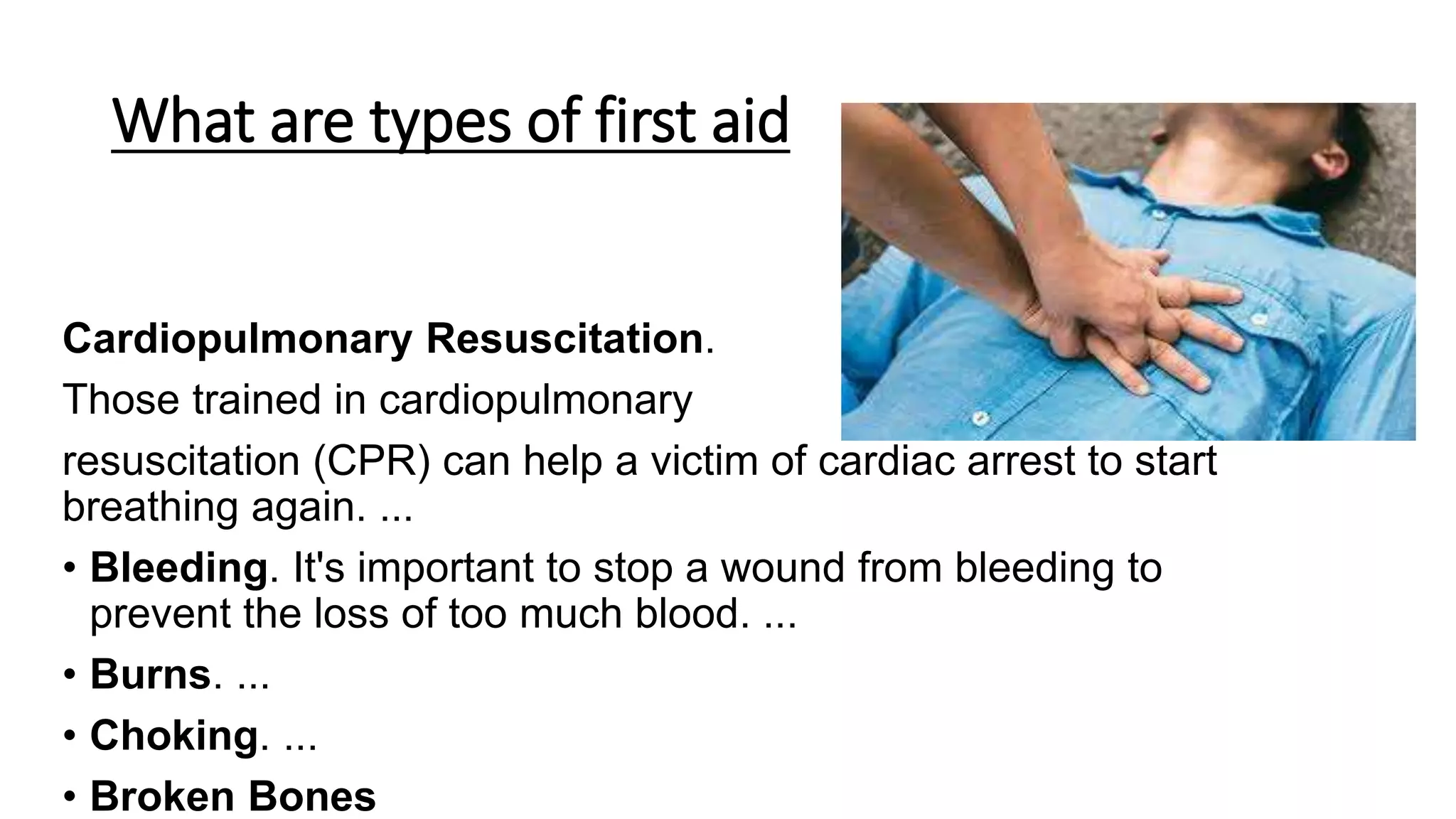
Cardiopulmonary Resuscitation.
Those trained in cardiopulmonary
resuscitation (CPR) can help a victim of cardiac arrest to start
breathing again. ...
• Bleeding. It's important to stop a wound from bleeding to
prevent the loss of too much blood. ...
• Burns. ...
• Choking. ...
• Broken Bones
Here are the 5 Steps to First Aid:
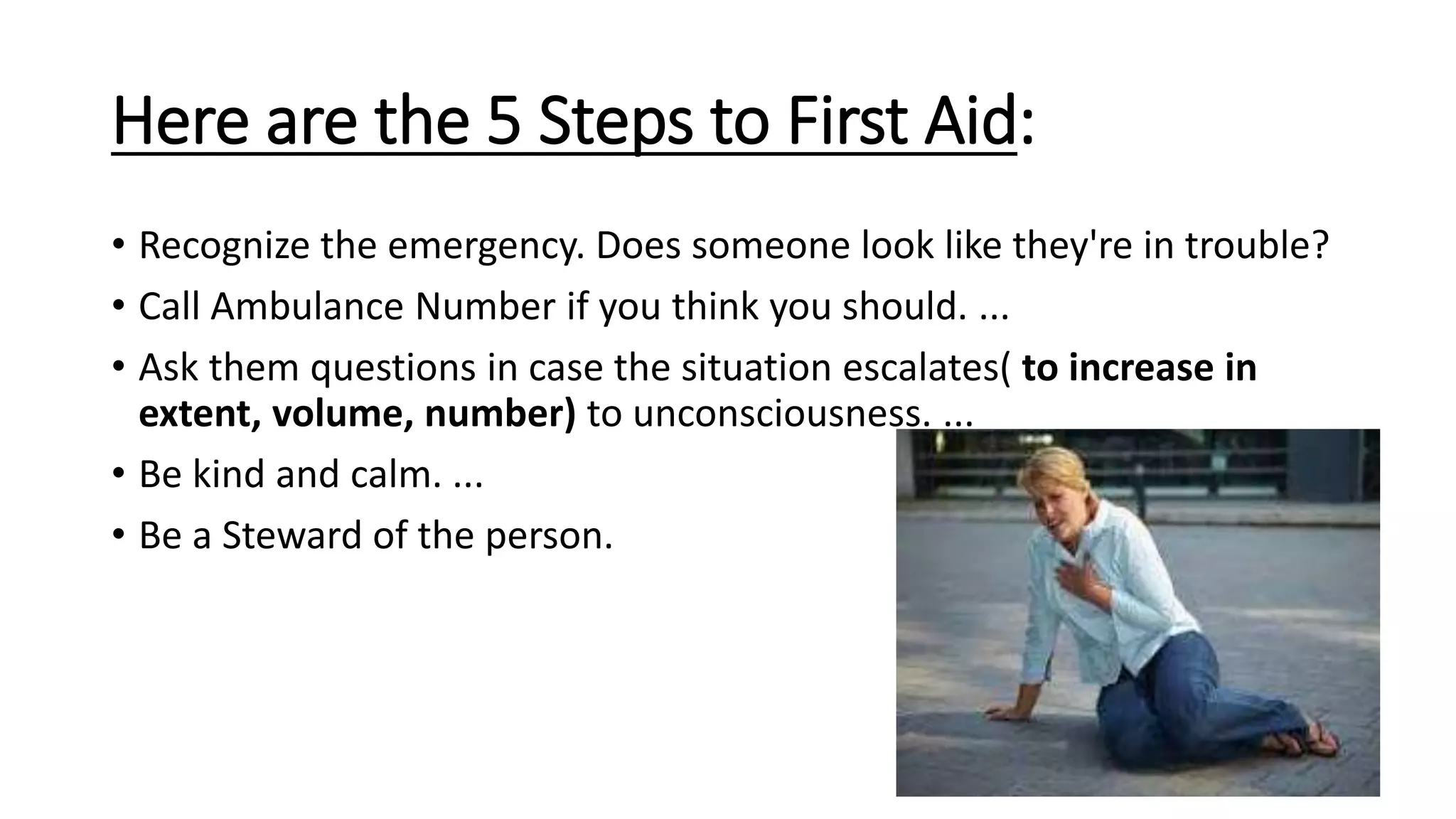
• Recognize the emergency. Does someone look like they're in trouble?
• Call Ambulance Number if you think you should. ...
• Ask them questions in case the situation escalates( to increase in
extent, volume, number) to unconsciousness. ...
• Be kind and calm. ...
• Be a Steward of the person.
THREE P’s OF FIRST AID
• Clean the wound by gently running over it. Avoid using soap on an
open wound. Apply antibiotic to the wound, Cover the wound with a
bandage
With deep wounds:
• Apply pressure.
• Don't apply ointments. ...
• Seek medical attention as soon as possible
Read through these detailed guides on all 10
items
• The “Three P's” The “Three P's” are the primary goals of first aid. ...
• Check the Scene for Danger. ...
• Treating Cuts and Scrapes. ...
• Treating Sprains. ...
• Treating Heat Exhaustion. ...
• Treating Hypothermia. ...
• Treating Burns. ...
• Allergic Reactions.
• What are the basic first aid procedures?
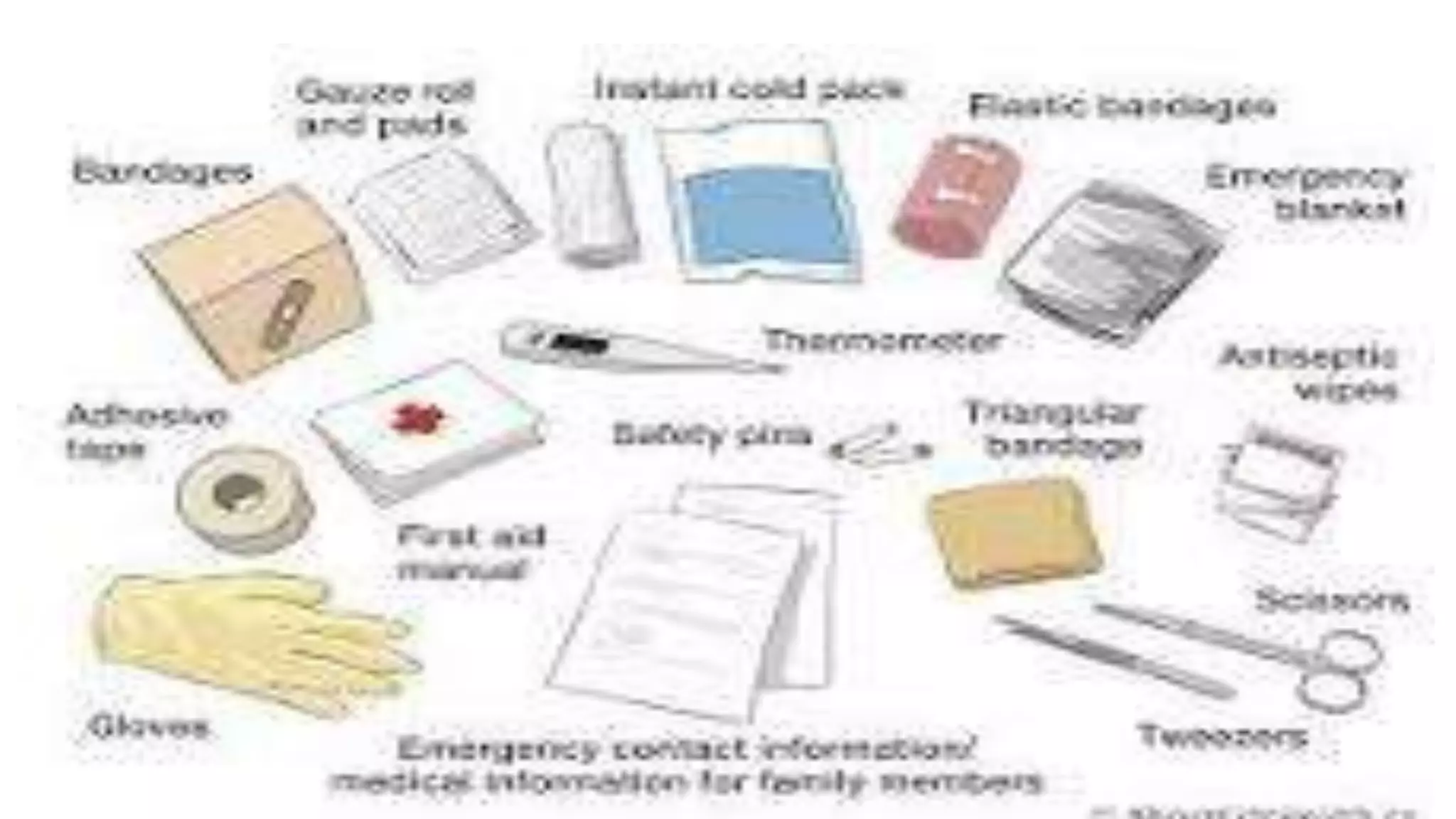
A basic first aid kit should include:
• alcohol pads or antiseptic pads.
• Band-Aids (all sizes)
• cotton balls and Q-tips.
• elastic bandages.
• hot and cold packs.
• medical tape.
• small container of sterile water or saline spray.
• soap and hand sanitizer.
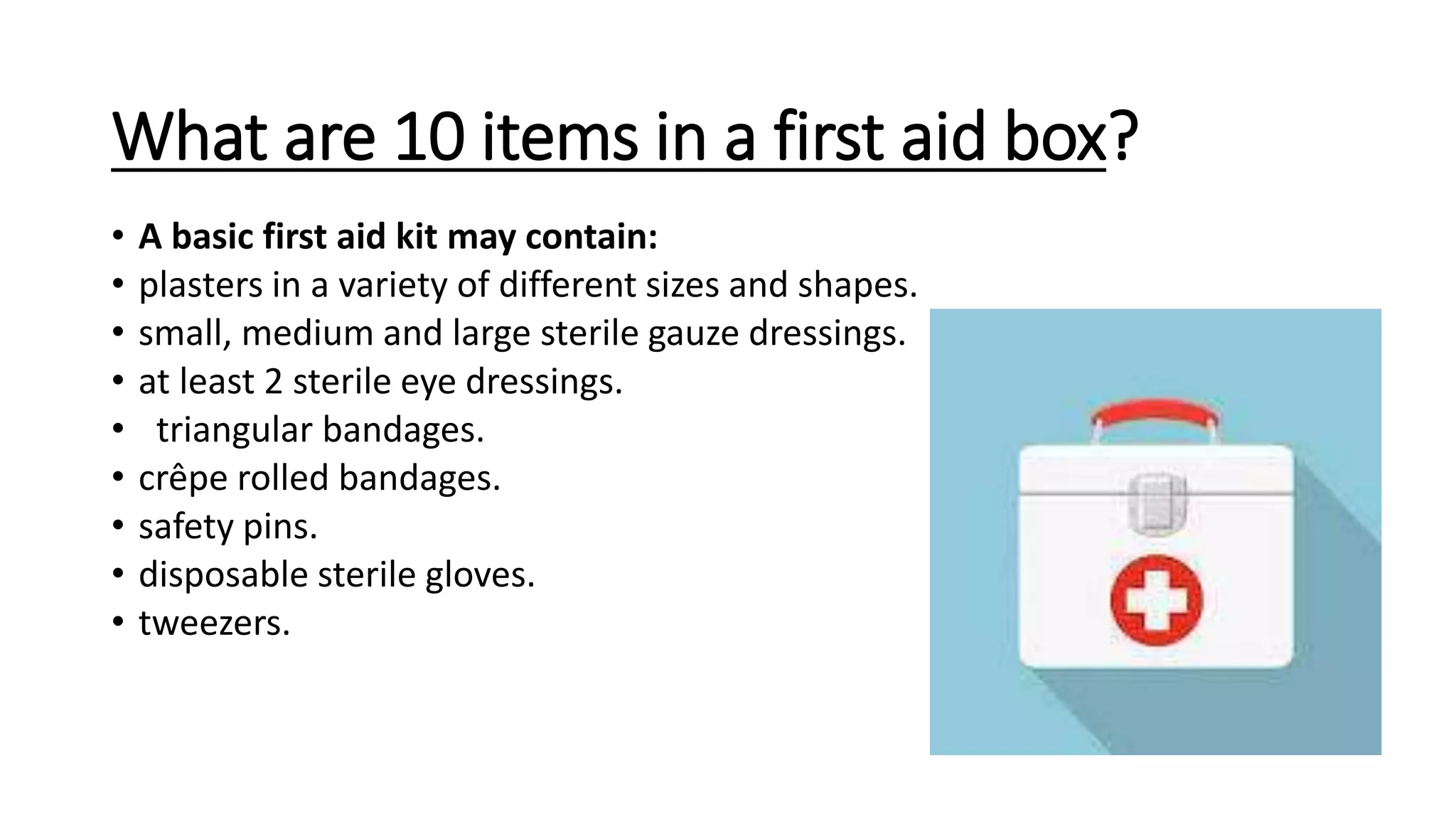
What are 10 items in a first aid box?
• A basic first aid kit may contain:
• plasters in a variety of different sizes and shapes.
• small, medium and large sterile gauze dressings.
• at least 2 sterile eye dressings.
• triangular bandages.
• crêpe rolled bandages.
• safety pins.
• disposable sterile gloves.
• tweezers.
What are the 3 main procedures for first aid?
First aid is as easy as ABC –
• airway,
• breathing and CPR (cardiopulmonary resuscitation).
• Circulation : Puls and heart rate In any situation.
Why are first aid procedures important?
• First aid can save lives
When it comes to more serious injuries, first aid provides an essential
role in keeping a casualty from getting worse and helps to stabilise
their condition before professional(Doctor) help can arrive.
What are the 8 steps of first aid?
• John is passionate about first aid and believes everyone should have the
skills and confidence to take action in an emergency situation.
The 8 steps to evaluate a casualty
• Responsiveness – are they conscious? ...
• Breathing.
• Pulse.
• Bleeding.
• Shock.
• Fractures.
• Burns.
• Concussions / head injuries
What is first aid in emergency?
• First aid sometimes referred to as EMERGENCY AID is the first skilled
[acceptable] assistance given to a victim (sick or injured)
• on the occurrence of accident or sudden illness in order to preserve
life,
• prevent further injury relive suffering until qualified medical care is
available
The golden rules of First Aid
• Do first things first quickly, quietly and with out fuss or panic.
• Give artificial reparation if breathing has stopped---every
second count.
• Stop any bleeding .
• Guard against or treat for shock-- by moving the casualty as
little as possible and handling him gently.
• Do not attempt too much – do the minimum that is essential
to save life and prevent the condition from worsening.
• Reassure the casualty and those around and so help to
lessen anxiety.
cont:
• Do not allow people to crowd-- as fresh air is essential.
• Do not remove clothes– un necessarily.
• Arranger for the removal of the casualty – to the care of a, Doctors or
hospital as soon as possible.
Principles of First Aid
• Preserve Life. ...
• Prevent Deterioration. ...(bad condition)
• Promote Recovery. ...
• Taking immediate action. ...
• Calming down the situation. ...
• Calling for medical assistance. ...
• Apply the relevant treatment
FIRST AID ppt (1).pptx

FIRST AID ppt (1).pptx

  • 1.
  • 2.
    UNIT NO 1 FIRSTAID BY: Ms Angelina Kakhshan
  • 3.
    OBJECTIVES At the endof the lecture the students will be able to: • Definition of first aid. • Understand the key steps of first aid. • To learn about basic skills of first aid. • Knowledge about types of first aid. • Guidline of first aid Procedure. • Knowledge about first aid kit. • Explain the golden rules of first aid. • Learn the principles of first aid.
  • 4.
    When was theword first aid used? • The term “first aid” first appeared in 1878 as a combination of “first treatment” and “National Aid.” In Britain, civilian ambulance crews were trained specifically for the railways, mines, and the police. Who coined(Found) the word first aid? • Friedrich Esmarch, the Founder of Modern First Aid.
  • 5.
    WHAT IS FIRSTAID • First aid is emergency care given immediately to an injured person. • The purpose of first aid is to minimize injury and future disability. • In serious cases, first aid may be necessary to keep the victim (PATIENT)alive.
  • 6.
    Definition of firstaid • Emergency care or treatment given to an ill or injured person before regular medical aid can be obtained.
  • 7.
    What are the3 importance of first aid? • In the time it takes for more advanced care to arrive, • first aid aims • to prevent medical conditions from deteriorating, • help relieve pain, • provide reassurance
  • 8.
    What are the5 key steps of first aid? • DRABC is used by first aiders when providing first aid: • D for Danger – Assess the situation. • R for Response – Check consciousness, check on vital signs. • A for Airway – Open airway. • B for Breathing – Check respiration rates. • C for Circulation – Give chest compressions.
  • 9.
    1.Basic skills likeCPR, 2.setting a splint, 3.stopping bleeding in dire situations, are important life skills. •.
  • 10.
    What are typesof first aid Cardiopulmonary Resuscitation. Those trained in cardiopulmonary resuscitation (CPR) can help a victim of cardiac arrest to start breathing again. ... • Bleeding. It's important to stop a wound from bleeding to prevent the loss of too much blood. ... • Burns. ... • Choking. ... • Broken Bones
  • 11.
    Here are the5 Steps to First Aid: • Recognize the emergency. Does someone look like they're in trouble? • Call Ambulance Number if you think you should. ... • Ask them questions in case the situation escalates( to increase in extent, volume, number) to unconsciousness. ... • Be kind and calm. ... • Be a Steward of the person.
  • 12.
    THREE P’s OFFIRST AID • Clean the wound by gently running over it. Avoid using soap on an open wound. Apply antibiotic to the wound, Cover the wound with a bandage With deep wounds: • Apply pressure. • Don't apply ointments. ... • Seek medical attention as soon as possible
  • 13.
    Read through thesedetailed guides on all 10 items • The “Three P's” The “Three P's” are the primary goals of first aid. ... • Check the Scene for Danger. ... • Treating Cuts and Scrapes. ... • Treating Sprains. ... • Treating Heat Exhaustion. ... • Treating Hypothermia. ... • Treating Burns. ... • Allergic Reactions. • What are the basic first aid procedures?
  • 15.
    A basic firstaid kit should include: • alcohol pads or antiseptic pads. • Band-Aids (all sizes) • cotton balls and Q-tips. • elastic bandages. • hot and cold packs. • medical tape. • small container of sterile water or saline spray. • soap and hand sanitizer.
  • 16.
    What are 10items in a first aid box? • A basic first aid kit may contain: • plasters in a variety of different sizes and shapes. • small, medium and large sterile gauze dressings. • at least 2 sterile eye dressings. • triangular bandages. • crêpe rolled bandages. • safety pins. • disposable sterile gloves. • tweezers.
  • 17.
    What are the3 main procedures for first aid? First aid is as easy as ABC – • airway, • breathing and CPR (cardiopulmonary resuscitation). • Circulation : Puls and heart rate In any situation.
  • 18.
    Why are firstaid procedures important? • First aid can save lives When it comes to more serious injuries, first aid provides an essential role in keeping a casualty from getting worse and helps to stabilise their condition before professional(Doctor) help can arrive.
  • 19.
    What are the8 steps of first aid? • John is passionate about first aid and believes everyone should have the skills and confidence to take action in an emergency situation. The 8 steps to evaluate a casualty • Responsiveness – are they conscious? ... • Breathing. • Pulse. • Bleeding. • Shock. • Fractures. • Burns. • Concussions / head injuries
  • 20.
    What is firstaid in emergency? • First aid sometimes referred to as EMERGENCY AID is the first skilled [acceptable] assistance given to a victim (sick or injured) • on the occurrence of accident or sudden illness in order to preserve life, • prevent further injury relive suffering until qualified medical care is available
  • 21.
    The golden rulesof First Aid • Do first things first quickly, quietly and with out fuss or panic. • Give artificial reparation if breathing has stopped---every second count. • Stop any bleeding . • Guard against or treat for shock-- by moving the casualty as little as possible and handling him gently. • Do not attempt too much – do the minimum that is essential to save life and prevent the condition from worsening. • Reassure the casualty and those around and so help to lessen anxiety.
  • 22.
    cont: • Do notallow people to crowd-- as fresh air is essential. • Do not remove clothes– un necessarily. • Arranger for the removal of the casualty – to the care of a, Doctors or hospital as soon as possible.
  • 23.
    Principles of FirstAid • Preserve Life. ... • Prevent Deterioration. ...(bad condition) • Promote Recovery. ... • Taking immediate action. ... • Calming down the situation. ... • Calling for medical assistance. ... • Apply the relevant treatment