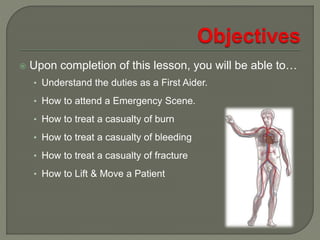
 Upon completion of this lesson, you will be able to… 
• Understand the duties as a First Aider. 
• How to attend a Emergency Scene. 
• How to treat a casualty of burn 
• How to treat a casualty of bleeding 
• How to treat a casualty of fracture 
• How to Lift & Move a Patient
 Emergency aid or treatment given to someone injured, 
suddenly ill, etc., before regular medical services arrive 
or can be reached. 
 First aid is the provision of initial limited care for an 
illness or Injury to a sick or injured patient until medical 
treatment can be accessed.
 As a first aider you must respond to first aid emergencies 
within the limits of your training. 
 Arrange without delay medical assistance, unless injury 
is so minor it can be handled without professional 
attention. 
 Render appropriate first aid until transportation of 
casualty to further medical care, if necessary. 
 Discharge treatment without endangering the life or 
health of the casualty or first aider. 
 Report the treatment given by you.
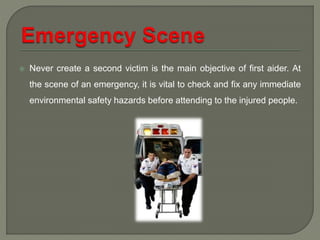
 Never create a second victim is the main objective of first aider. At 
the scene of an emergency, it is vital to check and fix any immediate 
environmental safety hazards before attending to the injured people.
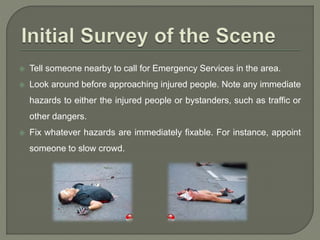
 Tell someone nearby to call for Emergency Services in the area. 
 Look around before approaching injured people. Note any immediate 
hazards to either the injured people or bystanders, such as traffic or 
other dangers. 
 Fix whatever hazards are immediately fixable. For instance, appoint 
someone to slow crowd.
 Determine whether the injured person needs to be moved. 
 Consider spinal injury. If you do not suspect one, then you can move 
the injured person fairly quickly. 
 Take full spinal precautions if you have even the slightest suspicion 
of spinal cord injury. 
 Put on latex gloves to prevent infection or transmission of disease. 
 Move the injured person out of the dangerous area with a method 
appropriate to his or her condition if you have determined that a 
sufficiently dire hazard is present.
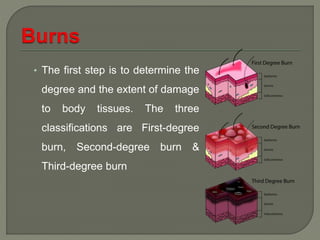
• The first step is to determine the 
degree and the extent of damage 
to body tissues. The three 
classifications are First-degree 
burn, Second-degree burn & 
Third-degree burn
 There are many causes of burns. 
• Dry Heat – This is the most common type of burn & 
includes burns caused by hot objects. 
• Wet Heat – Also know as scalds, wet heat usually refers to 
hot water or steam but it can also include other hot liquids. 
• Friction – When two objects rub together very quickly 
friction generates heat , causing another type of dry burn.
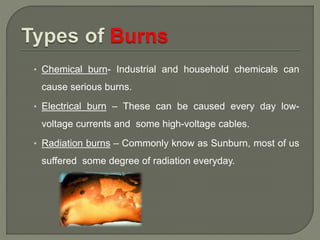
• Chemical burn- Industrial and household chemicals can 
cause serious burns. 
• Electrical burn – These can be caused every day low-voltage 
currents and some high-voltage cables. 
• Radiation burns – Commonly know as Sunburn, most of us 
suffered some degree of radiation everyday.
 First-degree burn; The least serious burns are those in 
which only the outer layer of skin is burned. The skin is 
usually red, with swelling and pain sometimes present. 
 Second-degree burn; When the first layer of skin has 
been burned through and the second layer of skin 
(dermis) also is burned, Blisters develop and the skin 
takes on an intensely reddened, splotchy appearance. 
 Third-degree burn; The most serious burns are 
painless, involve all layers of the skin and cause 
permanent tissue damage. Fat, muscle and even bone 
may be affected.
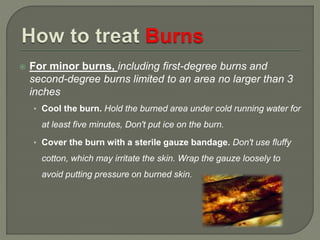
 For minor burns, including first-degree burns and 
second-degree burns limited to an area no larger than 3 
inches 
• Cool the burn. Hold the burned area under cold running water for 
at least five minutes, Don't put ice on the burn. 
• Cover the burn with a sterile gauze bandage. Don't use fluffy 
cotton, which may irritate the skin. Wrap the gauze loosely to 
avoid putting pressure on burned skin.
 Major burns, call for emergency. Until an emergency 
unit arrives; 
• Don't remove burnt clothing. However, do make sure the victim 
is no longer in contact with smoldering materials or exposed to 
smoke or heat. 
• Don't immerse large severe burns in cold water. Doing so 
could cause shock. 
• Check for signs of circulation (breathing, coughing or 
movement). If there is no breathing or other sign of circulation, 
CPR 
• Elevate the burned body part or parts. Raise above heart level, 
when possible. 
• Cover the area of the burn. Use a cool, moist, sterile bandage; 
clean, moist cloth; or moist towels.
 Blood is carried around the body in a transport system of arteries, 
capillaries and veins, any damage to this network results Bleeding. 
Bleeding be both External or Internal. 
 To Stop bleeding we need to indentify the cause & the place of 
bleeding. 
 Bleeding is the major cause of death in an accident. 
 A human body has an average of 05 to 06 liters of blood. 
 Loosing 02 or more liters of blood can lead to death of the patient.
 Bleeding or hemorrhaging is simply blood escaping from its vessels. 
 There are varying degrees of seriousness. 
 The main method of arresting the blood flow is by applying direct 
pressure. 
 Elevating the bleeding part if possible. 
 If necessary treat the patient for SHOCK 
 Apply tourniquet as a last resort.
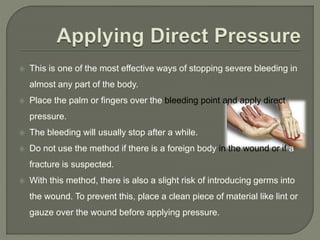
 This is one of the most effective ways of stopping severe bleeding in 
almost any part of the body. 
 Place the palm or fingers over the bleeding point and apply direct 
pressure. 
 The bleeding will usually stop after a while. 
 Do not use the method if there is a foreign body in the wound or if a 
fracture is suspected. 
 With this method, there is also a slight risk of introducing germs into 
the wound. To prevent this, place a clean piece of material like lint or 
gauze over the wound before applying pressure.
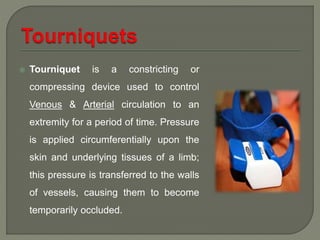
 Tourniquet is a constricting or 
compressing device used to control 
Venous & Arterial circulation to an 
extremity for a period of time. Pressure 
is applied circumferentially upon the 
skin and underlying tissues of a limb; 
this pressure is transferred to the walls 
of vessels, causing them to become 
temporarily occluded.
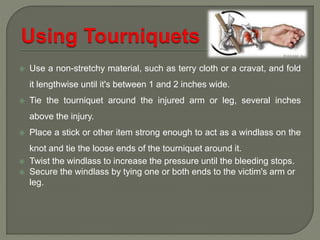
 Use a non-stretchy material, such as terry cloth or a cravat, and fold 
it lengthwise until it's between 1 and 2 inches wide. 
 Tie the tourniquet around the injured arm or leg, several inches 
above the injury. 
 Place a stick or other item strong enough to act as a windlass on the 
knot and tie the loose ends of the tourniquet around it. 
 Twist the windlass to increase the pressure until the bleeding stops. 
 Secure the windlass by tying one or both ends to the victim's arm or 
leg.
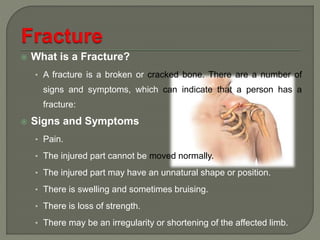
 What is a Fracture? 
• A fracture is a broken or cracked bone. There are a number of 
signs and symptoms, which can indicate that a person has a 
fracture: 
 Signs and Symptoms 
• Pain. 
• The injured part cannot be moved normally. 
• The injured part may have an unnatural shape or position. 
• There is swelling and sometimes bruising. 
• There is loss of strength. 
• There may be an irregularity or shortening of the affected limb.
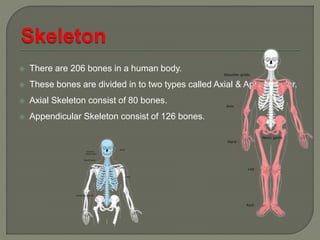
 There are 206 bones in a human body. 
 These bones are divided in to two types called Axial & Appendicular. 
 Axial Skeleton consist of 80 bones. 
 Appendicular Skeleton consist of 126 bones.
 Protection — Bones can serve to protect internal organs. 
 Shape — Bones provide a frame to keep the body supported. 
 Blood production —Produces Red blood cells. 
 Mineral storage — Bones act as reserves of minerals important for 
the body. 
 Fat Storage — The yellow bone marrow acts as a storage reserve of 
fatty acids. 
 Movement — Bones help body to move properly. 
 Sound transduction — Bones are important in the mechanical aspect 
of Hearing.
 Treat severe bleeding and difficulty in breathing first. 
 Treat on the spot. Avoid unnecessary movement. 
 Immobilize the injured part; splint the joint above and the joint below 
the injury. 
 When treating a compound fracture avoid splints in the area. 
 Use appropriate type of splint to the fracture. 
 Check Vital Signs after splinting 
 Don’t over splint the patient. 
 Immobilization is the best treatment for Fractures.
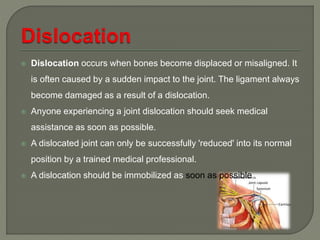
 Dislocation occurs when bones become displaced or misaligned. It 
is often caused by a sudden impact to the joint. The ligament always 
become damaged as a result of a dislocation. 
 Anyone experiencing a joint dislocation should seek medical 
assistance as soon as possible. 
 A dislocated joint can only be successfully 'reduced' into its normal 
position by a trained medical professional. 
 A dislocation should be immobilized as soon as possible.
 Lifting & Moving a Patient incorrectly can cause more injuries. 
 As a First Aider we must always follow the Basic principles. 
• Plan your move before lifting 
• Use your legs to lift, not your back 
• Keep the weight of the object as close to your body as possible 
• Move your body as a unit 
• Reduce the height or distance you need to move 
• Reposition &lift in stages 
 The key to prevent injury is correct alignment of the spine. 
 Team work is essential with good communication.
 Making an emergency move only when there is immediate danger to 
the patient. 
 Emergency move should be carried out if the scene is, 
• On fire or threat of fire 
• Explosion or threat of explosion 
• Unstable building 
• Rolled over car 
• Hostile crowd 
• Hazardous Materials 
• Extreme weather 
• If the patient needs CPR 
 Types of Emergency moves are 
• Shirt drag, 
• Shoulder or forearm drag, 
• Blanket drag, 
• Piggy back carry, 
• Fireman drag, etc..
Any Questions…