
FIRST AID MANAGEMENT IN A WORK PLACE
BY:DR AZUKAEGO NNAJI
FOR:PRESTON HEALTHCARE CONSULTING LTD.
DATE: 3RD MARCH, 2017.
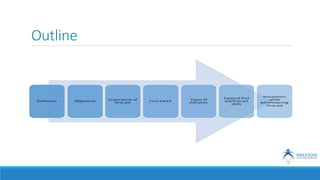
Outline
Definition
Help given to a sick or injured person until full medical treatment is
available.
Objectives
- To understand the importance of first aid
- To identify when to administer first aid
- To understand who needs to benefit from first aid
- To be capable of administering simple first aid
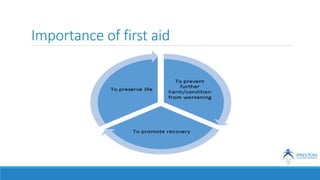
Importance of first aid
To preserve life
This is the main aim of first aid: to save lives. This includes
 the life of the first aider
 the casualty (the victim, the injured/sick person)
 +/- spectators
To prevent further harm
The stability of the patient is very important. This may include
 Moving the patient out of harm's way
 Applying first aid techniques
 Keeping him/her warm and dry
 Applying pressure to wounds to stop bleeding, etc.
To promote recovery
This may include
 Applying a plaster (bandage) to a small wound
 Reassuring the person and allaying fear and anxiety
 Anything that may help in the recovery process.
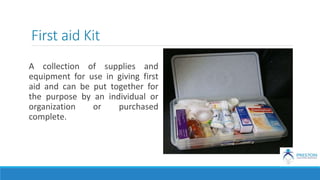
First aid Kit
A collection of supplies and
equipment for use in giving first
aid and can be put together for
the purpose by an individual or
organization or purchased
complete.
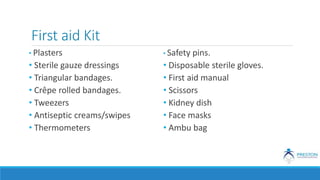
First aid Kit
• Plasters
• Sterile gauze dressings
• Triangular bandages.
• Crêpe rolled bandages.
• Tweezers
• Antiseptic creams/swipes
• Thermometers
• Safety pins.
• Disposable sterile gloves.
• First aid manual
• Scissors
• Kidney dish
• Face masks
• Ambu bag
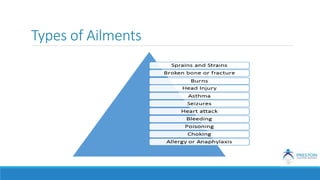
Types of Ailments
Types of first aid/first aid skills
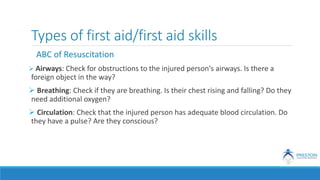
ABC of Resuscitation
 Airways: Check for obstructions to the injured person's airways. Is there a
foreign object in the way?
 Breathing: Check if they are breathing. Is their chest rising and falling? Do they
need additional oxygen?
 Circulation: Check that the injured person has adequate blood circulation. Do
they have a pulse? Are they conscious?
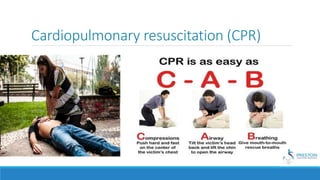
Cardiopulmonary resuscitation (CPR)
Cardiopulmonary Resuscitation
Defibrillation
Some organizations have this fourth step, while others include this as
part of circulation.
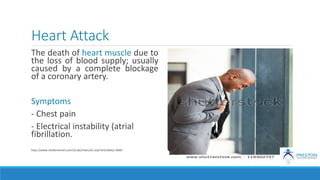
Heart Attack
The death of heart muscle due to
the loss of blood supply; usually
caused by a complete blockage
of a coronary artery.
Symptoms
- Chest pain
- Electrical instability (atrial
fibrillation.
http://www.medicinenet.com/script/main/art.asp?articlekey=3669
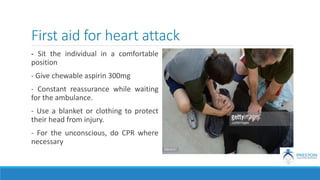
First aid for heart attack
- Sit the individual in a comfortable
position
- Give chewable aspirin 300mg
- Constant reassurance while waiting
for the ambulance.
- Use a blanket or clothing to protect
their head from injury.
- For the unconscious, do CPR where
necessary
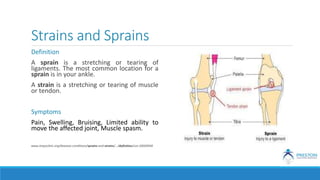
Strains and Sprains
Definition
A sprain is a stretching or tearing of
ligaments. The most common location for a
sprain is in your ankle.
A strain is a stretching or tearing of muscle
or tendon.
Symptoms
Pain, Swelling, Bruising, Limited ability to
move the affected joint, Muscle spasm.
www.mayoclinic.org/diseases-conditions/sprains-and-strains/.../definition/con-20020958
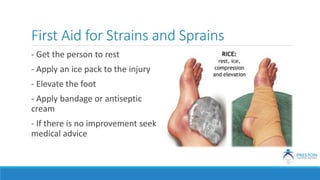
First Aid for Strains and Sprains
- Get the person to rest
- Apply an ice pack to the injury
- Elevate the foot
- Apply bandage or antiseptic
cream
- If there is no improvement seek
medical advice
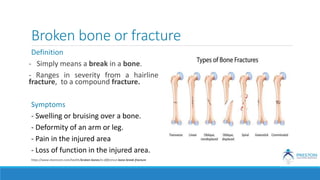
Broken bone or fracture
Definition
- Simply means a break in a bone.
- Ranges in severity from a hairline
fracture, to a compound fracture.
Symptoms
- Swelling or bruising over a bone.
- Deformity of an arm or leg.
- Pain in the injured area
- Loss of function in the injured area.
https://www.sharecare.com/health/broken-bones/is-difference-bone-break-fracture
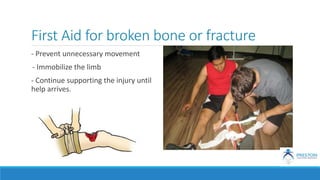
First Aid for broken bone or fracture
- Prevent unnecessary movement
- Immobilize the limb
- Continue supporting the injury until
help arrives.
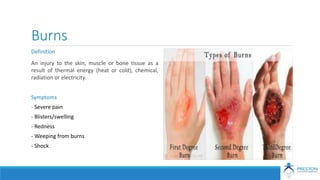
Burns
Definition
An injury to the skin, muscle or bone tissue as a
result of thermal energy (heat or cold), chemical,
radiation or electricity.
Symptoms
- Severe pain
- Blisters/swelling
- Redness
- Weeping from burns
- Shock
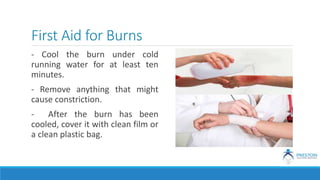
First Aid for Burns
- Cool the burn under cold
running water for at least ten
minutes.
- Remove anything that might
cause constriction.
- After the burn has been
cooled, cover it with clean film or
a clean plastic bag.
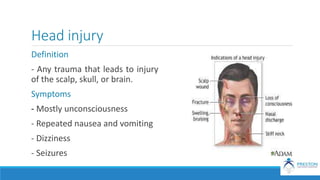
Head injury
Definition
- Any trauma that leads to injury
of the scalp, skull, or brain.
Symptoms
- Mostly unconsciousness
- Repeated nausea and vomiting
- Dizziness
- Seizures
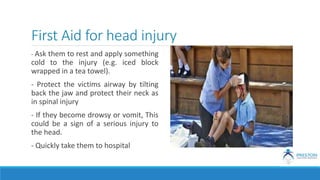
First Aid for head injury
- Ask them to rest and apply something
cold to the injury (e.g. iced block
wrapped in a tea towel).
- Protect the victims airway by tilting
back the jaw and protect their neck as
in spinal injury
- If they become drowsy or vomit, This
could be a sign of a serious injury to
the head.
- Quickly take them to hospital
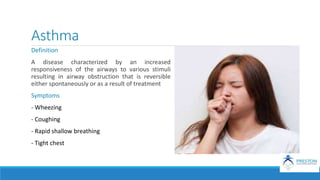
Asthma
Definition
A disease characterized by an increased
responsiveness of the airways to various stimuli
resulting in airway obstruction that is reversible
either spontaneously or as a result of treatment
Symptoms
- Wheezing
- Coughing
- Rapid shallow breathing
- Tight chest
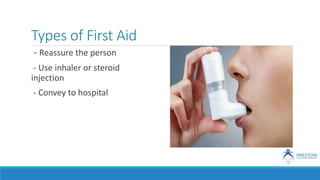
Types of First Aid
- Reassure the person
- Use inhaler or steroid
injection
- Convey to hospital
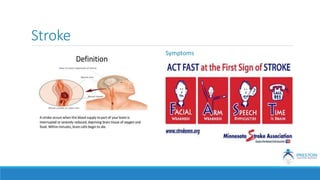
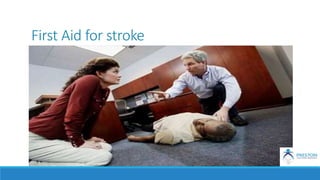
Stroke
Symptoms
First Aid for stroke
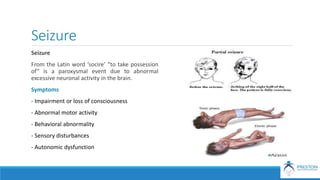
Seizure
Seizure
From the Latin word ‘socire’ “to take possession
of” is a paroxysmal event due to abnormal
excessive neuronal activity in the brain.
Symptoms
- Impairment or loss of consciousness
- Abnormal motor activity
- Behavioral abnormality
- Sensory disturbances
- Autonomic dysfunction
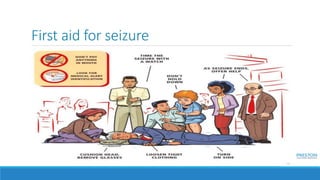
First aid for seizure
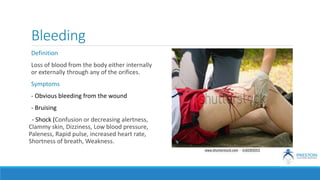
Bleeding
Definition
Loss of blood from the body either internally
or externally through any of the orifices.
Symptoms
- Obvious bleeding from the wound
- Bruising
- Shock (Confusion or decreasing alertness,
Clammy skin, Dizziness, Low blood pressure,
Paleness, Rapid pulse, increased heart rate,
Shortness of breath, Weakness.
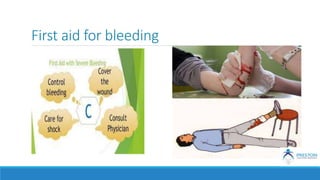
First aid for bleeding
Poisoning
Definition
Poisoning occurs when any substance
interferes with normal body functions after it
is swallowed, inhaled, injected, or absorbed.
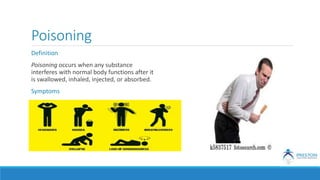
Symptoms
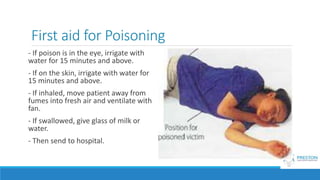
First aid for Poisoning
- If poison is in the eye, irrigate with
water for 15 minutes and above.
- If on the skin, irrigate with water for
15 minutes and above.
- If inhaled, move patient away from
fumes into fresh air and ventilate with
fan.
- If swallowed, give glass of milk or
water.
- Then send to hospital.
Choking
Definition
Choking is a condition caused by inhalation or
ingestion of a foreign object that partially or
fully blocks the airway.
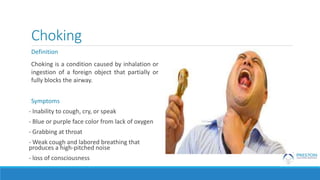
Symptoms
- Inability to cough, cry, or speak
- Blue or purple face color from lack of oxygen
- Grabbing at throat
- Weak cough and labored breathing that
produces a high-pitched noise
- loss of consciousness
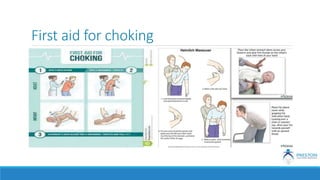
First aid for choking
Allergy or Anaphylaxis
Definition
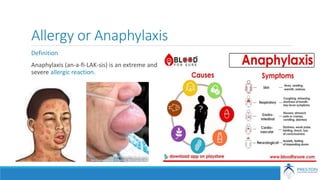
Anaphylaxis (an-a-fi-LAK-sis) is an extreme and
severe allergic reaction.
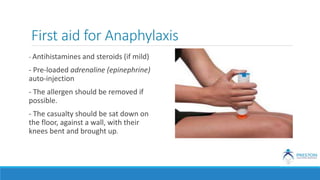
First aid for Anaphylaxis
- Antihistamines and steroids (if mild)
- Pre-loaded adrenaline (epinephrine)
auto-injection
- The allergen should be removed if
possible.
- The casualty should be sat down on
the floor, against a wall, with their
knees bent and brought up.
Precautions while administering First Aid
You must remember that self protection comes first.
- Ensure you wear gloves
- Ensure you put on your mask depending on the injury
- Be careful with handling of body fluids
- Do not expose others to danger
Precautions while carrying out First Aid
If you accidentally get exposed to body fluids
- Immediately wash your hands with soap and water
- Ensure you do not touch your face or any opening
- Disinfect your hands with sodium hypochlorite
- Report to appropriate authorities
First Aid Management In A Work Place

First Aid Management In A Work Place

  • 1.
    FIRST AID MANAGEMENTIN A WORK PLACE BY:DR AZUKAEGO NNAJI FOR:PRESTON HEALTHCARE CONSULTING LTD. DATE: 3RD MARCH, 2017.
  • 2.
  • 3.
    Definition Help given toa sick or injured person until full medical treatment is available.
  • 4.
    Objectives - To understandthe importance of first aid - To identify when to administer first aid - To understand who needs to benefit from first aid - To be capable of administering simple first aid
  • 5.
  • 6.
    To preserve life Thisis the main aim of first aid: to save lives. This includes  the life of the first aider  the casualty (the victim, the injured/sick person)  +/- spectators
  • 7.
    To prevent furtherharm The stability of the patient is very important. This may include  Moving the patient out of harm's way  Applying first aid techniques  Keeping him/her warm and dry  Applying pressure to wounds to stop bleeding, etc.
  • 8.
    To promote recovery Thismay include  Applying a plaster (bandage) to a small wound  Reassuring the person and allaying fear and anxiety  Anything that may help in the recovery process.
  • 9.
    First aid Kit Acollection of supplies and equipment for use in giving first aid and can be put together for the purpose by an individual or organization or purchased complete.
  • 10.
    First aid Kit •Plasters • Sterile gauze dressings • Triangular bandages. • Crêpe rolled bandages. • Tweezers • Antiseptic creams/swipes • Thermometers • Safety pins. • Disposable sterile gloves. • First aid manual • Scissors • Kidney dish • Face masks • Ambu bag
  • 11.
  • 12.
    Types of firstaid/first aid skills ABC of Resuscitation  Airways: Check for obstructions to the injured person's airways. Is there a foreign object in the way?  Breathing: Check if they are breathing. Is their chest rising and falling? Do they need additional oxygen?  Circulation: Check that the injured person has adequate blood circulation. Do they have a pulse? Are they conscious?
  • 13.
  • 14.
    Cardiopulmonary Resuscitation Defibrillation Some organizationshave this fourth step, while others include this as part of circulation.
  • 15.
    Heart Attack The deathof heart muscle due to the loss of blood supply; usually caused by a complete blockage of a coronary artery. Symptoms - Chest pain - Electrical instability (atrial fibrillation. http://www.medicinenet.com/script/main/art.asp?articlekey=3669
  • 16.
    First aid forheart attack - Sit the individual in a comfortable position - Give chewable aspirin 300mg - Constant reassurance while waiting for the ambulance. - Use a blanket or clothing to protect their head from injury. - For the unconscious, do CPR where necessary
  • 17.
    Strains and Sprains Definition Asprain is a stretching or tearing of ligaments. The most common location for a sprain is in your ankle. A strain is a stretching or tearing of muscle or tendon. Symptoms Pain, Swelling, Bruising, Limited ability to move the affected joint, Muscle spasm. www.mayoclinic.org/diseases-conditions/sprains-and-strains/.../definition/con-20020958
  • 18.
    First Aid forStrains and Sprains - Get the person to rest - Apply an ice pack to the injury - Elevate the foot - Apply bandage or antiseptic cream - If there is no improvement seek medical advice
  • 19.
    Broken bone orfracture Definition - Simply means a break in a bone. - Ranges in severity from a hairline fracture, to a compound fracture. Symptoms - Swelling or bruising over a bone. - Deformity of an arm or leg. - Pain in the injured area - Loss of function in the injured area. https://www.sharecare.com/health/broken-bones/is-difference-bone-break-fracture
  • 20.
    First Aid forbroken bone or fracture - Prevent unnecessary movement - Immobilize the limb - Continue supporting the injury until help arrives.
  • 21.
    Burns Definition An injury tothe skin, muscle or bone tissue as a result of thermal energy (heat or cold), chemical, radiation or electricity. Symptoms - Severe pain - Blisters/swelling - Redness - Weeping from burns - Shock
  • 22.
    First Aid forBurns - Cool the burn under cold running water for at least ten minutes. - Remove anything that might cause constriction. - After the burn has been cooled, cover it with clean film or a clean plastic bag.
  • 23.
    Head injury Definition - Anytrauma that leads to injury of the scalp, skull, or brain. Symptoms - Mostly unconsciousness - Repeated nausea and vomiting - Dizziness - Seizures
  • 24.
    First Aid forhead injury - Ask them to rest and apply something cold to the injury (e.g. iced block wrapped in a tea towel). - Protect the victims airway by tilting back the jaw and protect their neck as in spinal injury - If they become drowsy or vomit, This could be a sign of a serious injury to the head. - Quickly take them to hospital
  • 25.
    Asthma Definition A disease characterizedby an increased responsiveness of the airways to various stimuli resulting in airway obstruction that is reversible either spontaneously or as a result of treatment Symptoms - Wheezing - Coughing - Rapid shallow breathing - Tight chest
  • 26.
    Types of FirstAid - Reassure the person - Use inhaler or steroid injection - Convey to hospital
  • 27.
  • 28.
  • 29.
    Seizure Seizure From the Latinword ‘socire’ “to take possession of” is a paroxysmal event due to abnormal excessive neuronal activity in the brain. Symptoms - Impairment or loss of consciousness - Abnormal motor activity - Behavioral abnormality - Sensory disturbances - Autonomic dysfunction
  • 30.
  • 31.
    Bleeding Definition Loss of bloodfrom the body either internally or externally through any of the orifices. Symptoms - Obvious bleeding from the wound - Bruising - Shock (Confusion or decreasing alertness, Clammy skin, Dizziness, Low blood pressure, Paleness, Rapid pulse, increased heart rate, Shortness of breath, Weakness.
  • 32.
    First aid forbleeding
  • 33.
    Poisoning Definition Poisoning occurs whenany substance interferes with normal body functions after it is swallowed, inhaled, injected, or absorbed. Symptoms
  • 34.
    First aid forPoisoning - If poison is in the eye, irrigate with water for 15 minutes and above. - If on the skin, irrigate with water for 15 minutes and above. - If inhaled, move patient away from fumes into fresh air and ventilate with fan. - If swallowed, give glass of milk or water. - Then send to hospital.
  • 35.
    Choking Definition Choking is acondition caused by inhalation or ingestion of a foreign object that partially or fully blocks the airway. Symptoms - Inability to cough, cry, or speak - Blue or purple face color from lack of oxygen - Grabbing at throat - Weak cough and labored breathing that produces a high-pitched noise - loss of consciousness
  • 36.
  • 37.
    Allergy or Anaphylaxis Definition Anaphylaxis(an-a-fi-LAK-sis) is an extreme and severe allergic reaction.
  • 38.
    First aid forAnaphylaxis - Antihistamines and steroids (if mild) - Pre-loaded adrenaline (epinephrine) auto-injection - The allergen should be removed if possible. - The casualty should be sat down on the floor, against a wall, with their knees bent and brought up.
  • 39.
    Precautions while administeringFirst Aid You must remember that self protection comes first. - Ensure you wear gloves - Ensure you put on your mask depending on the injury - Be careful with handling of body fluids - Do not expose others to danger
  • 40.
    Precautions while carryingout First Aid If you accidentally get exposed to body fluids - Immediately wash your hands with soap and water - Ensure you do not touch your face or any opening - Disinfect your hands with sodium hypochlorite - Report to appropriate authorities