First Aid
Training
Welcome
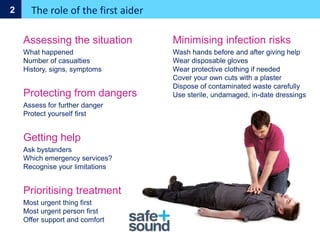
The role of the first aider
2
Assessing the situation
What happened
Number of casualties
History, signs, symptoms
Protecting from dangers
Assess for further danger
Protect yourself first
Getting help
Ask bystanders
Which emergency services?
Recognise your limitations
Prioritising treatment
Most urgent thing first
Most urgent person first
Offer support and comfort
Minimising infection risks
Wash hands before and after giving help
Wear disposable gloves
Wear protective clothing if needed
Cover your own cuts with a plaster
Dispose of contaminated waste carefully
Use sterile, undamaged, in-date dressings
Preserve Life
Prevent Worsening
Promote Recovery
The aims of first aid
2
P
P
P
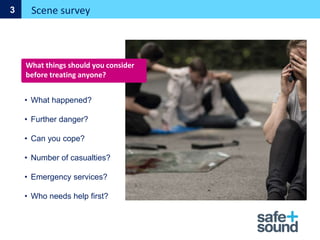
What things should you consider
before treating anyone?
• What happened?
• Further danger?
• Can you cope?
• Number of casualties?
• Emergency services?
• Who needs help first?
Scene survey
3
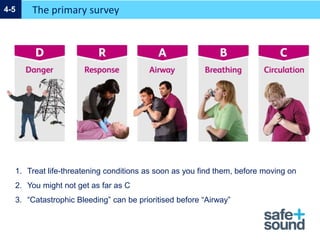
The primary survey
4-5
1. Treat life-threatening conditions as soon as you find them, before moving on
2. You might not get as far as C
3. “Catastrophic Bleeding” can be prioritised before “Airway”
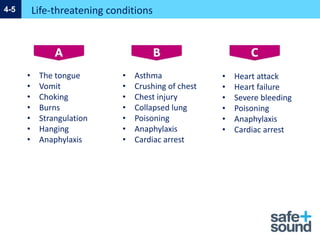
Life-threatening conditions
4-5
• The tongue
• Vomit
• Choking
• Burns
• Strangulation
• Hanging
• Anaphylaxis
• Asthma
• Crushing of chest
• Chest injury
• Collapsed lung
• Poisoning
• Anaphylaxis
• Cardiac arrest
• Heart attack
• Heart failure
• Severe bleeding
• Poisoning
• Anaphylaxis
• Cardiac arrest
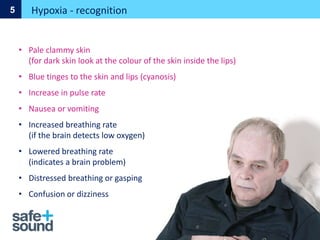
Hypoxia - recognition
5
• Pale clammy skin
(for dark skin look at the colour of the skin inside the lips)
• Blue tinges to the skin and lips (cyanosis)
• Increase in pulse rate
• Nausea or vomiting
• Increased breathing rate
(if the brain detects low oxygen)
• Lowered breathing rate
(indicates a brain problem)
• Distressed breathing or gasping
• Confusion or dizziness
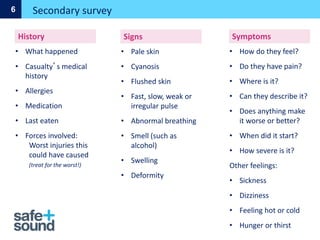
Secondary survey
6
• What happened
• Casualty’s medical
history
• Allergies
• Medication
• Last eaten
• Forces involved:
Worst injuries this
could have caused
(treat for the worst!)
History
• Pale skin
• Cyanosis
• Flushed skin
• Fast, slow, weak or
irregular pulse
• Abnormal breathing
• Smell (such as
alcohol)
• Swelling
• Deformity
Signs
• How do they feel?
• Do they have pain?
• Where is it?
• Can they describe it?
• Does anything make
it worse or better?
• When did it start?
• How severe is it?
Other feelings:
• Sickness
• Dizziness
• Feeling hot or cold
• Hunger or thirst
Symptoms
Secondary survey
6
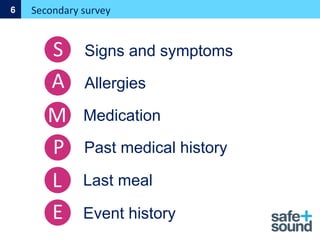
Allergies
Medication
Past medical history
Last meal
Event history
A
M
P
L
E
Signs and symptoms
S
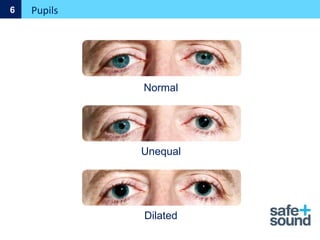
Pupils
6
Normal
Unequal
Dilated
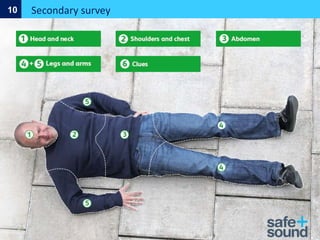
Secondary survey
10
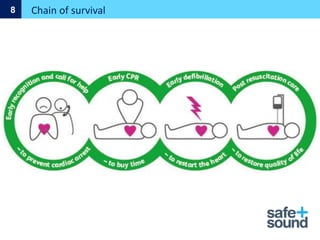
Chain of survival
8
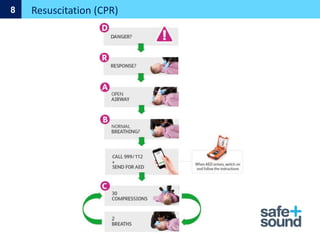
Resuscitation (CPR)
8
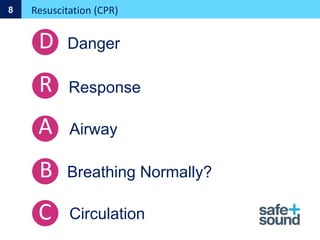
Danger
Response
Airway
Resuscitation (CPR)
8
Breathing Normally?
Circulation
D
R
A
B
C
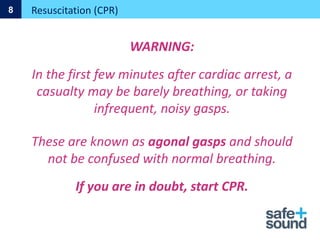
WARNING:
In the first few minutes after cardiac arrest, a
casualty may be barely breathing, or taking
infrequent, noisy gasps.
These are known as agonal gasps and should
not be confused with normal breathing.
If you are in doubt, start CPR.
Resuscitation (CPR)
8
:
Old guidelines, slow CPR, but there isn’t a better
video to show agonal gasps!
Agonal Gasps – Bondi Beach
Sometimes a casualty can have a seizure-like
episode when the heart stops.
Carefully consider if the casualty is breathing
normally.
Resuscitation (CPR)
8
CHRIS SOLOMENS YOUTUBE LINK:
‘Seizure like episode’ at 2:37.
Please ignore the speed and depth of the chest
compressions!
Resuscitation (CPR)
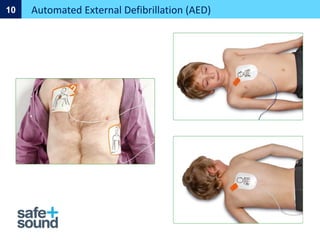
Automated External Defibrillation (AED)
10
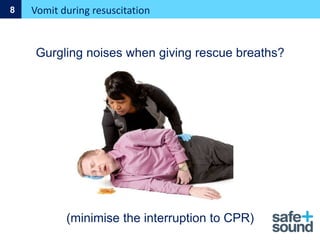
Vomit during resuscitation
8
Gurgling noises when giving rescue breaths?
(minimise the interruption to CPR)
First aiders can use the adult
sequence of resuscitation
on a child or baby who is
unresponsive and not breathing
normally.
Child and baby CPR
11
Child and baby CPR
11
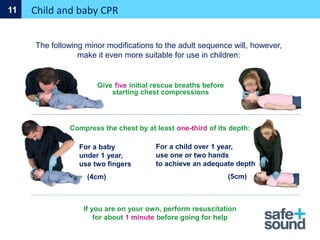
The following minor modifications to the adult sequence will, however,
make it even more suitable for use in children:
If you are on your own, perform resuscitation
for about 1 minute before going for help
Give five initial rescue breaths before
starting chest compressions
For a baby
under 1 year,
use two fingers
(4cm)
For a child over 1 year,
use one or two hands
to achieve an adequate depth
(5cm)
Compress the chest by at least one-third of its depth:
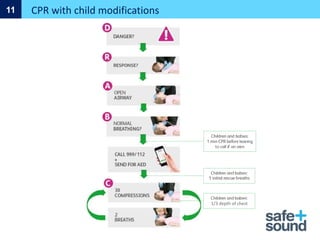
CPR with child modifications
11
1/3 depth of chest
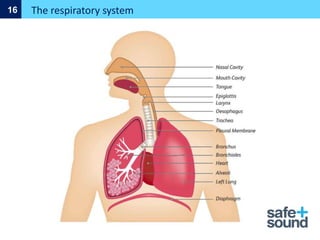
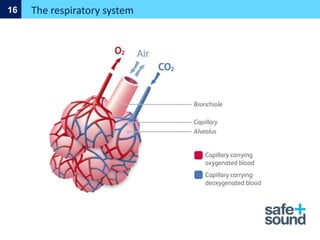
The respiratory system
16
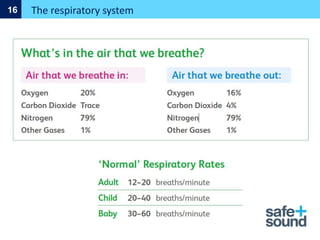
The respiratory system
16
The respiratory system
16
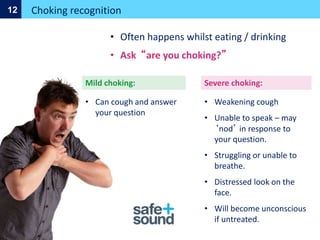
Choking recognition
12
• Often happens whilst eating / drinking
• Ask “are you choking?”
• Can cough and answer
your question
Mild choking:
• Weakening cough
• Unable to speak – may
‘nod’ in response to
your question.
• Struggling or unable to
breathe.
• Distressed look on the
face.
• Will become unconscious
if untreated.
Severe choking:
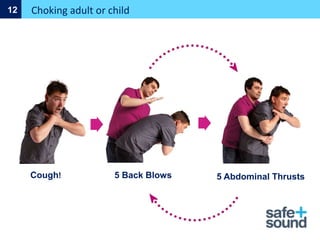
Choking adult or child
12
Cough! 5 Back Blows 5 Abdominal Thrusts
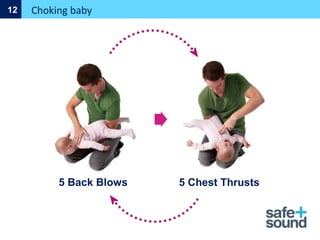
Choking baby
12
5 Back Blows 5 Chest Thrusts
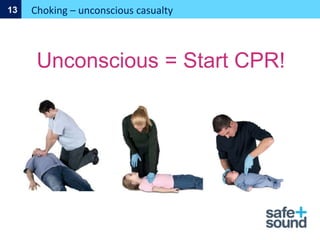
Unconscious = Start CPR!
Choking – unconscious casualty
13
Choking – seeking medical advice
13
After successful choking treatment,
seek immediate medical attention if the casualty:
•Has received abdominal thrusts;
•Has difficulty swallowing;
•Has a persistent cough; OR
•Feels like ‘an object is still stuck in the throat’.
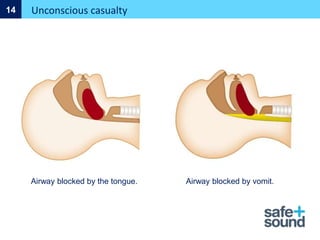
Unconscious casualty
14
Airway blocked by the tongue. Airway blocked by vomit.
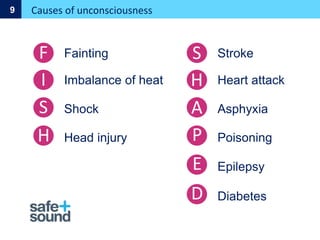
Fainting
Causes of unconsciousness
9
F
I
S
H
Imbalance of heat
Shock
Head injury
Stroke
S
H
A
P
Heart attack
Asphyxia
Poisoning
E Epilepsy
D Diabetes
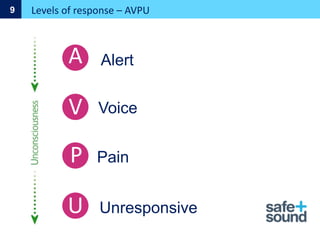
Alert
Voice
Pain
Unresponsive
Levels of response – AVPU
9
A
V
P
U
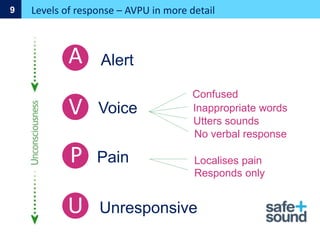
Alert
Voice
Pain
Unresponsive
Confused
Inappropriate words
Utters sounds
No verbal response
Localises pain
Responds only
Levels of response – AVPU in more detail
9
A
V
P
U
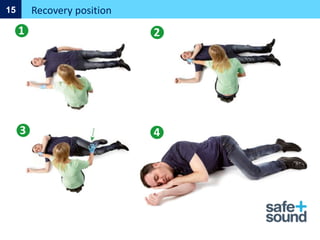
Recovery position
15
1 2
3 4
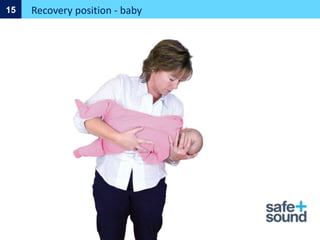
Recovery position - baby
15
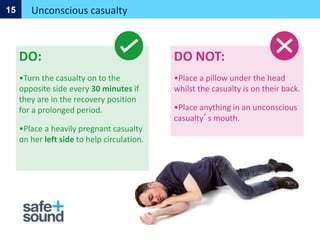
DO:
•Turn the casualty on to the
opposite side every 30 minutes if
they are in the recovery position
for a prolonged period.
•Place a heavily pregnant casualty
on her left side to help circulation.
Unconscious casualty
15
DO NOT:
•Place a pillow under the head
whilst the casualty is on their back.
•Place anything in an unconscious
casualty’s mouth.
What is Anaphylaxis?
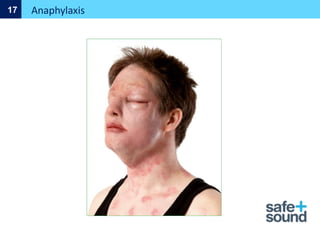
Anaphylaxis
17
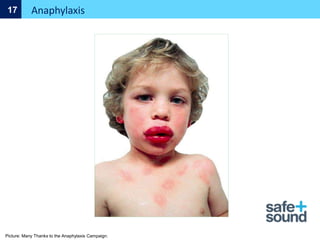
Picture: Many Thanks to the Anaphylaxis Campaign.
Anaphylaxis
17
Anaphylaxis – recognition
5
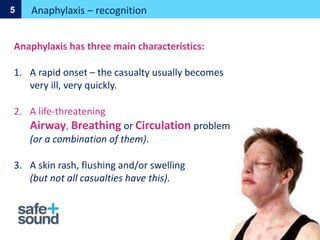
Anaphylaxis has three main characteristics:
1. A rapid onset – the casualty usually becomes
very ill, very quickly.
2. A life-threatening
Airway, Breathing or Circulation problem
(or a combination of them).
3. A skin rash, flushing and/or swelling
(but not all casualties have this).
Spotting and treating anaphylaxis reaction
Anaphylaxis – recognition
5
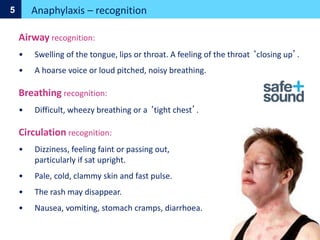
Airway recognition:
• Swelling of the tongue, lips or throat. A feeling of the throat ‘closing up’.
• A hoarse voice or loud pitched, noisy breathing.
Breathing recognition:
• Difficult, wheezy breathing or a ‘tight chest’.
Circulation recognition:
• Dizziness, feeling faint or passing out,
particularly if sat upright.
• Pale, cold, clammy skin and fast pulse.
• The rash may disappear.
• Nausea, vomiting, stomach cramps, diarrhoea.
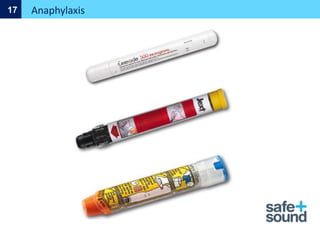
Anaphylaxis
17
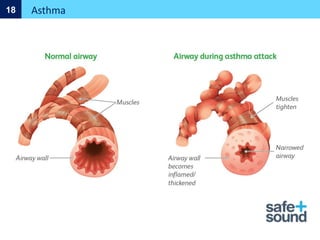
Asthma
18
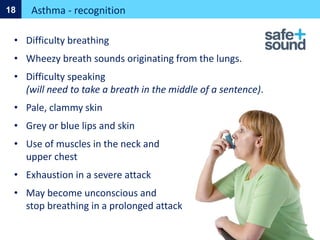
Asthma - recognition
18
• Difficulty breathing
• Wheezy breath sounds originating from the lungs.
• Difficulty speaking
(will need to take a breath in the middle of a sentence).
• Pale, clammy skin
• Grey or blue lips and skin
• Use of muscles in the neck and
upper chest
• Exhaustion in a severe attack
• May become unconscious and
stop breathing in a prolonged attack
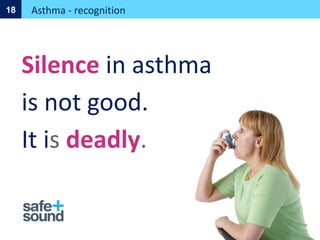
Asthma - recognition
18
Silence in asthma
is not good.
It is deadly.
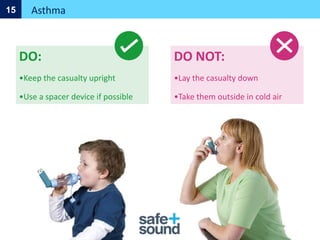
DO:
•Keep the casualty upright
•Use a spacer device if possible
Asthma
15
DO NOT:
•Lay the casualty down
•Take them outside in cold air
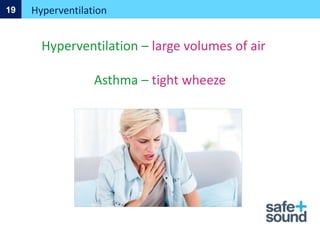
Hyperventilation
19
Hyperventilation – large volumes of air
Asthma – tight wheeze
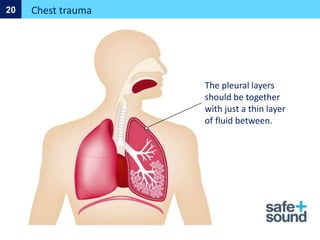
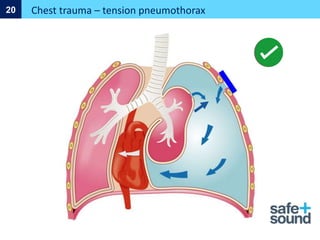
Chest trauma
20
The pleural layers
should be together
with just a thin layer
of fluid between.
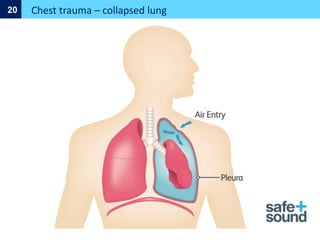
Chest trauma – collapsed lung
20
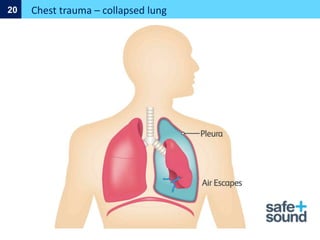
Chest trauma – collapsed lung
20
Chest trauma – tension pneumothorax
20
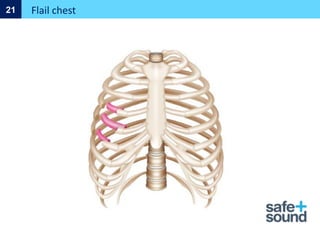
Flail chest
21
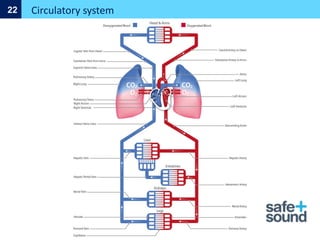
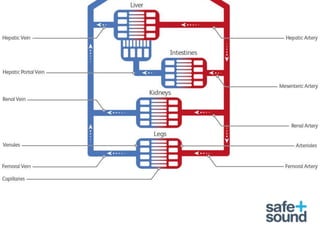
Circulatory system
22
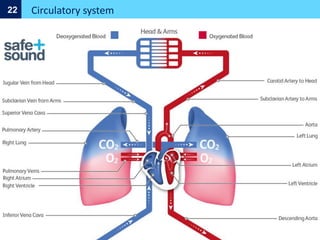
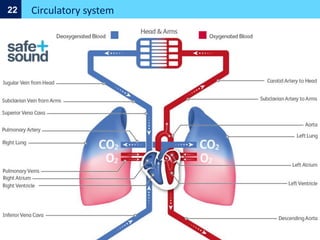
Circulatory system
22
Circulatory system
22
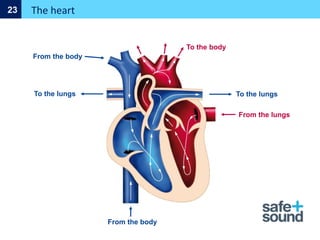
From the body
From the body
To the lungs To the lungs
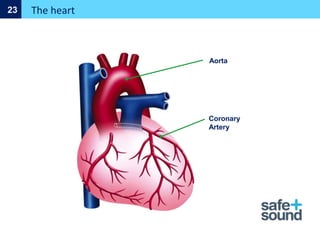
The heart
23
From the lungs
To the body
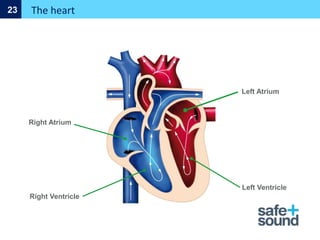
Right Atrium
Right Ventricle
Left Ventricle
The heart
23
Left Atrium
Aorta
Coronary
Artery
The heart
23
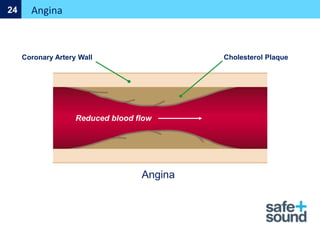
Cholesterol Plaque
Coronary Artery Wall
Reduced blood flow
Angina
Angina
24
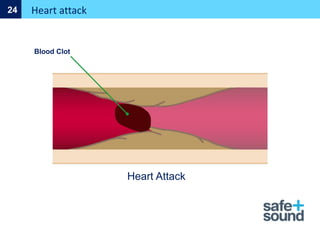
Heart Attack
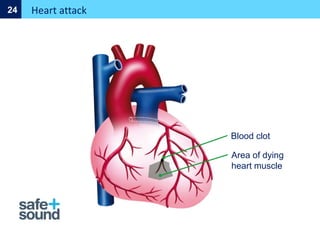
Heart attack
24
Blood Clot
Heart attack
24
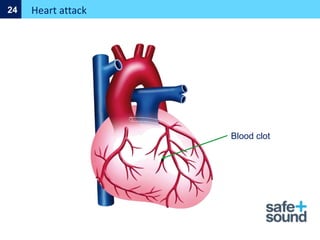
Blood clot
Area of dying
heart muscle
Heart attack
24
Blood clot
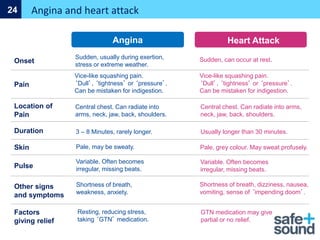
Factors
giving relief
Other signs
and symptoms
Pulse
Skin
Duration
Location of
Pain
Pain
Onset
Sudden, usually during exertion,
stress or extreme weather.
Sudden, can occur at rest.
Vice-like squashing pain.
‘Dull’, ‘tightness’ or ‘pressure’.
Can be mistaken for indigestion.
Central chest. Can radiate into
arms, neck, jaw, back, shoulders.
Vice-like squashing pain.
‘Dull’, ‘tightness’ or ‘pressure’.
Can be mistaken for indigestion.
Central chest. Can radiate into arms,
neck, jaw, back, shoulders.
3 – 8 Minutes, rarely longer. Usually longer than 30 minutes.
Pale, may be sweaty. Pale, grey colour. May sweat profusely.
Variable. Often becomes
irregular, missing beats.
Variable. Often becomes
irregular, missing beats.
Shortness of breath,
weakness, anxiety.
Shortness of breath, dizziness, nausea,
vomiting, sense of ‘impending doom’.
Resting, reducing stress,
taking ‘GTN’ medication.
GTN medication may give
partial or no relief.
Angina Heart Attack
Angina and heart attack
24
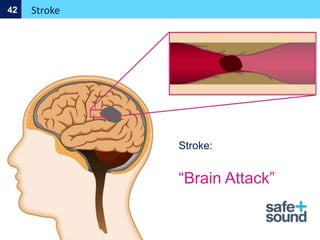
Stroke
42
Stroke:
“Brain Attack”
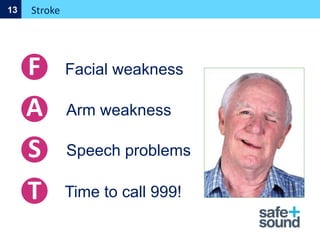
Facial weakness
Arm weakness
Speech problems
Time to call 999!
Stroke
13
F
A
S
T
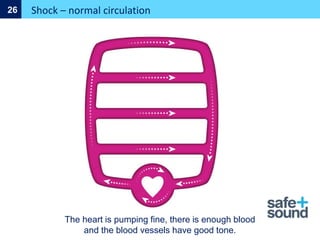
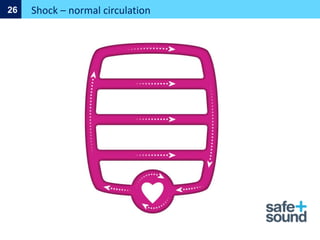
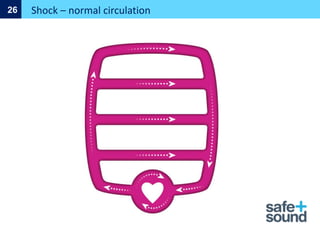
Shock – normal circulation
26
The heart is pumping fine, there is enough blood
and the blood vessels have good tone.
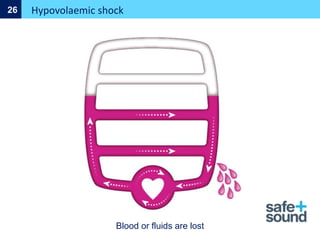
Hypovolaemic shock
26
Blood or fluids are lost
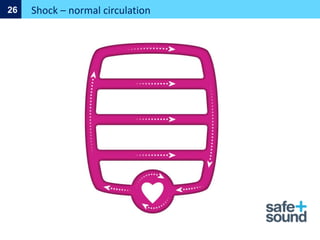
Shock – normal circulation
26
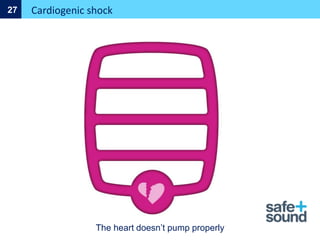
Cardiogenic shock
27
The heart doesn’t pump properly
Shock – normal circulation
26
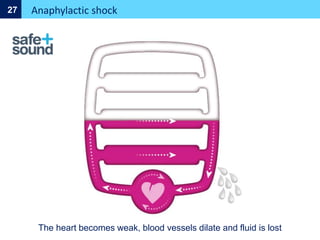
Anaphylactic shock
27
The heart becomes weak, blood vessels dilate and fluid is lost
Shock – normal circulation
26
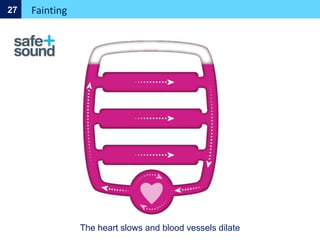
Fainting
27
The heart slows and blood vessels dilate
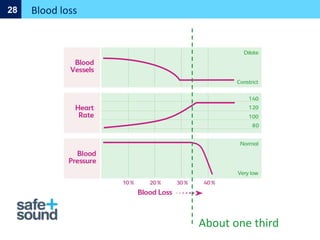
Blood loss
28
About one third
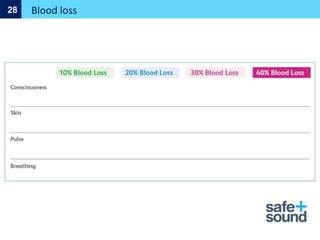
Blood loss
28
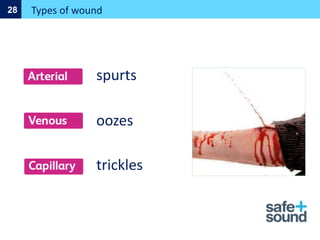
Types of wound
28
spurts
oozes
trickles
Rapidly assess:
•Type of bleed
•Exact point of bleeding
•Foreign objects
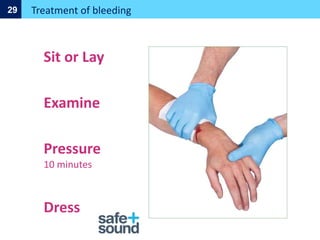
Sit or Lay
Examine
Pressure
10 minutes
Dress
Treatment of bleeding
29
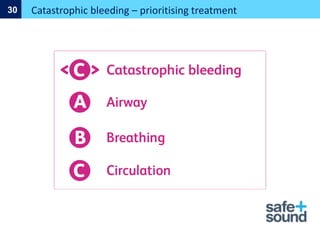
Catastrophic bleeding – prioritising treatment
30
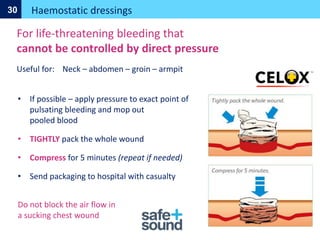
Haemostatic dressings
30
For life-threatening bleeding that
cannot be controlled by direct pressure
Useful for: Neck – abdomen – groin – armpit
• If possible – apply pressure to exact point of
pulsating bleeding and mop out
pooled blood
• TIGHTLY pack the whole wound
• Compress for 5 minutes (repeat if needed)
• Send packaging to hospital with casualty
Do not block the air flow in
a sucking chest wound
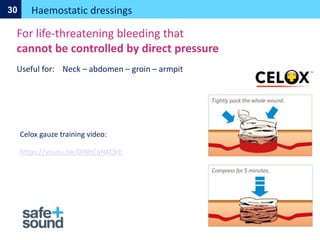
Haemostatic dressings
30
For life-threatening bleeding that
cannot be controlled by direct pressure
Useful for: Neck – abdomen – groin – armpit
Celox gauze training video:
https://youtu.be/0iNhCaNKQkE
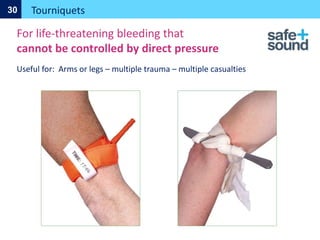
Tourniquets
30
For life-threatening bleeding that
cannot be controlled by direct pressure
Useful for: Arms or legs – multiple trauma – multiple casualties
Tourniquets
30
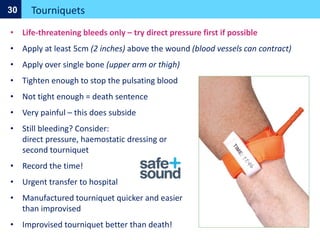
• Life-threatening bleeds only – try direct pressure first if possible
• Apply at least 5cm (2 inches) above the wound (blood vessels can contract)
• Apply over single bone (upper arm or thigh)
• Tighten enough to stop the pulsating blood
• Not tight enough = death sentence
• Very painful – this does subside
• Still bleeding? Consider:
direct pressure, haemostatic dressing or
second tourniquet
• Record the time!
• Urgent transfer to hospital
• Manufactured tourniquet quicker and easier
than improvised
• Improvised tourniquet better than death!
Tourniquets
30
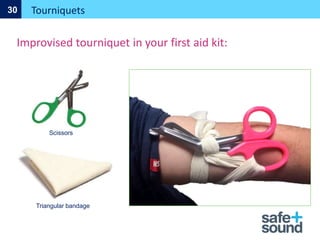
Improvised tourniquet in your first aid kit:
Triangular bandage
Scissors
Tourniquets
30
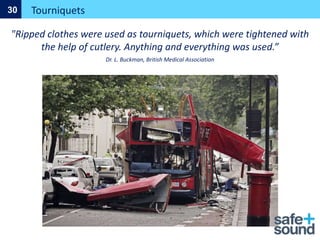
"Ripped clothes were used as tourniquets, which were tightened with
the help of cutlery. Anything and everything was used.”
Dr. L. Buckman, British Medical Association
Tourniquets
30
For life-threatening bleeding that
cannot be controlled by direct pressure
Useful for: Arms or legs – multiple trauma – multiple casualties
CAT Tourniquet training videos:
https://youtu.be/tzXNsfesUb0
https://youtu.be/LDN03FgUhxU
Types of wound
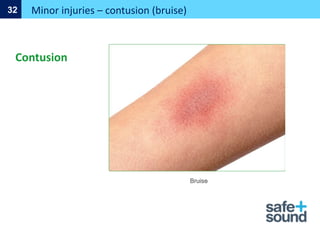
Contusion
Bruise
Minor injuries – contusion (bruise)
32
Contusion
Types of wound
Contusion
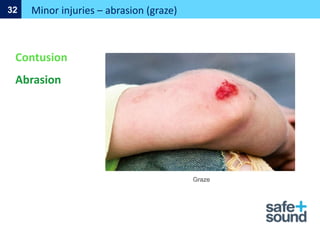
Abrasion
Graze
Minor injuries – abrasion (graze)
32
Contusion
Abrasion
Types of wound
Contusion
Abrasion
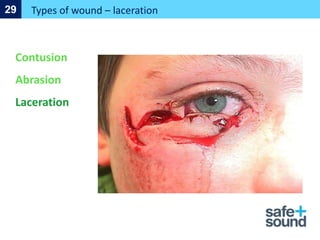
Laceration
Types of wound – laceration
29
Contusion
Abrasion
Laceration
Types of wound
Contusion
Abrasion
Laceration
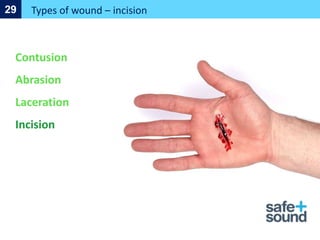
Incision
Types of wound – incision
29
Contusion
Abrasion
Laceration
Incision
Types of wound
Contusion
Abrasion
Laceration
Incision
Penetrating
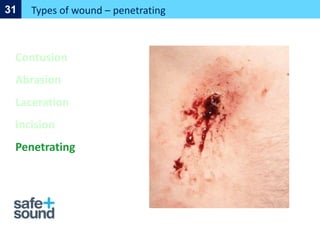
Types of wound – penetrating
31
Contusion
Abrasion
Laceration
Incision
Penetrating
Types of wound – penetrating
31
Contusion
Abrasion
Laceration
Incision
Penetrating
Types of wound – penetrating / laceration
31
Contusion
Abrasion
Laceration
Incision
Penetrating
Types of wound
Contusion
Abrasion
Laceration
Incision
Penetrating
Amputation
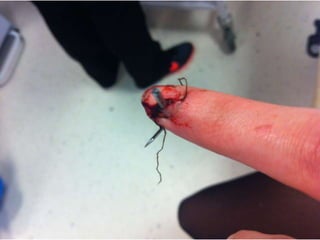
Types of wound – amputation
33
Contusion
Abrasion
Laceration
Incision
Penetrating
Amputation
Amputation
33
Contusion
Abrasion
Laceration
Incision
Penetrating
Amputation
Contusion
Abrasion
Laceration
Incision
Penetrating
Amputation
De-gloved
Types of wound
Types of wound – de-gloved
31
Contusion
Abrasion
Laceration
Incision
Penetrating
Amputation
De-gloved
Embedded glass
Minor injuries – embedded object
32
Tetanus?
Minor injuries – splinter
32
4
Nosebleed
Minor injuries – nosebleed
33
Minor injuries – insect sting
33
Animal (or human) bite
33
Crush injury
33
Eye irrigation
Eye injury - chemicals
33
Poisons
35
• Ingested
• Inhaled
• Absorbed
• Injected
• Corrosive
• Non-corrosive
Corrosive Substance:
• Danger
• Wash away / dilute (if can swallow)
• 999/112
• Monitor Airway & Breathing
• Unconscious – recovery position
Non-corrosive Substance:
• 999/112
• Follow instructions
• Monitor Airway & Breathing
• Unconscious – recovery position
Poisons – treatment
35
Poisons
35
Size
Cause
Age
Location
Depth
Severity of burns
36
S
C
A
L
D
1%
Burns – size
36
Superficial
Partial Thickness
Full Thickness
Burns – depth
36
>1%
Full
Thickness
Burns that need hospital treatment
36
Burns
36
Burns treatment
35
1
2
3
Cool
Remove
Dress
The skeleton
38
Types of fracture
38
Open
Closed
Complicated Green Stick
Types of fracture – closed
38
Types of fracture – open
38
Note the poor aseptic technique!
Types of fracture – open fracture
38
Types of fracture – open fracture
38
dislocated kneecap
Dislocation
38
Dislocated
Normal
Pain
Loss of power
Unnatural movement
Swelling or bruising
Deformity
Irregularity
Crepitus
Tenderness
Fractures – signs and symptoms
38
Elevated Sling
Slings
38
Support Sling
Slings
38
Rest
Ice
Compression
Elevation
Sprains and strains
40
R
I
C
E
The spine
40
7 Cervical
12 Thoracic
5 Lumbar
5 Fused Sacral
Spinal injury – recognition
40
• Blow to head, neck or back
(especially resulting in unconsciousness)
• Fall from height
(e.g. horse)
• Dive into shallow water
• Accident involving speed
(e.g. knocked down or a car accident)
• Cave in accident
(e.g. crushing, or collapsed rugby scrum).
• Multiple injuries
• Pain or tenderness in neck or back after accident
(pain killers or other injuries can mask pain – beware).
• If you are in any doubt
Spinal injury
41
Spinal injury
41
Serious head injuries – Concussion
42
Serious head injuries – Compression
42
Serious head injuries – Compression
42
Concussion Compression
Unconsciousness for a short period,
followed by an increase in levels of
response and recovery.
Could have a history of recent head
injury with apparent recovery, but then
deteriorates.
Short term memory loss (particularly of the
incident). Confusion, irritability.
Levels of response become worse as
condition develops.
Mild, general headache. Intense headache.
Pale, clammy skin. Flushed, dry skin.
Shallow / normal breathing. Deep, noisy, slow breathing.
(Pressure on the respiratory control area of the brain)
Rapid, weak pulse.
(Blood diverts away from the extremities)
Slow, strong pulse.
(Caused by raised blood pressure)
Normal pupils, reacting to light. One or both pupils dilate as pressure
increases on the brain.
Possible nausea or vomiting on
recovery.
Condition becomes worse. Fits may occur.
No recovery.
Head injuries
12
Body temperature
42
Shivering
Fatigue, slurred speech
Confusion, forgetfulness
Shivering stops, muscle rigidity
Noticeable drowsiness – 32˚C
Very slow, very weak pulse – 33˚C
Severe reduction in response levels
Unconsciousness – 30˚C
Dilated pupils
Pulse undetectable – 29˚C
Appearance of death – 28˚C
Death – 26˚C
Heat Exhaustion 38–40˚C
Normal Body Temperature 36–37˚C
Mild Hypothermia 31.5–35˚C
Severe Hypothermia Below 31.5˚C
Heat Stroke Over 40˚C
Unconsciousness / fitting
Confused / restless
Headache, dizzy, uncomfortable
Strong bounding pulse
Flushed dry skin, hot to touch
(or febrile convulsions)
Cramps in stomach / arms / legs
Pale sweaty skin
Nausea / loss of appetite
(or febrile convulsions)
Heat exhaustion and heat stroke - recognition
40
Heat exhaustion
• Pale, sweaty skin
• Nausea, loss of appetite, vomiting
• Fast, weak pulse and breathing
• Cramps in arms, legs, abdomen
• “I feel cold”, but hot to touch.
Heat stroke
• Dizziness, fainting, confusion, restlessness
• Throbbing headache
• Lowered levels of response leading
to unconsciousness
• Possibility of seizures
• Nausea, vomiting
• Flushed, hot, dry skin (no sweating)
Brain
overheating
Heat exhaustion
40
Heat exhaustion
Heat stroke
40
Heat stroke
Diabetes
46
insulin
Fixed amount
injected:
Burns up sugar! To balance the
insulin taken.
Eaten:
sugar
Diabetes – untreated
46
insulin
sugar
Diabetes – low blood sugar
46
sugar
insulin
Overdosed
on insulin
Or not eaten
enough food;
Or over
exercised.
Oxygen + Food = Energy = LIFE
Why is low blood sugar so dangerous?
Brain cells can only use glucose (sugar) for energy
Diabetes – low blood sugar
46
High Blood Sugar Low Blood Sugar
Onset Slow Fast
Levels of
response
Deteriorate slowly Deteriorate rapidly
Skin Dry and warm Pale, cold, sweaty
Breathing Deep sighing breaths Shallow and rapid
Pulse Rapid Rapid
Other
symptoms
Excessive urination
Very thirsty
Hunger
Fruity smell on breath
May be confused for
drunkenness
Diabetes
47
20g of Glucose:
• 150ml Lucozade Original
• 200ml lemonade
• 200ml orange juice
• 4 jelly babies
• 4 teaspoons of sugar
• 20 skittles
• Glucose tablets vary
x4
Diabetes – low blood sugar treatment
46
Focal seizure
48
Focal leading to generalised seizure
48
Seizures
49
Red Flag early warning signs!
• Cold hands and feet
• Pain in the limbs or joints
• Abnormal skin colour (pallor or mottling)
Other signs, which can occur later:
• Fever and vomiting
• Rash that doesn’t fade with tumbler test
• Drowsiness or lowered levels of consciousness
• Severe headache
• Stiff neck (rare)
• Dislike of bright lights (rare)
Meningitis
50
Meningitis
50
Meningitis
50
Meningitis
50
Sickle Cell
51
Sickle Cell
51
First aid kits
54
Gloves Face shield
Plasters Wound dressings Eye pad
Finger dressing Burns dressing Triangular bandage Conforming bandage
Wipes
Safety pins Adhesive tape Foil blanket
Eye wash Scissors
First aid kits
54
First aid kits
54
First aid kits
54
HSE first aid courses
54
HSE first aid courses – sequence of training
54
Name
Address
Occupation
Name
Address
Occupation
When
Where
How / Cause
Injuries
www.RIDDOR.gov.uk
Accident book
57
Successful Resuscitation?
and finally…
How to complete your answer paper
First Aid
Training
Thank you!
The airway
8
Make your own slides / mnemonics
X
Alpha
Bravo
Charlie
Delta
Echo
A
B
C
D
E
Alpha
Make your own slides / mnemonics
X
1
2
3
4
Bravo
Charlie
Delta
Echo
E
F
G
H
Golf
Hotel
Foxtrot
Indigo
I
J
K
L
Kilo
Lima
Juliette
Mike
M
N
O
P
November
Oscar
Papa
Quebec
Q
R
S
T
Sierra
Tango
Romeo
Uniform
U
V
W
X
Whiskey
X-ray
Victor
Y
Z
Yankee
Zulu

First-Aid-Made-Easy-Training-Presentation (1).pptx