Patient Positioning
• Reposition a patient only when necessary

• Reposition a breathing, unresponsive, non-
  trauma patient in the recovery position

• Don’t move or reposition a trauma patient unless
  necessary to treat life-threatening condition

• Allow responsive patient to assume comfortable
  position
                                                   2
Recovery Position


•   Helps keep airway open
•   Allows fluid to drain from mouth
•   Prevents aspiration
•   If possible, put victim onto left side
•   Continue to monitor breathing            3
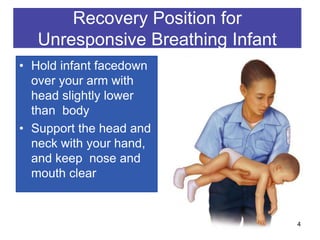
Recovery Position for
   Unresponsive Breathing Infant
• Hold infant facedown
  over your arm with
  head slightly lower
  than body
• Support the head and
  neck with your hand,
  and keep nose and
  mouth clear


                                   4
1. Extend victim’s arm farther      2. Position victim’s other arm
from you above victim’s head                 across chest


3. Bend victim’s nearer leg at   4. Put forearm nearer victim’s head
             knee                under victim’s nearer shoulder with
                                     hand under hollow of neck


                                                                 5
                                                                     5
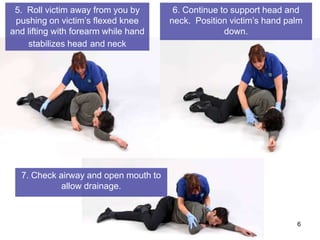
5. Roll victim away from you by       6. Continue to support head and
 pushing on victim’s flexed knee      neck. Position victim’s hand palm
and lifting with forearm while hand                 down.
     stabilizes head and neck


  7. Check airway and open mouth to
            allow drainage.


                                                                     6
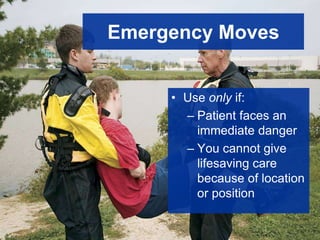
Emergency Moves


     • Use only if:
       – Patient faces an
         immediate danger
       – You cannot give
         lifesaving care
         because of location
         or position
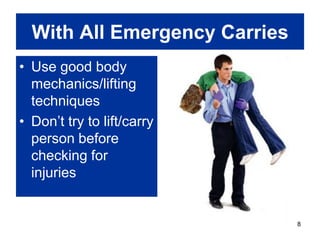
With All Emergency Carries
• Use good body
  mechanics/lifting
  techniques
• Don’t try to lift/carry
  person before
  checking for
  injuries


                               8
Moving Victims – If Alone
• Unresponsive victim
  who cannot safely be
  dragged
   – Pack-strap carry


                               9
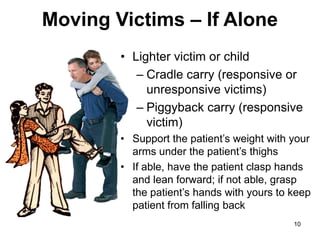
Moving Victims – If Alone
        • Lighter victim or child
           – Cradle carry (responsive or
             unresponsive victims)
           – Piggyback carry (responsive
             victim)
        • Support the patient’s weight with your
          arms under the patient’s thighs
        • If able, have the patient clasp hands
          and lean forward; if not able, grasp
          the patient’s hands with yours to keep
          patient from falling back
                                            10
Moving Victims – If Alone
         • Responsive victim
           who can walk with
           help
            – One-person
              walking assist


                               11
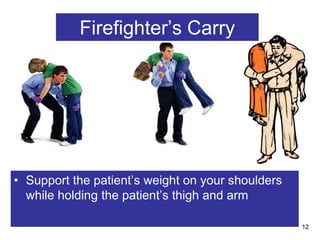
Firefighter’s Carry


• Support the patient’s weight on your shoulders
  while holding the patient’s thigh and arm

                                                   12
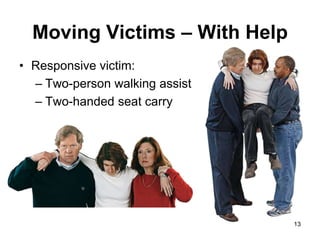
Moving Victims – With Help
• Responsive victim:
  – Two-person walking assist
  – Two-handed seat carry


                                13
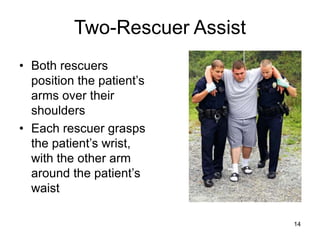
Two-Rescuer Assist
• Both rescuers
  position the patient’s
  arms over their
  shoulders
• Each rescuer grasps
  the patient’s wrist,
  with the other arm
  around the patient’s
  waist

                               14
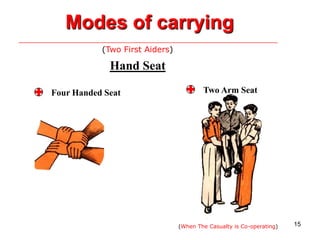
Modes of carrying
           (Two First Aiders)

             Hand Seat

Four Handed Seat                        Two Arm Seat


                                (When The Casualty is Co-operating)   15
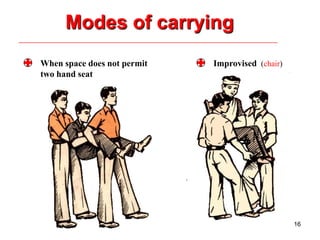
Modes of carrying
When space does not permit   Improvised (chair)
two hand seat


                                                  16
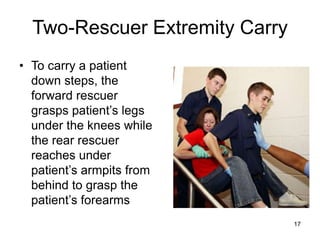
Two-Rescuer Extremity Carry
• To carry a patient
  down steps, the
  forward rescuer
  grasps patient’s legs
  under the knees while
  the rear rescuer
  reaches under
  patient’s armpits from
  behind to grasp the
  patient’s forearms
                                17
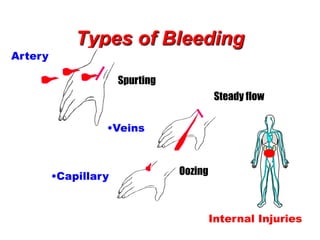
Types of Bleeding
Artery

                      Spurting
                                          Steady flow

                  •Veins


         •Capillary              Oozing


                                          Internal Injuries
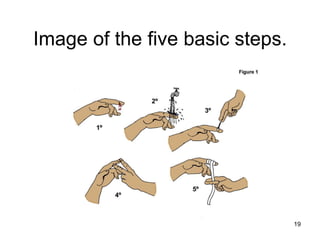
Image of the five basic steps.


                                 19
Control of Bleeding
                               Elevation
Direct Pressure


                       Pressure bandage
   Cold Applications
Pressure Points
                         Temporal
Where the artery
passes over a bone       Facial
close to the skin        Carotid

                     Sub-clavian
                     Brachial
                     Radial
                     Ulnar


                     Femoral
                     Popliteal
                     Pedal
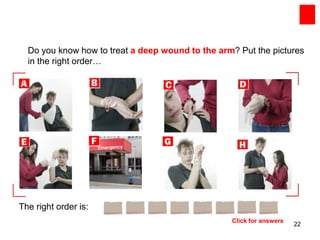
e. how to treat a big bleed


  Do you know how to treat a deep wound to the arm? Put the pictures
  in the right order…


The right order is:   H     D       B      G         E   A     C       F
                                                             Click for answers
                                                                                 22

First aid lesson carrying

  • 2.
    Patient Positioning • Repositiona patient only when necessary • Reposition a breathing, unresponsive, non- trauma patient in the recovery position • Don’t move or reposition a trauma patient unless necessary to treat life-threatening condition • Allow responsive patient to assume comfortable position 2
  • 3.
    Recovery Position • Helps keep airway open • Allows fluid to drain from mouth • Prevents aspiration • If possible, put victim onto left side • Continue to monitor breathing 3
  • 4.
    Recovery Position for Unresponsive Breathing Infant • Hold infant facedown over your arm with head slightly lower than body • Support the head and neck with your hand, and keep nose and mouth clear 4
  • 5.
    1. Extend victim’sarm farther 2. Position victim’s other arm from you above victim’s head across chest 3. Bend victim’s nearer leg at 4. Put forearm nearer victim’s head knee under victim’s nearer shoulder with hand under hollow of neck 5 5
  • 6.
    5. Roll victimaway from you by 6. Continue to support head and pushing on victim’s flexed knee neck. Position victim’s hand palm and lifting with forearm while hand down. stabilizes head and neck 7. Check airway and open mouth to allow drainage. 6
  • 7.
    Emergency Moves • Use only if: – Patient faces an immediate danger – You cannot give lifesaving care because of location or position
  • 8.
    With All EmergencyCarries • Use good body mechanics/lifting techniques • Don’t try to lift/carry person before checking for injuries 8
  • 9.
    Moving Victims –If Alone • Unresponsive victim who cannot safely be dragged – Pack-strap carry 9
  • 10.
    Moving Victims –If Alone • Lighter victim or child – Cradle carry (responsive or unresponsive victims) – Piggyback carry (responsive victim) • Support the patient’s weight with your arms under the patient’s thighs • If able, have the patient clasp hands and lean forward; if not able, grasp the patient’s hands with yours to keep patient from falling back 10
  • 11.
    Moving Victims –If Alone • Responsive victim who can walk with help – One-person walking assist 11
  • 12.
    Firefighter’s Carry • Supportthe patient’s weight on your shoulders while holding the patient’s thigh and arm 12
  • 13.
    Moving Victims –With Help • Responsive victim: – Two-person walking assist – Two-handed seat carry 13
  • 14.
    Two-Rescuer Assist • Bothrescuers position the patient’s arms over their shoulders • Each rescuer grasps the patient’s wrist, with the other arm around the patient’s waist 14
  • 15.
    Modes of carrying (Two First Aiders) Hand Seat Four Handed Seat Two Arm Seat (When The Casualty is Co-operating) 15
  • 16.
    Modes of carrying Whenspace does not permit Improvised (chair) two hand seat 16
  • 17.
    Two-Rescuer Extremity Carry •To carry a patient down steps, the forward rescuer grasps patient’s legs under the knees while the rear rescuer reaches under patient’s armpits from behind to grasp the patient’s forearms 17
  • 18.
    Types of Bleeding Artery Spurting Steady flow •Veins •Capillary Oozing Internal Injuries
  • 19.
    Image of thefive basic steps. 19
  • 20.
    Control of Bleeding Elevation Direct Pressure Pressure bandage Cold Applications
  • 21.
    Pressure Points Temporal Where the artery passes over a bone Facial close to the skin Carotid Sub-clavian Brachial Radial Ulnar Femoral Popliteal Pedal
  • 22.
    e. how totreat a big bleed Do you know how to treat a deep wound to the arm? Put the pictures in the right order… The right order is: H D B G E A C F Click for answers 22