
Basic Electric Circuits – © 2020 Mouli Sankaran Email: mouli.sankaran@yahoo.com
2Basic Electric Circuits – © 2020 Mouli Sankaran Email: mouli.sankaran@yahoo.com 2
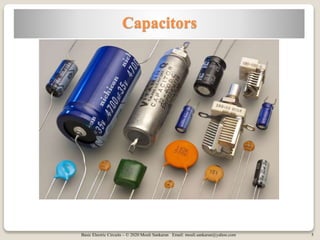
Capacitors
Basic Electric Circuits – © 2020 Mouli Sankaran Email: mouli.sankaran@yahoo.com 3
Session 15A: Focus
 What is a Capacitor?
 Nature’s Huge Capacitor
 Construction of Capacitors
◦ Unit of Capacitor (Farad)
 Dielectric Materials
Basic Electric Circuits – © 2020 Mouli Sankaran Email: mouli.sankaran@yahoo.com
Capacitors
Basic Electric Circuits – © 2020 Mouli Sankaran Email: mouli.sankaran@yahoo.com 5
Capacitors
Basic Electric Circuits – © 2020 Mouli Sankaran Email: mouli.sankaran@yahoo.com 6
What is a Capacitor?
 Capacitors (sometimes known as condensers) are energy-
storing devices that are widely used in
◦ Television, Radios, electronic equipments
 Tune a radio into a station, take a flash photo with a digital
camera, you're making good use of capacitors
 Capacitors have the ability to both store and deliver finite
amounts of energy
 They differ from ideal sources in this respect, since they
cannot sustain a finite average power flow over an infinite
time interval
6
Basic Electric Circuits – © 2020 Mouli Sankaran Email: mouli.sankaran@yahoo.com
Nature’s Huge Capacitors
Basic Electric Circuits – © 2020 Mouli Sankaran Email: mouli.sankaran@yahoo.com 8
Huge Capacitors in Nature!!!
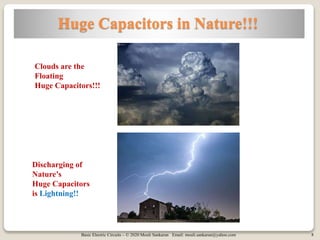
Discharging of
Nature’s
Huge Capacitors
is Lightning!!
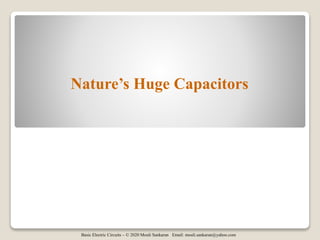
Clouds are the
Floating
Huge Capacitors!!!
Basic Electric Circuits – © 2020 Mouli Sankaran Email: mouli.sankaran@yahoo.com 9
Huge Capacitors in Nature Explained
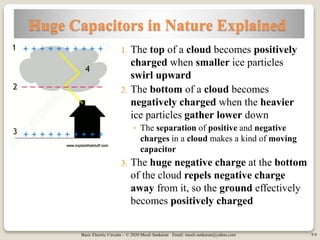
1. The top of a cloud becomes positively
charged when smaller ice particles
swirl upward
2. The bottom of a cloud becomes
negatively charged when the heavier
ice particles gather lower down
◦ The separation of positive and negative
charges in a cloud makes a kind of moving
capacitor
3. The huge negative charge at the bottom
of the cloud repels negative charge
away from it, so the ground effectively
becomes positively charged
9
Basic Electric Circuits – © 2020 Mouli Sankaran Email: mouli.sankaran@yahoo.com 10
Huge Capacitors in Nature Explained
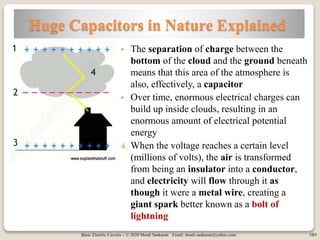
• The separation of charge between the
bottom of the cloud and the ground beneath
means that this area of the atmosphere is
also, effectively, a capacitor
• Over time, enormous electrical charges can
build up inside clouds, resulting in an
enormous amount of electrical potential
energy
4. When the voltage reaches a certain level
(millions of volts), the air is transformed
from being an insulator into a conductor,
and electricity will flow through it as
though it were a metal wire, creating a
giant spark better known as a bolt of
lightning
10
Basic Electric Circuits – © 2020 Mouli Sankaran Email: mouli.sankaran@yahoo.com
Construction of Capacitors
Basic Electric Circuits – © 2020 Mouli Sankaran Email: mouli.sankaran@yahoo.com 12
Definition of a Capacitor
 Capacitor is a component which has the
ability or “capacity” to store energy in the
form of an electrical energy producing a
potential difference (Static Voltage) across
its plates, much like a small rechargeable
battery.
Basic Electric Circuits – © 2020 Mouli Sankaran Email: mouli.sankaran@yahoo.com 13
Construction of a Capacitor
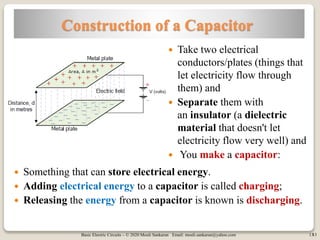
 Take two electrical
conductors/plates (things that
let electricity flow through
them) and
 Separate them with
an insulator (a dielectric
material that doesn't let
electricity flow very well) and
 You make a capacitor:
13
 Something that can store electrical energy.
 Adding electrical energy to a capacitor is called charging;
 Releasing the energy from a capacitor is known is discharging.
Basic Electric Circuits – © 2020 Mouli Sankaran Email: mouli.sankaran@yahoo.com 14
Unit of Capacitor (Farad)
 Capacitance is the electrical property of a
capacitor
 And is the measure of a capacitor’s ability to
store an electrical energy onto its two plates
 The unit of capacitance is
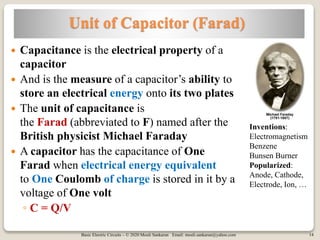
the Farad (abbreviated to F) named after the
British physicist Michael Faraday
 A capacitor has the capacitance of One
Farad when electrical energy equivalent
to One Coulomb of charge is stored in it by a
voltage of One volt
◦ C = Q/V
Inventions:
Electromagnetism
Benzene
Bunsen Burner
Popularized:
Anode, Cathode,
Electrode, Ion, …
Basic Electric Circuits – © 2020 Mouli Sankaran Email: mouli.sankaran@yahoo.com 15
Unit of Capacitor .. Continued
 Capacitance, C is always positive and has no
negative units.
 However, the Farad is a very large unit of
measurement to use on its own
◦ One Coulomb of charge = 6.25x10¹⁸ electrons
 So, sub-multiples of the Farad are generally used
such as:
◦ 1 micro-farads (μF) = 10-6 F
◦ 1 nano-farads (nF) = 10-9 F
◦ 1 pico-farads (pF) = 10-12 F
Basic Electric Circuits – © 2020 Mouli Sankaran Email: mouli.sankaran@yahoo.com
Dielectric Materials
Basic Electric Circuits – © 2020 Mouli Sankaran Email: mouli.sankaran@yahoo.com 17
Insulator Vs Dielectric Material
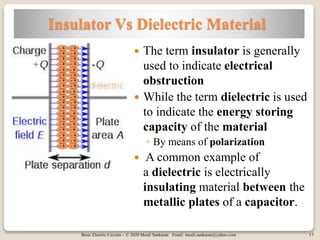
 The term insulator is generally
used to indicate electrical
obstruction
 While the term dielectric is used
to indicate the energy storing
capacity of the material
◦ By means of polarization
 A common example of
a dielectric is electrically
insulating material between the
metallic plates of a capacitor.
Basic Electric Circuits – © 2020 Mouli Sankaran Email: mouli.sankaran@yahoo.com 18
Different Dielectric Materials Used in
Capacitors
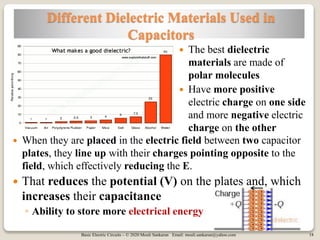
 When they are placed in the electric field between two capacitor
plates, they line up with their charges pointing opposite to the
field, which effectively reducing the E.
 That reduces the potential (V) on the plates and, which
increases their capacitance
◦ Ability to store more electrical energy
 The best dielectric
materials are made of
polar molecules
 Have more positive
electric charge on one side
and more negative electric
charge on the other
Basic Electric Circuits – © 2020 Mouli Sankaran Email: mouli.sankaran@yahoo.com 19
Permittivity (ε) Explained
 Different materials make better or worse dielectrics
according to how well they insulate the space between a
capacitor's plates and
◦ Reduce the electric field between them, there by reducing the
voltage across the plates
 A measurement called the relative permittivity (ε) tells
us how good a dielectric material is.
 A vacuum is the worst dielectric and is given a relative
permittivity of one
◦ Other dielectrics are measured relative (by comparing them) to a
vacuum
◦ Paper is about 3 times higher
◦ Water is 80 times better than vacuum (but not used in capacitors)
Basic Electric Circuits – © 2020 Mouli Sankaran Email: mouli.sankaran@yahoo.com 20
Session 15A: Summary
 What is a Capacitor?
 Nature’s Huge Capacitor
 Construction of Capacitors
◦ Unit of Capacitor (Farad)
 Dielectric Materials
Basic Electric Circuits – © 2020 Mouli Sankaran Email: mouli.sankaran@yahoo.com 21
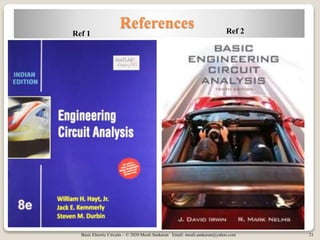
References
Ref 1 Ref 2

Basic Electric Circuits Session 15A

  • 1.
    Basic Electric Circuits– © 2020 Mouli Sankaran Email: mouli.sankaran@yahoo.com
  • 2.
    2Basic Electric Circuits– © 2020 Mouli Sankaran Email: mouli.sankaran@yahoo.com 2 Capacitors
  • 3.
    Basic Electric Circuits– © 2020 Mouli Sankaran Email: mouli.sankaran@yahoo.com 3 Session 15A: Focus  What is a Capacitor?  Nature’s Huge Capacitor  Construction of Capacitors ◦ Unit of Capacitor (Farad)  Dielectric Materials
  • 4.
    Basic Electric Circuits– © 2020 Mouli Sankaran Email: mouli.sankaran@yahoo.com Capacitors
  • 5.
    Basic Electric Circuits– © 2020 Mouli Sankaran Email: mouli.sankaran@yahoo.com 5 Capacitors
  • 6.
    Basic Electric Circuits– © 2020 Mouli Sankaran Email: mouli.sankaran@yahoo.com 6 What is a Capacitor?  Capacitors (sometimes known as condensers) are energy- storing devices that are widely used in ◦ Television, Radios, electronic equipments  Tune a radio into a station, take a flash photo with a digital camera, you're making good use of capacitors  Capacitors have the ability to both store and deliver finite amounts of energy  They differ from ideal sources in this respect, since they cannot sustain a finite average power flow over an infinite time interval 6
  • 7.
    Basic Electric Circuits– © 2020 Mouli Sankaran Email: mouli.sankaran@yahoo.com Nature’s Huge Capacitors
  • 8.
    Basic Electric Circuits– © 2020 Mouli Sankaran Email: mouli.sankaran@yahoo.com 8 Huge Capacitors in Nature!!! Discharging of Nature’s Huge Capacitors is Lightning!! Clouds are the Floating Huge Capacitors!!!
  • 9.
    Basic Electric Circuits– © 2020 Mouli Sankaran Email: mouli.sankaran@yahoo.com 9 Huge Capacitors in Nature Explained 1. The top of a cloud becomes positively charged when smaller ice particles swirl upward 2. The bottom of a cloud becomes negatively charged when the heavier ice particles gather lower down ◦ The separation of positive and negative charges in a cloud makes a kind of moving capacitor 3. The huge negative charge at the bottom of the cloud repels negative charge away from it, so the ground effectively becomes positively charged 9
  • 10.
    Basic Electric Circuits– © 2020 Mouli Sankaran Email: mouli.sankaran@yahoo.com 10 Huge Capacitors in Nature Explained • The separation of charge between the bottom of the cloud and the ground beneath means that this area of the atmosphere is also, effectively, a capacitor • Over time, enormous electrical charges can build up inside clouds, resulting in an enormous amount of electrical potential energy 4. When the voltage reaches a certain level (millions of volts), the air is transformed from being an insulator into a conductor, and electricity will flow through it as though it were a metal wire, creating a giant spark better known as a bolt of lightning 10
  • 11.
    Basic Electric Circuits– © 2020 Mouli Sankaran Email: mouli.sankaran@yahoo.com Construction of Capacitors
  • 12.
    Basic Electric Circuits– © 2020 Mouli Sankaran Email: mouli.sankaran@yahoo.com 12 Definition of a Capacitor  Capacitor is a component which has the ability or “capacity” to store energy in the form of an electrical energy producing a potential difference (Static Voltage) across its plates, much like a small rechargeable battery.
  • 13.
    Basic Electric Circuits– © 2020 Mouli Sankaran Email: mouli.sankaran@yahoo.com 13 Construction of a Capacitor  Take two electrical conductors/plates (things that let electricity flow through them) and  Separate them with an insulator (a dielectric material that doesn't let electricity flow very well) and  You make a capacitor: 13  Something that can store electrical energy.  Adding electrical energy to a capacitor is called charging;  Releasing the energy from a capacitor is known is discharging.
  • 14.
    Basic Electric Circuits– © 2020 Mouli Sankaran Email: mouli.sankaran@yahoo.com 14 Unit of Capacitor (Farad)  Capacitance is the electrical property of a capacitor  And is the measure of a capacitor’s ability to store an electrical energy onto its two plates  The unit of capacitance is the Farad (abbreviated to F) named after the British physicist Michael Faraday  A capacitor has the capacitance of One Farad when electrical energy equivalent to One Coulomb of charge is stored in it by a voltage of One volt ◦ C = Q/V Inventions: Electromagnetism Benzene Bunsen Burner Popularized: Anode, Cathode, Electrode, Ion, …
  • 15.
    Basic Electric Circuits– © 2020 Mouli Sankaran Email: mouli.sankaran@yahoo.com 15 Unit of Capacitor .. Continued  Capacitance, C is always positive and has no negative units.  However, the Farad is a very large unit of measurement to use on its own ◦ One Coulomb of charge = 6.25x10¹⁸ electrons  So, sub-multiples of the Farad are generally used such as: ◦ 1 micro-farads (μF) = 10-6 F ◦ 1 nano-farads (nF) = 10-9 F ◦ 1 pico-farads (pF) = 10-12 F
  • 16.
    Basic Electric Circuits– © 2020 Mouli Sankaran Email: mouli.sankaran@yahoo.com Dielectric Materials
  • 17.
    Basic Electric Circuits– © 2020 Mouli Sankaran Email: mouli.sankaran@yahoo.com 17 Insulator Vs Dielectric Material  The term insulator is generally used to indicate electrical obstruction  While the term dielectric is used to indicate the energy storing capacity of the material ◦ By means of polarization  A common example of a dielectric is electrically insulating material between the metallic plates of a capacitor.
  • 18.
    Basic Electric Circuits– © 2020 Mouli Sankaran Email: mouli.sankaran@yahoo.com 18 Different Dielectric Materials Used in Capacitors  When they are placed in the electric field between two capacitor plates, they line up with their charges pointing opposite to the field, which effectively reducing the E.  That reduces the potential (V) on the plates and, which increases their capacitance ◦ Ability to store more electrical energy  The best dielectric materials are made of polar molecules  Have more positive electric charge on one side and more negative electric charge on the other
  • 19.
    Basic Electric Circuits– © 2020 Mouli Sankaran Email: mouli.sankaran@yahoo.com 19 Permittivity (ε) Explained  Different materials make better or worse dielectrics according to how well they insulate the space between a capacitor's plates and ◦ Reduce the electric field between them, there by reducing the voltage across the plates  A measurement called the relative permittivity (ε) tells us how good a dielectric material is.  A vacuum is the worst dielectric and is given a relative permittivity of one ◦ Other dielectrics are measured relative (by comparing them) to a vacuum ◦ Paper is about 3 times higher ◦ Water is 80 times better than vacuum (but not used in capacitors)
  • 20.
    Basic Electric Circuits– © 2020 Mouli Sankaran Email: mouli.sankaran@yahoo.com 20 Session 15A: Summary  What is a Capacitor?  Nature’s Huge Capacitor  Construction of Capacitors ◦ Unit of Capacitor (Farad)  Dielectric Materials
  • 21.
    Basic Electric Circuits– © 2020 Mouli Sankaran Email: mouli.sankaran@yahoo.com 21 References Ref 1 Ref 2