Digital Design – © 2020 Mouli Sankaran Email: mouli.sankaran@yahoo.com
Digital Design – © 2020 Mouli Sankaran Email: mouli.sankaran@yahoo.com 2
Session 20: Focus
 Master-slave - D-Flip-flop
◦ Negative edge triggered
◦ Positive edge triggered
 D Flip-flop
◦ Preset and Clear Implementation
 Circuits using D Flip-flop
◦ Data latches
◦ Detecting the sequence of Edges
Digital Design – © 2020 Mouli Sankaran Email: mouli.sankaran@yahoo.com
Master-Slave D Flip-flop
Negative and Positive Triggered
Digital Design – © 2020 Mouli Sankaran Email: mouli.sankaran@yahoo.com 4
Master-Slave D-Flip-flops
Positive edge Triggered D Flip-flop
Q
Negative edge Triggered D Flip-flop
Q
Digital Design – © 2020 Mouli Sankaran Email: mouli.sankaran@yahoo.com
D Flip-flop
Preset and Clear
Digital Design – © 2020 Mouli Sankaran Email: mouli.sankaran@yahoo.com 6
Preset and Clear Signals: D Flip-Flop
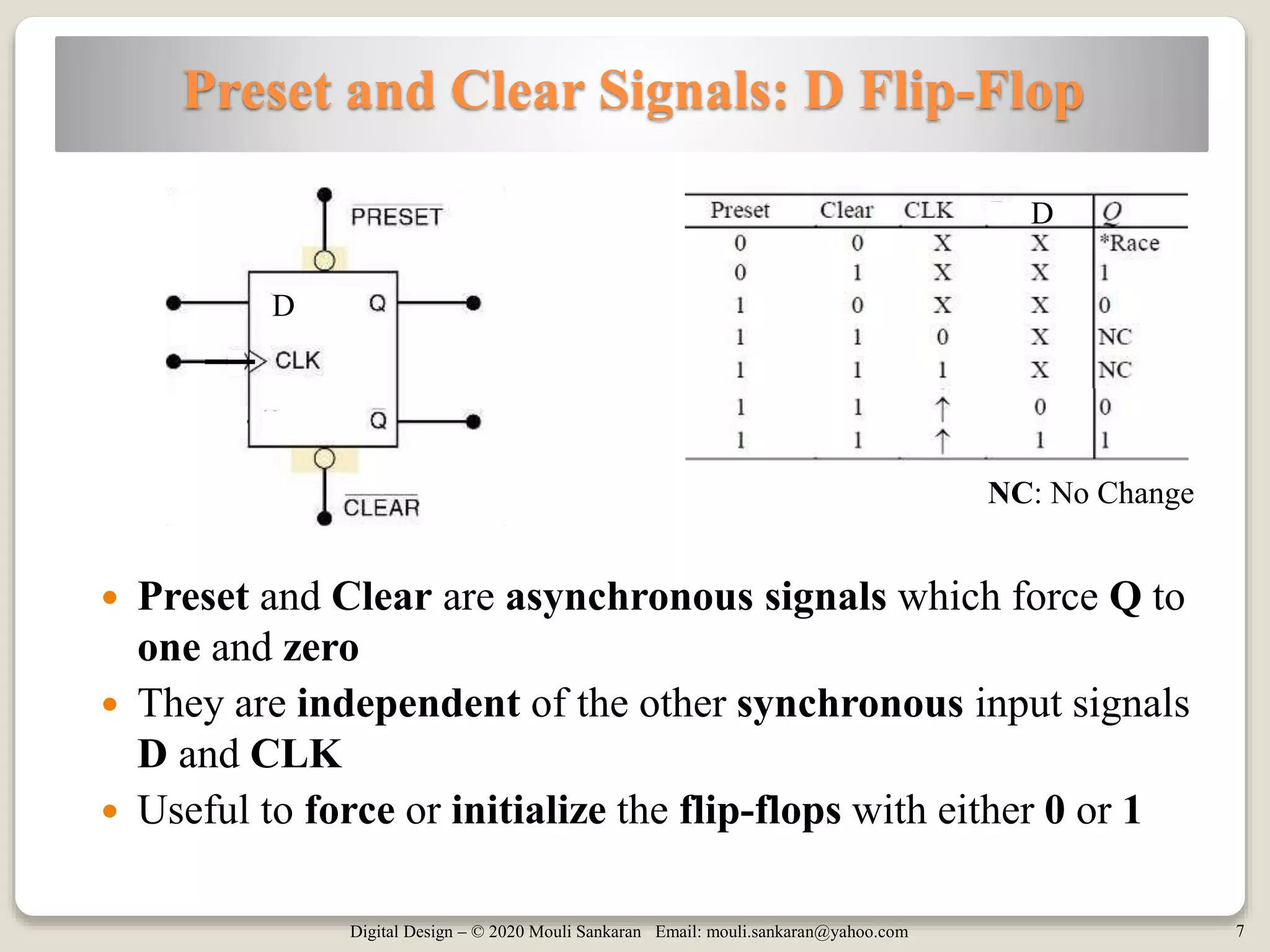
 Preset and Clear are Active low signals, force Q to 1 and 0
6
Clear
Preset
Positive edge
triggered
D Flip-flop
Direct Set (S): Preset
Direct Reset (R): Clear
Function Table
Digital Design – © 2020 Mouli Sankaran Email: mouli.sankaran@yahoo.com 7
Preset and Clear Signals: D Flip-Flop
 Preset and Clear are asynchronous signals which force Q to
one and zero
 They are independent of the other synchronous input signals
D and CLK
 Useful to force or initialize the flip-flops with either 0 or 1
D
D
NC: No Change
Digital Design – © 2020 Mouli Sankaran Email: mouli.sankaran@yahoo.com
Circuits using D-Flip-flops
Digital Design – © 2020 Mouli Sankaran Email: mouli.sankaran@yahoo.com 9
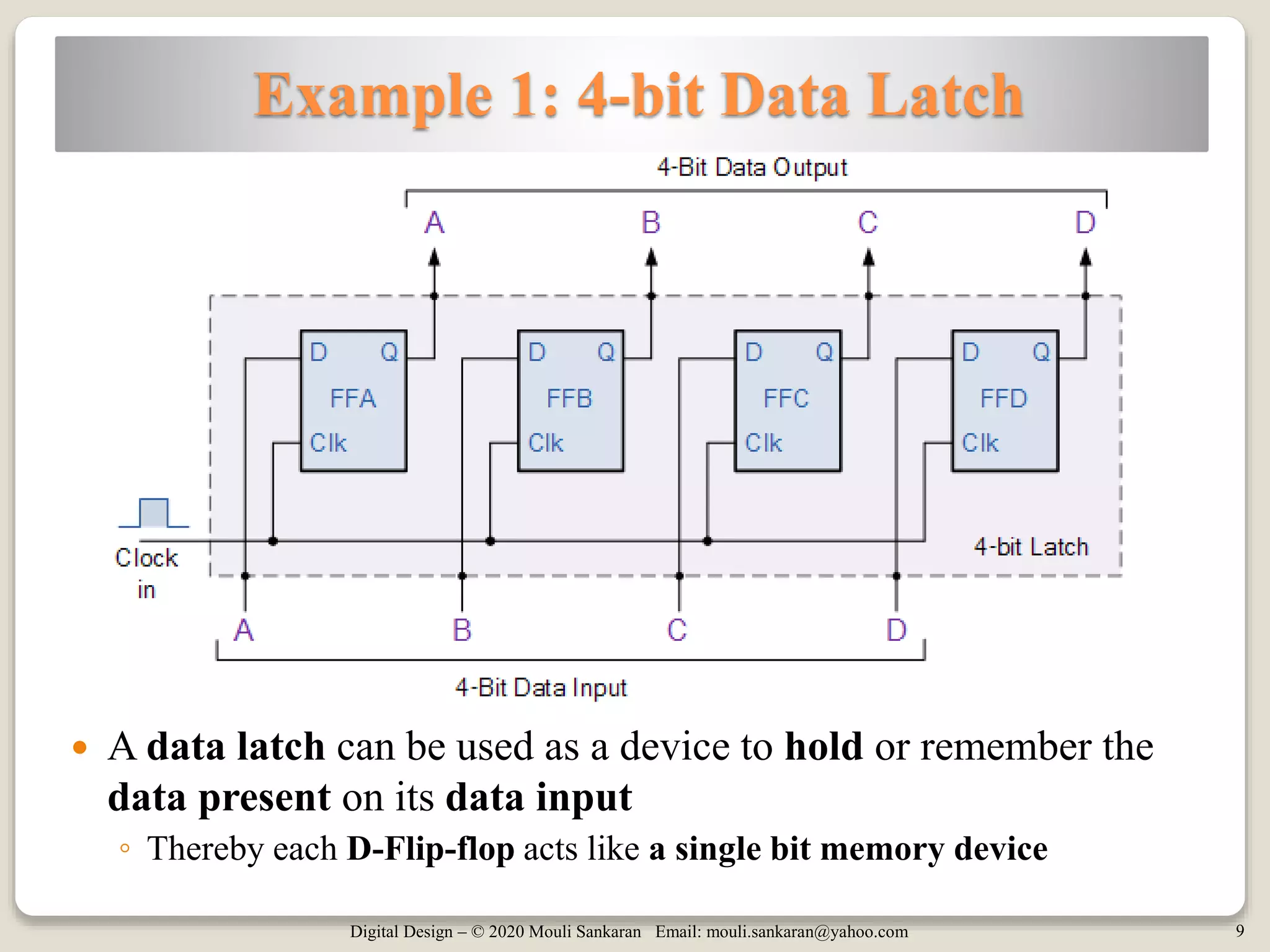
Example 1: 4-bit Data Latch
 A data latch can be used as a device to hold or remember the
data present on its data input
◦ Thereby each D-Flip-flop acts like a single bit memory device
Digital Design – © 2020 Mouli Sankaran Email: mouli.sankaran@yahoo.com 10
Example 2: Detecting the Sequence of Edges
 Here, D flip-flop is used to detect whether a positive-
going edge A follows or precedes another positive-
going edge B.
 If A happens before B:
 If A happens after B:
10
Signal
Given to D
Signal
Given to CLK
Positive edge triggered D Flip-flop
Q goes from Zero to One at B
Q remains at Zero
Initially Q is Zero
Digital Design – © 2020 Mouli Sankaran Email: mouli.sankaran@yahoo.com 11
Session 20: Summary
 Master-slave - D-Flip-flop
◦ Negative edge triggered
◦ Positive edge triggered
 D Flip-flop
◦ Preset and Clear Implementation
 Circuits using D Flip-flop
◦ Data latches
◦ Detecting the sequence of Edges
Digital Design – © 2020 Mouli Sankaran Email: mouli.sankaran@yahoo.com 12
References
Ref 1 Ref 2

Digital Design Session 20

  • 1.
    Digital Design –© 2020 Mouli Sankaran Email: mouli.sankaran@yahoo.com
  • 2.
    Digital Design –© 2020 Mouli Sankaran Email: mouli.sankaran@yahoo.com 2 Session 20: Focus  Master-slave - D-Flip-flop ◦ Negative edge triggered ◦ Positive edge triggered  D Flip-flop ◦ Preset and Clear Implementation  Circuits using D Flip-flop ◦ Data latches ◦ Detecting the sequence of Edges
  • 3.
    Digital Design –© 2020 Mouli Sankaran Email: mouli.sankaran@yahoo.com Master-Slave D Flip-flop Negative and Positive Triggered
  • 4.
    Digital Design –© 2020 Mouli Sankaran Email: mouli.sankaran@yahoo.com 4 Master-Slave D-Flip-flops Positive edge Triggered D Flip-flop Q Negative edge Triggered D Flip-flop Q
  • 5.
    Digital Design –© 2020 Mouli Sankaran Email: mouli.sankaran@yahoo.com D Flip-flop Preset and Clear
  • 6.
    Digital Design –© 2020 Mouli Sankaran Email: mouli.sankaran@yahoo.com 6 Preset and Clear Signals: D Flip-Flop  Preset and Clear are Active low signals, force Q to 1 and 0 6 Clear Preset Positive edge triggered D Flip-flop Direct Set (S): Preset Direct Reset (R): Clear Function Table
  • 7.
    Digital Design –© 2020 Mouli Sankaran Email: mouli.sankaran@yahoo.com 7 Preset and Clear Signals: D Flip-Flop  Preset and Clear are asynchronous signals which force Q to one and zero  They are independent of the other synchronous input signals D and CLK  Useful to force or initialize the flip-flops with either 0 or 1 D D NC: No Change
  • 8.
    Digital Design –© 2020 Mouli Sankaran Email: mouli.sankaran@yahoo.com Circuits using D-Flip-flops
  • 9.
    Digital Design –© 2020 Mouli Sankaran Email: mouli.sankaran@yahoo.com 9 Example 1: 4-bit Data Latch  A data latch can be used as a device to hold or remember the data present on its data input ◦ Thereby each D-Flip-flop acts like a single bit memory device
  • 10.
    Digital Design –© 2020 Mouli Sankaran Email: mouli.sankaran@yahoo.com 10 Example 2: Detecting the Sequence of Edges  Here, D flip-flop is used to detect whether a positive- going edge A follows or precedes another positive- going edge B.  If A happens before B:  If A happens after B: 10 Signal Given to D Signal Given to CLK Positive edge triggered D Flip-flop Q goes from Zero to One at B Q remains at Zero Initially Q is Zero
  • 11.
    Digital Design –© 2020 Mouli Sankaran Email: mouli.sankaran@yahoo.com 11 Session 20: Summary  Master-slave - D-Flip-flop ◦ Negative edge triggered ◦ Positive edge triggered  D Flip-flop ◦ Preset and Clear Implementation  Circuits using D Flip-flop ◦ Data latches ◦ Detecting the sequence of Edges
  • 12.
    Digital Design –© 2020 Mouli Sankaran Email: mouli.sankaran@yahoo.com 12 References Ref 1 Ref 2