Digital Design – © 2020 Mouli Sankaran Email: mouli.sankaran@yahoo.com
Digital Design – © 2020 Mouli Sankaran Email: mouli.sankaran@yahoo.com 2
Session 29: Focus
 Design of Sequence Recognizer (1001)
◦ State Diagram
◦ State Table
◦ State Assignment
◦ State Transition Table
◦ Designing combinational circuit
◦ Circuit Diagram – Home work
Digital Design – © 2020 Mouli Sankaran Email: mouli.sankaran@yahoo.com
Design of Sequence Detector (1001)
Digital Design – © 2020 Mouli Sankaran Email: mouli.sankaran@yahoo.com 4
Step 1: Problem Definition
 Design a sequence recognizer which detects an input sequence
of 1001
 The sequential circuit is to be designed using only JK flip-
flops
 The sequence recognizer outputs a ‘1’ on detecting the input
sequence (1001).
◦ Note that the last four bits need to be 1001 for the output to be 1
◦ Every four clock cycles the output will be one, if the following
sequence is input to the circuit (100110011001 …)
◦ Every three clock cycles after the first pattern is detected, if the input
is (1001001001001 …)
Digital Design – © 2020 Mouli Sankaran Email: mouli.sankaran@yahoo.com 5
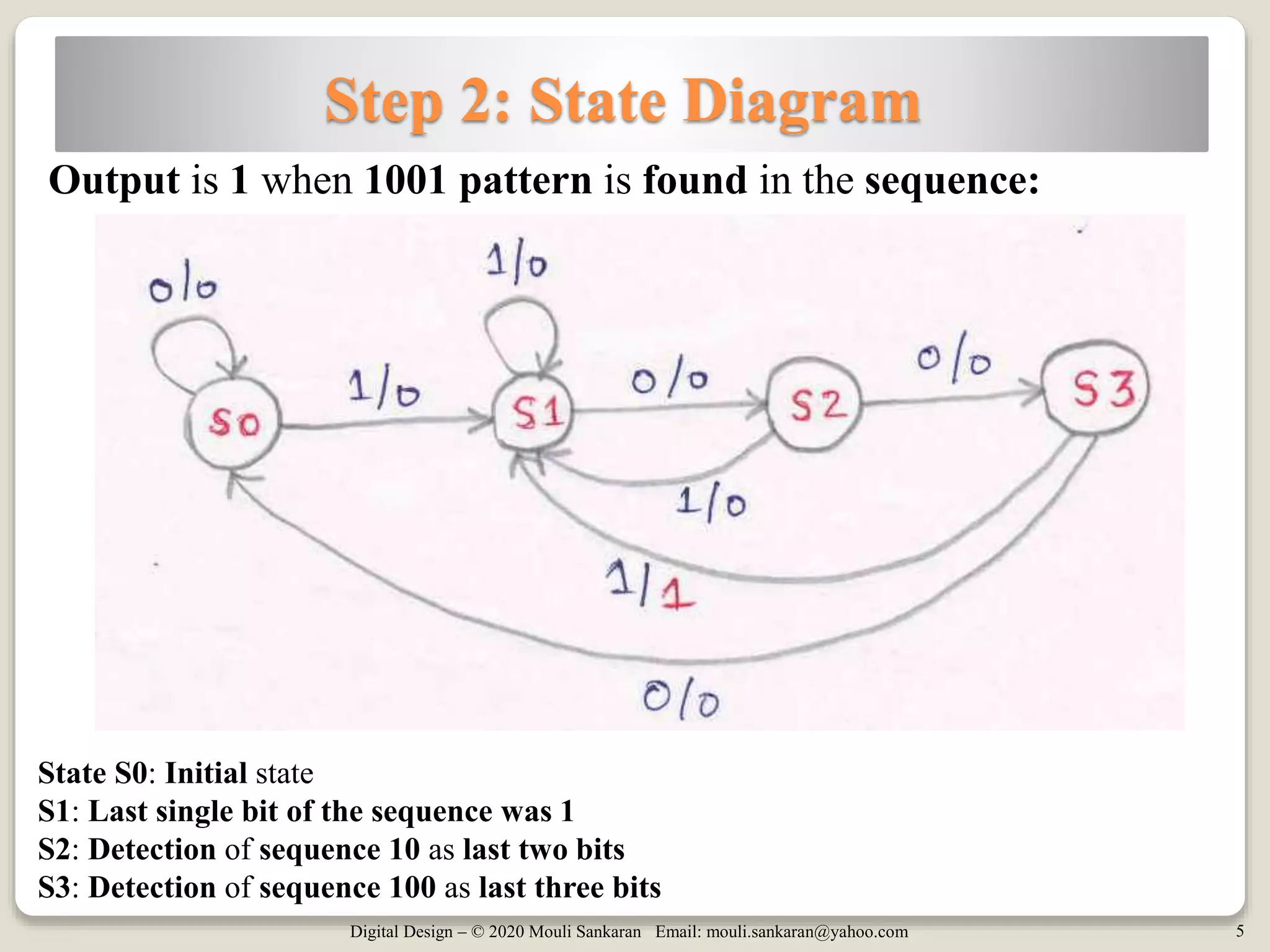
Step 2: State Diagram
Output is 1 when 1001 pattern is found in the sequence:
State S0: Initial state
S1: Last single bit of the sequence was 1
S2: Detection of sequence 10 as last two bits
S3: Detection of sequence 100 as last three bits
Digital Design – © 2020 Mouli Sankaran Email: mouli.sankaran@yahoo.com 6
Step 3: State Table
Output is 1 when 1011 pattern is found in the sequence:
State S0: Initial state
S1: Last single bit of the sequence was 1
S2: Detection of sequence 10 as last two bits
S3: Detection of sequence 100 as last three bits
X is Input
Y is Output
Y
State Table in an
Alternative Format
Y
0
0
0
0
0
0
0
1
S0
S1
S2
S1
S3
S1
S0
S1
Digital Design – © 2020 Mouli Sankaran Email: mouli.sankaran@yahoo.com 7
Step 4: State Assignment
Output is 1 when 1001 pattern is found in the sequence:
 It is necessary to replace symbolic names of the states with
binary codes in order to proceed with the design.
 So that Flip-flops can be used to maintain the states of the
machine
 For this design we need two JK flip-flops since there are four
states are to be maintained by the machine
State Transition Table
Digital Design – © 2020 Mouli Sankaran Email: mouli.sankaran@yahoo.com 8
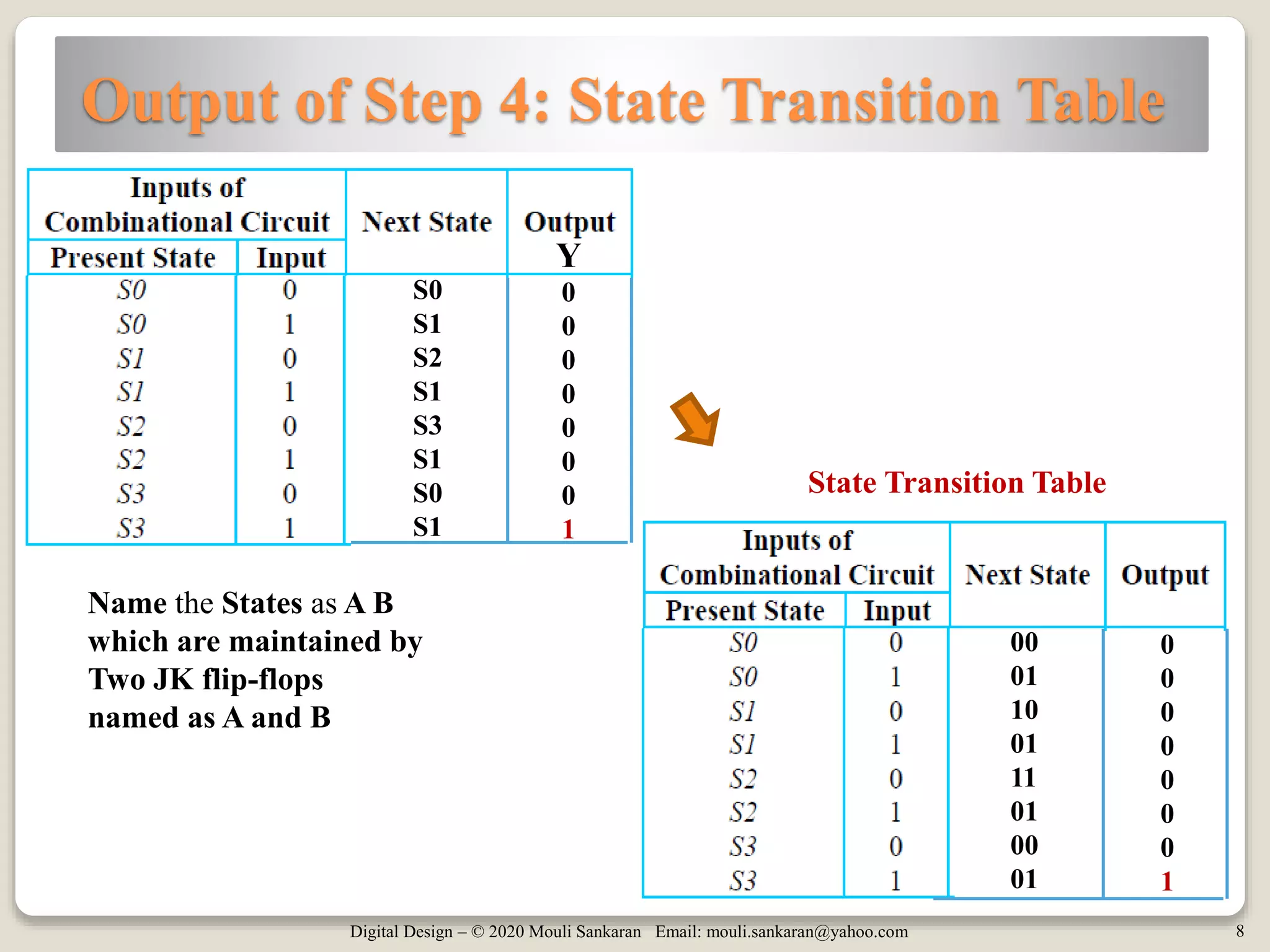
Output of Step 4: State Transition Table
State Transition Table
Name the States as A B
which are maintained by
Two JK flip-flops
named as A and B
0
0
0
0
0
0
0
1
S0
S1
S2
S1
S3
S1
S0
S1
Y
00
01
10
01
11
01
00
01
0
0
0
0
0
0
0
1
Digital Design – © 2020 Mouli Sankaran Email: mouli.sankaran@yahoo.com 9
General Structure of Sequence Detector
 Circuit would have:
◦ Input (X)
◦ Output (Y)
◦ JK Flip-flops – 2 nos.
◦ Clock
◦ Combination circuits
◦ Output of combination circuits
driving the inputs of flip-flops
◦ Flip-flop’s outputs feeding
back into combinational
circuit
J
K
J
K
B
A
Q
Q
B
A
JB
KB
JA
KA
Digital Design – © 2020 Mouli Sankaran Email: mouli.sankaran@yahoo.com 10
Deriving the Excitation Table
B
KB
JB
B
KA
JA
A
A
Next
State
Out
put
JA KA JB KB
0 X
0 X
1 X
0 X
X 0
X 1
X 1
X 1
0 X
1 X
X 1
X 0
1 X
1 X
X 1
X 0
Check the flip-flop excitation inputs for the state transitions
Digital Design – © 2020 Mouli Sankaran Email: mouli.sankaran@yahoo.com 11
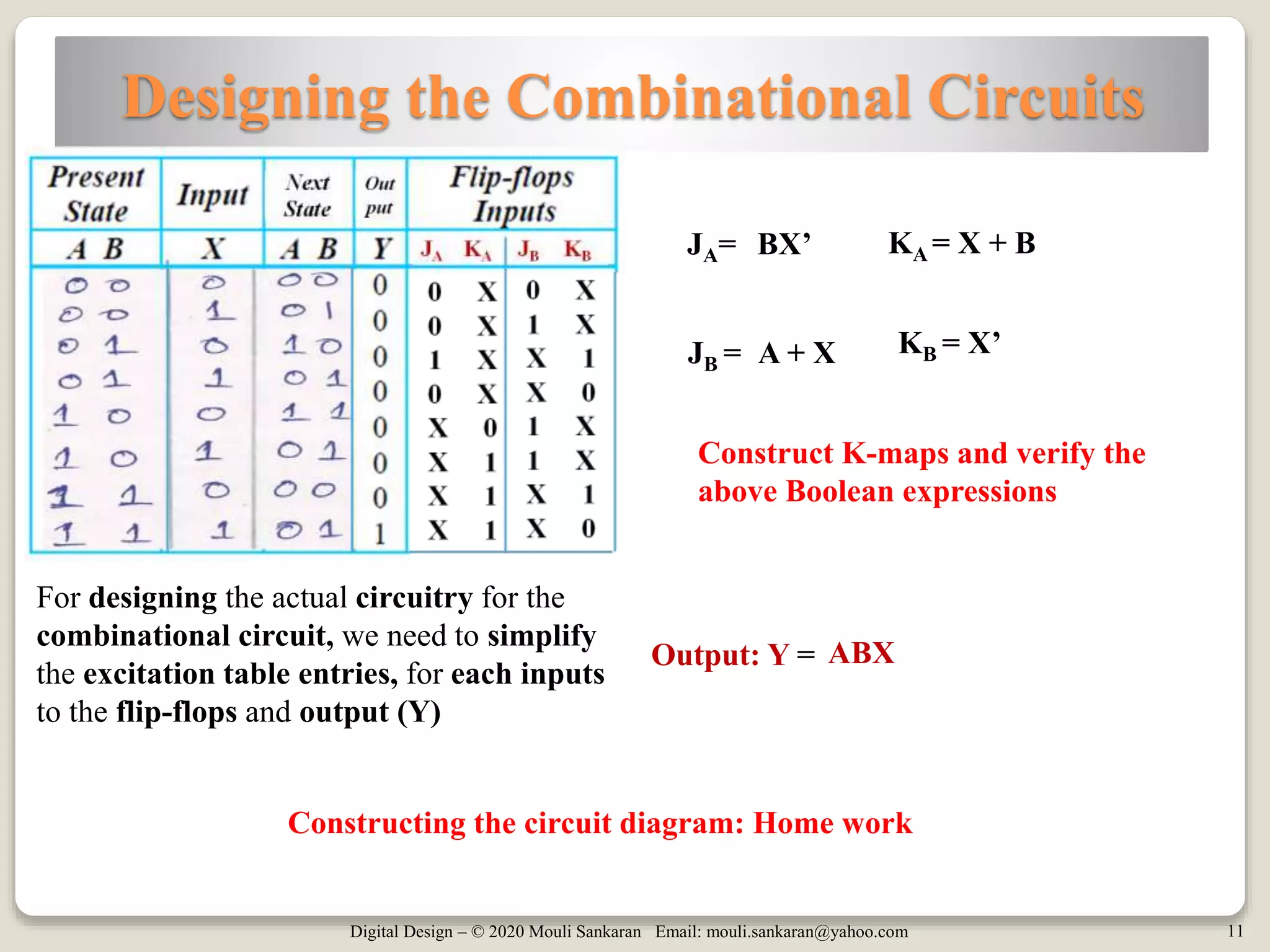
Designing the Combinational Circuits
For designing the actual circuitry for the
combinational circuit, we need to simplify
the excitation table entries, for each inputs
to the flip-flops and output (Y)
JA= BX’ KA = X + B
JB = A + X
Output: Y = ABX
KB = X’
Construct K-maps and verify the
above Boolean expressions
Constructing the circuit diagram: Home work
Digital Design – © 2020 Mouli Sankaran Email: mouli.sankaran@yahoo.com 12
Session 29: Summary
 Design of Sequence Recognizer (1001)
◦ State Diagram
◦ State Table
◦ State Assignment
◦ State Transition Table
◦ Designing combinational circuit
◦ Circuit Diagram – Home work
Digital Design – © 2020 Mouli Sankaran Email: mouli.sankaran@yahoo.com 13
References
Ref 1 Ref 2

Digital Design Session 29

  • 1.
    Digital Design –© 2020 Mouli Sankaran Email: mouli.sankaran@yahoo.com
  • 2.
    Digital Design –© 2020 Mouli Sankaran Email: mouli.sankaran@yahoo.com 2 Session 29: Focus  Design of Sequence Recognizer (1001) ◦ State Diagram ◦ State Table ◦ State Assignment ◦ State Transition Table ◦ Designing combinational circuit ◦ Circuit Diagram – Home work
  • 3.
    Digital Design –© 2020 Mouli Sankaran Email: mouli.sankaran@yahoo.com Design of Sequence Detector (1001)
  • 4.
    Digital Design –© 2020 Mouli Sankaran Email: mouli.sankaran@yahoo.com 4 Step 1: Problem Definition  Design a sequence recognizer which detects an input sequence of 1001  The sequential circuit is to be designed using only JK flip- flops  The sequence recognizer outputs a ‘1’ on detecting the input sequence (1001). ◦ Note that the last four bits need to be 1001 for the output to be 1 ◦ Every four clock cycles the output will be one, if the following sequence is input to the circuit (100110011001 …) ◦ Every three clock cycles after the first pattern is detected, if the input is (1001001001001 …)
  • 5.
    Digital Design –© 2020 Mouli Sankaran Email: mouli.sankaran@yahoo.com 5 Step 2: State Diagram Output is 1 when 1001 pattern is found in the sequence: State S0: Initial state S1: Last single bit of the sequence was 1 S2: Detection of sequence 10 as last two bits S3: Detection of sequence 100 as last three bits
  • 6.
    Digital Design –© 2020 Mouli Sankaran Email: mouli.sankaran@yahoo.com 6 Step 3: State Table Output is 1 when 1011 pattern is found in the sequence: State S0: Initial state S1: Last single bit of the sequence was 1 S2: Detection of sequence 10 as last two bits S3: Detection of sequence 100 as last three bits X is Input Y is Output Y State Table in an Alternative Format Y 0 0 0 0 0 0 0 1 S0 S1 S2 S1 S3 S1 S0 S1
  • 7.
    Digital Design –© 2020 Mouli Sankaran Email: mouli.sankaran@yahoo.com 7 Step 4: State Assignment Output is 1 when 1001 pattern is found in the sequence:  It is necessary to replace symbolic names of the states with binary codes in order to proceed with the design.  So that Flip-flops can be used to maintain the states of the machine  For this design we need two JK flip-flops since there are four states are to be maintained by the machine State Transition Table
  • 8.
    Digital Design –© 2020 Mouli Sankaran Email: mouli.sankaran@yahoo.com 8 Output of Step 4: State Transition Table State Transition Table Name the States as A B which are maintained by Two JK flip-flops named as A and B 0 0 0 0 0 0 0 1 S0 S1 S2 S1 S3 S1 S0 S1 Y 00 01 10 01 11 01 00 01 0 0 0 0 0 0 0 1
  • 9.
    Digital Design –© 2020 Mouli Sankaran Email: mouli.sankaran@yahoo.com 9 General Structure of Sequence Detector  Circuit would have: ◦ Input (X) ◦ Output (Y) ◦ JK Flip-flops – 2 nos. ◦ Clock ◦ Combination circuits ◦ Output of combination circuits driving the inputs of flip-flops ◦ Flip-flop’s outputs feeding back into combinational circuit J K J K B A Q Q B A JB KB JA KA
  • 10.
    Digital Design –© 2020 Mouli Sankaran Email: mouli.sankaran@yahoo.com 10 Deriving the Excitation Table B KB JB B KA JA A A Next State Out put JA KA JB KB 0 X 0 X 1 X 0 X X 0 X 1 X 1 X 1 0 X 1 X X 1 X 0 1 X 1 X X 1 X 0 Check the flip-flop excitation inputs for the state transitions
  • 11.
    Digital Design –© 2020 Mouli Sankaran Email: mouli.sankaran@yahoo.com 11 Designing the Combinational Circuits For designing the actual circuitry for the combinational circuit, we need to simplify the excitation table entries, for each inputs to the flip-flops and output (Y) JA= BX’ KA = X + B JB = A + X Output: Y = ABX KB = X’ Construct K-maps and verify the above Boolean expressions Constructing the circuit diagram: Home work
  • 12.
    Digital Design –© 2020 Mouli Sankaran Email: mouli.sankaran@yahoo.com 12 Session 29: Summary  Design of Sequence Recognizer (1001) ◦ State Diagram ◦ State Table ◦ State Assignment ◦ State Transition Table ◦ Designing combinational circuit ◦ Circuit Diagram – Home work
  • 13.
    Digital Design –© 2020 Mouli Sankaran Email: mouli.sankaran@yahoo.com 13 References Ref 1 Ref 2