Digital Design – © 2020 Mouli Sankaran Email: mouli.sankaran@yahoo.com
Digital Design – © 2020 Mouli Sankaran Email: mouli.sankaran@yahoo.com 2
Session 17: Focus
 Storage Elements
◦ SR – Latches
 Using NOR gates
◦ S’R’-Latches
 Using NAND Gate
 D Latch (Transparent latch)
 Graphic Symbols of Latches
Digital Design – © 2020 Mouli Sankaran Email: mouli.sankaran@yahoo.com 3
SR-Latches with NOR Gates
Logic Diagram Function Table
Active HIGH circuit
Active HIGH here corresponds to the control inputs (R & S)
When R = 1, Q is Reset to 0
When S = 1, Q is set to 1
Always Set means setting a value to ONE
Always Reset means resetting a value to ZERO
It is forbidden because
If both Set (1) and Reset (1)
Are given together
the next state of
Q and Q’ both will be zero
which is an incorrect state
Digital Design – © 2020 Mouli Sankaran Email: mouli.sankaran@yahoo.com
Storage Elements
S’R’ Latches – With NAND Gates
Digital Design – © 2020 Mouli Sankaran Email: mouli.sankaran@yahoo.com 5
S’R’-Latches with NAND Gates
Logic Diagram Function Table
Active LOW circuit
Active low here corresponds to the control inputs (R ‘& S’)
When R’ = 0, Q is Reset to 0
When S’ = 0, Q is set to 1
Always Set means setting a value to ONE
Always Reset means resetting a value to ZERO
It is forbidden because
If both Set (0) and Reset (0)
the next state of
Q and Q’ are indeterminate
S’ R’S’
R’
(after S’ = 1, R’ = 0)
R’
(after S’ = 0, R’ = 1)
Digital Design – © 2020 Mouli Sankaran Email: mouli.sankaran@yahoo.com 6
S’R’-Latches with NAND Gates (Active Low)
 After both inputs go back to 1, we are allowed to change the state of
the latch by placing a 0 in the R’ input
 This action causes the circuit to go to the reset state and stay there
even after both inputs return to 1
 The condition that is forbidden for the NAND latch is both inputs
being equal to 0 at the same time,
 An input combination that should be avoided
 It operates normally with both inputs at 1,
unless the state of the latch has to be changed
 Giving a 0 to the S’ input causes output Q to go
to 1, putting the latch in the set state
 When the S’ input goes back to 1, the
circuit remains in the set state.
Active LOW circuit
R’
S’
S’ R’
Digital Design – © 2020 Mouli Sankaran Email: mouli.sankaran@yahoo.com 7
S’R’-Latches with NAND Gates
 Note that the input signals for the NAND require the
complement of those values to be used for the NOR latch
 Because the NAND latch requires a 0 signal to change its state,
it is referred to as an S’R’ latch
 The primes (or, sometimes, bars over the letters) designate the
fact that the inputs must be in their complement form to
activate the circuit.
 NAND based implementation of S’R’ Latches are more
preferred than NOR based design
 Because NAND based designs are faster and smaller in size
 Though SR or S’R’ latches are not used in real circuits
 Other useful latches and flip-flops are constructed from it
Digital Design – © 2020 Mouli Sankaran Email: mouli.sankaran@yahoo.com 8
Quiz 1: Draw the output waveform
S’
R’
Q
Active LOW circuit
S’
R’
(after S’ = 1, R’ = 0)
(after S’ = 0, R’ = 1)
S’ R’
S’
R’
1
1
Digital Design – © 2020 Mouli Sankaran Email: mouli.sankaran@yahoo.com 9
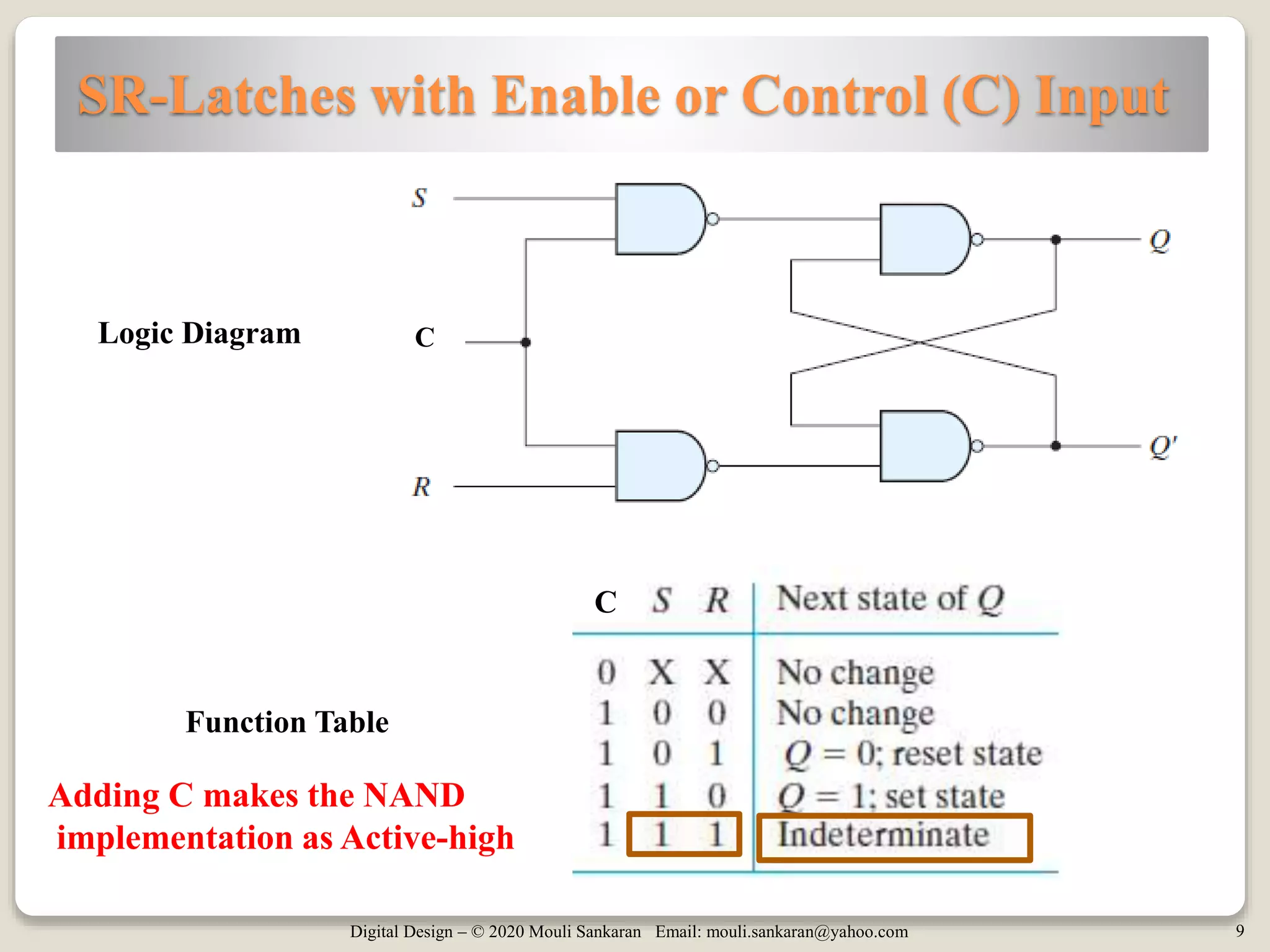
SR-Latches with Enable or Control (C) Input
Logic Diagram
Adding C makes the NAND
implementation as Active-high
C
Function Table
C
Digital Design – © 2020 Mouli Sankaran Email: mouli.sankaran@yahoo.com 10
Quiz 2: Draw the output waveform
C
C
C
Digital Design – © 2020 Mouli Sankaran Email: mouli.sankaran@yahoo.com
D Latch
(Transparent Latch)
Digital Design – © 2020 Mouli Sankaran Email: mouli.sankaran@yahoo.com 12
D Latch – Transparent Latch
Here SR inputs becoming 11 is eliminated
Logic Diagrams
Function Tables
SR-Latch D-Latch
S
R
C
S
R
C
C
C
Basic S’R’ Latch
Digital Design – © 2020 Mouli Sankaran Email: mouli.sankaran@yahoo.com 13
D Latch – Transparent Latch
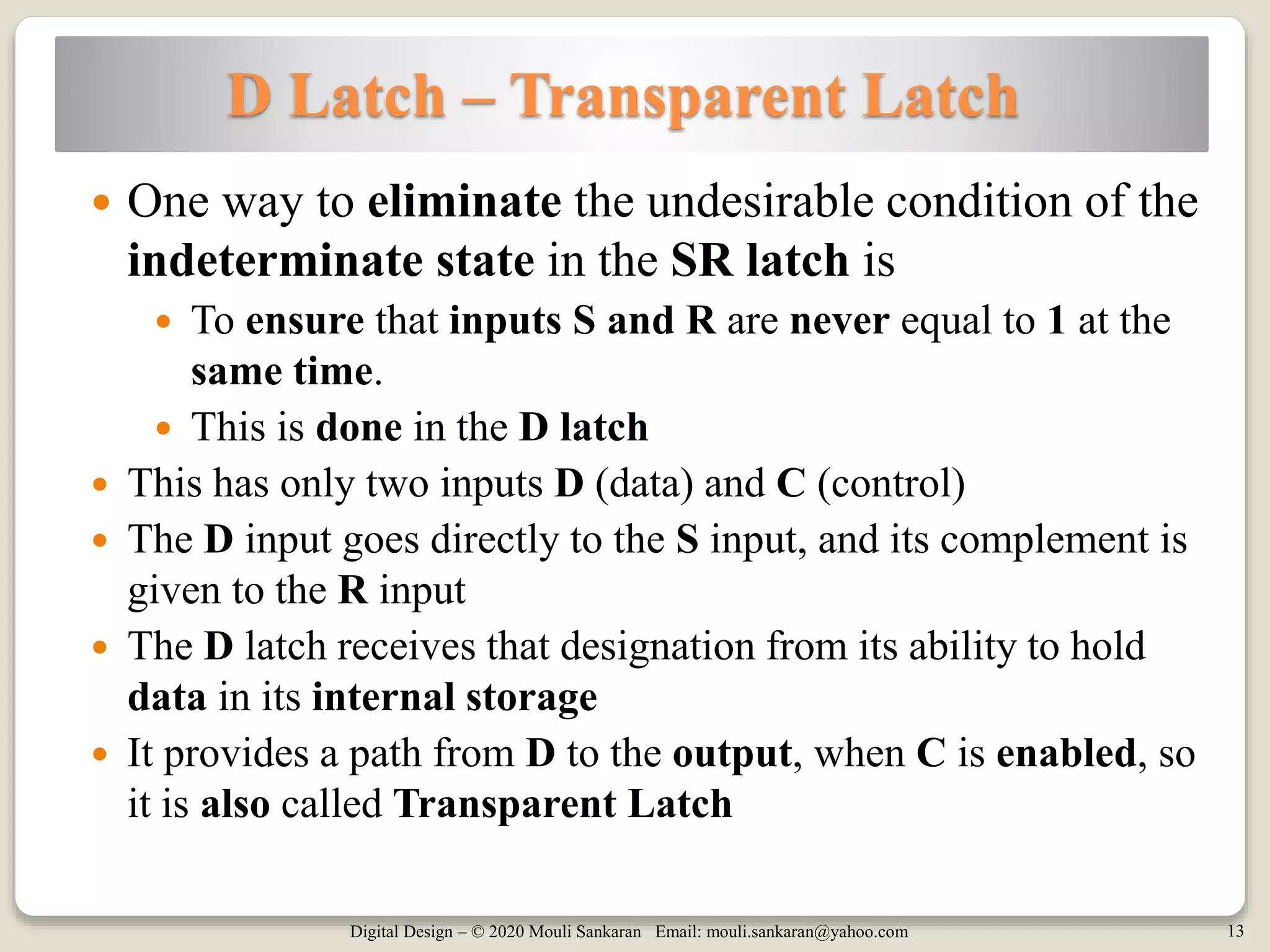
 One way to eliminate the undesirable condition of the
indeterminate state in the SR latch is
 To ensure that inputs S and R are never equal to 1 at the
same time.
 This is done in the D latch
 This has only two inputs D (data) and C (control)
 The D input goes directly to the S input, and its complement is
given to the R input
 The D latch receives that designation from its ability to hold
data in its internal storage
 It provides a path from D to the output, when C is enabled, so
it is also called Transparent Latch
Digital Design – © 2020 Mouli Sankaran Email: mouli.sankaran@yahoo.com 14
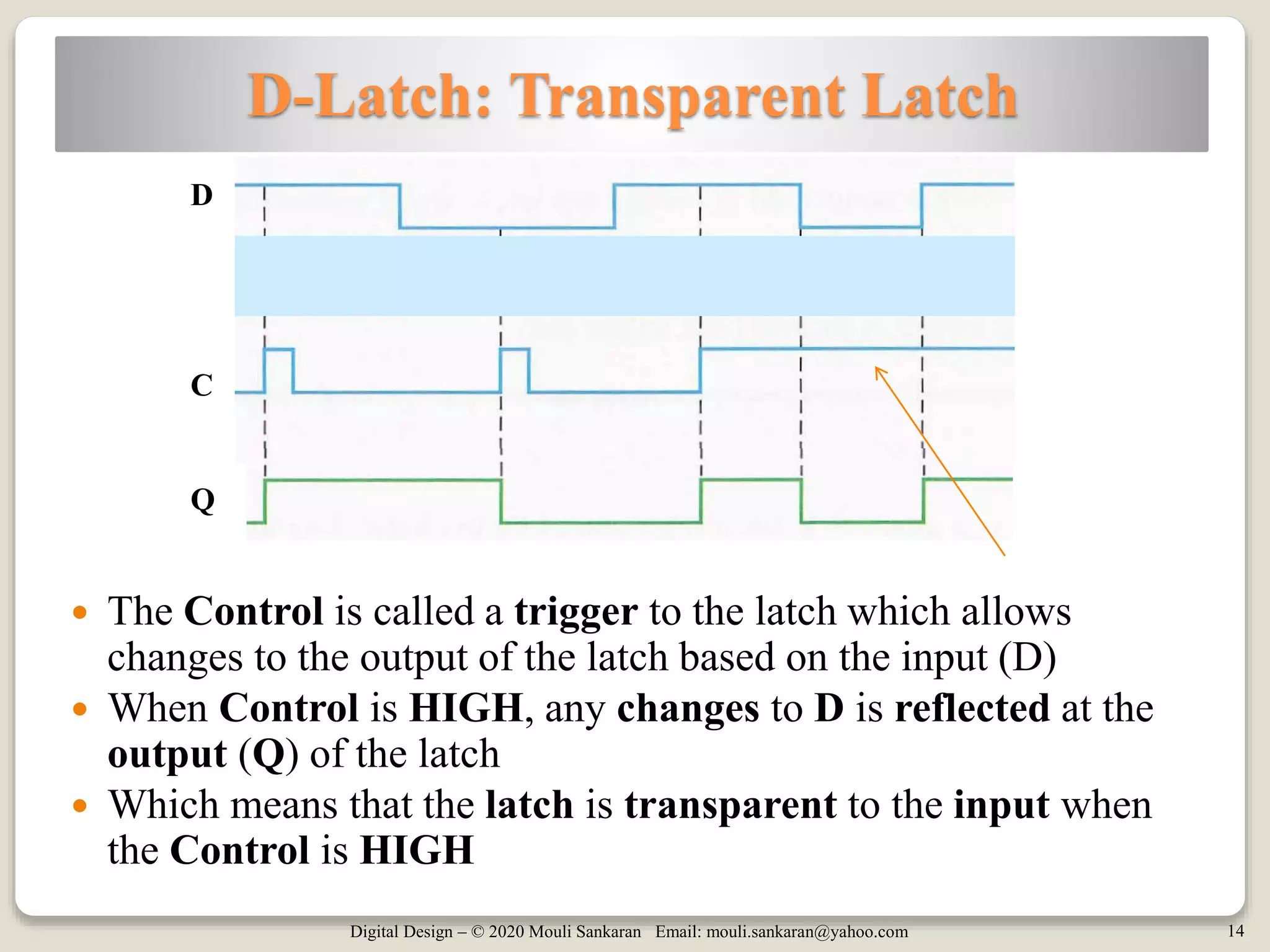
D-Latch: Transparent Latch
 The Control is called a trigger to the latch which allows
changes to the output of the latch based on the input (D)
 When Control is HIGH, any changes to D is reflected at the
output (Q) of the latch
 Which means that the latch is transparent to the input when
the Control is HIGH
D
C
Q
Digital Design – © 2020 Mouli Sankaran Email: mouli.sankaran@yahoo.com 15
Problem with the Latches
 When latches are used for the storage elements, a
serious difficulty arises.
 The state transitions of the latches start as soon as the
clock pulse (Control input) changes to the logic 1 or
High level.
 The new state of a latch may appear at its output while
the control or clock pulse is still active.
 The final state depends on how long the clock pulse
stays at the logic-1 level
 Because of this behaviour, output of a latch cannot be
given to another latch as input which runs on the same
clock pulse
Digital Design – © 2020 Mouli Sankaran Email: mouli.sankaran@yahoo.com 16
Graphic Symbols of Latches
SR Latch
Built with NOR Gates
Active HIGH
S’R’ Latch
Built with NAND Gates
Active LOW
D Latch
Active HIGH
Digital Design – © 2020 Mouli Sankaran Email: mouli.sankaran@yahoo.com 17
Session 17: Summary
 Storage Elements
◦ SR-Latches
 NAND Gate
◦ SR Latch with Enable Input
 D Latch (Transparent latch)
 Graphic Symbols of Latches
Digital Design – © 2020 Mouli Sankaran Email: mouli.sankaran@yahoo.com 18
References
Ref 1 Ref 2

Digital Design Session 17

  • 1.
    Digital Design –© 2020 Mouli Sankaran Email: mouli.sankaran@yahoo.com
  • 2.
    Digital Design –© 2020 Mouli Sankaran Email: mouli.sankaran@yahoo.com 2 Session 17: Focus  Storage Elements ◦ SR – Latches  Using NOR gates ◦ S’R’-Latches  Using NAND Gate  D Latch (Transparent latch)  Graphic Symbols of Latches
  • 3.
    Digital Design –© 2020 Mouli Sankaran Email: mouli.sankaran@yahoo.com 3 SR-Latches with NOR Gates Logic Diagram Function Table Active HIGH circuit Active HIGH here corresponds to the control inputs (R & S) When R = 1, Q is Reset to 0 When S = 1, Q is set to 1 Always Set means setting a value to ONE Always Reset means resetting a value to ZERO It is forbidden because If both Set (1) and Reset (1) Are given together the next state of Q and Q’ both will be zero which is an incorrect state
  • 4.
    Digital Design –© 2020 Mouli Sankaran Email: mouli.sankaran@yahoo.com Storage Elements S’R’ Latches – With NAND Gates
  • 5.
    Digital Design –© 2020 Mouli Sankaran Email: mouli.sankaran@yahoo.com 5 S’R’-Latches with NAND Gates Logic Diagram Function Table Active LOW circuit Active low here corresponds to the control inputs (R ‘& S’) When R’ = 0, Q is Reset to 0 When S’ = 0, Q is set to 1 Always Set means setting a value to ONE Always Reset means resetting a value to ZERO It is forbidden because If both Set (0) and Reset (0) the next state of Q and Q’ are indeterminate S’ R’S’ R’ (after S’ = 1, R’ = 0) R’ (after S’ = 0, R’ = 1)
  • 6.
    Digital Design –© 2020 Mouli Sankaran Email: mouli.sankaran@yahoo.com 6 S’R’-Latches with NAND Gates (Active Low)  After both inputs go back to 1, we are allowed to change the state of the latch by placing a 0 in the R’ input  This action causes the circuit to go to the reset state and stay there even after both inputs return to 1  The condition that is forbidden for the NAND latch is both inputs being equal to 0 at the same time,  An input combination that should be avoided  It operates normally with both inputs at 1, unless the state of the latch has to be changed  Giving a 0 to the S’ input causes output Q to go to 1, putting the latch in the set state  When the S’ input goes back to 1, the circuit remains in the set state. Active LOW circuit R’ S’ S’ R’
  • 7.
    Digital Design –© 2020 Mouli Sankaran Email: mouli.sankaran@yahoo.com 7 S’R’-Latches with NAND Gates  Note that the input signals for the NAND require the complement of those values to be used for the NOR latch  Because the NAND latch requires a 0 signal to change its state, it is referred to as an S’R’ latch  The primes (or, sometimes, bars over the letters) designate the fact that the inputs must be in their complement form to activate the circuit.  NAND based implementation of S’R’ Latches are more preferred than NOR based design  Because NAND based designs are faster and smaller in size  Though SR or S’R’ latches are not used in real circuits  Other useful latches and flip-flops are constructed from it
  • 8.
    Digital Design –© 2020 Mouli Sankaran Email: mouli.sankaran@yahoo.com 8 Quiz 1: Draw the output waveform S’ R’ Q Active LOW circuit S’ R’ (after S’ = 1, R’ = 0) (after S’ = 0, R’ = 1) S’ R’ S’ R’ 1 1
  • 9.
    Digital Design –© 2020 Mouli Sankaran Email: mouli.sankaran@yahoo.com 9 SR-Latches with Enable or Control (C) Input Logic Diagram Adding C makes the NAND implementation as Active-high C Function Table C
  • 10.
    Digital Design –© 2020 Mouli Sankaran Email: mouli.sankaran@yahoo.com 10 Quiz 2: Draw the output waveform C C C
  • 11.
    Digital Design –© 2020 Mouli Sankaran Email: mouli.sankaran@yahoo.com D Latch (Transparent Latch)
  • 12.
    Digital Design –© 2020 Mouli Sankaran Email: mouli.sankaran@yahoo.com 12 D Latch – Transparent Latch Here SR inputs becoming 11 is eliminated Logic Diagrams Function Tables SR-Latch D-Latch S R C S R C C C Basic S’R’ Latch
  • 13.
    Digital Design –© 2020 Mouli Sankaran Email: mouli.sankaran@yahoo.com 13 D Latch – Transparent Latch  One way to eliminate the undesirable condition of the indeterminate state in the SR latch is  To ensure that inputs S and R are never equal to 1 at the same time.  This is done in the D latch  This has only two inputs D (data) and C (control)  The D input goes directly to the S input, and its complement is given to the R input  The D latch receives that designation from its ability to hold data in its internal storage  It provides a path from D to the output, when C is enabled, so it is also called Transparent Latch
  • 14.
    Digital Design –© 2020 Mouli Sankaran Email: mouli.sankaran@yahoo.com 14 D-Latch: Transparent Latch  The Control is called a trigger to the latch which allows changes to the output of the latch based on the input (D)  When Control is HIGH, any changes to D is reflected at the output (Q) of the latch  Which means that the latch is transparent to the input when the Control is HIGH D C Q
  • 15.
    Digital Design –© 2020 Mouli Sankaran Email: mouli.sankaran@yahoo.com 15 Problem with the Latches  When latches are used for the storage elements, a serious difficulty arises.  The state transitions of the latches start as soon as the clock pulse (Control input) changes to the logic 1 or High level.  The new state of a latch may appear at its output while the control or clock pulse is still active.  The final state depends on how long the clock pulse stays at the logic-1 level  Because of this behaviour, output of a latch cannot be given to another latch as input which runs on the same clock pulse
  • 16.
    Digital Design –© 2020 Mouli Sankaran Email: mouli.sankaran@yahoo.com 16 Graphic Symbols of Latches SR Latch Built with NOR Gates Active HIGH S’R’ Latch Built with NAND Gates Active LOW D Latch Active HIGH
  • 17.
    Digital Design –© 2020 Mouli Sankaran Email: mouli.sankaran@yahoo.com 17 Session 17: Summary  Storage Elements ◦ SR-Latches  NAND Gate ◦ SR Latch with Enable Input  D Latch (Transparent latch)  Graphic Symbols of Latches
  • 18.
    Digital Design –© 2020 Mouli Sankaran Email: mouli.sankaran@yahoo.com 18 References Ref 1 Ref 2