Digital Design – © 2020 Mouli Sankaran Email: mouli.sankaran@yahoo.com
Digital Design – © 2020 Mouli Sankaran Email: mouli.sankaran@yahoo.com 2
Session 26: Focus
 State Diagrams
◦ Some Examples
 Design of Sequential Circuits
 Design Steps
 Design of Sequence Recognizer (1011)
◦ State Diagram
◦ State Table
◦ State Assignment
Digital Design – © 2020 Mouli Sankaran Email: mouli.sankaran@yahoo.com
State Diagrams: Some Examples
Digital Design – © 2020 Mouli Sankaran Email: mouli.sankaran@yahoo.com 4
Example 1: Find 11 in the Sequence
S0 S1
1 / 1
1 / 0
0 / 0
0 / 0
Output is 1 when two consecutive 1s are found in the sequence:
Input/output
Note: The number of arcs leaving any circle is 2n,
where n is the number of inputs to the sequential circuit.
Digital Design – © 2020 Mouli Sankaran Email: mouli.sankaran@yahoo.com 5
Example 2: Find 111 in the Sequence
S0 S1
1 / 0
0 / 0
S2
1 / 1
1 / 0
0 / 0
0 / 0
Output is 1 when three consecutive 1s are found in the sequence:
Corrected S1 to S2 transition
From 1/1 to 1/0
Digital Design – © 2020 Mouli Sankaran Email: mouli.sankaran@yahoo.com
Design of
Synchronous Sequential Circuits
Digital Design – © 2020 Mouli Sankaran Email: mouli.sankaran@yahoo.com 7
Design Steps
Digital Design – © 2020 Mouli Sankaran Email: mouli.sankaran@yahoo.com 8
Design Steps Explained …
1. Start with verbal specifications of the problem
2. Derive the state table from it
• In some cases, it is easier to first obtain a state diagram from
the verbal description and then state table
3. Try to minimize number states to get reduced state
table
4. Assign binary codes to the reduced states
 Which is called output or state transition table
5. Derive Flip-flops input equations using flip-flops excitation
tables
 It depends on the choice of flip-flops to be used in the circuit
6. Derive Output equation in terms of inputs and flip-flop outputs
7. Finally, the logic diagram of the sequential circuit is constructed
Digital Design – © 2020 Mouli Sankaran Email: mouli.sankaran@yahoo.com
Example Design of a
Sequential Circuits
Digital Design – © 2020 Mouli Sankaran Email: mouli.sankaran@yahoo.com 10
Step 1: Problem Definition
 Design a sequence recognizer which detects an input
sequence of 1011
 The sequence recognizer outputs a ‘1’ on detecting an
the input sequence (1011).
 The sequential circuit is to be designed using JK and D
type flip-flops
 A sample input/output trace for the sequence detector
is given below:
Digital Design – © 2020 Mouli Sankaran Email: mouli.sankaran@yahoo.com 11
Step 2: State Diagram
Output is 1 when 1011 pattern is found in the sequence:
State S0: Initial state
S1: Last single bit of the sequence was 1
S2: Detection of sequence 10 as last two bits
S3: Detection of sequence 101 as last three bits
Digital Design – © 2020 Mouli Sankaran Email: mouli.sankaran@yahoo.com 12
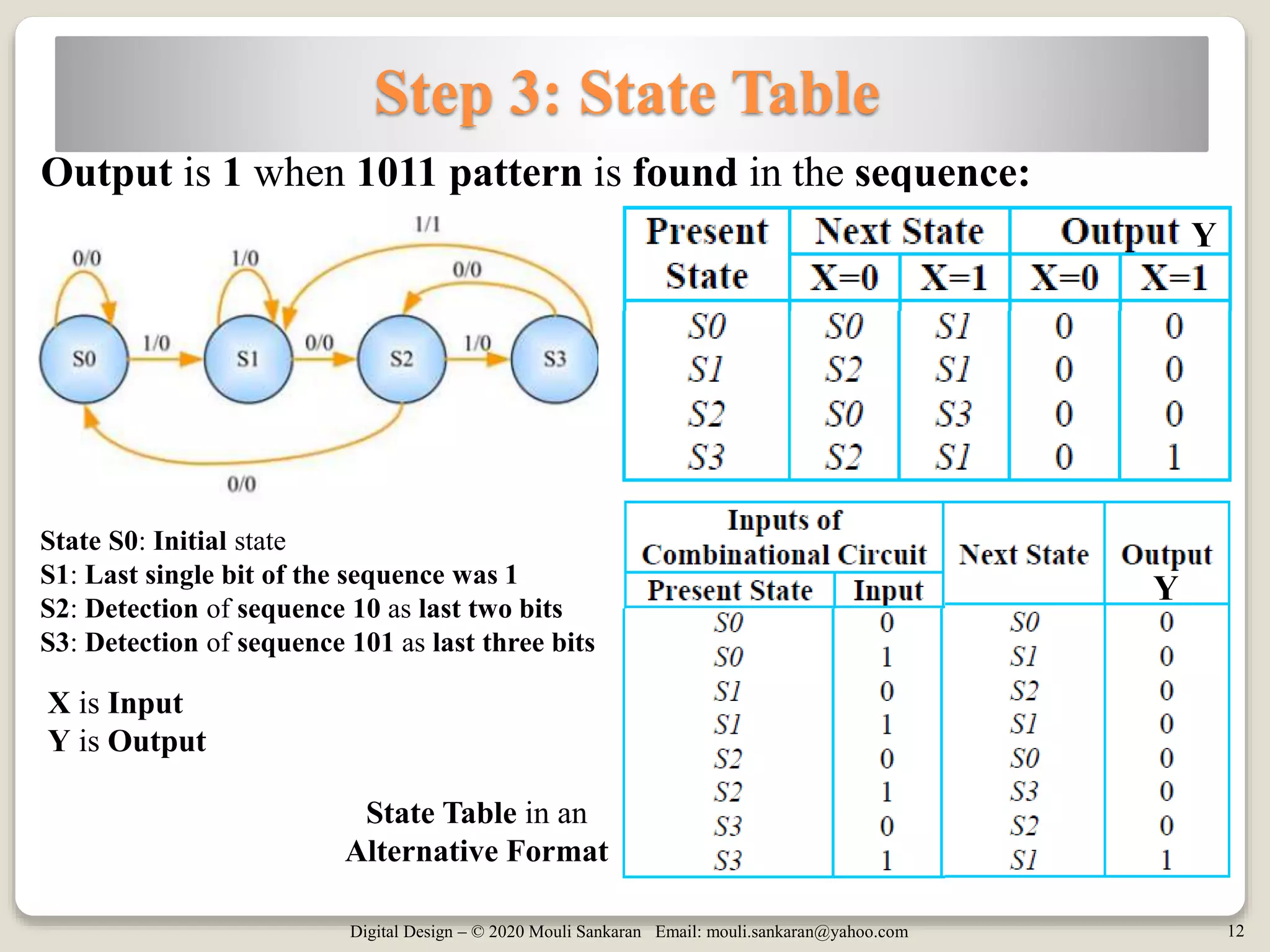
Step 3: State Table
Output is 1 when 1011 pattern is found in the sequence:
State S0: Initial state
S1: Last single bit of the sequence was 1
S2: Detection of sequence 10 as last two bits
S3: Detection of sequence 101 as last three bits
X is Input
Y is Output
Y
State Table in an
Alternative Format
Y
Digital Design – © 2020 Mouli Sankaran Email: mouli.sankaran@yahoo.com 13
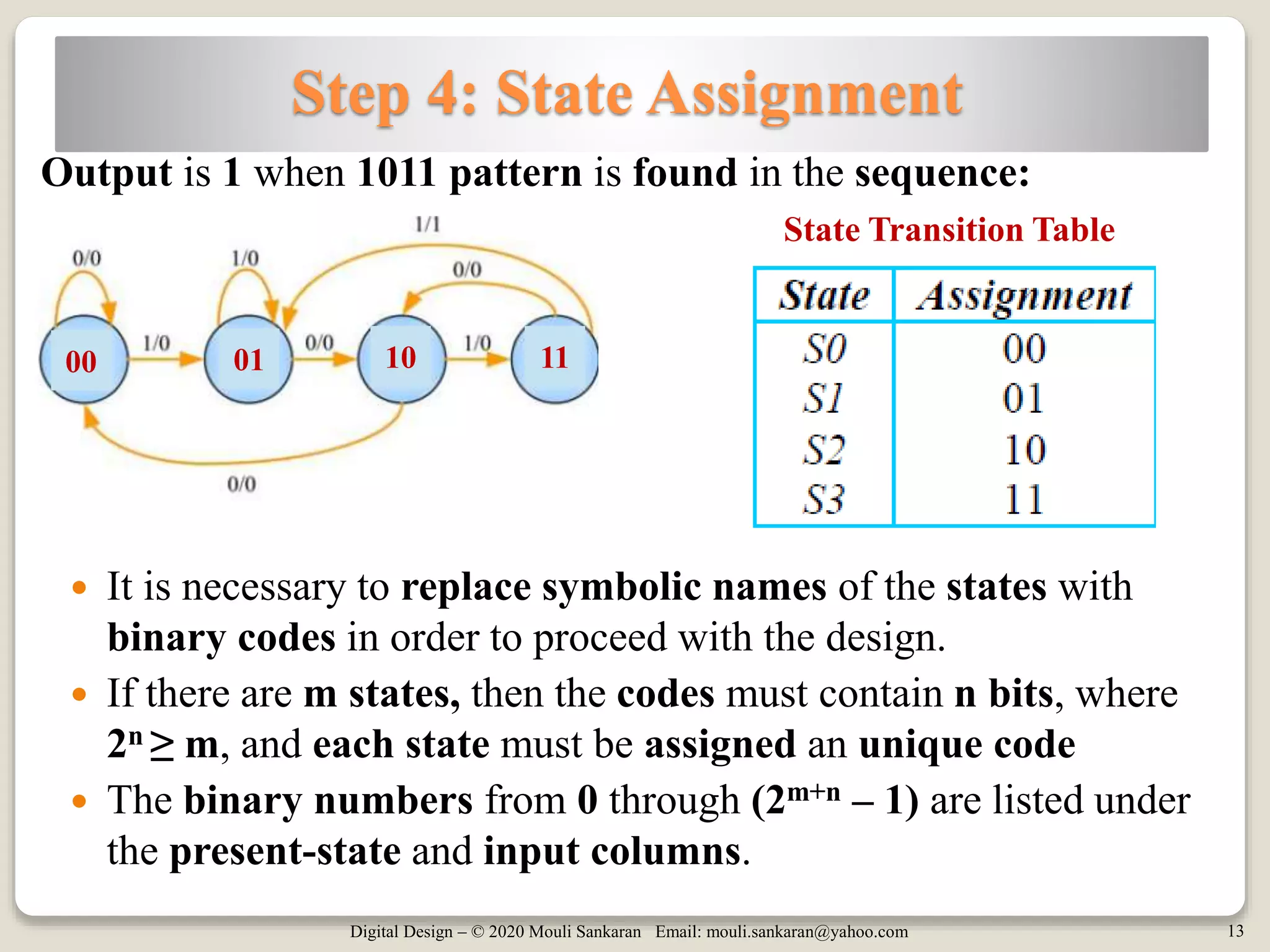
Step 4: State Assignment
Output is 1 when 1011 pattern is found in the sequence:
01 111000
 It is necessary to replace symbolic names of the states with
binary codes in order to proceed with the design.
 If there are m states, then the codes must contain n bits, where
2n ≥ m, and each state must be assigned an unique code
 The binary numbers from 0 through (2m+n – 1) are listed under
the present-state and input columns.
State Transition Table
Digital Design – © 2020 Mouli Sankaran Email: mouli.sankaran@yahoo.com 14
Session 26: Summary
 State Diagrams
◦ Some Examples
 Design of Sequential Circuits
 Design Steps
 Design of Sequence Recognizer (1011)
◦ State Diagram
◦ State Table
◦ State Assignment
Digital Design – © 2020 Mouli Sankaran Email: mouli.sankaran@yahoo.com 15
References
Ref 1 Ref 2

Digital Design Session 26

  • 1.
    Digital Design –© 2020 Mouli Sankaran Email: mouli.sankaran@yahoo.com
  • 2.
    Digital Design –© 2020 Mouli Sankaran Email: mouli.sankaran@yahoo.com 2 Session 26: Focus  State Diagrams ◦ Some Examples  Design of Sequential Circuits  Design Steps  Design of Sequence Recognizer (1011) ◦ State Diagram ◦ State Table ◦ State Assignment
  • 3.
    Digital Design –© 2020 Mouli Sankaran Email: mouli.sankaran@yahoo.com State Diagrams: Some Examples
  • 4.
    Digital Design –© 2020 Mouli Sankaran Email: mouli.sankaran@yahoo.com 4 Example 1: Find 11 in the Sequence S0 S1 1 / 1 1 / 0 0 / 0 0 / 0 Output is 1 when two consecutive 1s are found in the sequence: Input/output Note: The number of arcs leaving any circle is 2n, where n is the number of inputs to the sequential circuit.
  • 5.
    Digital Design –© 2020 Mouli Sankaran Email: mouli.sankaran@yahoo.com 5 Example 2: Find 111 in the Sequence S0 S1 1 / 0 0 / 0 S2 1 / 1 1 / 0 0 / 0 0 / 0 Output is 1 when three consecutive 1s are found in the sequence: Corrected S1 to S2 transition From 1/1 to 1/0
  • 6.
    Digital Design –© 2020 Mouli Sankaran Email: mouli.sankaran@yahoo.com Design of Synchronous Sequential Circuits
  • 7.
    Digital Design –© 2020 Mouli Sankaran Email: mouli.sankaran@yahoo.com 7 Design Steps
  • 8.
    Digital Design –© 2020 Mouli Sankaran Email: mouli.sankaran@yahoo.com 8 Design Steps Explained … 1. Start with verbal specifications of the problem 2. Derive the state table from it • In some cases, it is easier to first obtain a state diagram from the verbal description and then state table 3. Try to minimize number states to get reduced state table 4. Assign binary codes to the reduced states  Which is called output or state transition table 5. Derive Flip-flops input equations using flip-flops excitation tables  It depends on the choice of flip-flops to be used in the circuit 6. Derive Output equation in terms of inputs and flip-flop outputs 7. Finally, the logic diagram of the sequential circuit is constructed
  • 9.
    Digital Design –© 2020 Mouli Sankaran Email: mouli.sankaran@yahoo.com Example Design of a Sequential Circuits
  • 10.
    Digital Design –© 2020 Mouli Sankaran Email: mouli.sankaran@yahoo.com 10 Step 1: Problem Definition  Design a sequence recognizer which detects an input sequence of 1011  The sequence recognizer outputs a ‘1’ on detecting an the input sequence (1011).  The sequential circuit is to be designed using JK and D type flip-flops  A sample input/output trace for the sequence detector is given below:
  • 11.
    Digital Design –© 2020 Mouli Sankaran Email: mouli.sankaran@yahoo.com 11 Step 2: State Diagram Output is 1 when 1011 pattern is found in the sequence: State S0: Initial state S1: Last single bit of the sequence was 1 S2: Detection of sequence 10 as last two bits S3: Detection of sequence 101 as last three bits
  • 12.
    Digital Design –© 2020 Mouli Sankaran Email: mouli.sankaran@yahoo.com 12 Step 3: State Table Output is 1 when 1011 pattern is found in the sequence: State S0: Initial state S1: Last single bit of the sequence was 1 S2: Detection of sequence 10 as last two bits S3: Detection of sequence 101 as last three bits X is Input Y is Output Y State Table in an Alternative Format Y
  • 13.
    Digital Design –© 2020 Mouli Sankaran Email: mouli.sankaran@yahoo.com 13 Step 4: State Assignment Output is 1 when 1011 pattern is found in the sequence: 01 111000  It is necessary to replace symbolic names of the states with binary codes in order to proceed with the design.  If there are m states, then the codes must contain n bits, where 2n ≥ m, and each state must be assigned an unique code  The binary numbers from 0 through (2m+n – 1) are listed under the present-state and input columns. State Transition Table
  • 14.
    Digital Design –© 2020 Mouli Sankaran Email: mouli.sankaran@yahoo.com 14 Session 26: Summary  State Diagrams ◦ Some Examples  Design of Sequential Circuits  Design Steps  Design of Sequence Recognizer (1011) ◦ State Diagram ◦ State Table ◦ State Assignment
  • 15.
    Digital Design –© 2020 Mouli Sankaran Email: mouli.sankaran@yahoo.com 15 References Ref 1 Ref 2