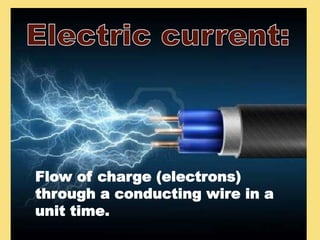

Flow of charge (electrons)
through a conducting wire in a
unit time.
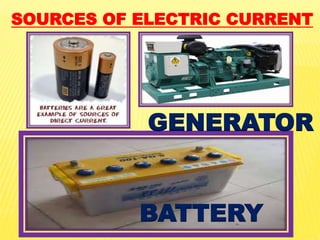
SOURCES OF ELECTRIC CURRENT
GENERATOR
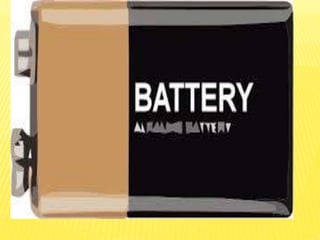
BATTERY
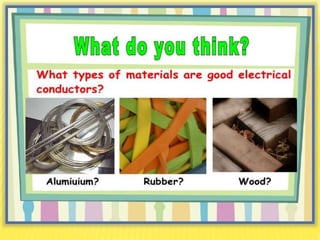
What are CONDUCTORS?
What are INSULATORS?
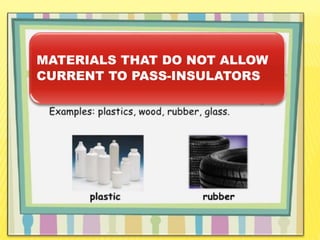
MATERIALS THAT DO NOT ALLOW
CURRENT TO PASS-INSULATORS
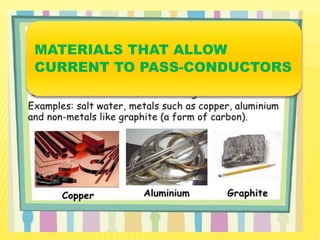
MATERIALS THAT ALLOW
CURRENT TO PASS-CONDUCTORS
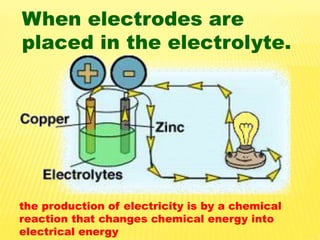
When electrodes are
placed in the electrolyte.
the production of electricity is by a chemical
reaction that changes chemical energy into
electrical energy
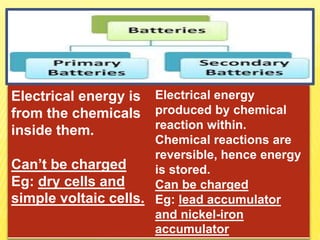
Electrical energy is
from the chemicals
inside them.
Can’t be charged
Eg: dry cells and
simple voltaic cells.
Electrical energy
produced by chemical
reaction within.
Chemical reactions are
reversible, hence energy
is stored.
Can be charged
Eg: lead accumulator
and nickel-iron
accumulator
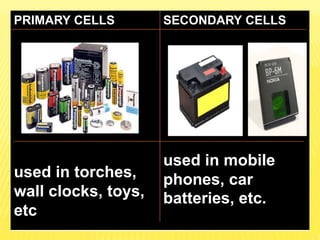
PRIMARY CELLS
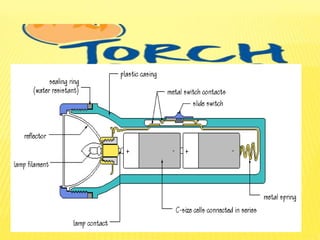
used in torches,
wall clocks, toys,
etc
SECONDARY CELLS
used in mobile
phones, car
batteries, etc.
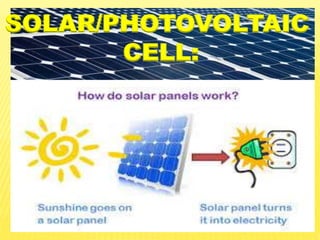
SOLAR/PHOTOVOLTAIC
CELL:
WORKING OF
PRIMARY
CELL
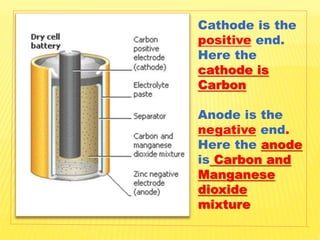
Cathode is the
positive end.
Here the
cathode is
Carbon
Anode is the
negative end.
Here the anode
is Carbon and
Manganese
dioxide
mixture
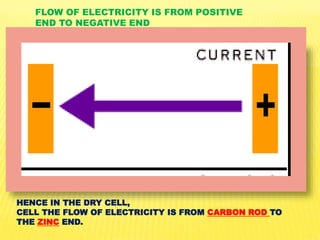
HENCE IN THE DRY CELL,
CELL THE FLOW OF ELECTRICITY IS FROM CARBON ROD TO
THE ZINC END.
FLOW OF ELECTRICITY IS FROM POSITIVE
END TO NEGATIVE END
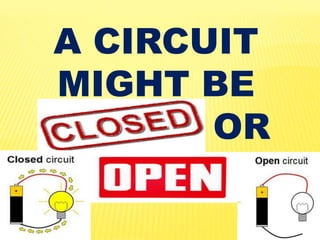
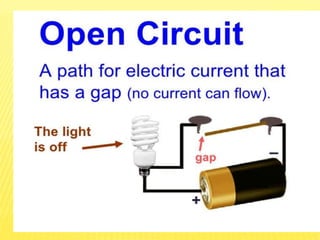
A CIRCUIT
MIGHT BE
CLOSED OR
OPEN
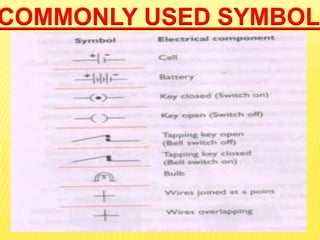
COMMONLY USED SYMBOL
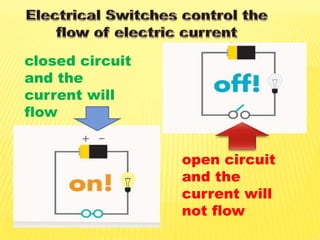
open circuit
and the
current will
not flow
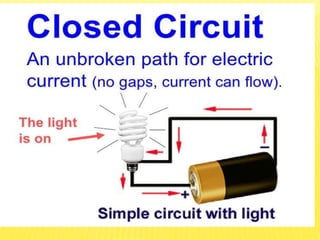
closed circuit
and the
current will
flow
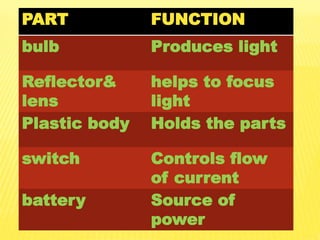
PART FUNCTION
bulb Produces light
Reflector&
lens
helps to focus
light
Plastic body Holds the parts
switch Controls flow
of current
battery Source of
power
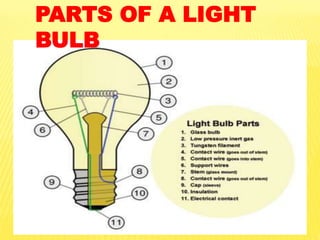
PARTS OF A LIGHT
BULB

ELECTRICITY