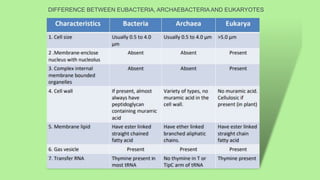
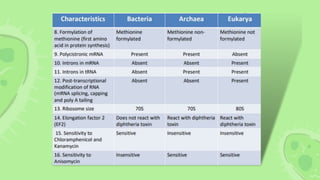
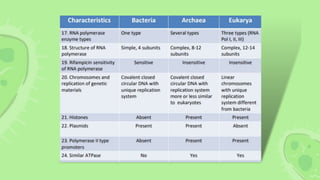
This document compares and contrasts eubacteria, archaebacteria, and eukaryotes. Eubacteria are unicellular prokaryotes that have cell walls containing peptidoglycan. Archaebacteria are also unicellular prokaryotes but they do not have cell walls containing peptidoglycan. Eukaryotic cells are multicellular and contain membrane-bound organelles like the nucleus. They reproduce sexually in most cases. Chemotaxonomy uses biochemical similarities and differences to characterize and classify bacteria, providing important information for identification that complements phylogenetic analysis. Key chemotaxonomic markers include cell wall composition, lipids, proteins, and other complex molecules.







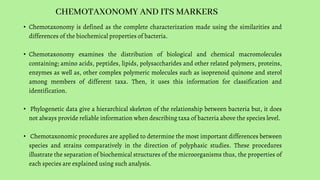
![• In general, the characters used in bacterial chemotaxonomy are; peptidoglycan, Diamino acids,
polysaccharides, teichoic acids, mycolic acid, fatty acids, polar acids, isoprenoid quinones, polyamines,
prokaryotic pigments and LPS.
• Chemotaxonomy provides an important solution for the identification of bacterial species so
chemotaxonomic analysis should be mandatory to identify new species. In the past, when chemotaxonomic
classification was not yet to be fully understood, many species were classified and published.
• The species classified during this period have to be reclassified and identified as they might belong to
different groups. A striking example is that most of the bacteria belonged to the genus Thermomonospora and
Microtetraspora at the beginning of 1998, were later identified as members of the genus Nonomuraea and were
reclassified with the help of chemotaxonomic analysis . No matter how much the chemical structure of the
bacteria is present in their genetic architecture, the structure may be affected by the feeding site, osmotic
pressure, pH, etc. as well as other environmental conditions. A standardized developmental procedure should
be applied for the development of cultures, prior to a comparative chemotaxonomic study. Standardized
culture conditions are of great importance in studies involving the qualitative analysis of chemical data [23].
As a result; in addition to molecular analyses and numerical studies, chemotaxonomic markers are important
in the biochemical structure of living bacterial organisms so in their identification](https://image.slidesharecdn.com/differencesbetweeneubacteriaarchaebacteriaandeukaryotes-221103065054-50d2eb62/85/DIFFERENCES-BETWEEN-EUBACTERIA-ARCHAEBACTERIA-AND-EUKARYOTES-pptx-14-320.jpg)


![Human Reproduction [ Reproductive System ] Notes @irfanullah_mehar Irfanullah...](https://cdn.slidesharecdn.com/ss_thumbnails/humanreproductionreproductivesystemnotesirfanullahmeharirfanullahmeharjanantantra-260111172350-56e85778-thumbnail.jpg?width=640&height=640&fit=bounds)


