Dr. V. RAMESH
Assistant Professor & Head
Department of Botany
Vivekananda College
Tiruvedakam West – 625 234
ramesh.vnr09@gmail.com
AGARICUS STRUCTURE &
REPRODUCTION
AGARICUS
It is a saprophytic fungus, belongs to the class Basidiomyctes.
It is found in dead and decaying organic matter during rainy seasons.
It is commonly called as Club fungi and White Button Mushrooms.
It has more than 25 species like
Agaricus campestries
A. cosmosus
A. regalis
A. bisporus
Systematic Position
Kingdom:Fungi
Class: Basidiomycetes
Order: Agaricales
Family:Agaricaceae
Genus: Agaricus
Species: bisporus
STRUCTURE
The vegetative body of Agaricus is mycelium produced by Basidiospore
It consists of septate hyphae, cells are uninucleate.
This uninucleate mycelium is commonly called as primary mycelium.
The primary mycelium is branched, septate and grow below the soil.
The two different (+strain & - strain) hyphae of primary mycelium
fuse to form secondary mycelium.
Sec. mycelium is binucleate, brancehd, septate and short celled.
The hyphae of the sec. mycelium are interwoven compactely to form
rope like structure called as rhizomorph.
This rhizomorph produced the basidiocarp or fruit body above the
soil. It is edible.
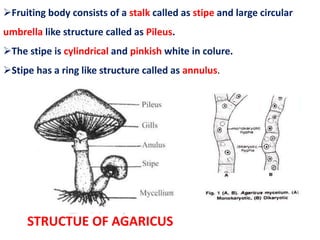
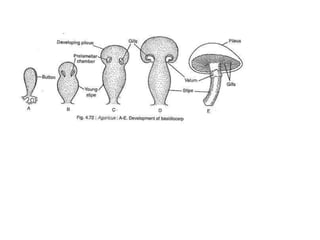
Fruiting body consists of a stalk called as stipe and large circular
umbrella like structure called as Pileus.
The stipe is cylindrical and pinkish white in colure.
Stipe has a ring like structure called as annulus.
STRUCTUE OF AGARICUS
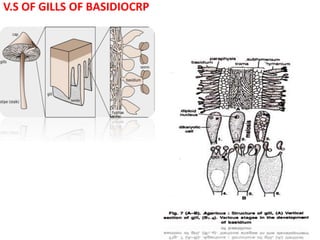
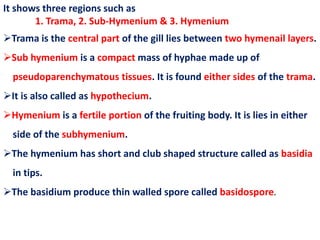
V.S OF GILLS OF BASIDIOCRP
It shows three regions such as
1. Trama, 2. Sub-Hymenium & 3. Hymenium
Trama is the central part of the gill lies between two hymenail layers.
Sub hymenium is a compact mass of hyphae made up of
pseudoparenchymatous tissues. It is found either sides of the trama.
It is also called as hypothecium.
Hymenium is a fertile portion of the fruiting body. It is lies in either
side of the subhymenium.
The hymenium has short and club shaped structure called as basidia
in tips.
The basidium produce thin walled spore called basidospore.
Reproduction in Agaricus
1. Vegetative Reproduction, 2. Asexual Reproduction
& 3. Sexual Reproduction
1. Vegetative Reproduction
It reproduces vegetatively by its perennating mycelium
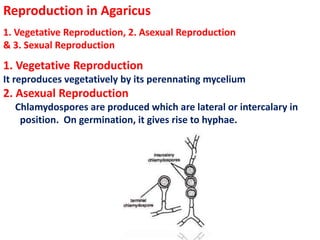
2. Asexual Reproduction
Chlamydospores are produced which are lateral or intercalary in
position. On germination, it gives rise to hyphae.
3. Sexual Reproduction
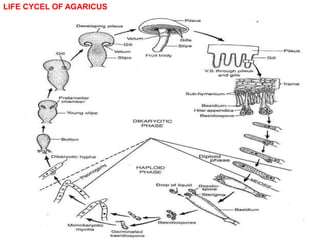
LIFE CYCEL OF AGARICUS
THANK YOU

Agaricus

  • 1.
    Dr. V. RAMESH AssistantProfessor & Head Department of Botany Vivekananda College Tiruvedakam West – 625 234 ramesh.vnr09@gmail.com AGARICUS STRUCTURE & REPRODUCTION
  • 2.
    AGARICUS It is asaprophytic fungus, belongs to the class Basidiomyctes. It is found in dead and decaying organic matter during rainy seasons. It is commonly called as Club fungi and White Button Mushrooms. It has more than 25 species like Agaricus campestries A. cosmosus A. regalis A. bisporus Systematic Position Kingdom:Fungi Class: Basidiomycetes Order: Agaricales Family:Agaricaceae Genus: Agaricus Species: bisporus
  • 3.
    STRUCTURE The vegetative bodyof Agaricus is mycelium produced by Basidiospore It consists of septate hyphae, cells are uninucleate. This uninucleate mycelium is commonly called as primary mycelium. The primary mycelium is branched, septate and grow below the soil. The two different (+strain & - strain) hyphae of primary mycelium fuse to form secondary mycelium. Sec. mycelium is binucleate, brancehd, septate and short celled. The hyphae of the sec. mycelium are interwoven compactely to form rope like structure called as rhizomorph. This rhizomorph produced the basidiocarp or fruit body above the soil. It is edible.
  • 4.
    Fruiting body consistsof a stalk called as stipe and large circular umbrella like structure called as Pileus. The stipe is cylindrical and pinkish white in colure. Stipe has a ring like structure called as annulus. STRUCTUE OF AGARICUS
  • 5.
    V.S OF GILLSOF BASIDIOCRP
  • 6.
    It shows threeregions such as 1. Trama, 2. Sub-Hymenium & 3. Hymenium Trama is the central part of the gill lies between two hymenail layers. Sub hymenium is a compact mass of hyphae made up of pseudoparenchymatous tissues. It is found either sides of the trama. It is also called as hypothecium. Hymenium is a fertile portion of the fruiting body. It is lies in either side of the subhymenium. The hymenium has short and club shaped structure called as basidia in tips. The basidium produce thin walled spore called basidospore.
  • 7.
    Reproduction in Agaricus 1.Vegetative Reproduction, 2. Asexual Reproduction & 3. Sexual Reproduction 1. Vegetative Reproduction It reproduces vegetatively by its perennating mycelium 2. Asexual Reproduction Chlamydospores are produced which are lateral or intercalary in position. On germination, it gives rise to hyphae.
  • 8.
  • 9.
    LIFE CYCEL OFAGARICUS
  • 11.