Saudi Arabia
Ministry of Higher Education
King Abdulaziz University
Faculty of Science - Girls department
Biology - Microbiology

Introduction to Bacteria
Definition , Structure and Function

Prepared by : Raghdah Abdulsalam Malibari
ID No. : ( 1200391 )
Supervision by : Dr. Magda Ali
For year : 2012 - 2013
Definition of Bacteria
Bacteria prokaryotic microorganisms a single-celled

microscopic organisms that lack nuclei and other
organized cell structures."Bacteria" is the plural form
of "bacterium.“
While several bacterial species are pathogenic (capable
of causing disease), most are non-infectious, and
many have critical roles in
decay, fermentation, nutrient recycling, and nitrogen
fixation. Bacteria are usually classified as grampositive or gram-negative based on a basic
microbiological staining procedure called the gram
stain. They come in a variety of shapes and sizes.
Shapes of Bacteria
Shapes of Bacteria
Size of Bacteria
Size of Bacteria
Cocci are true spheres with diameter ranging between
0.75 to 1.25 µm (and average of 1 µm).

Bacilli varyin length from 2-10 times their width.
Coccobacilli are very short bacilli.
Filaments are long threads of bacilli which have not
separated into single cells.
Were are Bacteria found?!
Environment bacteria
Found everywhere under the earth to a distance
of 400 meters - in the air at high altitudes, at
high temperatures around the craters - in
the polar regions, objects within objects
(animals in the digestive and respiratory
systems), their diet is the carbon dioxide and
produce oxygen.
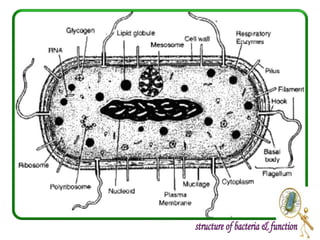
Structure of Bacteria and Function
Flagella
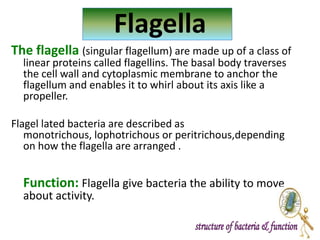
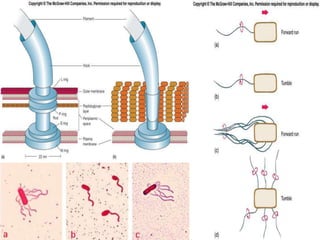
The flagella (singular flagellum) are made up of a class of
linear proteins called flagellins. The basal body traverses
the cell wall and cytoplasmic membrane to anchor the
flagellum and enables it to whirl about its axis like a
propeller.

Flagel lated bacteria are described as
monotrichous, lophotrichous or peritrichous,depending
on how the flagella are arranged .

Function: Flagella give bacteria the ability to move
about activity.
Capsule
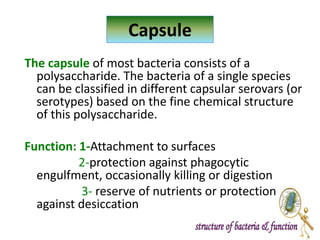
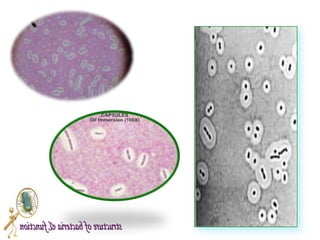
The capsule of most bacteria consists of a
polysaccharide. The bacteria of a single species
can be classified in different capsular serovars (or
serotypes) based on the fine chemical structure
of this polysaccharide.
Function: 1-Attachment to surfaces
2-protection against phagocytic
engulfment, occasionally killing or digestion
3- reserve of nutrients or protection
against desiccation
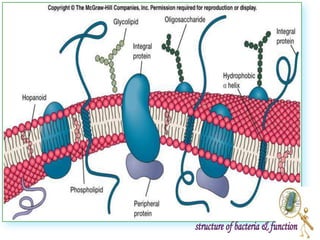
Plasma membrane
Plasma membranes in bacteria
are composed of
Phospholipids contain a
polar group attached to a 3
carbon glycerol back bone.
There are also two fatty acid
chains dangling from the
other carbons of glycerol.
The phosphate end of the
molecule is hydrophilic and
is attracted to water. The
fatty acids are hydrophobic .
Membranes also contain proteins. Typically 20-30% of
membrane ,Most of them are placed in the
membranes so that the hydrophobic amino acids
associate with the lipids in the membrane and the
hydrophilic amino acids are outside the membrane
interacting with either the cytoplasm.

Function: The plasma membrane is selectively
permeable in that it helps control what moves
into and out of its cell
Plasmid or Chromosome
The “cellular nucleus” in prokaryotes consists of
a tangle of double-stranded DNA, not
surrounded by a membrane and localized in the
cytoplasm .
- the formed, long DNA/protein fibers are
called chromatin;
- each fiber builds a so-called chromosome
-The plasmids of human pathogen bacteria
often bear important genes determining the
phenotype of their cells(resistance
genes, virulence genes).
Function:
Protein production
The single most important purpose of the genetic
material of any cell is that it holds all the information
necessary for a cell to carry out its many functions. The
sequence of bases in the DNA contain this information
or genetic code. Generally, this is translated into
messanger RNA and then into protein that then carry
out the many necessary functions of the cell.

DNA is transcribed into RNA that is
then translated into protein by the
ribosome.
Examples of advantages
plasmids bestow on the host
-Antibiotic resistance - Some
plasmids code for proteins that
degrade antibiotics-a big
advantage for pathogens.
-Some encode for proteins which
confer virulence factors on the
host. For example- E. coli plasmid
Ent P307 codes for an
enterotoxin which makes E.
coli pathogenic.
-Conjugative plasmids - These
allow exchange of DNA between
bacterial cells.
Additional function:
As Antigen – producing enzyme
Cytoplasm and Ribosomes
- The cytoplasm contains a large number of
solute low- and high-molecular weigh
substances.
- RNA and approximately 20 000
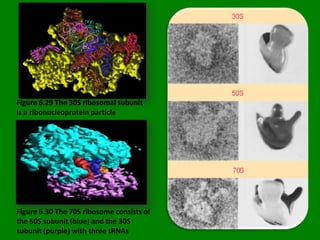
Ribosomescell. Bacteria have 70S Ribosomes
comprising 30S and 50S subunits.

Function: Ribosomes as the organelles for
protein synthesis.
Figure 6.29 The 30S ribosomal subunit
is a ribonucleoprotein particle

Figure 6.30 The 70S ribosome consists of
the 50S subunit (blue) and the 30S
subunit (purple) with three tRNAs
Cell Wall
Murein(syn.peptidoglycan)
The most important structural element of the
wall is murein, a netlike polymer material
surrounding the entire cell
(sacculus). It is made up of polysaccharide
chains cross linked by peptides.
The Structure of
Murein

The Murein
Building Block
The cell wall of Gram-positive bacteria:
The murein sacculus may consist of as many as 40 layers (15–80 nm
thick). The membrane lipoteichoic acids are anchored in the
cytoplasmic membrane, whereas the cell wall teichoic acids are
covalently coupled to the murein. The physiological role of the
teichoic acids is possibly they regulate the activity of the autolysins
that steer growth and transverse fission processes in the cell.
teichoic acids can activate the alternative complement pathway and
stimulate macrophages to secrete cytokines.Cell wall-associated
proteins frequently function as pathogenicity determinants (specific
adherence; phagocyte protection).
The cellwall of Gram-negative bacteria:
Here, the murein is only about 2 nm thick . The outer membrane is
the salient structural element. It contains numerous proteins
(50% by mass) as well as the medically critical
lipopolysaccharide.
— OmpA (outer membrane protein A) and the murein lipoprotein
form a bond between outer membrane and murein.
— Outer membrane-associated proteins constitute specific
structures that enable bacteria to attach to host cell receptors.
Lipopolysaccharide (LPS):
This molecular
complex, also known as
Endotoxin,is comprised of
the lipoid A, the core
polysaccharide .

Lipoid A:
is responsible for the toxic
effect.
Function:
1- the cell wall maintains the overall shape of a bacterial
cell.
2- The cell wall is an essential structure that protects the
cell protoplast from mechanical damage and from
osmotic rupture orlysis.

Introduction to bacteria, structure and function

  • 1.
    Saudi Arabia Ministry ofHigher Education King Abdulaziz University Faculty of Science - Girls department Biology - Microbiology Introduction to Bacteria Definition , Structure and Function Prepared by : Raghdah Abdulsalam Malibari ID No. : ( 1200391 ) Supervision by : Dr. Magda Ali For year : 2012 - 2013
  • 2.
  • 3.
    Definition of Bacteria Bacteriaprokaryotic microorganisms a single-celled microscopic organisms that lack nuclei and other organized cell structures."Bacteria" is the plural form of "bacterium.“ While several bacterial species are pathogenic (capable of causing disease), most are non-infectious, and many have critical roles in decay, fermentation, nutrient recycling, and nitrogen fixation. Bacteria are usually classified as grampositive or gram-negative based on a basic microbiological staining procedure called the gram stain. They come in a variety of shapes and sizes.
  • 5.
  • 6.
  • 7.
  • 8.
    Size of Bacteria Cocciare true spheres with diameter ranging between 0.75 to 1.25 µm (and average of 1 µm). Bacilli varyin length from 2-10 times their width. Coccobacilli are very short bacilli. Filaments are long threads of bacilli which have not separated into single cells.
  • 9.
  • 10.
    Environment bacteria Found everywhereunder the earth to a distance of 400 meters - in the air at high altitudes, at high temperatures around the craters - in the polar regions, objects within objects (animals in the digestive and respiratory systems), their diet is the carbon dioxide and produce oxygen.
  • 11.
  • 13.
    Flagella The flagella (singularflagellum) are made up of a class of linear proteins called flagellins. The basal body traverses the cell wall and cytoplasmic membrane to anchor the flagellum and enables it to whirl about its axis like a propeller. Flagel lated bacteria are described as monotrichous, lophotrichous or peritrichous,depending on how the flagella are arranged . Function: Flagella give bacteria the ability to move about activity.
  • 15.
    Capsule The capsule ofmost bacteria consists of a polysaccharide. The bacteria of a single species can be classified in different capsular serovars (or serotypes) based on the fine chemical structure of this polysaccharide. Function: 1-Attachment to surfaces 2-protection against phagocytic engulfment, occasionally killing or digestion 3- reserve of nutrients or protection against desiccation
  • 17.
    Plasma membrane Plasma membranesin bacteria are composed of Phospholipids contain a polar group attached to a 3 carbon glycerol back bone. There are also two fatty acid chains dangling from the other carbons of glycerol. The phosphate end of the molecule is hydrophilic and is attracted to water. The fatty acids are hydrophobic .
  • 18.
    Membranes also containproteins. Typically 20-30% of membrane ,Most of them are placed in the membranes so that the hydrophobic amino acids associate with the lipids in the membrane and the hydrophilic amino acids are outside the membrane interacting with either the cytoplasm. Function: The plasma membrane is selectively permeable in that it helps control what moves into and out of its cell
  • 20.
    Plasmid or Chromosome The“cellular nucleus” in prokaryotes consists of a tangle of double-stranded DNA, not surrounded by a membrane and localized in the cytoplasm . - the formed, long DNA/protein fibers are called chromatin; - each fiber builds a so-called chromosome -The plasmids of human pathogen bacteria often bear important genes determining the phenotype of their cells(resistance genes, virulence genes).
  • 21.
    Function: Protein production The singlemost important purpose of the genetic material of any cell is that it holds all the information necessary for a cell to carry out its many functions. The sequence of bases in the DNA contain this information or genetic code. Generally, this is translated into messanger RNA and then into protein that then carry out the many necessary functions of the cell. DNA is transcribed into RNA that is then translated into protein by the ribosome.
  • 22.
    Examples of advantages plasmidsbestow on the host -Antibiotic resistance - Some plasmids code for proteins that degrade antibiotics-a big advantage for pathogens. -Some encode for proteins which confer virulence factors on the host. For example- E. coli plasmid Ent P307 codes for an enterotoxin which makes E. coli pathogenic. -Conjugative plasmids - These allow exchange of DNA between bacterial cells. Additional function: As Antigen – producing enzyme
  • 23.
    Cytoplasm and Ribosomes -The cytoplasm contains a large number of solute low- and high-molecular weigh substances. - RNA and approximately 20 000 Ribosomescell. Bacteria have 70S Ribosomes comprising 30S and 50S subunits. Function: Ribosomes as the organelles for protein synthesis.
  • 24.
    Figure 6.29 The30S ribosomal subunit is a ribonucleoprotein particle Figure 6.30 The 70S ribosome consists of the 50S subunit (blue) and the 30S subunit (purple) with three tRNAs
  • 25.
    Cell Wall Murein(syn.peptidoglycan) The mostimportant structural element of the wall is murein, a netlike polymer material surrounding the entire cell (sacculus). It is made up of polysaccharide chains cross linked by peptides.
  • 26.
    The Structure of Murein TheMurein Building Block
  • 27.
    The cell wallof Gram-positive bacteria: The murein sacculus may consist of as many as 40 layers (15–80 nm thick). The membrane lipoteichoic acids are anchored in the cytoplasmic membrane, whereas the cell wall teichoic acids are covalently coupled to the murein. The physiological role of the teichoic acids is possibly they regulate the activity of the autolysins that steer growth and transverse fission processes in the cell. teichoic acids can activate the alternative complement pathway and stimulate macrophages to secrete cytokines.Cell wall-associated proteins frequently function as pathogenicity determinants (specific adherence; phagocyte protection).
  • 28.
    The cellwall ofGram-negative bacteria: Here, the murein is only about 2 nm thick . The outer membrane is the salient structural element. It contains numerous proteins (50% by mass) as well as the medically critical lipopolysaccharide. — OmpA (outer membrane protein A) and the murein lipoprotein form a bond between outer membrane and murein. — Outer membrane-associated proteins constitute specific structures that enable bacteria to attach to host cell receptors.
  • 29.
    Lipopolysaccharide (LPS): This molecular complex,also known as Endotoxin,is comprised of the lipoid A, the core polysaccharide . Lipoid A: is responsible for the toxic effect.
  • 30.
    Function: 1- the cellwall maintains the overall shape of a bacterial cell. 2- The cell wall is an essential structure that protects the cell protoplast from mechanical damage and from osmotic rupture orlysis.