VIRUSES
Presented
By
Kanchan Sinha
ShriShankaracharyaMahavidyalaya,Junwani,Bhilai
INTRODUCTION
• Virus: a microscopic particle that gets inside a
cell and often destroys the cell
• Viruses are tiny
• Smaller than the smallest bacteria
• Change rapidly
• So small and change so often that scientists
don’t know exactly how many types exist
• These properties make viruses difficult to fight
Definition
HISTORY
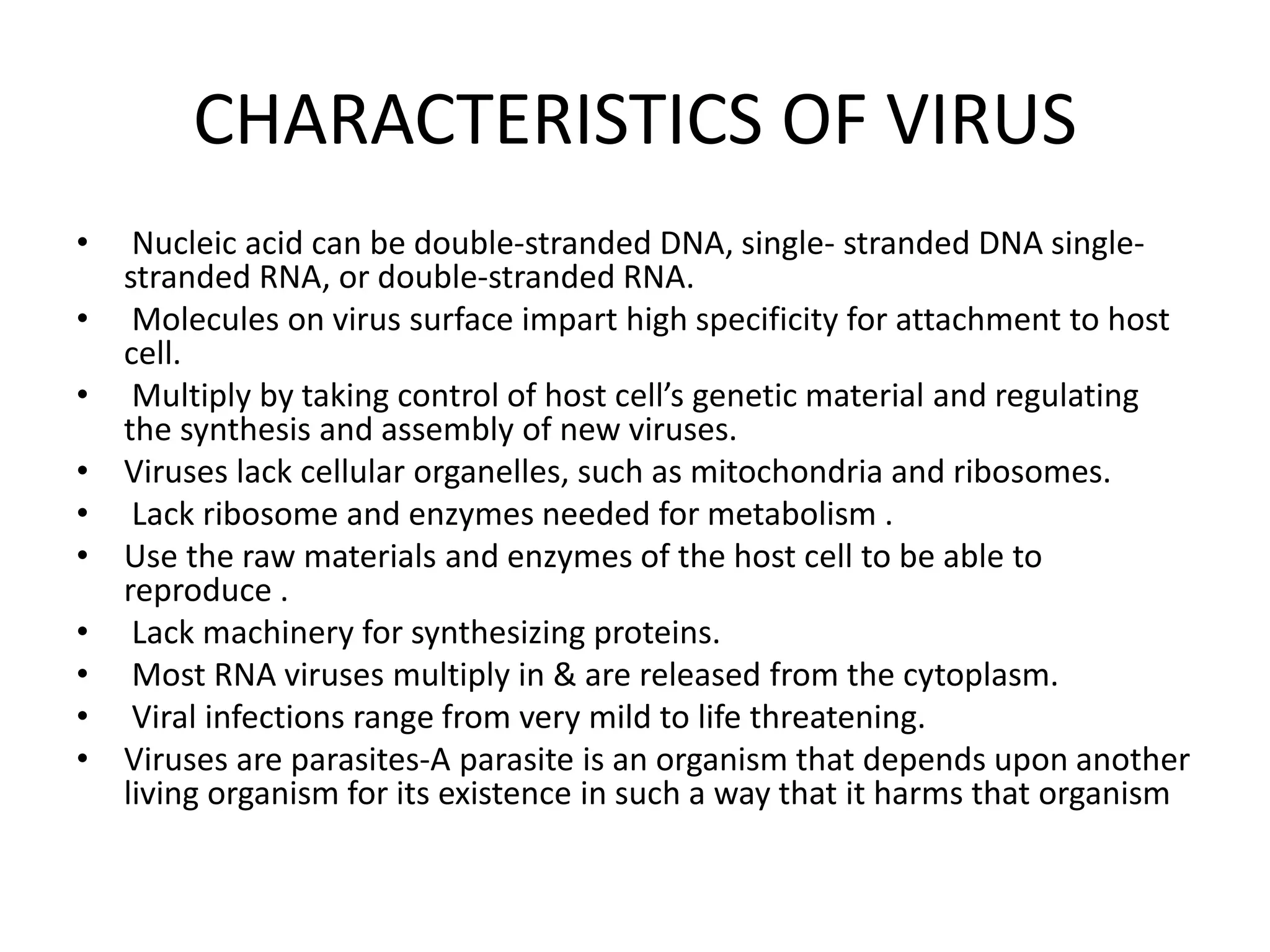
CHARACTERISTICS OF VIRUS
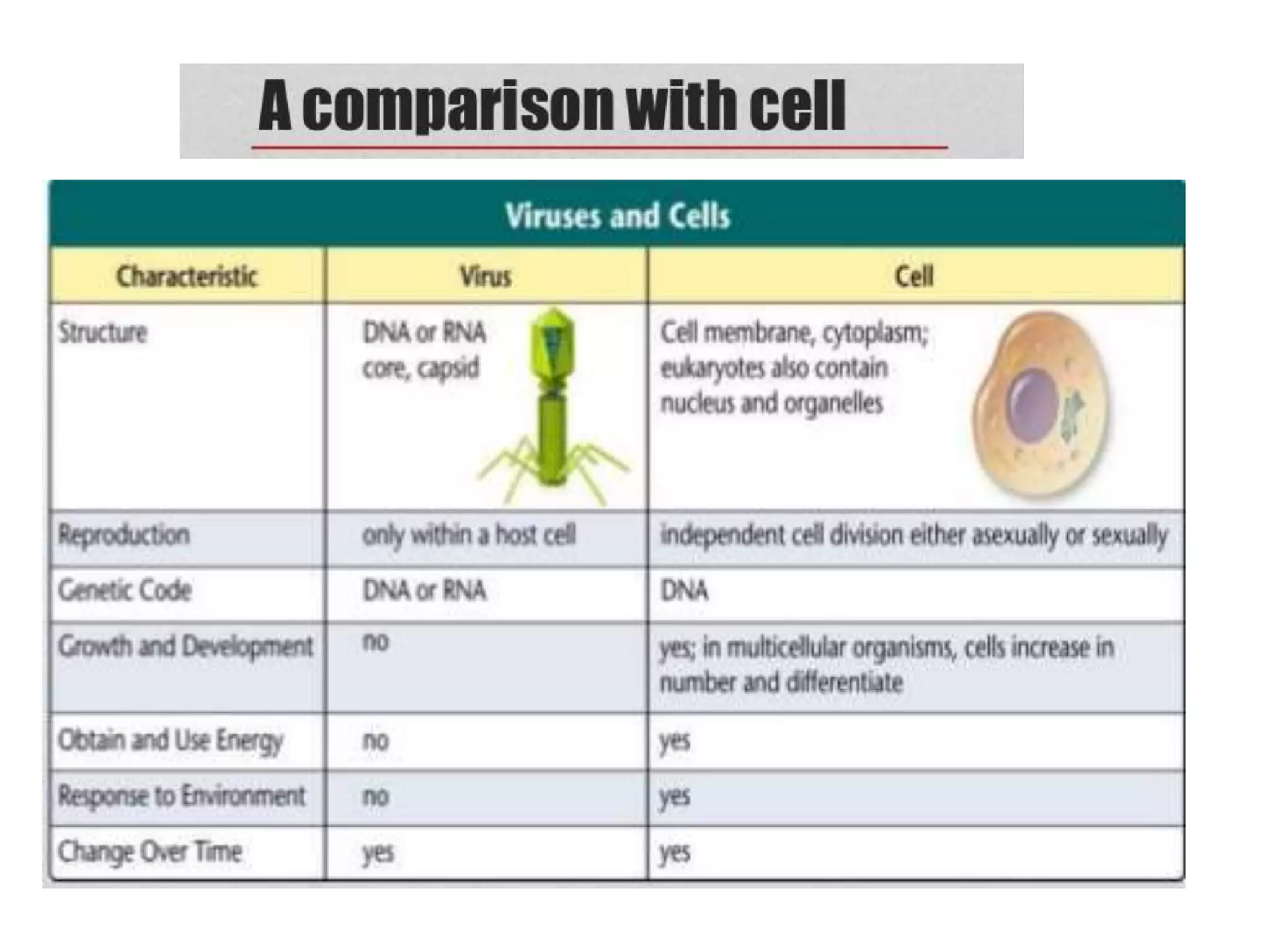
• Viruses are obligate intracellular parasites of bacteria,
protozoa, fungi, algae, plants, and animals.
• Ultramicroscopic size, ranging from 20 nm up to 450 nm
(diameter). Viruses are smaller than bacteria.
• Not cellular in nature; structure is very compact and
economical.
• Do not independently fulfill the characteristics of life.
• Inactive macromolecules outside the host cell and active
only inside host cells.
• Basic structure consists of protein shell (capsid)
surrounding nucleic acid core.
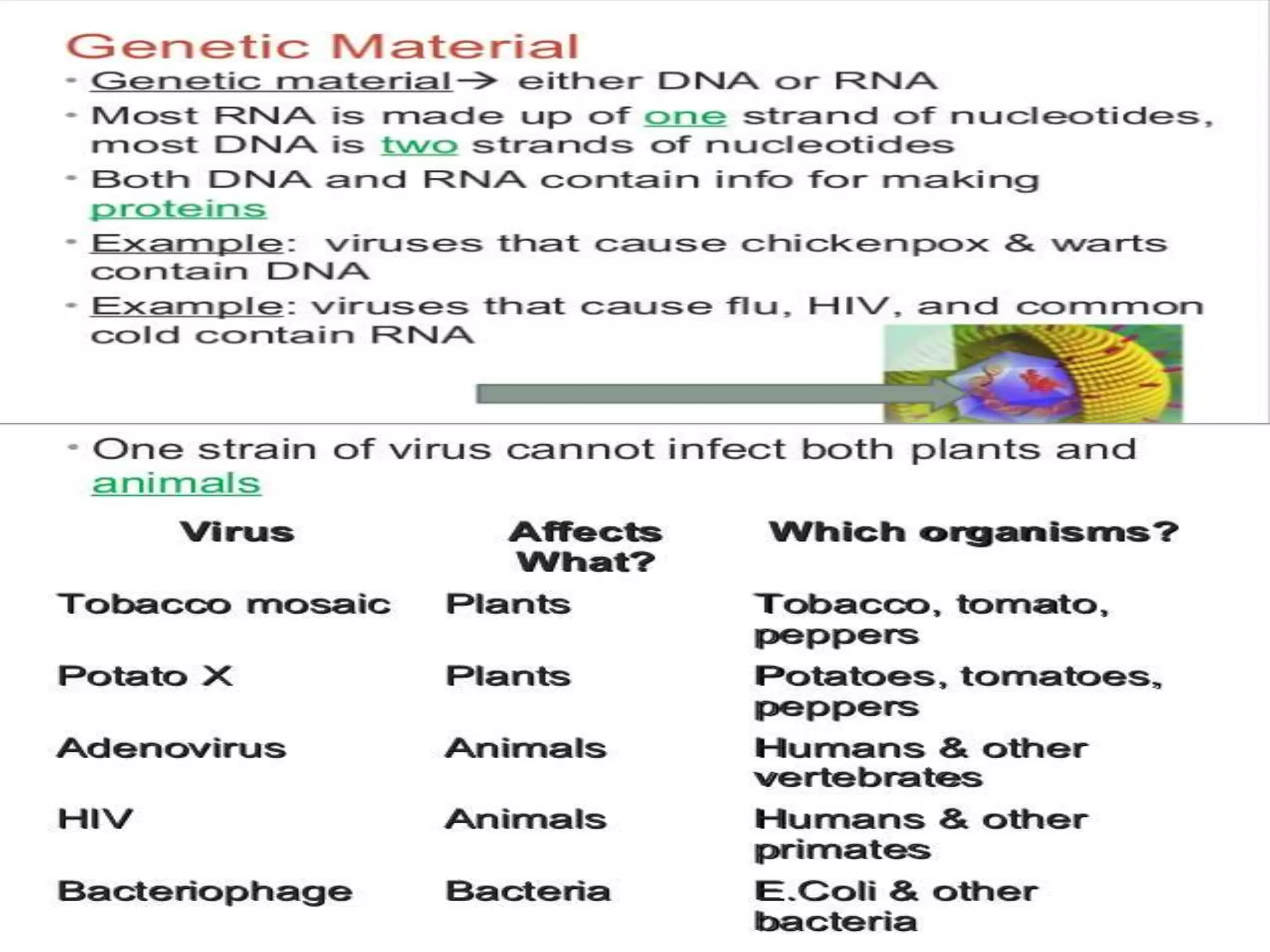
• Nucleic acid can be either DNA or RNA but not both.
CHARACTERISTICS OF VIRUS
• Nucleic acid can be double-stranded DNA, single- stranded DNA single-
stranded RNA, or double-stranded RNA.
• Molecules on virus surface impart high specificity for attachment to host
cell.
• Multiply by taking control of host cell’s genetic material and regulating
the synthesis and assembly of new viruses.
• Viruses lack cellular organelles, such as mitochondria and ribosomes.
• Lack ribosome and enzymes needed for metabolism .
• Use the raw materials and enzymes of the host cell to be able to
reproduce .
• Lack machinery for synthesizing proteins.
• Most RNA viruses multiply in & are released from the cytoplasm.
• Viral infections range from very mild to life threatening.
• Viruses are parasites-A parasite is an organism that depends upon another
living organism for its existence in such a way that it harms that organism
SHAPES OF VIRUS
• There are four main shape of virus -
TAXONOMY OF VIRUSES
• Family names end in -viridae
• Genus names end in -virus
• Viral species: A group of viruses sharing the same genetic information and
ecological niche (host).
• Common names are used for species.
• Subspecies are designated by a number.
REFERENCES
• https://www.slideshare.net/RIZWANABBAS3/viru
ses-structure-classification-and-characteristics
• https://www.slideshare.net/vidhyakalaivani29/vir
usessizeshape-types
• https://www.slideshare.net/kmtschida/virus-
powerpoint
• https://www.slideshare.net/jdrinks/viruses-ppt-
15932866
• https://www.slideshare.net/rajendra930136/viru
s-23717258?next_slideshow=1

B.sc.1 viruses general characteristics

  • 1.
  • 2.
    INTRODUCTION • Virus: amicroscopic particle that gets inside a cell and often destroys the cell • Viruses are tiny • Smaller than the smallest bacteria • Change rapidly • So small and change so often that scientists don’t know exactly how many types exist • These properties make viruses difficult to fight
  • 3.
  • 4.
  • 7.
    CHARACTERISTICS OF VIRUS •Viruses are obligate intracellular parasites of bacteria, protozoa, fungi, algae, plants, and animals. • Ultramicroscopic size, ranging from 20 nm up to 450 nm (diameter). Viruses are smaller than bacteria. • Not cellular in nature; structure is very compact and economical. • Do not independently fulfill the characteristics of life. • Inactive macromolecules outside the host cell and active only inside host cells. • Basic structure consists of protein shell (capsid) surrounding nucleic acid core. • Nucleic acid can be either DNA or RNA but not both.
  • 8.
    CHARACTERISTICS OF VIRUS •Nucleic acid can be double-stranded DNA, single- stranded DNA single- stranded RNA, or double-stranded RNA. • Molecules on virus surface impart high specificity for attachment to host cell. • Multiply by taking control of host cell’s genetic material and regulating the synthesis and assembly of new viruses. • Viruses lack cellular organelles, such as mitochondria and ribosomes. • Lack ribosome and enzymes needed for metabolism . • Use the raw materials and enzymes of the host cell to be able to reproduce . • Lack machinery for synthesizing proteins. • Most RNA viruses multiply in & are released from the cytoplasm. • Viral infections range from very mild to life threatening. • Viruses are parasites-A parasite is an organism that depends upon another living organism for its existence in such a way that it harms that organism
  • 10.
    SHAPES OF VIRUS •There are four main shape of virus -
  • 12.
    TAXONOMY OF VIRUSES •Family names end in -viridae • Genus names end in -virus • Viral species: A group of viruses sharing the same genetic information and ecological niche (host). • Common names are used for species. • Subspecies are designated by a number.
  • 17.
    REFERENCES • https://www.slideshare.net/RIZWANABBAS3/viru ses-structure-classification-and-characteristics • https://www.slideshare.net/vidhyakalaivani29/vir usessizeshape-types •https://www.slideshare.net/kmtschida/virus- powerpoint • https://www.slideshare.net/jdrinks/viruses-ppt- 15932866 • https://www.slideshare.net/rajendra930136/viru s-23717258?next_slideshow=1