Bacteria constitute a large domain of prokaryotic microorganisms.
Typically a few micrometres in length, bacteria have a number of
shapes, ranging from spheres to rods and spirals.
Bacteria
A prokaryote is a unicellular organism that lacks a membrane-
bound nucleus, mitochondria, or any other membrane-bound
organelle
Prokaryotes are divided into two domains, Archaea and Bacteria.
Bacteria were among the first life forms to appear on Earth, and are
present in most of its habitats. Bacteria inhabit soil, water, acidic
hot springs, radioactive waste and the deep biosphere of the
earth's crust. Bacteria also live in symbiotic and parasitic
relationships with plants and animals.
Bacteria were first observed by the Dutch
microscopist Antonie van Leeuwenhoek in
1676
Character Prokaryotes Eukaryotes
Nucleus Absent Nuclear envelope and nucleolus
Membrane-
bound
organelles
Absent Present. Includes mitochondria,
chloroplasts (plants), lysosomes
Chromosome
(DNA)
Single coiled chromosome in
cytoplasm ‘nucleoid’ region
Multiple linear chromosomes
with histone proteins
Cell wall Eubacteria have a cell wall of
peptidoglycan Archaea have cell walls
of pseudomurein
No cell wall in animal cells
Plant cell walls = cellulose
Fungal cell walls = chitin
Mitotic division Absent Present
Ribosomes 70S. Free in cytoplasm 80S. Both free in cytoplasm and
attached to rough E.R.
Flagella when present consist of protein
flagellin
consist of 9+2 arrangement of
microtubules
Mitochondria Absent Present
Lysosomes Absent Present
Golgi apparatus Absent Present
Endoplasmic
Reticulum
Absent Present
Bacteria
Shapes of Bacteria
• Coccus
– Chain = Streptoccus
– Cluster = Staphylococcus
• Bacillus
– Chain = Streptobacillus
• Coccobacillus
• Vibrio = curved
• Spirillum
• Spirochete
• Square
• Star
Bacteria
Bacteria Shapes and Arrangements
Bacterial Structures
• Chromosome
• Flagella
• Pili
• Capsule
• Plasma Membrane
• Cytoplasm
• Cell Wall
• Lipopolysaccharides
• Teichoic Acids
• Inclusions
• Spores
Bacteria
Bacteria
Flagella
• Motility - movement
• Swarming occurs with some bacteria
• Arrangement basis for classification
– Monotrichous; 1 flagella
– Lophotrichous; tuft at one end
– Amphitrichous; both ends
– Peritrichous; all around bacteria
Bacteria
Pilli
• Short protein appendages smaller than flagella
• Adhere bacteria to surfaces
– Antibodies to will block adherance
• F-pilus; used in conjugation
– Exchange of genetic information
• Flotation; increase boyancy
– Pellicle (scum on water),
– More oxygen on surface
Bacteria
Capsule or Slime Layer
• Glycocalyx - Polysaccharide on external
surface
• Adhere bacteria to surface
– S. mutans and enamel of teeth
• Prevents Phagocytosis
– Complement can’t penetrate sugars
Bacteria
Cytoplasm
• 80% Water {20% Salts-Proteins)
– Osmotic Shock important
• DNA is circular, Haploid
– Advantages of 1N DNA over 2N DNA
– More efficient; grows quicker
– Mutations allow adaptation to environment quicker
• Plasmids; extra circular DNA
– Antibiotic Resistance
• No organelles (Mitochondria, Golgi, etc.)
Bacteria
Bacteria
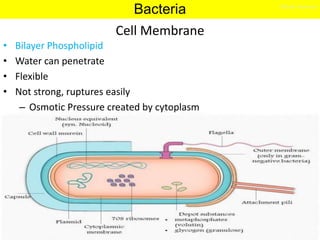
Cell Membrane
• Bilayer Phospholipid
• Water can penetrate
• Flexible
• Not strong, ruptures easily
– Osmotic Pressure created by cytoplasm
Bacteria
Cell Wall
• Peptido-glycan Polymer (amino acids + sugars)
• Unique to bacteria
• Sugars; NAG & NAM
– N-acetylglucosamine
– N-acetymuramic acid
• D form of Amino acids used not L form
– Hard to break down D form
• Amino acids cross link NAG & NAM
Bacteria
Chapter 4
Lipopolysaccharide (LPS)
• Endotoxin or Pyrogen
– Fever causing
– Toxin nomenclature
• Endo- part of bacteria
• Exo- excreted into environment
• Structure
– Lipid A
– Polysaccharide
• O Antigen of E. coli, Salmonella
• G- bacteria only
– Alcohol/Acetone removes
Bacteria
Bacteria
Bacteria
Bacteria
Endospores
• Resistant structure
– Heat, irradiation, cold
– Boiling >1 hr still viable
• Takes time and energy to make spores
• Location important in classification
– Central, Subterminal, Terminal
• Bacillus stearothermophilus -spores
– Used for quality control of heat sterilization
equipment
• Bacillus anthracis - spores
– Used in biological warfare
Bacteria
Bacteria
Bacteria
Bacteria
Bacteria
Nutrition
Bacteria
Bacteria
• Bacteria divide by binary fission
• Alternative means
– Budding
– Conidiospores
(filamentous bacteria)
– Fragmentation
Bacteria
Bacteria
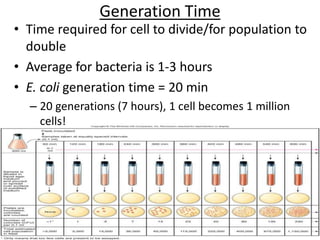
Generation Time
• Time required for cell to divide/for population to
double
• Average for bacteria is 1-3 hours
• E. coli generation time = 20 min
– 20 generations (7 hours), 1 cell becomes 1 million
cells!
Bacteria
Bacteria
• Commonly known as blue-green algae.
• Autotrophic (Photosynthetic).
• Contain chlorophyll a, phycocyanin (blue) and
phycoerythrin (red).
• They live in aquatic environments including
oceans, ponds, lakes, tidal flats, and moist
soil.
• They exist mostly as colonies and filaments
and sometimes as single cells.
Cyanobacteria
Cell structure
• The cell structure is very primitive.
• Each cell is composed of two parts:
a) cell wall
b) protoplast.
The cell wall is composed of 2 layers:
The inner layer of which is thin and firm
composed of peptidoglycan.
The outer layer of the wall is thicker and
gelatinous known as the sheath and
mainly constituted of pectic compounds.
Anabaena sp, Gloeocapsa sp, Microcystis sp
Stigonema sp
Chromoplast
Central body
Cell wall
Cyanobacteria
Nostoc
• Grows in water and on damp soils.
• Unbranched filaments with barrel-like cells.
• Certain enlarged cells appear at intervals,
which are known as heterocysts . Its
transparent and thick walls.
• The whole filament is surrounded with
gelatinous material.
Reproduction in by fission.
Prokaryotic cell.
Lack chlorophyll b.
Nostoc
• Nitrogen fixation
• Can be used as food (Japan, Chad, and China)
• Can pollute the water source (Lake).
• High concentration may cause fish toxicity and other
microorganism.
Reproduction
1. Vegetative reproduction.
2. Asexual reproduction.
B) By Akinetes.A) By fission.
Importance of Cyanobacteria
• Prokaryotic
• Lack peptidoglycan
• Live in extreme
environments
• Include:
– Methanogens
– Extreme halophiles
– Extreme thermophiles
Archaea
Property Archaea Bacteria Eukarya
Cell membrane Ether-linked lipids Ester-linked lipids Ester-linked lipids
Cell wall
Pseudopeptidoglycan,
glycoprotein, or S-layer
Peptidoglycan, S-layer, or no cell
wall
Various structures
Gene structure
Circular chromosomes,
similar translation and
transcription to Eukarya
Circular chromosomes, unique
translation and transcription
Multiple, linear
chromosomes, but
translation and
transcription similar to
Archaea
Internal cell
structure
No membrane-bound
organelles (?[62]) or nucleus
No membrane-bound organelles
or nucleus
Membrane-bound
organelles and nucleus
Metabolism[63]
Various, including
diazotrophy, with
methanogenesis unique to
Archaea
Various, including
photosynthesis, aerobic and
anaerobic respiration,
fermentation, diazotrophy, and
autotrophy
Photosynthesis,
cellular respiration,
and fermentation; no
diazotrophy
Reproduction
Asexual reproduction,
horizontal gene transfer
Asexual reproduction, horizontal
gene transfer
Sexual and asexual
reproduction
Protein
synthesis
initiation
Methionine Formylmethionine Methionine
RNA polymerase Many One Many
Toxin Sensitive to diphtheria toxin Resistant to diphtheria toxin
Sensitive to diphtheria
toxin
Archaea
Nutritional types in archaeal metabolism
Nutritional type
Source of
energy
Source of
carbon
Examples
Phototrophs Sunlight
Organic
compounds
Halobacterium
Lithotrophs
Inorganic
compounds
Organic
compounds or
carbon fixation
Ferroglobus,
Methanobacteri
a or Pyrolobus
Organotrophs
Organic
compounds
Organic
compounds or
carbon fixation
Pyrococcus,
Sulfolobus or
Methanosarcin
ales
Archaea
Actinomyces is a genus of the Actinobacteria class of
bacteria. They are all gram-positive.
Actinomyces species are facultatively anaerobic (except A.
meyeri and A. israelii both obligate anaerobe), and they
grow best under anaerobic conditions.
Actinomyces species may form endospores, and, while
individual bacteria are rod-shaped, Actinomyces colonies
form fungus-like branched networks of hyphae.
Actinomyces
Actinomyces
Rickettsia
Rickettsia
Bacteria
Bacteria
Disease Location Comments
Citrus canker Asia, Africa, Brazil, U.S. Caused eradication of millions of
trees in Florida in 1910s and
again in the 1980s and 1990s
Fire blight of pome
fruits
North America, Europe Kills numerous trees annually
Soft rot of vegetables Worldwide Huge losses of fleshy vegetables
Bacterial leaf blight
of rice
Destructive in Japan and
India
spreading
Bacterial wilt of
banana
Destructive in the
Americas;
spreading elsewhere
Pierce’s disease of
grape Deadly
in southeast U.S.;
spreading into California
spreading
Citrus variegation
chlorosis
Destructive in Brazil; spreading
Citrus greening
disease
Severe in Asia; spreading
Severe losses caused by Bacterial diseases
Symptoms of plant pathogenic Bacteria
Penetration and Invasion by Bacterial
Establishment of infection in a compatible reaction between
a pathogen and its host plant
Disease cycle of a bacterial leaf blight
Pseudomonas syringae pv. tabaci
Disease cycle of fire blight of pear and apple caused by
Erwinia amylovora.
Disease cycle of crown gall caused by
Agrobacterium tumefaciens
Disease cycle of common scab of potato caused by
Streptomyces scabies
THANKS

Bacteria

  • 2.
    Bacteria constitute alarge domain of prokaryotic microorganisms. Typically a few micrometres in length, bacteria have a number of shapes, ranging from spheres to rods and spirals. Bacteria A prokaryote is a unicellular organism that lacks a membrane- bound nucleus, mitochondria, or any other membrane-bound organelle Prokaryotes are divided into two domains, Archaea and Bacteria. Bacteria were among the first life forms to appear on Earth, and are present in most of its habitats. Bacteria inhabit soil, water, acidic hot springs, radioactive waste and the deep biosphere of the earth's crust. Bacteria also live in symbiotic and parasitic relationships with plants and animals. Bacteria were first observed by the Dutch microscopist Antonie van Leeuwenhoek in 1676
  • 5.
    Character Prokaryotes Eukaryotes NucleusAbsent Nuclear envelope and nucleolus Membrane- bound organelles Absent Present. Includes mitochondria, chloroplasts (plants), lysosomes Chromosome (DNA) Single coiled chromosome in cytoplasm ‘nucleoid’ region Multiple linear chromosomes with histone proteins Cell wall Eubacteria have a cell wall of peptidoglycan Archaea have cell walls of pseudomurein No cell wall in animal cells Plant cell walls = cellulose Fungal cell walls = chitin Mitotic division Absent Present Ribosomes 70S. Free in cytoplasm 80S. Both free in cytoplasm and attached to rough E.R. Flagella when present consist of protein flagellin consist of 9+2 arrangement of microtubules Mitochondria Absent Present Lysosomes Absent Present Golgi apparatus Absent Present Endoplasmic Reticulum Absent Present
  • 7.
  • 8.
    Shapes of Bacteria •Coccus – Chain = Streptoccus – Cluster = Staphylococcus • Bacillus – Chain = Streptobacillus • Coccobacillus • Vibrio = curved • Spirillum • Spirochete • Square • Star Bacteria
  • 9.
    Bacteria Shapes andArrangements
  • 10.
    Bacterial Structures • Chromosome •Flagella • Pili • Capsule • Plasma Membrane • Cytoplasm • Cell Wall • Lipopolysaccharides • Teichoic Acids • Inclusions • Spores Bacteria
  • 11.
  • 12.
    Flagella • Motility -movement • Swarming occurs with some bacteria • Arrangement basis for classification – Monotrichous; 1 flagella – Lophotrichous; tuft at one end – Amphitrichous; both ends – Peritrichous; all around bacteria Bacteria
  • 13.
    Pilli • Short proteinappendages smaller than flagella • Adhere bacteria to surfaces – Antibodies to will block adherance • F-pilus; used in conjugation – Exchange of genetic information • Flotation; increase boyancy – Pellicle (scum on water), – More oxygen on surface Bacteria
  • 14.
    Capsule or SlimeLayer • Glycocalyx - Polysaccharide on external surface • Adhere bacteria to surface – S. mutans and enamel of teeth • Prevents Phagocytosis – Complement can’t penetrate sugars Bacteria
  • 15.
    Cytoplasm • 80% Water{20% Salts-Proteins) – Osmotic Shock important • DNA is circular, Haploid – Advantages of 1N DNA over 2N DNA – More efficient; grows quicker – Mutations allow adaptation to environment quicker • Plasmids; extra circular DNA – Antibiotic Resistance • No organelles (Mitochondria, Golgi, etc.) Bacteria
  • 16.
  • 17.
    Cell Membrane • BilayerPhospholipid • Water can penetrate • Flexible • Not strong, ruptures easily – Osmotic Pressure created by cytoplasm Bacteria
  • 18.
    Cell Wall • Peptido-glycanPolymer (amino acids + sugars) • Unique to bacteria • Sugars; NAG & NAM – N-acetylglucosamine – N-acetymuramic acid • D form of Amino acids used not L form – Hard to break down D form • Amino acids cross link NAG & NAM Bacteria
  • 19.
    Chapter 4 Lipopolysaccharide (LPS) •Endotoxin or Pyrogen – Fever causing – Toxin nomenclature • Endo- part of bacteria • Exo- excreted into environment • Structure – Lipid A – Polysaccharide • O Antigen of E. coli, Salmonella • G- bacteria only – Alcohol/Acetone removes Bacteria
  • 20.
  • 21.
  • 22.
  • 24.
    Endospores • Resistant structure –Heat, irradiation, cold – Boiling >1 hr still viable • Takes time and energy to make spores • Location important in classification – Central, Subterminal, Terminal • Bacillus stearothermophilus -spores – Used for quality control of heat sterilization equipment • Bacillus anthracis - spores – Used in biological warfare Bacteria
  • 25.
  • 26.
  • 27.
  • 28.
  • 30.
  • 31.
    Bacteria • Bacteria divideby binary fission • Alternative means – Budding – Conidiospores (filamentous bacteria) – Fragmentation
  • 32.
  • 33.
  • 42.
    Generation Time • Timerequired for cell to divide/for population to double • Average for bacteria is 1-3 hours • E. coli generation time = 20 min – 20 generations (7 hours), 1 cell becomes 1 million cells!
  • 48.
  • 49.
  • 55.
    • Commonly knownas blue-green algae. • Autotrophic (Photosynthetic). • Contain chlorophyll a, phycocyanin (blue) and phycoerythrin (red). • They live in aquatic environments including oceans, ponds, lakes, tidal flats, and moist soil. • They exist mostly as colonies and filaments and sometimes as single cells. Cyanobacteria
  • 56.
    Cell structure • Thecell structure is very primitive. • Each cell is composed of two parts: a) cell wall b) protoplast. The cell wall is composed of 2 layers: The inner layer of which is thin and firm composed of peptidoglycan. The outer layer of the wall is thicker and gelatinous known as the sheath and mainly constituted of pectic compounds. Anabaena sp, Gloeocapsa sp, Microcystis sp Stigonema sp Chromoplast Central body Cell wall Cyanobacteria
  • 57.
    Nostoc • Grows inwater and on damp soils. • Unbranched filaments with barrel-like cells. • Certain enlarged cells appear at intervals, which are known as heterocysts . Its transparent and thick walls. • The whole filament is surrounded with gelatinous material. Reproduction in by fission. Prokaryotic cell. Lack chlorophyll b. Nostoc
  • 58.
    • Nitrogen fixation •Can be used as food (Japan, Chad, and China) • Can pollute the water source (Lake). • High concentration may cause fish toxicity and other microorganism. Reproduction 1. Vegetative reproduction. 2. Asexual reproduction. B) By Akinetes.A) By fission. Importance of Cyanobacteria
  • 59.
    • Prokaryotic • Lackpeptidoglycan • Live in extreme environments • Include: – Methanogens – Extreme halophiles – Extreme thermophiles Archaea
  • 60.
    Property Archaea BacteriaEukarya Cell membrane Ether-linked lipids Ester-linked lipids Ester-linked lipids Cell wall Pseudopeptidoglycan, glycoprotein, or S-layer Peptidoglycan, S-layer, or no cell wall Various structures Gene structure Circular chromosomes, similar translation and transcription to Eukarya Circular chromosomes, unique translation and transcription Multiple, linear chromosomes, but translation and transcription similar to Archaea Internal cell structure No membrane-bound organelles (?[62]) or nucleus No membrane-bound organelles or nucleus Membrane-bound organelles and nucleus Metabolism[63] Various, including diazotrophy, with methanogenesis unique to Archaea Various, including photosynthesis, aerobic and anaerobic respiration, fermentation, diazotrophy, and autotrophy Photosynthesis, cellular respiration, and fermentation; no diazotrophy Reproduction Asexual reproduction, horizontal gene transfer Asexual reproduction, horizontal gene transfer Sexual and asexual reproduction Protein synthesis initiation Methionine Formylmethionine Methionine RNA polymerase Many One Many Toxin Sensitive to diphtheria toxin Resistant to diphtheria toxin Sensitive to diphtheria toxin Archaea
  • 61.
    Nutritional types inarchaeal metabolism Nutritional type Source of energy Source of carbon Examples Phototrophs Sunlight Organic compounds Halobacterium Lithotrophs Inorganic compounds Organic compounds or carbon fixation Ferroglobus, Methanobacteri a or Pyrolobus Organotrophs Organic compounds Organic compounds or carbon fixation Pyrococcus, Sulfolobus or Methanosarcin ales Archaea
  • 62.
    Actinomyces is agenus of the Actinobacteria class of bacteria. They are all gram-positive. Actinomyces species are facultatively anaerobic (except A. meyeri and A. israelii both obligate anaerobe), and they grow best under anaerobic conditions. Actinomyces species may form endospores, and, while individual bacteria are rod-shaped, Actinomyces colonies form fungus-like branched networks of hyphae. Actinomyces
  • 63.
  • 64.
  • 65.
  • 67.
  • 68.
  • 69.
    Disease Location Comments Citruscanker Asia, Africa, Brazil, U.S. Caused eradication of millions of trees in Florida in 1910s and again in the 1980s and 1990s Fire blight of pome fruits North America, Europe Kills numerous trees annually Soft rot of vegetables Worldwide Huge losses of fleshy vegetables Bacterial leaf blight of rice Destructive in Japan and India spreading Bacterial wilt of banana Destructive in the Americas; spreading elsewhere Pierce’s disease of grape Deadly in southeast U.S.; spreading into California spreading Citrus variegation chlorosis Destructive in Brazil; spreading Citrus greening disease Severe in Asia; spreading Severe losses caused by Bacterial diseases
  • 70.
    Symptoms of plantpathogenic Bacteria
  • 71.
  • 72.
    Establishment of infectionin a compatible reaction between a pathogen and its host plant
  • 73.
    Disease cycle ofa bacterial leaf blight Pseudomonas syringae pv. tabaci
  • 74.
    Disease cycle offire blight of pear and apple caused by Erwinia amylovora.
  • 75.
    Disease cycle ofcrown gall caused by Agrobacterium tumefaciens
  • 76.
    Disease cycle ofcommon scab of potato caused by Streptomyces scabies
  • 77.