Microbiology
Lecture 2:- Bacterial morphology , bacterial cell structure
Dr. Raghda Saad Mohammed
bacterial morphology , bacterial cell structure
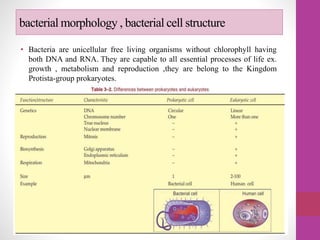
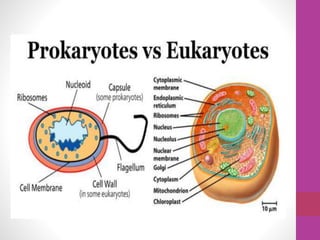
• Bacteria are unicellular free living organisms without chlorophyll having
both DNA and RNA. They are capable to all essential processes of life ex.
growth , metabolism and reproduction ,they are belong to the Kingdom
Protista-group prokaryotes.
bacterialmorphology , bacterialcellstructure
The morphology of bacterial cell includes characteristics such as
size, shape, structure etc. First of all, Leeuwenhoek revealed the
gross appearance of microorganism including bacteria by light
microscope. By the discovery of electron microscope in early
1940’s the study of structural bacterial cell has been made very
easier. The morphological characteristic of a bacterial cell is as
follows.
Size: Bacteria vary in size from cell to cell. It can be as small as
0.1 to 0.2 μm in width to as large as more than 50 μm in
diameter. A few very large prokaryotes such as Epulopiscium
fishelsoni that inhabits the intestinal tract of Surgeon fish are up
to 50 μm in diameter and can be more than 0.5 mm in length.
However, the dimension of an average rod cell prokaryotes
E.coli are about 1×3 μm.
The shape of cell is referred to as its morphology. Several shapes
of bacteria has been recognized and have been given different
names.
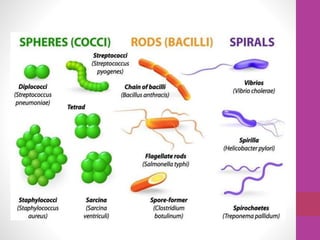
1. Coccus: A bacteria that is spherical or ovoid in morphology.
Example; Staphylococcus species.
1. Cocci in cluster :- ex staphylococcus aureus
2. Cocci in chain :- streptococcus pyogenes
3. Cocci in pair ( diplococci) :- pneumococcus and Neisseria.
4. Cocci in group of four (Tetrads ) Ex; Micrococcus
5. Cocci in group of eight (Sarcina ) Ex Sarcina
2. Rod or bacillus: A bacterium with cylindrical shape. Example;
E.coli , Salmonella
Shape and arrangement
3. Spirillum: Some rods are curved frequently forming spherical
shape pattern. Example; Rhodospirillum rubrum
4. Spirochete: Several group of bacteria which are tightly coiled.
Example; Spirochaeta stenostrepta and Treponema pallidum
5. Vibroid: Bacterial cell having less than one complete twist
form. Example; Vibrio cholerae.
6. Appendaged: Bacteria which possess extension of their cell as
their long tubes or stalks. Example; Rhodomicrobium species
7. Filamentous: Bacteria which are long and filament like
structure. Example; Chloroflexus species
8. Pleomorphic bacteria: Bacteria having irregular shape and can
change their structure. Example; Rhizobium species and
Mycobacterium species
Shape and arrangement
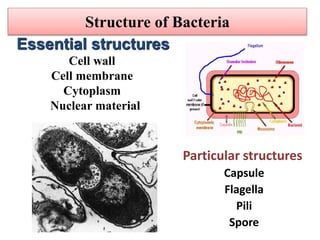
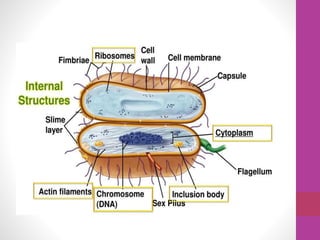
Structure of Bacteria
Particular structures
Capsule
Flagella
Pili
Spore
Essential structures
Cell wall
Cell membrane
Cytoplasm
Nuclear material
Cell Envelope
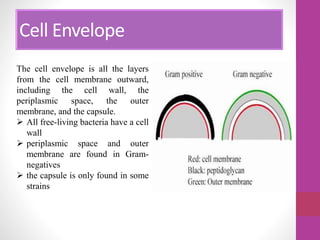
The cell envelope is all the layers
from the cell membrane outward,
including the cell wall, the
periplasmic space, the outer
membrane, and the capsule.
 All free-living bacteria have a cell
wall
 periplasmic space and outer
membrane are found in Gram-
negatives
 the capsule is only found in some
strains
Cell wall
• Definition
It's the outermost basic component of all bacteria
It's multilayered structure located external to
cytoplasmic membrane
• Function
Maintain the shape: rigid structure
 Protect and support C M: Osmotically insensitive
 Has role in replication: transverse septum
Responsible stain affinity: G +ve or G –ve
Cell wall
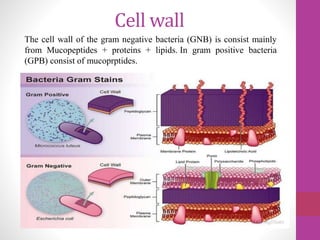
The cell wall of the gram negative bacteria (GNB) is consist mainly
from Mucopeptides + proteins + lipids. In gram positive bacteria
(GPB) consist of mucoprptides.
Cell wall
• The chemical structure of the cell wall for G+ve &
G-ve bacteria
G+ve bacteria G-ve bacteria
1- Thick layer of peptidoglycan 1- Thin layer of peptidoglycan
2- polysaccharides 2- lipopolysaccharides
3- teichoic acid 3- lipoprotein
Cytoplasm membrane
• Its thin semi permeable membrane which covers the cell wall
from the inside and consist of lipoprotein with small amount of
carbohydrate.
• Functions
1. It contains inflow and outflow of metabolites to and from
protoplast
2. Permease plays important role in passage through membrane
Cytoplasm
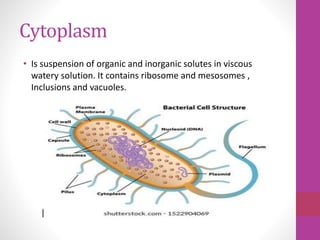
• Is suspension of organic and inorganic solutes in viscous
watery solution. It contains ribosome and mesosomes ,
Inclusions and vacuoles.
Nucleus
• It is a long filament of DNA coiled inside the cytoplasm. The
bacterial nucleus is not surrounded by nuclear membrane and
don't have nucleolus.
• The genome consists of a single molecule of double stranded
DNA arranged in the form circle bacterial chromosomes in
haploid and replicate by simple fission.
• Ribosome's
• These are ribonuclcoprotein granules, They are sites of synthesis
• Mesosomes
• They are the sites of respiratory in bacteria and coordinate nuclear
and cytoplasm division
Flagellum
• (Flagellum):- These are thread like structure arises from the
cytoplasm and its function is for locomotion. Chemically flagella
composed mainly of a protein called flagellin very few.
• Note: flagella occur most commonly among rod shaped bacteria.
Distribution (Arrangement) of flagella
• The arrangement of flagella may be in one of the following ways
1. Monotrichous: one flagellum at one end of the organism . ex :
vibrio ,pseudomonas
2. Amphitrichous: one flagellum at both the poles . ex :
Alcaligenes faecales
3. Lophotrichus : a tuft of flagella at one end of organism ex :
pseudomonas.
4. Peritrichus : several flagella present all over the surface of
bacteria ex: E.coli , Salmonella
The arrangement of flagella
• Fimbriae
They are filamentous short , thin , straight hair like appendage also called and project
from cell surface.
 Types of pilli ( fimbriae )
• common pilli
• F(fertility) pili
• Coli ( colicin )
 Function
• .Organ of adhesion
• .Conjunction tube
• .They are antigenic
• Spors
• They are highly resistance dormant state of bacteria found in certain genera ex:
Bacilli and Clostridium .
• :Function
They make survival of organism possible under unfavorable conditions like dry state.
Spores are resistant to freezing and toxic chemicals
• Capsule
• It is gelatinous secretion of bacteria which gets organism as a thick coat around
cell wall, it :may be composite of
1. Complex polysaccharide = pneumococcal , klebsilla
2. .Polypeptide = bacilli
Thanks for
your attention

Lecture 2:- Bacterial morphology , bacterial cell structure

  • 1.
    Microbiology Lecture 2:- Bacterialmorphology , bacterial cell structure Dr. Raghda Saad Mohammed
  • 2.
    bacterial morphology ,bacterial cell structure • Bacteria are unicellular free living organisms without chlorophyll having both DNA and RNA. They are capable to all essential processes of life ex. growth , metabolism and reproduction ,they are belong to the Kingdom Protista-group prokaryotes.
  • 4.
    bacterialmorphology , bacterialcellstructure Themorphology of bacterial cell includes characteristics such as size, shape, structure etc. First of all, Leeuwenhoek revealed the gross appearance of microorganism including bacteria by light microscope. By the discovery of electron microscope in early 1940’s the study of structural bacterial cell has been made very easier. The morphological characteristic of a bacterial cell is as follows. Size: Bacteria vary in size from cell to cell. It can be as small as 0.1 to 0.2 μm in width to as large as more than 50 μm in diameter. A few very large prokaryotes such as Epulopiscium fishelsoni that inhabits the intestinal tract of Surgeon fish are up to 50 μm in diameter and can be more than 0.5 mm in length. However, the dimension of an average rod cell prokaryotes E.coli are about 1×3 μm.
  • 5.
    The shape ofcell is referred to as its morphology. Several shapes of bacteria has been recognized and have been given different names. 1. Coccus: A bacteria that is spherical or ovoid in morphology. Example; Staphylococcus species. 1. Cocci in cluster :- ex staphylococcus aureus 2. Cocci in chain :- streptococcus pyogenes 3. Cocci in pair ( diplococci) :- pneumococcus and Neisseria. 4. Cocci in group of four (Tetrads ) Ex; Micrococcus 5. Cocci in group of eight (Sarcina ) Ex Sarcina 2. Rod or bacillus: A bacterium with cylindrical shape. Example; E.coli , Salmonella Shape and arrangement
  • 6.
    3. Spirillum: Somerods are curved frequently forming spherical shape pattern. Example; Rhodospirillum rubrum 4. Spirochete: Several group of bacteria which are tightly coiled. Example; Spirochaeta stenostrepta and Treponema pallidum 5. Vibroid: Bacterial cell having less than one complete twist form. Example; Vibrio cholerae. 6. Appendaged: Bacteria which possess extension of their cell as their long tubes or stalks. Example; Rhodomicrobium species 7. Filamentous: Bacteria which are long and filament like structure. Example; Chloroflexus species 8. Pleomorphic bacteria: Bacteria having irregular shape and can change their structure. Example; Rhizobium species and Mycobacterium species Shape and arrangement
  • 8.
    Structure of Bacteria Particularstructures Capsule Flagella Pili Spore Essential structures Cell wall Cell membrane Cytoplasm Nuclear material
  • 9.
    Cell Envelope The cellenvelope is all the layers from the cell membrane outward, including the cell wall, the periplasmic space, the outer membrane, and the capsule.  All free-living bacteria have a cell wall  periplasmic space and outer membrane are found in Gram- negatives  the capsule is only found in some strains
  • 10.
    Cell wall • Definition It'sthe outermost basic component of all bacteria It's multilayered structure located external to cytoplasmic membrane • Function Maintain the shape: rigid structure  Protect and support C M: Osmotically insensitive  Has role in replication: transverse septum Responsible stain affinity: G +ve or G –ve
  • 11.
    Cell wall The cellwall of the gram negative bacteria (GNB) is consist mainly from Mucopeptides + proteins + lipids. In gram positive bacteria (GPB) consist of mucoprptides.
  • 12.
    Cell wall • Thechemical structure of the cell wall for G+ve & G-ve bacteria G+ve bacteria G-ve bacteria 1- Thick layer of peptidoglycan 1- Thin layer of peptidoglycan 2- polysaccharides 2- lipopolysaccharides 3- teichoic acid 3- lipoprotein
  • 13.
    Cytoplasm membrane • Itsthin semi permeable membrane which covers the cell wall from the inside and consist of lipoprotein with small amount of carbohydrate. • Functions 1. It contains inflow and outflow of metabolites to and from protoplast 2. Permease plays important role in passage through membrane
  • 14.
    Cytoplasm • Is suspensionof organic and inorganic solutes in viscous watery solution. It contains ribosome and mesosomes , Inclusions and vacuoles.
  • 15.
    Nucleus • It isa long filament of DNA coiled inside the cytoplasm. The bacterial nucleus is not surrounded by nuclear membrane and don't have nucleolus. • The genome consists of a single molecule of double stranded DNA arranged in the form circle bacterial chromosomes in haploid and replicate by simple fission. • Ribosome's • These are ribonuclcoprotein granules, They are sites of synthesis • Mesosomes • They are the sites of respiratory in bacteria and coordinate nuclear and cytoplasm division
  • 16.
    Flagellum • (Flagellum):- Theseare thread like structure arises from the cytoplasm and its function is for locomotion. Chemically flagella composed mainly of a protein called flagellin very few. • Note: flagella occur most commonly among rod shaped bacteria. Distribution (Arrangement) of flagella • The arrangement of flagella may be in one of the following ways 1. Monotrichous: one flagellum at one end of the organism . ex : vibrio ,pseudomonas 2. Amphitrichous: one flagellum at both the poles . ex : Alcaligenes faecales 3. Lophotrichus : a tuft of flagella at one end of organism ex : pseudomonas. 4. Peritrichus : several flagella present all over the surface of bacteria ex: E.coli , Salmonella
  • 17.
  • 18.
    • Fimbriae They arefilamentous short , thin , straight hair like appendage also called and project from cell surface.  Types of pilli ( fimbriae ) • common pilli • F(fertility) pili • Coli ( colicin )  Function • .Organ of adhesion • .Conjunction tube • .They are antigenic • Spors • They are highly resistance dormant state of bacteria found in certain genera ex: Bacilli and Clostridium . • :Function They make survival of organism possible under unfavorable conditions like dry state. Spores are resistant to freezing and toxic chemicals • Capsule • It is gelatinous secretion of bacteria which gets organism as a thick coat around cell wall, it :may be composite of 1. Complex polysaccharide = pneumococcal , klebsilla 2. .Polypeptide = bacilli
  • 20.