DEPARTMENT OF GENETICS AND PLANT BREEDING
COURSE TITLE: PLANT BIOTECHNOLOGY
COURSE CODE: PLB 608
CREDIT HOUR: 3 (2+1)
PRESENTATION ON: TRANSPOSABLE GENETIC ENZYMES
PRESENTED BY: AJAY KUMAR YADAV
EXAM ROLL NO: PLB-01M-2022
CLASS ROLL NO: PLB-07M-2022
M. Sc. Ag. 1st Year 1st Semester
AGRICULTURE AND FORESTRY UNIVERSITY (AFU)
FACULTY OF AGRICULTURE
RAMPUR, CHITWAN
• Biotechnology is broadly defined as the science of using living organisms, or the
products of living organisms, for human benefit.
• Term “Biotechnology” was first coined by a Hungarian Agricultural Engineer
Karoly Ereky (“The father of biotechnology”) in 1919.
• Plant Biotechnology is a technique used for development of desired varieties of
plants by manipulating its genetics.
INTRODUCTION
Fields of plant Biotechnology:
• Plant Tissue culture
• Plant Genome sequencing
• Genetic structures and mechanisms
• Genetic engineering (Methods for transgenic biotechnology)
• Molecular markers/ Marker assisted selection and bioinformatics
• Gene Editing/Genome Editing
INTRODUCTION Cont…
• Identified in Prokaryotes and all Eukaryotes:
(with exception of parasitic Plasmodium falciparum)
- Animals 3-45%, Fungi 2-20%, Plants 10-80%.
• More abundant in eukaryotic genomes than prokaryotes.
• Transposons make up the major content of eukaryotic genomes.
~50% of genomes of Human, Mouse, Ape
~ 10% of several fish species
~ 12 % of Caenorhabditis elegans genome
~75% of Maize genome
~85% of Barley genome
~98% of Iris genome
WHAT ARE TRANSPOSONS?
Iris brevicaulis Iris fulva
• A discrete sequence in the genome that are mobile and able to insert itself at a new location in
the genome, without having any sequence relationship with the target locus.
• Term was given by Hedges and Jacob (1947)
• Other names viz., Jumping genes, Junk DNA, Selfish DNA, Molecular parasites, Mobile
genetics elements and Controlling elements.
• These elements comprise at least 45% of the human genome while coding sequences occupy
<3%.
• Transposons are segments of DNA that can move around to different positions in the genome
of a single cell.
• In the process, they may cause mutations and increase (or decrease) the amount of DNA in the
genome of the cell, and if the cell is the precursor of a gamete, in the genomes of any
descendants.
TRANSPOSON (TRANSPOSABLE ELEMENT):
• Cold Spring Harbor Laboratory, New York.
• Nobel Prize in Physiology and Medicine (1983)
• “Discovery of mobile genetic elements”
• Her discovery of jumping genes, through an analysis of genetic instability in
Maize.
• The instability involves chromosome breakage and was found to occur at sites
where transposable elements were located i.e. at C locus of 9th chromosome.
BARBARA McCLINTOCK (1902-1992) EXPERIMENT:
There must be two elements to the process:
• An element that actually caused the mutation: The dissociator (Ds), located on
the short arm of chromosome 9 (where the breaks occurred).
• An additional element that controlled the activity of the first element: The
activator (Ac)
Dr. McCLINTOCK’S CONCLUSIONS
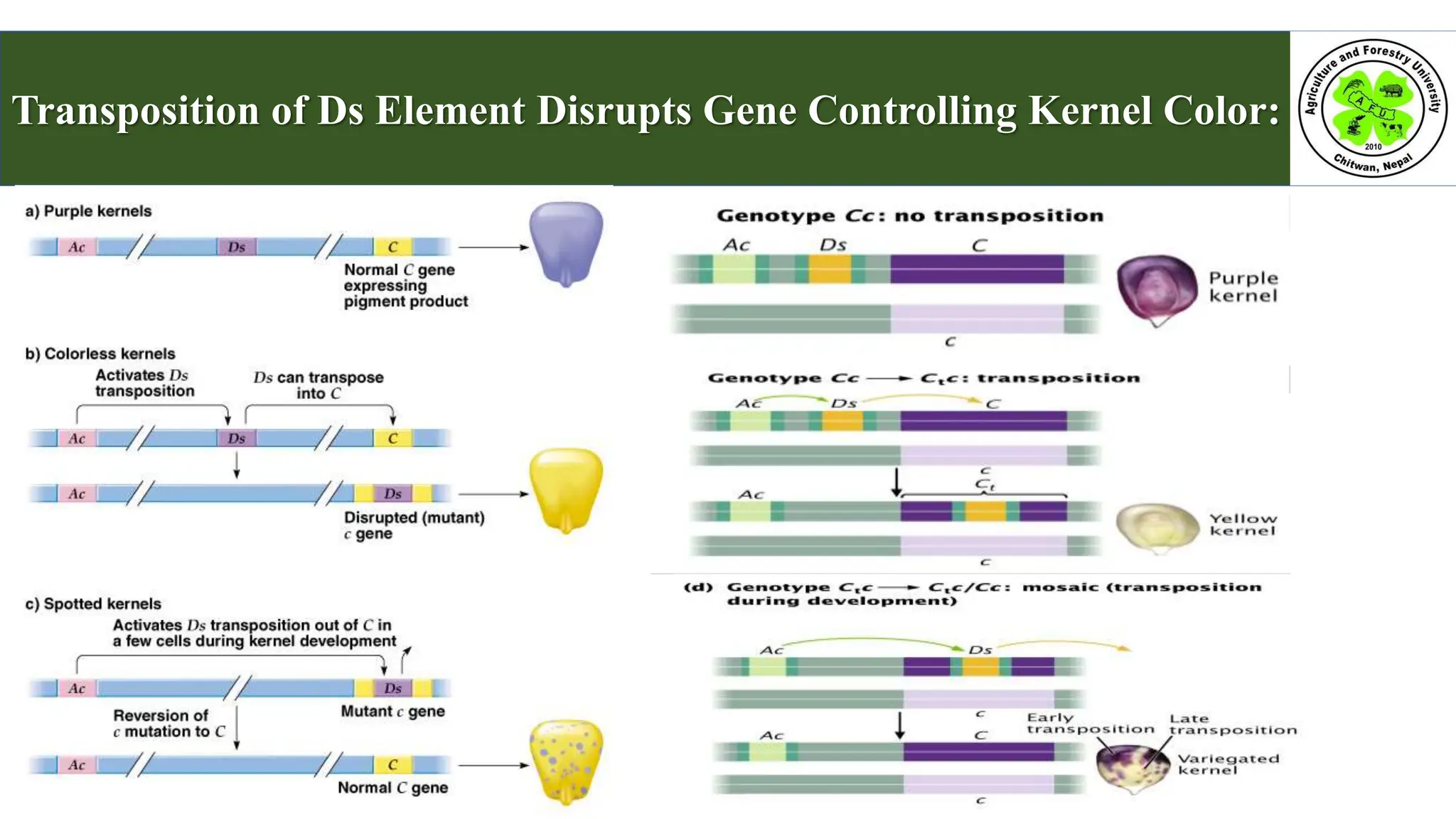
Transposition of Ds Element Disrupts Gene Controlling Kernel Color:
• c/c = White kernels and C/- = Purple kernels
• Kernal color alleles/traits are “unstable”.
• If reversion of c to C occurs in a cell, cell will produce purple pigment and a spot.
• Earlier in development reversion occurs, the larger the spot.
• McClintock concluded “c” allele results from a non-autonomous transposon
called “Ds” inserted into the “C” gene.
• (Ds = dissassociation)
• Autonomous transposon “Ac” controls “Ds” transposon.
• (Ac = activator).
• Ac element is autonomous while Ds element is non-autonomous.
McCLINTOCK’S DISCOVERY OF TRANSPOSONS IN CORN:
• Ac is 4,563 bp with 11 bp ITRs and 1 transcription unit encoding an 807 amino
acid Transposase.
• Ac activates Ds; Ds varies in length and sequence, but possesses same ITRs as Ac.
• Many Ds elements are deleted or rearranged version of Ac; Ds element derived
from Ac.
• Ac/Ds are developmentally regulated; Ac/Ds transpose only during chromosome
replication and do not leave copies behind.
McCLINTOCK’S DISCOVERY OF TRANSPOSONS IN CORN Cont… :
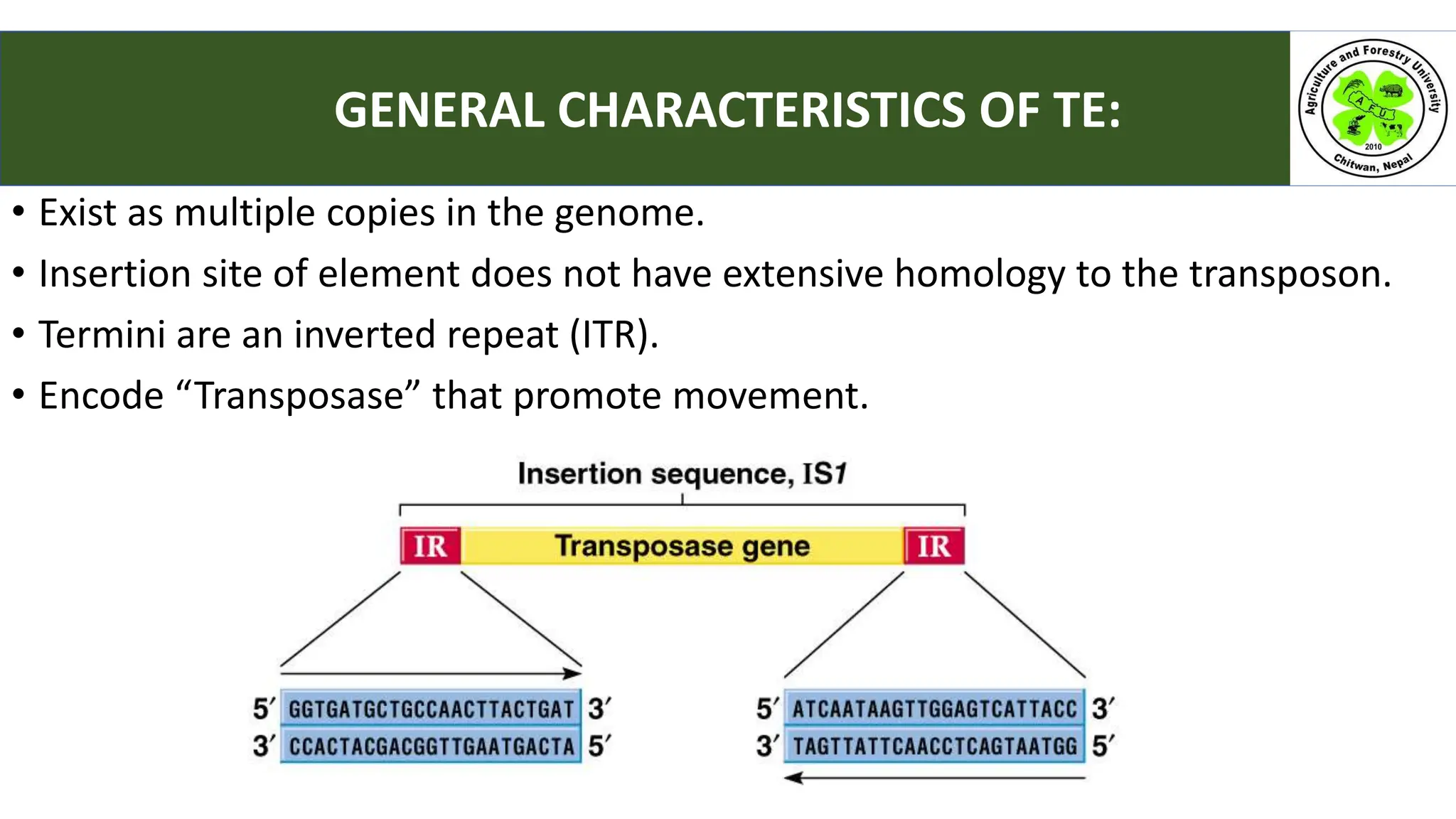
• Exist as multiple copies in the genome.
• Insertion site of element does not have extensive homology to the transposon.
• Termini are an inverted repeat (ITR).
• Encode “Transposase” that promote movement.
GENERAL CHARACTERISTICS OF TE:
1. Transposition: The process by which these sequences are copied and inserted
into a new site in the genome.
2. Segments of the genome that are capable of moving around to different
locations.
• Transposable elements usually are flanked by repeated sequences.
• Often carry “Transposase genes” that confer the transposition ability.
TRANSPOSITION OF TES:
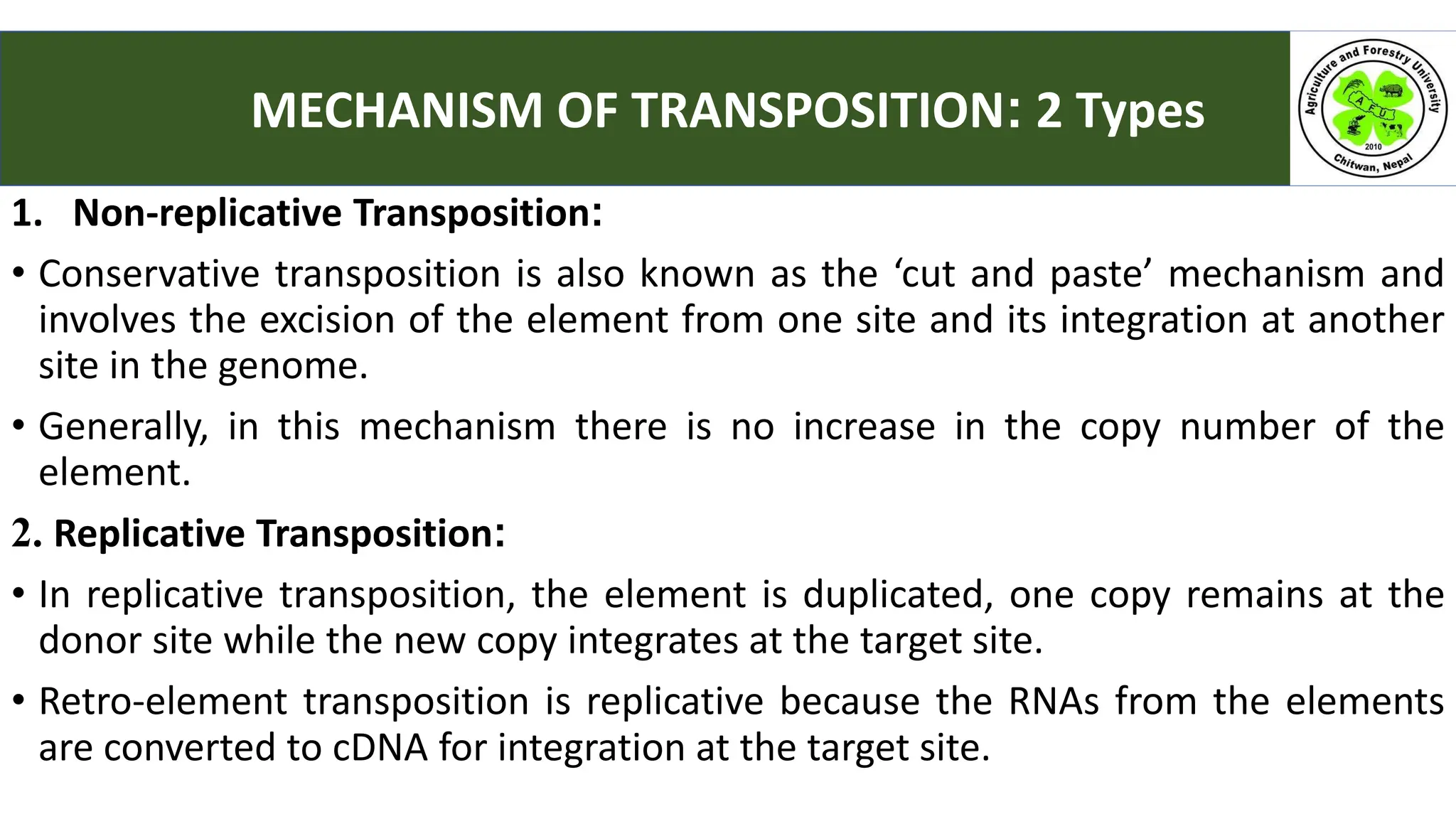
1. Non-replicative Transposition:
• Conservative transposition is also known as the ‘cut and paste’ mechanism and
involves the excision of the element from one site and its integration at another
site in the genome.
• Generally, in this mechanism there is no increase in the copy number of the
element.
2. Replicative Transposition:
• In replicative transposition, the element is duplicated, one copy remains at the
donor site while the new copy integrates at the target site.
• Retro-element transposition is replicative because the RNAs from the elements
are converted to cDNA for integration at the target site.
MECHANISM OF TRANSPOSITION: 2 Types
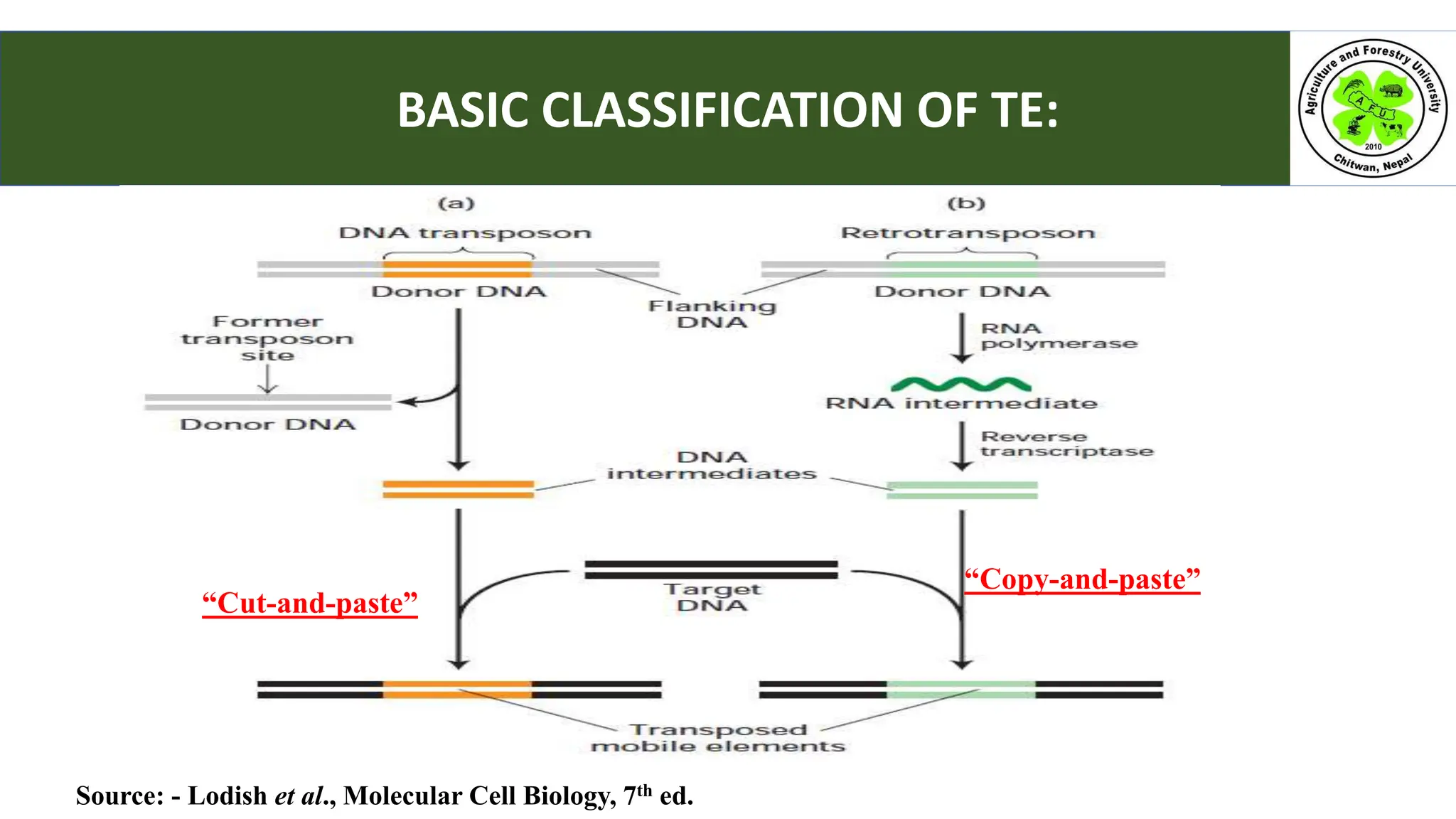
BASIC CLASSIFICATION OF TE:
Source: - Lodish et al., Molecular Cell Biology, 7th ed.
“Copy-and-paste”
“Cut-and-paste”
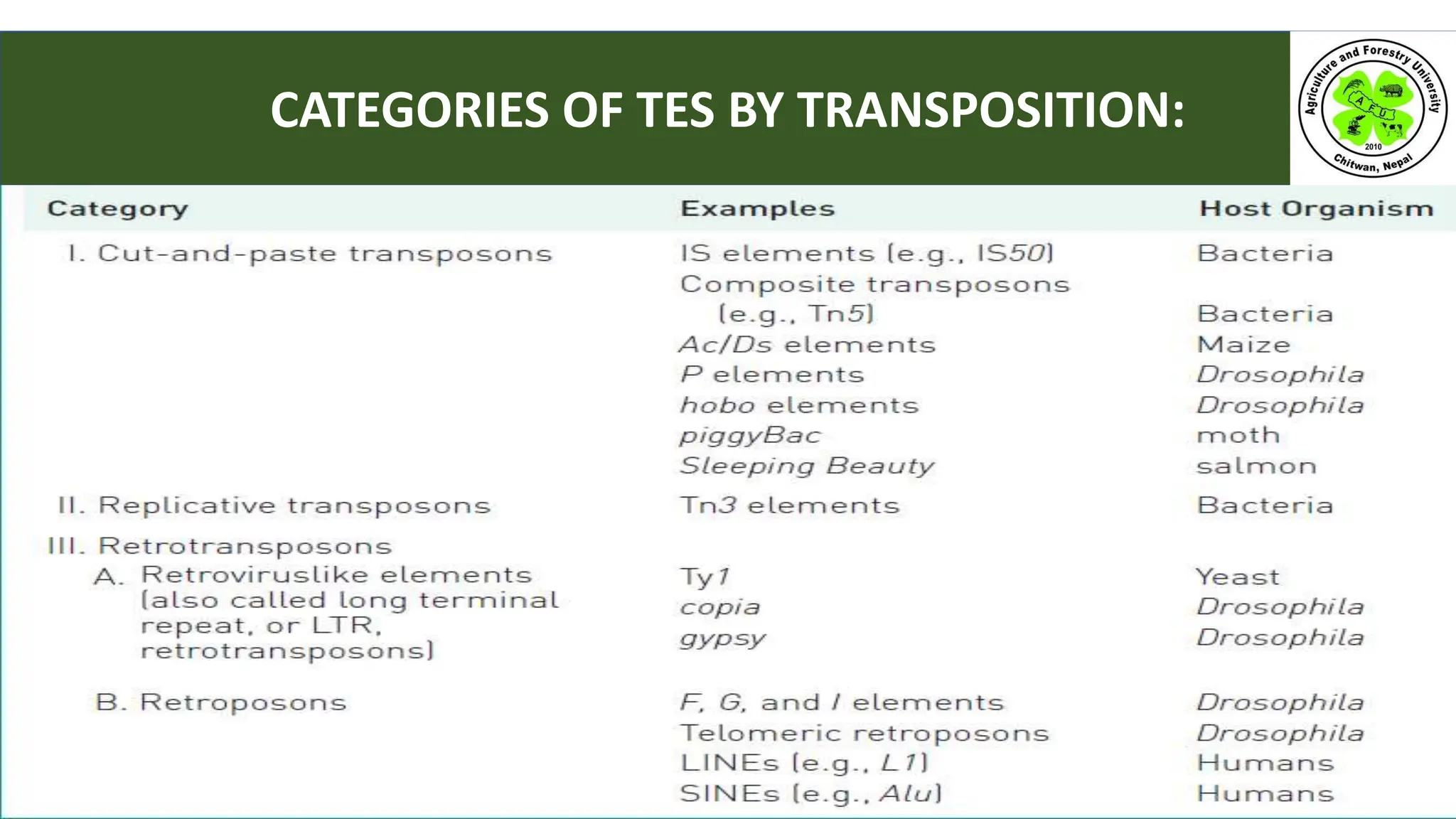
CATEGORIES OF TES BY TRANSPOSITION:
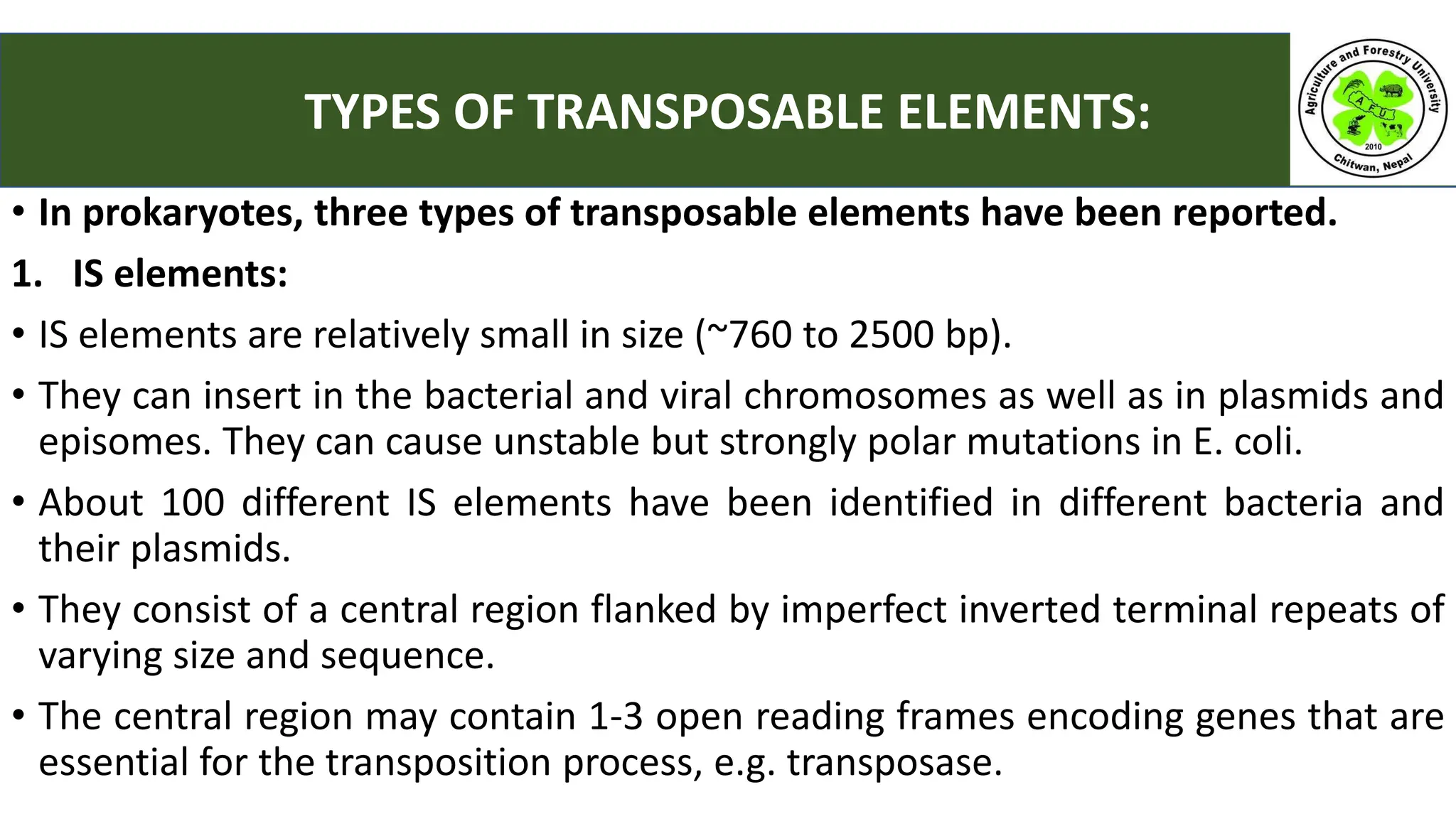
• In prokaryotes, three types of transposable elements have been reported.
1. IS elements:
• IS elements are relatively small in size (~760 to 2500 bp).
• They can insert in the bacterial and viral chromosomes as well as in plasmids and
episomes. They can cause unstable but strongly polar mutations in E. coli.
• About 100 different IS elements have been identified in different bacteria and
their plasmids.
• They consist of a central region flanked by imperfect inverted terminal repeats of
varying size and sequence.
• The central region may contain 1-3 open reading frames encoding genes that are
essential for the transposition process, e.g. transposase.
TYPES OF TRANSPOSABLE ELEMENTS:
2. Composite or compound transposons (Tn):
• The central region of these transposable elements contains some nonessential genes, e.g.
antibiotic resistance which is flanked by two IS elements.
• They are designated as Tn.
• The transposase may be provided by one or both IS elements.
• The IS elements may be in the same or opposite orientation, thus the composite transposon
appears to have long direct or long inverted repeats.
3. Complex transposons:
• Complex transposons are similar to IS elements but contain genes essential for transposition
along with nonessential genes.
• These genes are located in the central region which is flanked by short inverted terminal repeats.
• They are generally 5000bp in size and contain inverted terminal repeats of ~386 bp at both ends.
TYPES OF TRANSPOSABLE ELEMENTS Cont…
• In eukaryotes, the transposable elements are of two types:
1. Class I - which mobilize using RNA intermediate (termed as retrotransposons)
2. Cass II- which directly mobilize as DNA (termed as transposons)
Class Retrotransposons have RNA intermediate. These are of two types:
(a) Retrovirus- like elements:
• The basic structure of retrovirus-like element has central region coding for two genes which is flanked
by long terminal repeats (LTRs).
• The LTRs are oriented in the same direction and bounded by short inverted repeats.
• The two genes encode for a structural protein of the virus capsule and a reverse transcriptase/ integrase
enzyme.
• The transposition process involves transcription of DNA sequence, reverse transcription of the RNA,
synthesis of double-stranded DNA from RNA and insertion at a new target site in the chromosome.
• Retrovirus carries a third gene coding for the protein of the virus envelope.
TYPES OF TRANSPOSABLE ELEMENTS Cont…
(b) Retroposons:
• These elements also move through RNA intermediate but do not contain direct or
inverted repeats at their termini.
• They possess a long stretch of A-T base pairs at one end of the DNA.
• In Drosophila, several retroposons are reported which are known to occur at the
end of chromosomes and participates in the replication of telomeres.
• LINE-1 retroposon is the transposable element reported in humans.
TYPES OF TRANSPOSABLE ELEMENTS Cont…
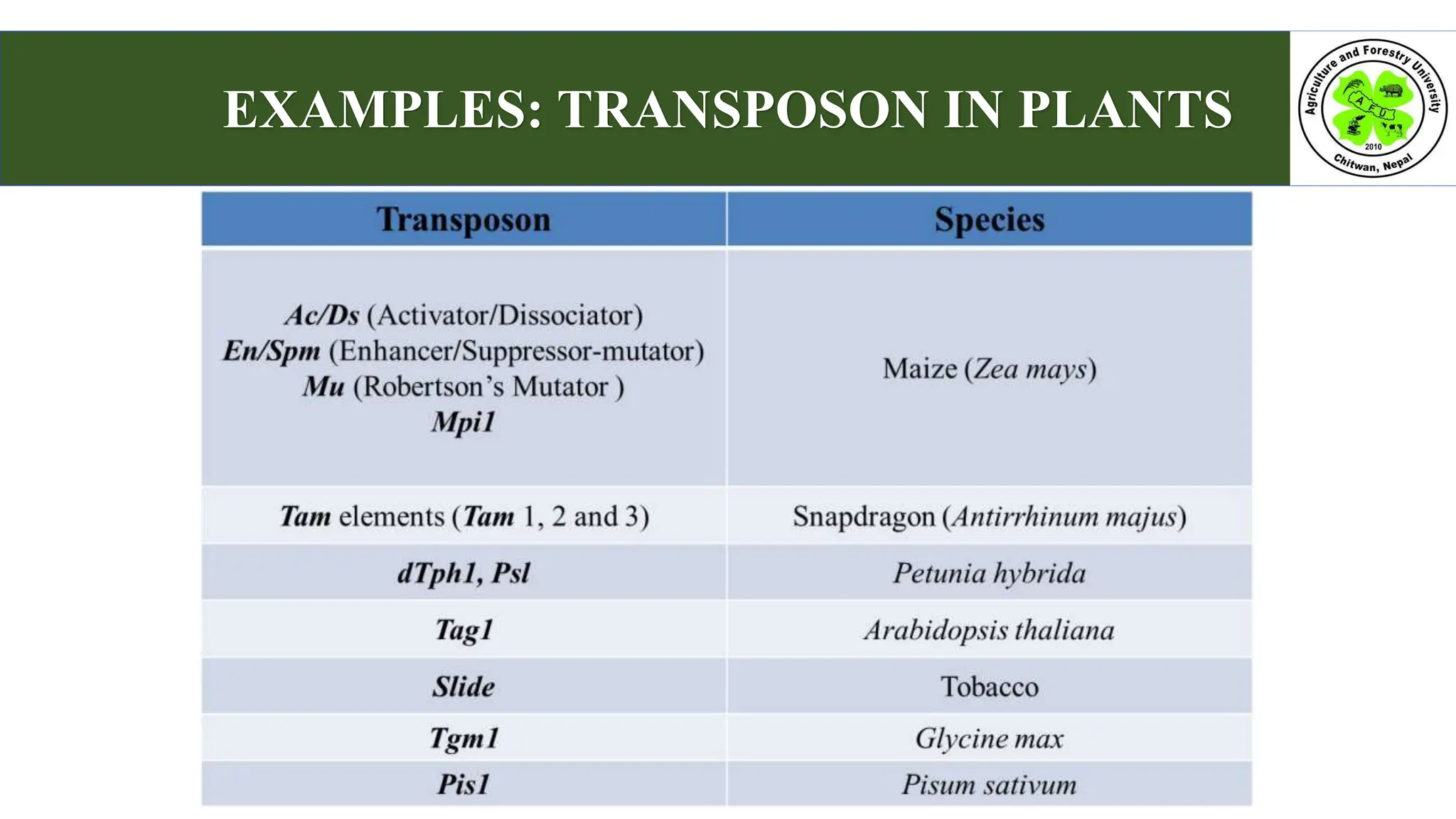
EXAMPLES: TRANSPOSON IN PLANTS
• They provide a means for genomic change and variation, particularly in response
to stress (McClintock’s "stress" hypothesis)-(1983, Nobel lecture, Science
226:792)
• The movement of a transposable element can generate mutations or
chromosomal rearrangements and thus affect the expression of other genes -
Federoff, N. 1984
• No known examples of an element playing a normal role in development.
BIOLOGICAL SIGNIFICANCE OF TRANSPOSONS:
1. Gene Mutation
• Inactivation of genes by insertion.
• They cause mutation which is used in the production of different colour of grapes, corn
and other fruits.
2. Gene Structural Modification After Insertion
• A TE inserts itself into a functional gene, it will probably damage it.
• Insertion into exons, introns, and even into DNA flanking the genes can destroys or alter
the genes activity.
3.Gene Movement
4. Gene Creation- Pseudo gene Creation
• Fragments in a single TE or fusion of a TE with the regulatory and/or coding regions of a
host gene by transposases.
EFFECTS CAUSED BY TRANSPOSONS:
5. Gene Regulation
• Because TEs routinely carry their own regulatory modules that determine the
different expression
• Patterns for TE genes, it is not surprising that TE insertion near a gene often alters
its regulation.
EFFECTS CAUSED BY TRANSPOSONS Cont…
• As cloning vehicles: Transformation vectors for transferring genes between
organisms. Also drug resistance genes encoded by many transposons are useful
in the development of plasmids as cloning vehicles.
• Transposons mutagenesis: Use of transposons to increase rate of mutation due
to insertional inactivation
USES OF TRANSPOSONS:
• In shaping the structure of chromosomes.
• In modulating the expression of genes.
• In converting RNA molecules to DNA.
• In changing positions of DNA sequence in genome.
• In carrying gene for enzyme that catalyzes transposition.
• In carrying antibiotic resistance genes.
ROLES OF TRANSPOSABLE ELEMENTS: They Have Roles:
• Transposable elements can be used as a genetic tool for the analysis of gene
expression and protein functioning.
• These are used in genetic engineering to insert or remove specific genetic
sequences, and also to cause frame shift mutation.
• TEs are also a widely used tool for mutagenesis of most experimentally tractable
organisms.
• These are used for the reconstruction of phylogenies by the means of
presence/absence analyses.
• They can act as biological mutagen in bacteria like Arabidopsis thaliana,
Escherichia coli.
APPLICATION OF TRANSPOSABLE ELEMENTS:
Transposable element may alter gene expression: Gene expression may be altered
by the presence of a transposable element.
• An insertion may obliterate the reading frame (phenotypic effects).
• A transposable element may contain regulatory elements (effects on
transcription of nearby genes).
• Transposable elements may contain splice sites (effects on RNA processing even if
the element is in an intron).
TRANSPOSONS ROLE IN PLANT GENETIC ENGINEERING:
Maize: – inactivation of CCT (photoperiod response) by CACTA-like element (DNA
TE) insertion to promoter.
• Allowed cultivation in temporal climate (long-day flowering)
• Block of branching (TE enhancer -OE of inhibitor)
TE affected gene expression:
REFERENCES:
Nishihara M., Yamada E., Saito M., Fujita K., Takahashi H. and Nakatsuka T. (2014).
Molecular characterization of mutations in white-flowered torenia plants;
BMC Plant Biology, 14:86
BIOLOGY: John W. Kimball, Tufts University & Harvard University, 10.4
Islam, T. (2022). Transposable genetic element introduction. Noakhali Science &
Technology University.
MOLECULAR BIOLOGY OF THE GENE: James D. Watson, Tania A. Baker, Stephan P.
Bell and others, 5th edition, Pearson- Benjamin Cummings.
MAIN TRANSPOSABLE GENETICS ASSIMENT.pptx

MAIN TRANSPOSABLE GENETICS ASSIMENT.pptx

  • 1.
    DEPARTMENT OF GENETICSAND PLANT BREEDING COURSE TITLE: PLANT BIOTECHNOLOGY COURSE CODE: PLB 608 CREDIT HOUR: 3 (2+1) PRESENTATION ON: TRANSPOSABLE GENETIC ENZYMES PRESENTED BY: AJAY KUMAR YADAV EXAM ROLL NO: PLB-01M-2022 CLASS ROLL NO: PLB-07M-2022 M. Sc. Ag. 1st Year 1st Semester AGRICULTURE AND FORESTRY UNIVERSITY (AFU) FACULTY OF AGRICULTURE RAMPUR, CHITWAN
  • 2.
    • Biotechnology isbroadly defined as the science of using living organisms, or the products of living organisms, for human benefit. • Term “Biotechnology” was first coined by a Hungarian Agricultural Engineer Karoly Ereky (“The father of biotechnology”) in 1919. • Plant Biotechnology is a technique used for development of desired varieties of plants by manipulating its genetics. INTRODUCTION
  • 3.
    Fields of plantBiotechnology: • Plant Tissue culture • Plant Genome sequencing • Genetic structures and mechanisms • Genetic engineering (Methods for transgenic biotechnology) • Molecular markers/ Marker assisted selection and bioinformatics • Gene Editing/Genome Editing INTRODUCTION Cont…
  • 4.
    • Identified inProkaryotes and all Eukaryotes: (with exception of parasitic Plasmodium falciparum) - Animals 3-45%, Fungi 2-20%, Plants 10-80%. • More abundant in eukaryotic genomes than prokaryotes. • Transposons make up the major content of eukaryotic genomes. ~50% of genomes of Human, Mouse, Ape ~ 10% of several fish species ~ 12 % of Caenorhabditis elegans genome ~75% of Maize genome ~85% of Barley genome ~98% of Iris genome WHAT ARE TRANSPOSONS? Iris brevicaulis Iris fulva
  • 5.
    • A discretesequence in the genome that are mobile and able to insert itself at a new location in the genome, without having any sequence relationship with the target locus. • Term was given by Hedges and Jacob (1947) • Other names viz., Jumping genes, Junk DNA, Selfish DNA, Molecular parasites, Mobile genetics elements and Controlling elements. • These elements comprise at least 45% of the human genome while coding sequences occupy <3%. • Transposons are segments of DNA that can move around to different positions in the genome of a single cell. • In the process, they may cause mutations and increase (or decrease) the amount of DNA in the genome of the cell, and if the cell is the precursor of a gamete, in the genomes of any descendants. TRANSPOSON (TRANSPOSABLE ELEMENT):
  • 6.
    • Cold SpringHarbor Laboratory, New York. • Nobel Prize in Physiology and Medicine (1983) • “Discovery of mobile genetic elements” • Her discovery of jumping genes, through an analysis of genetic instability in Maize. • The instability involves chromosome breakage and was found to occur at sites where transposable elements were located i.e. at C locus of 9th chromosome. BARBARA McCLINTOCK (1902-1992) EXPERIMENT:
  • 7.
    There must betwo elements to the process: • An element that actually caused the mutation: The dissociator (Ds), located on the short arm of chromosome 9 (where the breaks occurred). • An additional element that controlled the activity of the first element: The activator (Ac) Dr. McCLINTOCK’S CONCLUSIONS
  • 8.
    Transposition of DsElement Disrupts Gene Controlling Kernel Color:
  • 9.
    • c/c =White kernels and C/- = Purple kernels • Kernal color alleles/traits are “unstable”. • If reversion of c to C occurs in a cell, cell will produce purple pigment and a spot. • Earlier in development reversion occurs, the larger the spot. • McClintock concluded “c” allele results from a non-autonomous transposon called “Ds” inserted into the “C” gene. • (Ds = dissassociation) • Autonomous transposon “Ac” controls “Ds” transposon. • (Ac = activator). • Ac element is autonomous while Ds element is non-autonomous. McCLINTOCK’S DISCOVERY OF TRANSPOSONS IN CORN:
  • 10.
    • Ac is4,563 bp with 11 bp ITRs and 1 transcription unit encoding an 807 amino acid Transposase. • Ac activates Ds; Ds varies in length and sequence, but possesses same ITRs as Ac. • Many Ds elements are deleted or rearranged version of Ac; Ds element derived from Ac. • Ac/Ds are developmentally regulated; Ac/Ds transpose only during chromosome replication and do not leave copies behind. McCLINTOCK’S DISCOVERY OF TRANSPOSONS IN CORN Cont… :
  • 11.
    • Exist asmultiple copies in the genome. • Insertion site of element does not have extensive homology to the transposon. • Termini are an inverted repeat (ITR). • Encode “Transposase” that promote movement. GENERAL CHARACTERISTICS OF TE:
  • 12.
    1. Transposition: Theprocess by which these sequences are copied and inserted into a new site in the genome. 2. Segments of the genome that are capable of moving around to different locations. • Transposable elements usually are flanked by repeated sequences. • Often carry “Transposase genes” that confer the transposition ability. TRANSPOSITION OF TES:
  • 13.
    1. Non-replicative Transposition: •Conservative transposition is also known as the ‘cut and paste’ mechanism and involves the excision of the element from one site and its integration at another site in the genome. • Generally, in this mechanism there is no increase in the copy number of the element. 2. Replicative Transposition: • In replicative transposition, the element is duplicated, one copy remains at the donor site while the new copy integrates at the target site. • Retro-element transposition is replicative because the RNAs from the elements are converted to cDNA for integration at the target site. MECHANISM OF TRANSPOSITION: 2 Types
  • 14.
    BASIC CLASSIFICATION OFTE: Source: - Lodish et al., Molecular Cell Biology, 7th ed. “Copy-and-paste” “Cut-and-paste”
  • 15.
    CATEGORIES OF TESBY TRANSPOSITION:
  • 16.
    • In prokaryotes,three types of transposable elements have been reported. 1. IS elements: • IS elements are relatively small in size (~760 to 2500 bp). • They can insert in the bacterial and viral chromosomes as well as in plasmids and episomes. They can cause unstable but strongly polar mutations in E. coli. • About 100 different IS elements have been identified in different bacteria and their plasmids. • They consist of a central region flanked by imperfect inverted terminal repeats of varying size and sequence. • The central region may contain 1-3 open reading frames encoding genes that are essential for the transposition process, e.g. transposase. TYPES OF TRANSPOSABLE ELEMENTS:
  • 17.
    2. Composite orcompound transposons (Tn): • The central region of these transposable elements contains some nonessential genes, e.g. antibiotic resistance which is flanked by two IS elements. • They are designated as Tn. • The transposase may be provided by one or both IS elements. • The IS elements may be in the same or opposite orientation, thus the composite transposon appears to have long direct or long inverted repeats. 3. Complex transposons: • Complex transposons are similar to IS elements but contain genes essential for transposition along with nonessential genes. • These genes are located in the central region which is flanked by short inverted terminal repeats. • They are generally 5000bp in size and contain inverted terminal repeats of ~386 bp at both ends. TYPES OF TRANSPOSABLE ELEMENTS Cont…
  • 18.
    • In eukaryotes,the transposable elements are of two types: 1. Class I - which mobilize using RNA intermediate (termed as retrotransposons) 2. Cass II- which directly mobilize as DNA (termed as transposons) Class Retrotransposons have RNA intermediate. These are of two types: (a) Retrovirus- like elements: • The basic structure of retrovirus-like element has central region coding for two genes which is flanked by long terminal repeats (LTRs). • The LTRs are oriented in the same direction and bounded by short inverted repeats. • The two genes encode for a structural protein of the virus capsule and a reverse transcriptase/ integrase enzyme. • The transposition process involves transcription of DNA sequence, reverse transcription of the RNA, synthesis of double-stranded DNA from RNA and insertion at a new target site in the chromosome. • Retrovirus carries a third gene coding for the protein of the virus envelope. TYPES OF TRANSPOSABLE ELEMENTS Cont…
  • 19.
    (b) Retroposons: • Theseelements also move through RNA intermediate but do not contain direct or inverted repeats at their termini. • They possess a long stretch of A-T base pairs at one end of the DNA. • In Drosophila, several retroposons are reported which are known to occur at the end of chromosomes and participates in the replication of telomeres. • LINE-1 retroposon is the transposable element reported in humans. TYPES OF TRANSPOSABLE ELEMENTS Cont…
  • 20.
  • 21.
    • They providea means for genomic change and variation, particularly in response to stress (McClintock’s "stress" hypothesis)-(1983, Nobel lecture, Science 226:792) • The movement of a transposable element can generate mutations or chromosomal rearrangements and thus affect the expression of other genes - Federoff, N. 1984 • No known examples of an element playing a normal role in development. BIOLOGICAL SIGNIFICANCE OF TRANSPOSONS:
  • 22.
    1. Gene Mutation •Inactivation of genes by insertion. • They cause mutation which is used in the production of different colour of grapes, corn and other fruits. 2. Gene Structural Modification After Insertion • A TE inserts itself into a functional gene, it will probably damage it. • Insertion into exons, introns, and even into DNA flanking the genes can destroys or alter the genes activity. 3.Gene Movement 4. Gene Creation- Pseudo gene Creation • Fragments in a single TE or fusion of a TE with the regulatory and/or coding regions of a host gene by transposases. EFFECTS CAUSED BY TRANSPOSONS:
  • 23.
    5. Gene Regulation •Because TEs routinely carry their own regulatory modules that determine the different expression • Patterns for TE genes, it is not surprising that TE insertion near a gene often alters its regulation. EFFECTS CAUSED BY TRANSPOSONS Cont…
  • 24.
    • As cloningvehicles: Transformation vectors for transferring genes between organisms. Also drug resistance genes encoded by many transposons are useful in the development of plasmids as cloning vehicles. • Transposons mutagenesis: Use of transposons to increase rate of mutation due to insertional inactivation USES OF TRANSPOSONS:
  • 25.
    • In shapingthe structure of chromosomes. • In modulating the expression of genes. • In converting RNA molecules to DNA. • In changing positions of DNA sequence in genome. • In carrying gene for enzyme that catalyzes transposition. • In carrying antibiotic resistance genes. ROLES OF TRANSPOSABLE ELEMENTS: They Have Roles:
  • 26.
    • Transposable elementscan be used as a genetic tool for the analysis of gene expression and protein functioning. • These are used in genetic engineering to insert or remove specific genetic sequences, and also to cause frame shift mutation. • TEs are also a widely used tool for mutagenesis of most experimentally tractable organisms. • These are used for the reconstruction of phylogenies by the means of presence/absence analyses. • They can act as biological mutagen in bacteria like Arabidopsis thaliana, Escherichia coli. APPLICATION OF TRANSPOSABLE ELEMENTS:
  • 27.
    Transposable element mayalter gene expression: Gene expression may be altered by the presence of a transposable element. • An insertion may obliterate the reading frame (phenotypic effects). • A transposable element may contain regulatory elements (effects on transcription of nearby genes). • Transposable elements may contain splice sites (effects on RNA processing even if the element is in an intron). TRANSPOSONS ROLE IN PLANT GENETIC ENGINEERING:
  • 28.
    Maize: – inactivationof CCT (photoperiod response) by CACTA-like element (DNA TE) insertion to promoter. • Allowed cultivation in temporal climate (long-day flowering) • Block of branching (TE enhancer -OE of inhibitor) TE affected gene expression:
  • 29.
    REFERENCES: Nishihara M., YamadaE., Saito M., Fujita K., Takahashi H. and Nakatsuka T. (2014). Molecular characterization of mutations in white-flowered torenia plants; BMC Plant Biology, 14:86 BIOLOGY: John W. Kimball, Tufts University & Harvard University, 10.4 Islam, T. (2022). Transposable genetic element introduction. Noakhali Science & Technology University. MOLECULAR BIOLOGY OF THE GENE: James D. Watson, Tania A. Baker, Stephan P. Bell and others, 5th edition, Pearson- Benjamin Cummings.