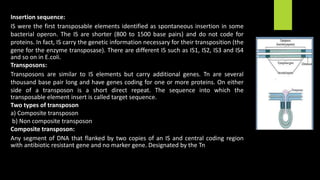
Barbara McClintock discovered transposons in corn in the 1940s. Transposons are DNA sequences that can change position within a genome through a "cut and paste" mechanism. There are two main types of transposons: those that move via a DNA intermediate, either replicatively or non-replicatively; and retrotransposons, which move via an RNA intermediate. Transposons make up about 45% of the human genome and can cause mutations by inserting into genes, though they are also used as tools for genetic engineering and mutagenesis experiments.