TRANSPOSABLE ELEMENTS
&
TRANSPOSABLE ELEMENTS IN
BACTERIA:
Insertion sequences (IS).
SEMINAR REPRESENTED BY
QAMRUNNISA ABDUL WAHID SHAIKH
MSC-II (MICROBIOLOGY)
MB702-Molecular biology
CONTENT:
Introduction
History
General characteristic
General mechanism
Classification
1) Retrotransposons
2) DNA transposons
Transposition
1) Replicative
2) Non replicative
Bacterial transposons
1) IS elements
2) Composite transposons
3)Non composite transposons
Effects of transposons
Uses of transposons
Conclusion
These are discrete sequences in the genome that are
mobile-they are able to transport themselves to other
locations within the genome.
Transposable elements make up a large fraction of the
genome and are responsible for much of the mass of DNA in
a eukaryotic cells.
TRANSPOSABLE ELEMENTS(TE)/JUMPING
GENES/MOBILE ELEMNETS:
These sequences are found in all organisms.
45% of human genome.
90% of maize genome
4
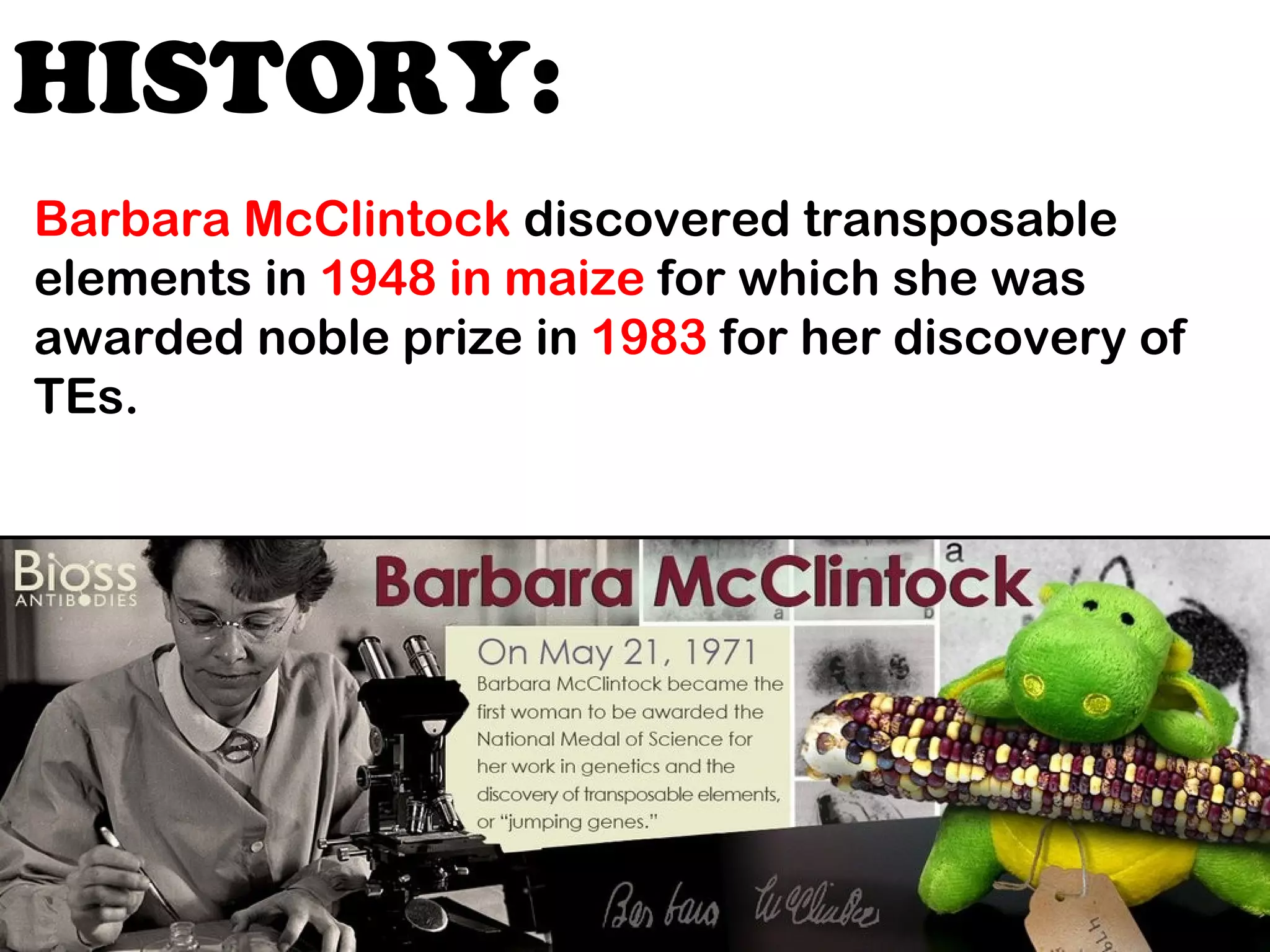
HISTORY:
Barbara McClintock discovered transposable
elements in 1948 in maize for which she was
awarded noble prize in 1983 for her discovery of
TEs.
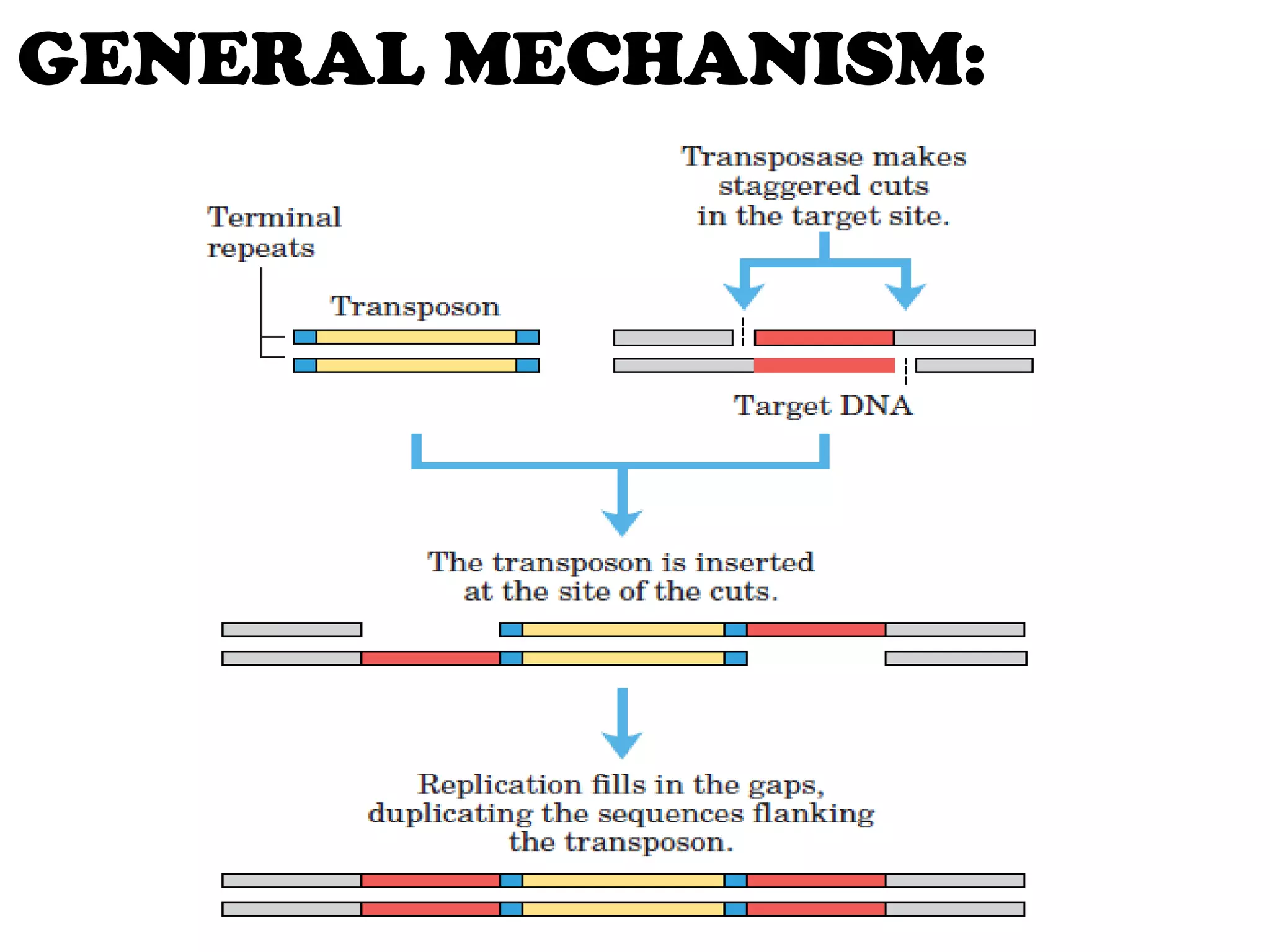
These elements encode enzymes that can
insert their sequence into new sites.
Terminal inverted repeats
are generally present
at the ends.
They generate direct repeats at the point of
insertion.
GENERAL CHARACTERISTICS:
GENERAL MECHANISM:
CLASSIFAICATION OF
TRANSPOSABLE ELEMENTS:
Yeast : Ty elements
Drosophilla : Copia
elements
LINES
SINES
Bacteria : IS elements
Drosophilla:Pelement
s
Corn : AC/ DC
elements
8
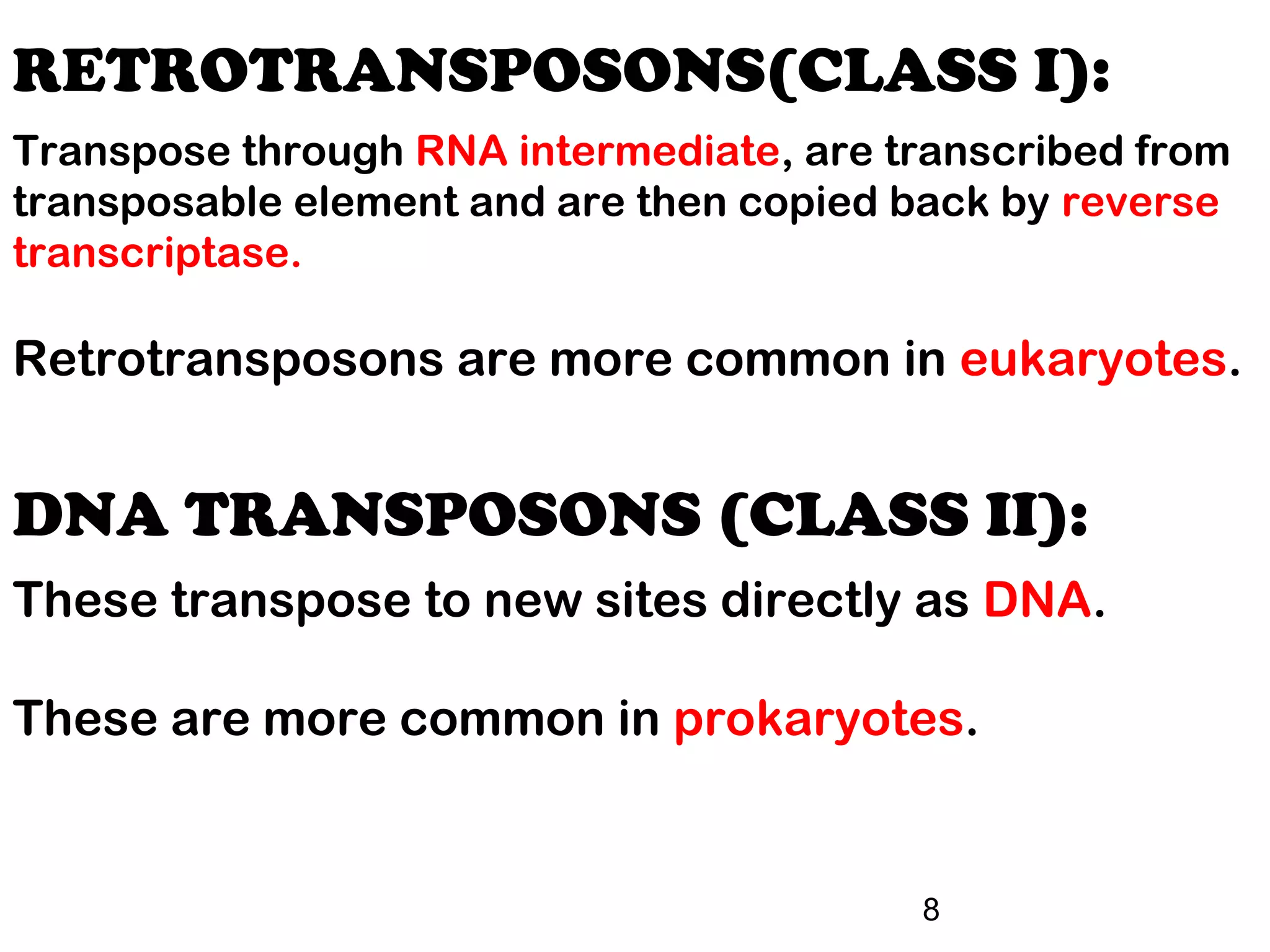
Transpose through RNA intermediate, are transcribed from
transposable element and are then copied back by reverse
transcriptase.
Retrotransposons are more common in eukaryotes.
RETROTRANSPOSONS(CLASS I):
DNA TRANSPOSONS (CLASS II):
These transpose to new sites directly as DNA.
These are more common in prokaryotes.
The process by which these sequences are copied and
inserted is called as transposition.
On the basis of mechanism involved.
TRANSPOSITION:
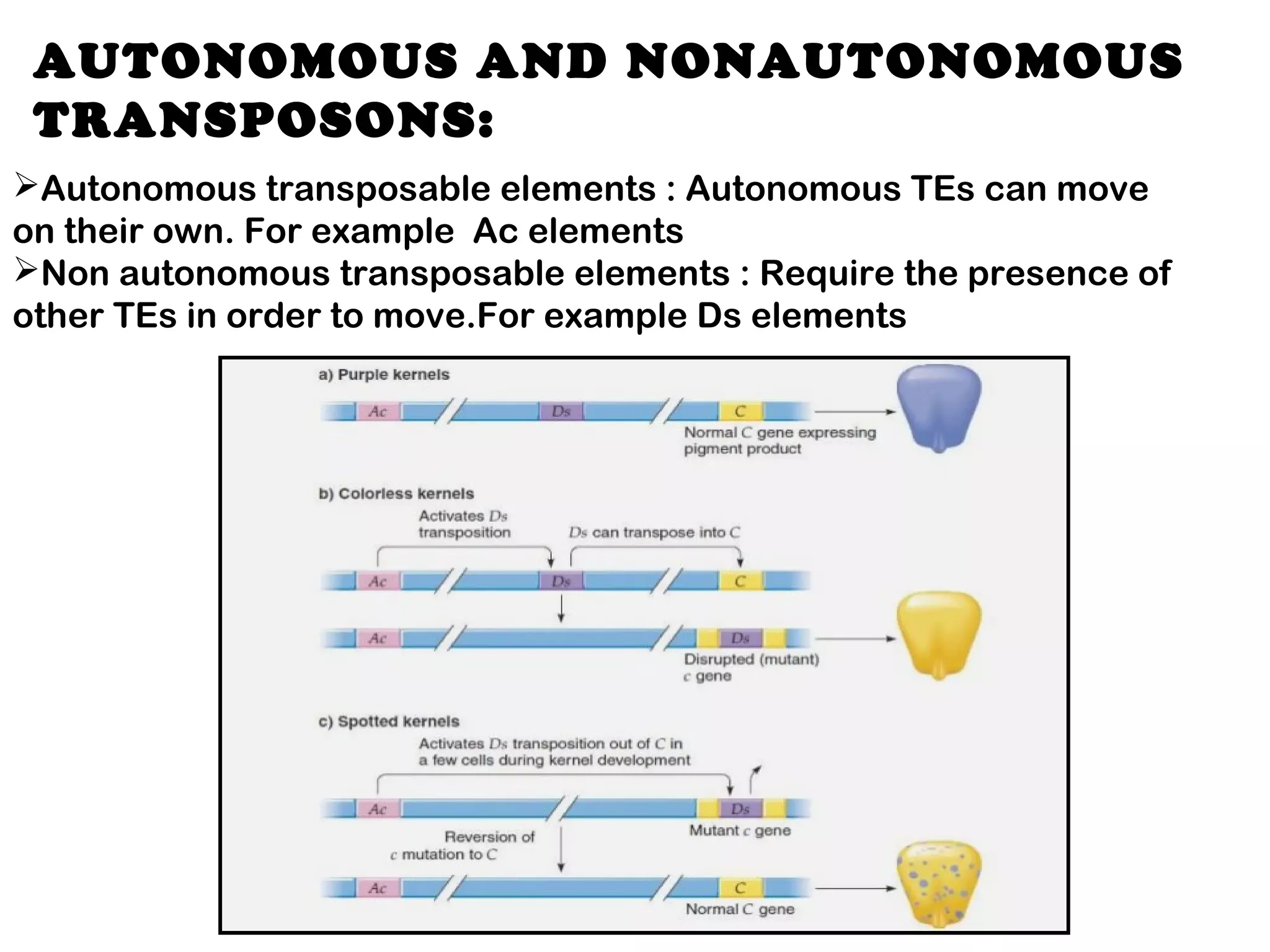
AUTONOMOUS AND NONAUTONOMOUS
TRANSPOSONS:
Autonomous transposable elements : Autonomous TEs can move
on their own. For example  Ac elements 
Non autonomous transposable elements : Require the presence of
other TEs in order to move.For example Ds elements
1.Insertion sequences (IS).
2.Composite transposons.
3.Non composite transposons.
They generally use non-replicative transposition.
TRANSPOSABLE
ELEMENTS IN BACTERIA:
1.INSERTION SEQUENCES (IS):
Simplest form of transposable elements found in prokaryotes.
First discovered in connection with genes controlling galactose
utillization in E.coli.
Prefix – IS followed by number. Examples: IS1,IS2,IS3 etc
700 IS elements
Normal constituent of bacterial chromosome and plasmid.
Autonomous unit
Short inverted repeats
Transposase
MAECHANISM OF TRANSPOSITION:
Transposons
Target
repeats
(bp)
Inverted
repeats
(bp)
Overall
length
(bp)
Target
selection
IS 1 9 23 768 Random
IS2 5 41 1327 Hotspot
IS3 11-13 18 1428 AAAN20TT
IS4 4 16 1195 Hotspot
IS10R 9 22 1329 NGCTNAGC
N
IS50R 9 9 1531 Hotspot
IS903 9 18 1057 Random
EXAMPLE:
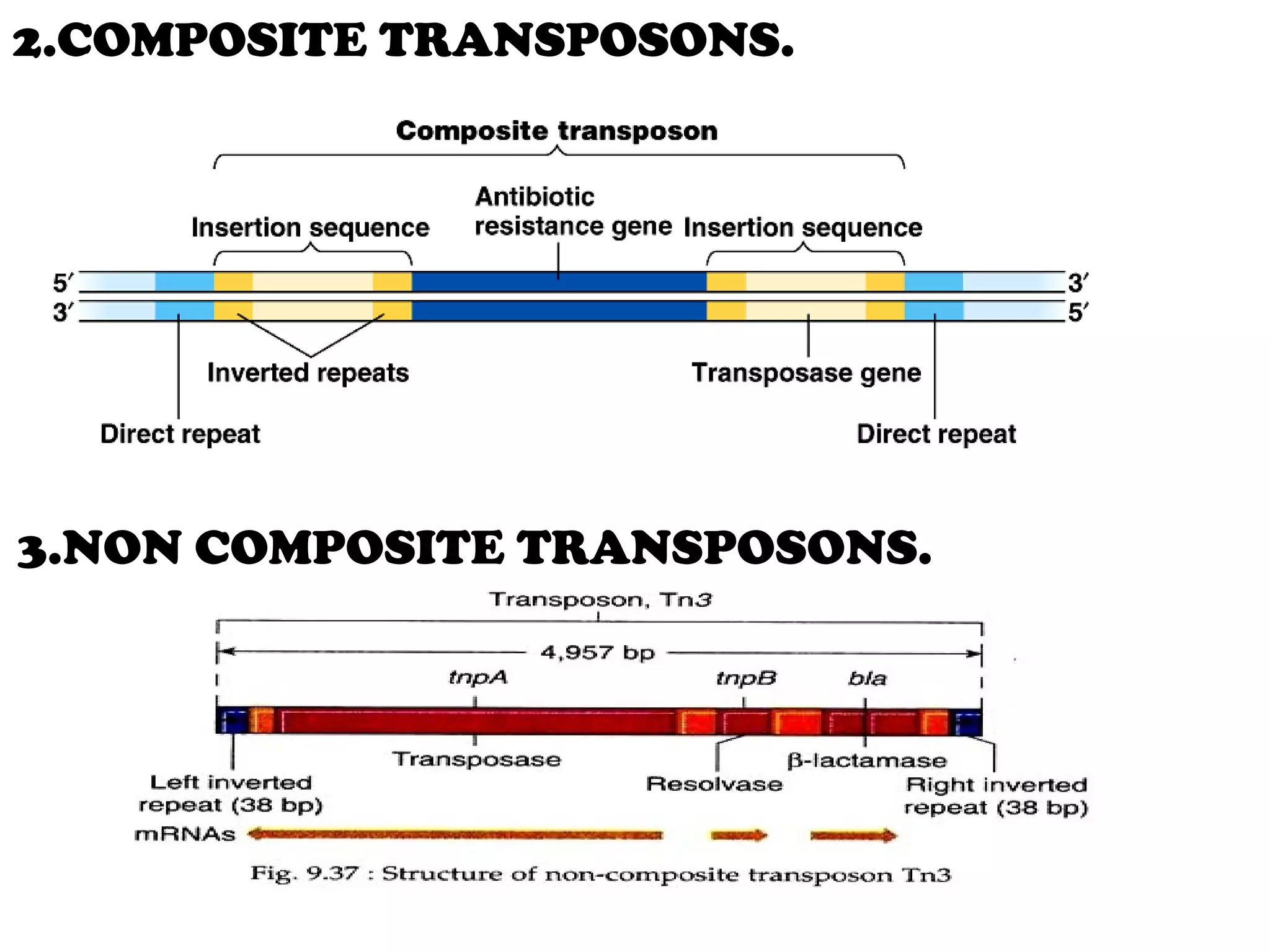
2.COMPOSITE TRANSPOSONS.
3.NON COMPOSITE TRANSPOSONS.
EFFECT :
Gene inactivation
Mutation
Gene alterations (Insertions, excisions, Duplication or
translocation)
Disease that are caused by TE:
Hemophilia A & B,
X-linked severe combined immunodeficiency,
Porphyria, cancer etc.
SO ARE TRANSPOSONS GOOD OR
USES :
Recent research has shown that transposons may help plants
respond and adapt to environmental stress by regulating other
genes.
In bacteria, transposons often carry genes that impart resistance
to antibiotic substances, helping the bacteria survive.
Insertional mutagenesis (induced mutation)
The Sleeping Beauty transposon system is a synthetic DNA
transposon designed to introduce precisely defined DNA
sequences into the chromosomes of vertebrate animals for
the purposes of introducing new traits and to discover new
genes and their functions
CONCLUSION:
Early view of mobile elements as junk DNA or completely
selfish molecular parasites appears to be premature.
Rather, they probably have made profound contributions to
the evolution of higher organisms by serving as the sites of
recombination, leading to the evolution of novel genes and
new controls on gene expressions.
REFRENCES:
GRIFFITHS_-_introduction_to_genetic_analysis
Lewin s Genes 11E (LSA Gwalior).pdf filename=UTF-8
Lewin 27s 20Genes 20(1)
Google
THANK YOU

Is elements transposons final

  • 1.
    TRANSPOSABLE ELEMENTS & TRANSPOSABLE ELEMENTSIN BACTERIA: Insertion sequences (IS). SEMINAR REPRESENTED BY QAMRUNNISA ABDUL WAHID SHAIKH MSC-II (MICROBIOLOGY) MB702-Molecular biology
  • 2.
    CONTENT: Introduction History General characteristic General mechanism Classification 1)Retrotransposons 2) DNA transposons Transposition 1) Replicative 2) Non replicative Bacterial transposons 1) IS elements 2) Composite transposons 3)Non composite transposons Effects of transposons Uses of transposons Conclusion
  • 3.
    These are discretesequences in the genome that are mobile-they are able to transport themselves to other locations within the genome. Transposable elements make up a large fraction of the genome and are responsible for much of the mass of DNA in a eukaryotic cells. TRANSPOSABLE ELEMENTS(TE)/JUMPING GENES/MOBILE ELEMNETS: These sequences are found in all organisms. 45% of human genome. 90% of maize genome
  • 4.
    4 HISTORY: Barbara McClintock discoveredtransposable elements in 1948 in maize for which she was awarded noble prize in 1983 for her discovery of TEs.
  • 5.
    These elements encodeenzymes that can insert their sequence into new sites. Terminal inverted repeats are generally present at the ends. They generate direct repeats at the point of insertion. GENERAL CHARACTERISTICS:
  • 6.
  • 7.
    CLASSIFAICATION OF TRANSPOSABLE ELEMENTS: Yeast: Ty elements Drosophilla : Copia elements LINES SINES Bacteria : IS elements Drosophilla:Pelement s Corn : AC/ DC elements
  • 8.
    8 Transpose through RNAintermediate, are transcribed from transposable element and are then copied back by reverse transcriptase. Retrotransposons are more common in eukaryotes. RETROTRANSPOSONS(CLASS I): DNA TRANSPOSONS (CLASS II): These transpose to new sites directly as DNA. These are more common in prokaryotes.
  • 10.
    The process bywhich these sequences are copied and inserted is called as transposition. On the basis of mechanism involved. TRANSPOSITION:
  • 11.
    AUTONOMOUS AND NONAUTONOMOUS TRANSPOSONS: Autonomoustransposable elements : Autonomous TEs can move on their own. For example  Ac elements  Non autonomous transposable elements : Require the presence of other TEs in order to move.For example Ds elements
  • 12.
    1.Insertion sequences (IS). 2.Compositetransposons. 3.Non composite transposons. They generally use non-replicative transposition. TRANSPOSABLE ELEMENTS IN BACTERIA:
  • 13.
    1.INSERTION SEQUENCES (IS): Simplestform of transposable elements found in prokaryotes. First discovered in connection with genes controlling galactose utillization in E.coli. Prefix – IS followed by number. Examples: IS1,IS2,IS3 etc 700 IS elements Normal constituent of bacterial chromosome and plasmid. Autonomous unit Short inverted repeats Transposase
  • 14.
  • 15.
    Transposons Target repeats (bp) Inverted repeats (bp) Overall length (bp) Target selection IS 1 923 768 Random IS2 5 41 1327 Hotspot IS3 11-13 18 1428 AAAN20TT IS4 4 16 1195 Hotspot IS10R 9 22 1329 NGCTNAGC N IS50R 9 9 1531 Hotspot IS903 9 18 1057 Random EXAMPLE:
  • 16.
  • 17.
    EFFECT : Gene inactivation Mutation Genealterations (Insertions, excisions, Duplication or translocation) Disease that are caused by TE: Hemophilia A & B, X-linked severe combined immunodeficiency, Porphyria, cancer etc. SO ARE TRANSPOSONS GOOD OR
  • 18.
    USES : Recent researchhas shown that transposons may help plants respond and adapt to environmental stress by regulating other genes. In bacteria, transposons often carry genes that impart resistance to antibiotic substances, helping the bacteria survive. Insertional mutagenesis (induced mutation) The Sleeping Beauty transposon system is a synthetic DNA transposon designed to introduce precisely defined DNA sequences into the chromosomes of vertebrate animals for the purposes of introducing new traits and to discover new genes and their functions
  • 19.
    CONCLUSION: Early view ofmobile elements as junk DNA or completely selfish molecular parasites appears to be premature. Rather, they probably have made profound contributions to the evolution of higher organisms by serving as the sites of recombination, leading to the evolution of novel genes and new controls on gene expressions.
  • 20.
    REFRENCES: GRIFFITHS_-_introduction_to_genetic_analysis Lewin s Genes11E (LSA Gwalior).pdf filename=UTF-8 Lewin 27s 20Genes 20(1) Google
  • 22.