TOPIC : STARVATION STRESS RESPONSE
PRESENTED BY:
TEJASWINI PETKAR
CONTENTS
 INTRODUCTION
 COMPONENTS OF STARVATION STRESS
RESPONSES
 STRINGENT RESPONSE
 OLIGOTROPHS
 STARVATION STRESS IN E.coli
 STARVATION STRESS IN SALMONELLA
 ADAPTATION OF BACTERIAL CELL DURING
STARVATION STRESS RESPONSE- RESISTANT
CELL
 CONCLUSION
 REFERENCES
INTRODUCTION
 A significant environmental impact on bacteria is stress, which, in effecting a myriad of
adaptive and protective responses, alters gene expression patterns and cell physiology in
ways that can and do influence antimicrobial susceptibility. This occurs indirectly, as a
result of stress-induced growth cessation or dormancy (due to starvation).
 In the lifecycle of microorganisms, prolonged starvation is prevalent and sustaining life
during starvation periods is a vital task.
 Starvation survival is defined as the ability to withstand long periods without energy
yielding substrates
 Nutritional stress can change bacterial morphology. The most frequent shape alteration
may be filamentation triggered by a limitation in the availability of one or more nutrients.
 Many species of gram-positive bacteria produce dormant spores in response to starvation.
By contrast, many gram negative bacteria develop resistance cells without dormancy.
 Stationary phases are distinct from starved cells. Cells in the former have stopped growing
following log phase in rich or non limiting media while in the latter cells have ceased
growing in response to exhaustion of one or more defined nutrients.
COMPONENTS OF STARVATION
STRESS RESPONSES
 Starvation of many non differentiating bacteria such as E.coli and Salmonella respond to starvation of
an essential nutrient like carbon by inducing expression of 50 or so new proteins or preexisting proteins.
 During bacterial starvation the USP genes upregulated will often arrest cell growth and promote its
metabolism to adapt to sparse nutrients(Siegele DA et al., 2005). The universal stress protein (USP)
domain is a superfamily of conserved genes which is induced by many environmental stressors such as
nutrient starvation.
 FadR( regulator of fatty acid metabolism) binds to medium/long chain fatty acyl CoA and represses
fatty acid biosynthesis genes and activates fatty acid degradation genes.
 Lrp (leucine responsive protein) which controls certain aspects of amino acid metabolism.
 Low levels of carbon, nitrogen or phosphorus, as well as amino acid starvation, trigger RpoS synthesis
(Gentry et al., 1993; Hengge, 2008). Induction of RpoS changes the gene expression pattern, aiming to
produce a more resistant cell.
 Proteins RelA and SpoT are both in charge of adjusting ppGpp concentration within the cell (Cashel
et al., 1996). ppGpp is a key factor (unusual nucleotide found during bacterial stress starvation) in
bacterial physiology because it responds rapidly to diverse stresses, shutting down growth and priming
cellular defensive and adaptive processes (Magnusson et al., 2005; Srivatsan & Wang, 2008).
STRINGENT RESPONSE
 Stringent Response, also called stringent control, is a stress response that occurs in bacteria in
reaction to amino-acid starvation, fatty acid limitation, iron limitation, heat shock, and other
stress conditions.
 During this control, bacteria experience conditions that limit the availability of one or more
amino acids (shift from rich medium to minimal medium) or exhaust their primary carbon source,
growth stops temporarily and rapid adjustments in metabolism occur.
 Here cells respond to amino acid starvation by downregulating rRNA biosynthesis, ribosomal
proteins and DNA replication, and upregulating the levels of RpoS, stress protein and amino acid
biosynthesis (Magnusson et al., 2005).
 Stringent response collectively enhances cellular viability during periods of amino acid or energy
limitation and allows rapid recovery and reinitiation of growth when conditions improve.
 In bacteria stringent response is mediated by a variety of RelA/SpoT Homologue (RSH) proteins.
Proteins RelA and SpoT are both in charge of adjusting ppGpp concentration within the cell
(Cashel et al., 1996).
RelA and SpoT are both in charge of adjusting ppGpp concentration within the cell.
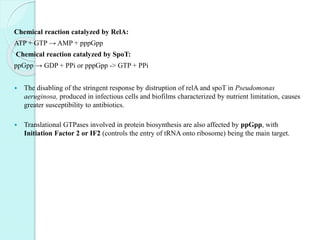
Chemical reaction catalyzed by RelA:
ATP + GTP → AMP + pppGpp
Chemical reaction catalyzed by SpoT:
ppGpp → GDP + PPi or pppGpp -> GTP + PPi
 The disabling of the stringent response by distruption of relA and spoT in Pseudomonas
aeruginosa, produced in infectious cells and biofilms characterized by nutrient limitation, causes
greater susceptibility to antibiotics.
 Translational GTPases involved in protein biosynthesis are also affected by ppGpp, with
Initiation Factor 2 or IF2 (controls the entry of tRNA onto ribosome) being the main target.
OLIGOTROPHS
 An oligotroph is an organism that thrives in an environment that offers very low levels of
nutrients.
 Oligotrophs are characterized by slow growth, low rates of metabolism, and generally low
population density.
 Oligotrophic environments and competition among microorganisms force bacteria to be able to
adapt quickly to rough and changing situations. A particular lifestyle composed of continuous
cycles of growth and starvation is commonly referred to as feast and famine.
 Bacteria have developed many different mechanisms to survive in nutrient-depleted and harsh
environments, varying from producing a more resistant vegetative cell to complex developmental
programmes.
 The entrance to the stationary phase in oligotrophs is a very regulated process governed by the
alternative sigma factor RpoS. Induction of RpoS changes the gene expression pattern, aiming to
produce a more resistant cell.
STARVATION STRESS IN E.coli
 When microorganisms encounter nutrient deprivation or starvation conditions, they can carry out
starvation-induced activities such as production of degradative enzymes such as proteases, lipases,
and substrate capturing enzymes such as glutamine synthetase, and alkaline phosphatase
(Kjelleberg and others 1987; Matin and others 1989; Siegle and Kolter 1992).
 When E. coli cells enter the stationary phase, a depletion of nutrients or starvation conditions are
encountered, and a number of morphological and physiological changes occur.
 Cells became smaller and rounder, the cells accumulated storage compounds such as glycogen and
polyphosphate, and the DNA condensed (Nystrom 1995; Huisman and others 1996).
 There were a number of changes in the fatty acid composition of the inner membrane and in the
protein composition of both inner and outer membranes in E. coli (Huisman and others 1996;
DiRusso and Nystrom 1998).
 RpoS is the major regulator of the stationary phase or general stress response in E. coli and other
enteric bacteria. This alternative sigma factor has been recognized as a key factor in producing
greater resistance of stationary phase and stressed cells.

 In E. coli, two classes of genes encoding starvation proteins have been defined. These are
the cst genes, controlled by carbon starvation, and the pex genes, controlled by carbon,
nitrogen, or phosphorus starvation (Martin 1991). The Pex (postexponential) proteins
played a significant role in coping with starvation stress in E. coli (Reeve and others 1984).
Several Pex proteins were induced during heat or oxidation stress and have been correlated
with the enhanced thermal and oxidative resistance that developed during starvation in E.
coli.
STARVATION STRESS IN
SALMONELLA
 One of the most common stresses is starvation for an essential nutrient such as a carbon/energy
(C)-source since Salmonellae occupy and survive in a wide range of niches where they can
encounter an even broader range of environmental stresses.
 The genetic loci whose expression increases in response to the starvation-stress compose the
SSR stimulon. Several loci of the SSR stimulon have been identified in Salmonella typhimurium
and grouped, based on putative or known functions or products, into transport systems, C-
compound catabolic enzymes, known protective enzymes, respiratory enzyme systems,
regulatory proteins, virulence loci and unclassified products. The majority of loci identified are
under positive control by the rpoS-encoded sigma factor, sigma S.
 Several SSR or stress starvation response loci are required for long-term starvation-survival
(core SSR loci), e.g. narZ, dadA, stiC and rpoS. In addition, a few of the core SSR loci are also
required for stress-specific-inducible and/or C-starvation-inducible resistance to H2O2 (e.g.
stiC), thermal (e.g. stiC), and/or acid pH (e.g. narZ), challenge. Interestingly, C-starved cells are
resistant to challenge with the antimicrobial peptide, polymyxin B.
 Furthermore, a link between the SSR and Salmonella virulence can be hypothesized; the spv
(Salmonella plasmid-associated virulence) genes, required for Salmonella to cause systemic
disease, are C (and P- and N-)-starvation-inducible.
ADAPTATION OF BACTERIAL CELL
DURING STARVATION STRESS
RESPONSE- RESISTANT CELL
 It is foremostly characterized by the accumulation of RpoS (with respect to cellulr physiology).
 Cells are smaller as the result of two processes, reductive division and dwarfing.
 Reductive division increases the surface/volume ratio, producing spherical cells.
 Dwarfing is a form of self-digestion and is the result of degradation of endogenous cell material,
especially from the cytoplasmic and the outer membranes.
 The periplasm accumulates membrane-derived oligosaccharides, such as trehalose, which function
as osmoprotectants.
 Alterations in the cell envelope occur together with changes in the cytoplasm. The nucleoid
becomes condensed to protect the DNA. Nucleoid condensation requires Dps (DNA-binding
protein from starved cells), a nonspecific DNA-binding protein that preferentially acts during
starvation .
 Starved microorganisms slow their growth rate dramatically and reduce protein synthesis (about
20%) and levels of rRNA and tRNA compared with cells in exponential growth.
 The activity of transport systems and the metabolism of carbohydrates, amino acids and
phospholipids are decreased as well.
 On the other hand, protein turnover increases fivefold in famished E. coli cells, as many of the
proteins synthesized in the early stages of starvation are proteases and peptidases (Groat et al.,
1986).

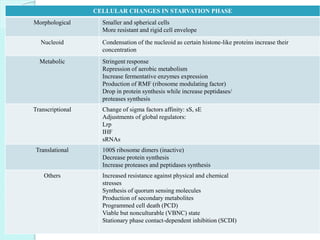
CELLULAR CHANGES IN STARVATION PHASE
Morphological Smaller and spherical cells
More resistant and rigid cell envelope
Nucleoid Condensation of the nucleoid as certain histone-like proteins increase their
concentration
Metabolic Stringent response
Repression of aerobic metabolism
Increase fermentative enzymes expression
Production of RMF (ribosome modulating factor)
Drop in protein synthesis while increase peptidases/
proteases synthesis
Transcriptional Change of sigma factors affinity: sS, sE
Adjustments of global regulators:
Lrp
IHF
sRNAs
Translational 100S ribosome dimers (inactive)
Decrease protein synthesis
Increase proteases and peptidases synthesis
Others Increased resistance against physical and chemical
stresses
Synthesis of quorum sensing molecules
Production of secondary metabolites
Programmed cell death (PCD)
Viable but nonculturable (VBNC) state
Stationary phase contact-dependent inhibition (SCDI)
CONCLUSION
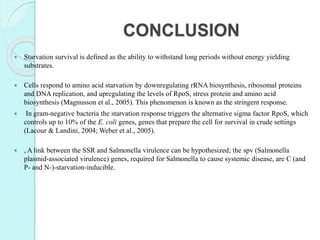
 Starvation survival is defined as the ability to withstand long periods without energy yielding
substrates.
 Cells respond to amino acid starvation by downregulating rRNA biosynthesis, ribosomal proteins
and DNA replication, and upregulating the levels of RpoS, stress protein and amino acid
biosynthesis (Magnusson et al., 2005). This phenomenon is known as the stringent response.
 In gram-negative bacteria the starvation response triggers the alternative sigma factor RpoS, which
controls up to 10% of the E. coli genes, genes that prepare the cell for survival in crude settings
(Lacour & Landini, 2004; Weber et al., 2005).
 , A link between the SSR and Salmonella virulence can be hypothesized; the spv (Salmonella
plasmid-associated virulence) genes, required for Salmonella to cause systemic disease, are C (and
P- and N-)-starvation-inducible.
REFERENCES
 Keith Poole (2012); Bacterial stress responses as determinants of antimicrobial resistance ;J
Antimicrob Chemother 2012; 67: 2069–2089.
 H.J. Chung, W. Bang, and M.A. Drake (2006) ; Stress Response of Escherichia coli ;
comprehensive reviews in food science and food safety—vol. 5, 2006.
 Juana Mar´ıa Navarro Llorens et al ; Stationary phase in gram-negative bacteria; Final version
published online 8 March 2010.; DOI:10.1111/j.1574-6976.2010.00213.x
 https://courses.lumenlearning.com/boundless-microbiology/chapter/cell-differentiation-and-
starvation/
 Albert G Moat, Michael P spector John and John W Foster : Microbial physiology (2009) third
edt.
 Spector MP et al., 1998 ; The starvation-stress response (SSR) of Salmonella ; Adv Microb
Physiol. 1998;40:233-79.

Starvation Stress Response (Bacterial)

  • 1.
    TOPIC : STARVATIONSTRESS RESPONSE PRESENTED BY: TEJASWINI PETKAR
  • 2.
    CONTENTS  INTRODUCTION  COMPONENTSOF STARVATION STRESS RESPONSES  STRINGENT RESPONSE  OLIGOTROPHS  STARVATION STRESS IN E.coli  STARVATION STRESS IN SALMONELLA  ADAPTATION OF BACTERIAL CELL DURING STARVATION STRESS RESPONSE- RESISTANT CELL  CONCLUSION  REFERENCES
  • 3.
    INTRODUCTION  A significantenvironmental impact on bacteria is stress, which, in effecting a myriad of adaptive and protective responses, alters gene expression patterns and cell physiology in ways that can and do influence antimicrobial susceptibility. This occurs indirectly, as a result of stress-induced growth cessation or dormancy (due to starvation).  In the lifecycle of microorganisms, prolonged starvation is prevalent and sustaining life during starvation periods is a vital task.  Starvation survival is defined as the ability to withstand long periods without energy yielding substrates  Nutritional stress can change bacterial morphology. The most frequent shape alteration may be filamentation triggered by a limitation in the availability of one or more nutrients.  Many species of gram-positive bacteria produce dormant spores in response to starvation. By contrast, many gram negative bacteria develop resistance cells without dormancy.  Stationary phases are distinct from starved cells. Cells in the former have stopped growing following log phase in rich or non limiting media while in the latter cells have ceased growing in response to exhaustion of one or more defined nutrients.
  • 4.
    COMPONENTS OF STARVATION STRESSRESPONSES  Starvation of many non differentiating bacteria such as E.coli and Salmonella respond to starvation of an essential nutrient like carbon by inducing expression of 50 or so new proteins or preexisting proteins.  During bacterial starvation the USP genes upregulated will often arrest cell growth and promote its metabolism to adapt to sparse nutrients(Siegele DA et al., 2005). The universal stress protein (USP) domain is a superfamily of conserved genes which is induced by many environmental stressors such as nutrient starvation.  FadR( regulator of fatty acid metabolism) binds to medium/long chain fatty acyl CoA and represses fatty acid biosynthesis genes and activates fatty acid degradation genes.  Lrp (leucine responsive protein) which controls certain aspects of amino acid metabolism.  Low levels of carbon, nitrogen or phosphorus, as well as amino acid starvation, trigger RpoS synthesis (Gentry et al., 1993; Hengge, 2008). Induction of RpoS changes the gene expression pattern, aiming to produce a more resistant cell.  Proteins RelA and SpoT are both in charge of adjusting ppGpp concentration within the cell (Cashel et al., 1996). ppGpp is a key factor (unusual nucleotide found during bacterial stress starvation) in bacterial physiology because it responds rapidly to diverse stresses, shutting down growth and priming cellular defensive and adaptive processes (Magnusson et al., 2005; Srivatsan & Wang, 2008).
  • 5.
    STRINGENT RESPONSE  StringentResponse, also called stringent control, is a stress response that occurs in bacteria in reaction to amino-acid starvation, fatty acid limitation, iron limitation, heat shock, and other stress conditions.  During this control, bacteria experience conditions that limit the availability of one or more amino acids (shift from rich medium to minimal medium) or exhaust their primary carbon source, growth stops temporarily and rapid adjustments in metabolism occur.  Here cells respond to amino acid starvation by downregulating rRNA biosynthesis, ribosomal proteins and DNA replication, and upregulating the levels of RpoS, stress protein and amino acid biosynthesis (Magnusson et al., 2005).  Stringent response collectively enhances cellular viability during periods of amino acid or energy limitation and allows rapid recovery and reinitiation of growth when conditions improve.  In bacteria stringent response is mediated by a variety of RelA/SpoT Homologue (RSH) proteins. Proteins RelA and SpoT are both in charge of adjusting ppGpp concentration within the cell (Cashel et al., 1996). RelA and SpoT are both in charge of adjusting ppGpp concentration within the cell.
  • 6.
    Chemical reaction catalyzedby RelA: ATP + GTP → AMP + pppGpp Chemical reaction catalyzed by SpoT: ppGpp → GDP + PPi or pppGpp -> GTP + PPi  The disabling of the stringent response by distruption of relA and spoT in Pseudomonas aeruginosa, produced in infectious cells and biofilms characterized by nutrient limitation, causes greater susceptibility to antibiotics.  Translational GTPases involved in protein biosynthesis are also affected by ppGpp, with Initiation Factor 2 or IF2 (controls the entry of tRNA onto ribosome) being the main target.
  • 7.
    OLIGOTROPHS  An oligotrophis an organism that thrives in an environment that offers very low levels of nutrients.  Oligotrophs are characterized by slow growth, low rates of metabolism, and generally low population density.  Oligotrophic environments and competition among microorganisms force bacteria to be able to adapt quickly to rough and changing situations. A particular lifestyle composed of continuous cycles of growth and starvation is commonly referred to as feast and famine.  Bacteria have developed many different mechanisms to survive in nutrient-depleted and harsh environments, varying from producing a more resistant vegetative cell to complex developmental programmes.  The entrance to the stationary phase in oligotrophs is a very regulated process governed by the alternative sigma factor RpoS. Induction of RpoS changes the gene expression pattern, aiming to produce a more resistant cell.
  • 8.
    STARVATION STRESS INE.coli  When microorganisms encounter nutrient deprivation or starvation conditions, they can carry out starvation-induced activities such as production of degradative enzymes such as proteases, lipases, and substrate capturing enzymes such as glutamine synthetase, and alkaline phosphatase (Kjelleberg and others 1987; Matin and others 1989; Siegle and Kolter 1992).  When E. coli cells enter the stationary phase, a depletion of nutrients or starvation conditions are encountered, and a number of morphological and physiological changes occur.  Cells became smaller and rounder, the cells accumulated storage compounds such as glycogen and polyphosphate, and the DNA condensed (Nystrom 1995; Huisman and others 1996).  There were a number of changes in the fatty acid composition of the inner membrane and in the protein composition of both inner and outer membranes in E. coli (Huisman and others 1996; DiRusso and Nystrom 1998).  RpoS is the major regulator of the stationary phase or general stress response in E. coli and other enteric bacteria. This alternative sigma factor has been recognized as a key factor in producing greater resistance of stationary phase and stressed cells. 
  • 9.
     In E.coli, two classes of genes encoding starvation proteins have been defined. These are the cst genes, controlled by carbon starvation, and the pex genes, controlled by carbon, nitrogen, or phosphorus starvation (Martin 1991). The Pex (postexponential) proteins played a significant role in coping with starvation stress in E. coli (Reeve and others 1984). Several Pex proteins were induced during heat or oxidation stress and have been correlated with the enhanced thermal and oxidative resistance that developed during starvation in E. coli.
  • 10.
    STARVATION STRESS IN SALMONELLA One of the most common stresses is starvation for an essential nutrient such as a carbon/energy (C)-source since Salmonellae occupy and survive in a wide range of niches where they can encounter an even broader range of environmental stresses.  The genetic loci whose expression increases in response to the starvation-stress compose the SSR stimulon. Several loci of the SSR stimulon have been identified in Salmonella typhimurium and grouped, based on putative or known functions or products, into transport systems, C- compound catabolic enzymes, known protective enzymes, respiratory enzyme systems, regulatory proteins, virulence loci and unclassified products. The majority of loci identified are under positive control by the rpoS-encoded sigma factor, sigma S.  Several SSR or stress starvation response loci are required for long-term starvation-survival (core SSR loci), e.g. narZ, dadA, stiC and rpoS. In addition, a few of the core SSR loci are also required for stress-specific-inducible and/or C-starvation-inducible resistance to H2O2 (e.g. stiC), thermal (e.g. stiC), and/or acid pH (e.g. narZ), challenge. Interestingly, C-starved cells are resistant to challenge with the antimicrobial peptide, polymyxin B.  Furthermore, a link between the SSR and Salmonella virulence can be hypothesized; the spv (Salmonella plasmid-associated virulence) genes, required for Salmonella to cause systemic disease, are C (and P- and N-)-starvation-inducible.
  • 11.
    ADAPTATION OF BACTERIALCELL DURING STARVATION STRESS RESPONSE- RESISTANT CELL  It is foremostly characterized by the accumulation of RpoS (with respect to cellulr physiology).  Cells are smaller as the result of two processes, reductive division and dwarfing.  Reductive division increases the surface/volume ratio, producing spherical cells.  Dwarfing is a form of self-digestion and is the result of degradation of endogenous cell material, especially from the cytoplasmic and the outer membranes.  The periplasm accumulates membrane-derived oligosaccharides, such as trehalose, which function as osmoprotectants.  Alterations in the cell envelope occur together with changes in the cytoplasm. The nucleoid becomes condensed to protect the DNA. Nucleoid condensation requires Dps (DNA-binding protein from starved cells), a nonspecific DNA-binding protein that preferentially acts during starvation .
  • 12.
     Starved microorganismsslow their growth rate dramatically and reduce protein synthesis (about 20%) and levels of rRNA and tRNA compared with cells in exponential growth.  The activity of transport systems and the metabolism of carbohydrates, amino acids and phospholipids are decreased as well.  On the other hand, protein turnover increases fivefold in famished E. coli cells, as many of the proteins synthesized in the early stages of starvation are proteases and peptidases (Groat et al., 1986). 
  • 13.
    CELLULAR CHANGES INSTARVATION PHASE Morphological Smaller and spherical cells More resistant and rigid cell envelope Nucleoid Condensation of the nucleoid as certain histone-like proteins increase their concentration Metabolic Stringent response Repression of aerobic metabolism Increase fermentative enzymes expression Production of RMF (ribosome modulating factor) Drop in protein synthesis while increase peptidases/ proteases synthesis Transcriptional Change of sigma factors affinity: sS, sE Adjustments of global regulators: Lrp IHF sRNAs Translational 100S ribosome dimers (inactive) Decrease protein synthesis Increase proteases and peptidases synthesis Others Increased resistance against physical and chemical stresses Synthesis of quorum sensing molecules Production of secondary metabolites Programmed cell death (PCD) Viable but nonculturable (VBNC) state Stationary phase contact-dependent inhibition (SCDI)
  • 14.
    CONCLUSION  Starvation survivalis defined as the ability to withstand long periods without energy yielding substrates.  Cells respond to amino acid starvation by downregulating rRNA biosynthesis, ribosomal proteins and DNA replication, and upregulating the levels of RpoS, stress protein and amino acid biosynthesis (Magnusson et al., 2005). This phenomenon is known as the stringent response.  In gram-negative bacteria the starvation response triggers the alternative sigma factor RpoS, which controls up to 10% of the E. coli genes, genes that prepare the cell for survival in crude settings (Lacour & Landini, 2004; Weber et al., 2005).  , A link between the SSR and Salmonella virulence can be hypothesized; the spv (Salmonella plasmid-associated virulence) genes, required for Salmonella to cause systemic disease, are C (and P- and N-)-starvation-inducible.
  • 15.
    REFERENCES  Keith Poole(2012); Bacterial stress responses as determinants of antimicrobial resistance ;J Antimicrob Chemother 2012; 67: 2069–2089.  H.J. Chung, W. Bang, and M.A. Drake (2006) ; Stress Response of Escherichia coli ; comprehensive reviews in food science and food safety—vol. 5, 2006.  Juana Mar´ıa Navarro Llorens et al ; Stationary phase in gram-negative bacteria; Final version published online 8 March 2010.; DOI:10.1111/j.1574-6976.2010.00213.x  https://courses.lumenlearning.com/boundless-microbiology/chapter/cell-differentiation-and- starvation/  Albert G Moat, Michael P spector John and John W Foster : Microbial physiology (2009) third edt.  Spector MP et al., 1998 ; The starvation-stress response (SSR) of Salmonella ; Adv Microb Physiol. 1998;40:233-79.