BACTERIAL TRANSPOSONS S.FEROSEKHAN FNB-41
TRANSPOSONS “ Transposable elements” “ Jumping genes” Mobile DNA  able to move from one place to another within a cell’s genome sometimes a copy is made and the copy moves insertion requires target DNA sequences
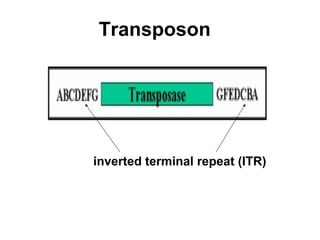
Transposon inverted terminal repeat (ITR)
In the process, they may - cause mutations. - increase (or decrease) the amount of  DNA in the genome. - promote genome rearrangements. - regulate gene expression.  - induce chromosome breakage and rearrangement.
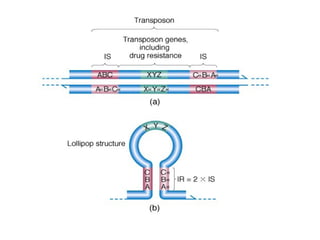
Discovery of transposons Barbara McClintock 1950’s Ac Ds system in maize influencing kernel color  unstable elements changing map position promote chromosomal breaks.   Rediscovery of bacterial insertion sequences source of polar mutations discrete change in physical length of DNA inverted repeat ends: form “lollipops” in EM after denaturation.
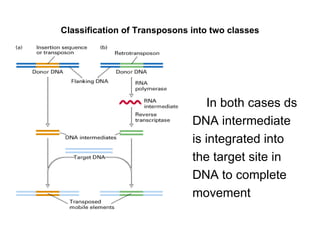
These mobile segments of DNA are sometimes called  "jumping genes" There are two distinct types of transposons: 1)  DNA transposons  -transposons consisting only of DNA that moves directly from place to place 2) Retrotransposons  - first transcribe the DNA into RNA and then - use reverse transcriptase to make a DNA copy    of the RNA to insert in a new location
Classification of Transposons into two classes In both cases ds DNA intermediate is integrated into the target site in DNA to complete movement
BACTERIAL TRANSPOSONS ●   In bacteria, transposons can jump from chromosomal DNA to plasmid DNA and back. ●  Transposons in bacteria usually carry an additional gene for function other than transposition---often for antibiotic resistance. ●   Bacterial transposons of this type belong to the Tn family. When the transposable elements lack additional genes, they are known as insertion sequences.
BACTERIAL TRANSPOSONS - TYPES 1. Insertion sequence 2.Composite transposon 3.Tn3-type transposon 4.Transposable phage
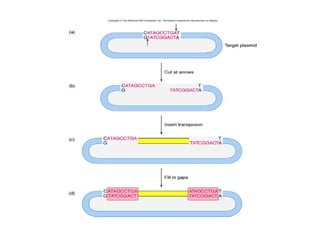
1.Insertion sequences Insertion sequences  – IS1 and IS186, present in  the 50-kb segment of the  E. coli  DNA, are examples of DNA transposons. Single  E. coli  genome may contain 20 of them. Most of the sequence is taken by one or two genes for  transposase  enzyme that catalyses transposition. IS elements transpose either replicatively or  conservatively.
cont…. IS elements Study of  E. coli  mutations resulting from insertion of 1-2 kb long sequence in the middle of certain genes. Inserted stretches or insertion sequences – could be visualized  by EM. IS - molecular parasites in bacterial cells. Transposition of IS is very rare – one in 105-107 cells per generation. Higher rates result in greater mutation rates.
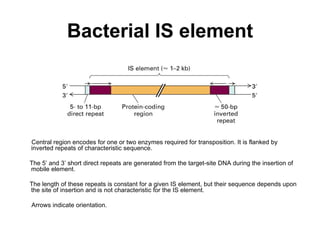
Bacterial IS element Central region encodes for one or two enzymes required for transposition. It is flanked by inverted repeats of characteristic sequence. The 5’ and 3’ short direct repeats are generated from the target-site DNA during the insertion of mobile element. The length of these repeats is constant for a given IS element, but their sequence depends upon the site of insertion and is not characteristic for the IS element. Arrows indicate orientation.
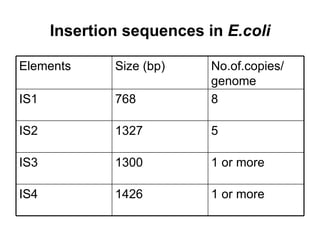
Insertion sequences in  E.coli 1 or more 1426 IS4 1 or more 1300 IS3 5 1327 IS2 8 768 IS1 No.of.copies/  genome  Size (bp) Elements
 
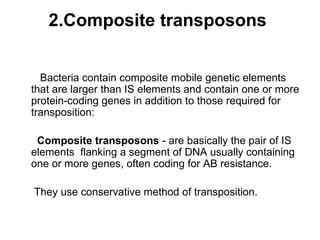
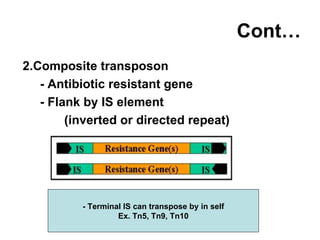
2.Composite transposons  Bacteria contain composite mobile genetic elements that are larger than IS elements and contain one or more protein-coding genes in addition to those required for transposition: Composite transposons  - are basically the pair of IS elements  flanking a segment of DNA usually containing one or more genes, often coding for AB resistance. They use conservative method of transposition.
Cont… 2.Composite transposon - Antibiotic resistant gene - Flank by IS element (inverted or directed repeat) - Terminal IS can transpose by in self Ex. Tn5, Tn9, Tn10
 
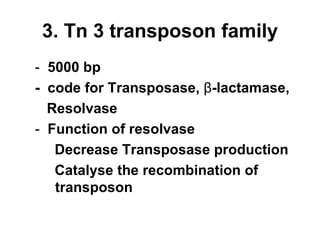
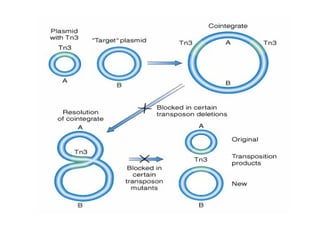
3. Tn 3 transposon family -  5000 bp -  code for Transposase,  β -lactamase, Resolvase -  Function of resolvase Decrease Transposase production Catalyse the recombination of     transposon
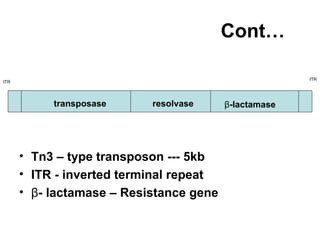
Cont… Tn3 – type transposon --- 5kb ITR - inverted terminal repeat β - lactamase – Resistance gene ITR ITR resolvase transposase β -lactamase
 
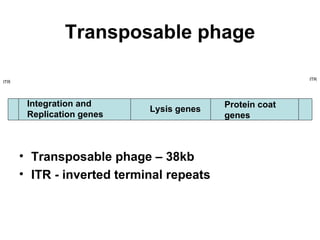
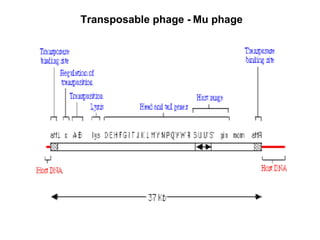
4.Transposable phage Transposable phages – bacterial viruses which tranpose replicatively as a part of their normal infectious cycle. Integrate into  E. coli  chromosome at  regulatory element Eg. Mu phage
Transposable phage Transposable phage – 38kb  ITR - inverted terminal repeats ITR ITR Lysis genes Integration and  Replication genes Protein coat genes
Transposable phage -   Mu phage
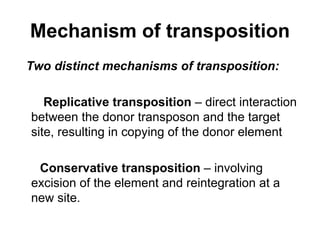
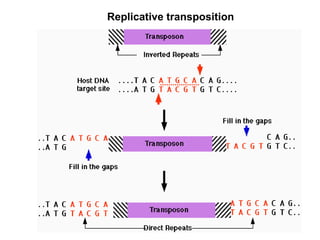
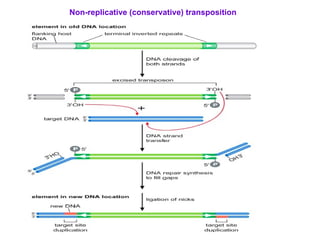
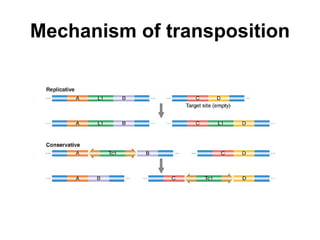
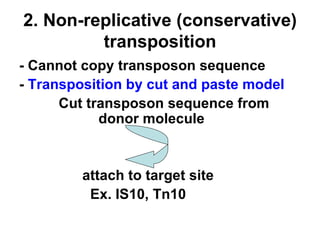
Mechanism of transposition Two distinct mechanisms of transposition: Replicative transposition  – direct interaction between the donor transposon and the target site, resulting in copying of the donor element Conservative transposition  – involving excision of the element and reintegration at a new site.
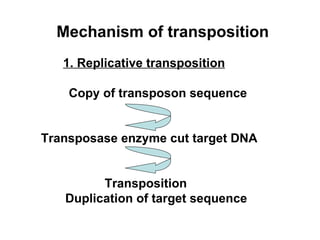
Mechanism of transposition 1. Replicative transposition Copy of transposon sequence Transposase enzyme cut target DNA Transposition Duplication of target sequence
Replicative transposition
2. Non-replicative (conservative) transposition - Cannot copy transposon sequence -  Transposition by cut and paste model Cut transposon sequence from    donor molecule attach to target site Ex. IS10, Tn10
Non-replicative (conservative) transposition
Mechanism of transposition
Evolution of Transposons Transposons are found in all major branches of life.  It arisen once and then spread to other kingdoms by horizontal gene transfer.  Duplications and DNA rearrangements contributed greatly to the evolution of new genes.
Cont… Mobile DNA most likely also influenced the evolution of genes that contain multiple copies of similar exons encoding similar protein domains (e.g., the fibronectin gene).  The evolution of an enormous variety of antibiotic resistance transposons and their spread among bacterial species.  example of genetic adaptation via natural selection. 
Transposons causing diseases  Transposons are mutagens. They can damage the genome of their host cell in different ways: 1. A transposon or a retroposon that inserts itself into a functional gene will most likely disable that gene. 2.After a transposon leaves a gene, the resulting gap will probably not be repaired correctly. 3.Multiple copies of the same sequence, such as Alu sequences can hinder precise chromosomal pairing during mitosis and meiosis, resulting in unequal crossovers, one of the main reasons for chromosome duplication.
Cont… Diseases caused by transposons include -hemophilia A and B -severe combined immunodeficiency -Porphyria -Cancer -Duchenne muscular dystrophy
Applications The first transposon was discovered in the plant maize ( Zea mays , corn species), and is named dissociator (Ds).  Likewise, the first transposon to be molecularly isolated was from a plant (Snapdragon).  Transposons have been an especially useful tool in plant molecular biology.  Researchers use transposons as a means of mutagenesis.
Cont… To identifying the mutant allele. To study the chemical mutagenesis methods. To study gene expression. Transposons are also a widely used tool for mutagenesis of most experimentally tractable organisms.
QUERIES ?

Bacterial Transposons

  • 1.
  • 2.
    TRANSPOSONS “ Transposableelements” “ Jumping genes” Mobile DNA able to move from one place to another within a cell’s genome sometimes a copy is made and the copy moves insertion requires target DNA sequences
  • 3.
  • 4.
    In the process,they may - cause mutations. - increase (or decrease) the amount of DNA in the genome. - promote genome rearrangements. - regulate gene expression. - induce chromosome breakage and rearrangement.
  • 5.
    Discovery of transposonsBarbara McClintock 1950’s Ac Ds system in maize influencing kernel color unstable elements changing map position promote chromosomal breaks. Rediscovery of bacterial insertion sequences source of polar mutations discrete change in physical length of DNA inverted repeat ends: form “lollipops” in EM after denaturation.
  • 6.
    These mobile segmentsof DNA are sometimes called "jumping genes" There are two distinct types of transposons: 1) DNA transposons -transposons consisting only of DNA that moves directly from place to place 2) Retrotransposons - first transcribe the DNA into RNA and then - use reverse transcriptase to make a DNA copy of the RNA to insert in a new location
  • 7.
    Classification of Transposonsinto two classes In both cases ds DNA intermediate is integrated into the target site in DNA to complete movement
  • 8.
    BACTERIAL TRANSPOSONS ● In bacteria, transposons can jump from chromosomal DNA to plasmid DNA and back. ● Transposons in bacteria usually carry an additional gene for function other than transposition---often for antibiotic resistance. ● Bacterial transposons of this type belong to the Tn family. When the transposable elements lack additional genes, they are known as insertion sequences.
  • 9.
    BACTERIAL TRANSPOSONS -TYPES 1. Insertion sequence 2.Composite transposon 3.Tn3-type transposon 4.Transposable phage
  • 10.
    1.Insertion sequences Insertionsequences – IS1 and IS186, present in the 50-kb segment of the E. coli DNA, are examples of DNA transposons. Single E. coli genome may contain 20 of them. Most of the sequence is taken by one or two genes for transposase enzyme that catalyses transposition. IS elements transpose either replicatively or conservatively.
  • 11.
    cont…. IS elementsStudy of E. coli mutations resulting from insertion of 1-2 kb long sequence in the middle of certain genes. Inserted stretches or insertion sequences – could be visualized by EM. IS - molecular parasites in bacterial cells. Transposition of IS is very rare – one in 105-107 cells per generation. Higher rates result in greater mutation rates.
  • 12.
    Bacterial IS elementCentral region encodes for one or two enzymes required for transposition. It is flanked by inverted repeats of characteristic sequence. The 5’ and 3’ short direct repeats are generated from the target-site DNA during the insertion of mobile element. The length of these repeats is constant for a given IS element, but their sequence depends upon the site of insertion and is not characteristic for the IS element. Arrows indicate orientation.
  • 13.
    Insertion sequences in E.coli 1 or more 1426 IS4 1 or more 1300 IS3 5 1327 IS2 8 768 IS1 No.of.copies/ genome Size (bp) Elements
  • 14.
  • 15.
    2.Composite transposons Bacteria contain composite mobile genetic elements that are larger than IS elements and contain one or more protein-coding genes in addition to those required for transposition: Composite transposons - are basically the pair of IS elements flanking a segment of DNA usually containing one or more genes, often coding for AB resistance. They use conservative method of transposition.
  • 16.
    Cont… 2.Composite transposon- Antibiotic resistant gene - Flank by IS element (inverted or directed repeat) - Terminal IS can transpose by in self Ex. Tn5, Tn9, Tn10
  • 17.
  • 18.
    3. Tn 3transposon family - 5000 bp - code for Transposase, β -lactamase, Resolvase - Function of resolvase Decrease Transposase production Catalyse the recombination of transposon
  • 19.
    Cont… Tn3 –type transposon --- 5kb ITR - inverted terminal repeat β - lactamase – Resistance gene ITR ITR resolvase transposase β -lactamase
  • 20.
  • 21.
    4.Transposable phage Transposablephages – bacterial viruses which tranpose replicatively as a part of their normal infectious cycle. Integrate into E. coli chromosome at regulatory element Eg. Mu phage
  • 22.
    Transposable phage Transposablephage – 38kb ITR - inverted terminal repeats ITR ITR Lysis genes Integration and Replication genes Protein coat genes
  • 23.
  • 24.
    Mechanism of transpositionTwo distinct mechanisms of transposition: Replicative transposition – direct interaction between the donor transposon and the target site, resulting in copying of the donor element Conservative transposition – involving excision of the element and reintegration at a new site.
  • 25.
    Mechanism of transposition1. Replicative transposition Copy of transposon sequence Transposase enzyme cut target DNA Transposition Duplication of target sequence
  • 26.
  • 27.
    2. Non-replicative (conservative)transposition - Cannot copy transposon sequence - Transposition by cut and paste model Cut transposon sequence from donor molecule attach to target site Ex. IS10, Tn10
  • 28.
  • 29.
  • 30.
    Evolution of TransposonsTransposons are found in all major branches of life. It arisen once and then spread to other kingdoms by horizontal gene transfer. Duplications and DNA rearrangements contributed greatly to the evolution of new genes.
  • 31.
    Cont… Mobile DNAmost likely also influenced the evolution of genes that contain multiple copies of similar exons encoding similar protein domains (e.g., the fibronectin gene). The evolution of an enormous variety of antibiotic resistance transposons and their spread among bacterial species. example of genetic adaptation via natural selection. 
  • 32.
    Transposons causing diseases Transposons are mutagens. They can damage the genome of their host cell in different ways: 1. A transposon or a retroposon that inserts itself into a functional gene will most likely disable that gene. 2.After a transposon leaves a gene, the resulting gap will probably not be repaired correctly. 3.Multiple copies of the same sequence, such as Alu sequences can hinder precise chromosomal pairing during mitosis and meiosis, resulting in unequal crossovers, one of the main reasons for chromosome duplication.
  • 33.
    Cont… Diseases causedby transposons include -hemophilia A and B -severe combined immunodeficiency -Porphyria -Cancer -Duchenne muscular dystrophy
  • 34.
    Applications The firsttransposon was discovered in the plant maize ( Zea mays , corn species), and is named dissociator (Ds). Likewise, the first transposon to be molecularly isolated was from a plant (Snapdragon). Transposons have been an especially useful tool in plant molecular biology. Researchers use transposons as a means of mutagenesis.
  • 35.
    Cont… To identifyingthe mutant allele. To study the chemical mutagenesis methods. To study gene expression. Transposons are also a widely used tool for mutagenesis of most experimentally tractable organisms.
  • 36.