BACTERIAL MORPHOLOGY I
Dr. Tarek Mahbub Khan
MBBS, M.Phil (virology)
Senior lecturer
Faculty of Medicine
Basic Medical Microbiology
Semester 3, Year 2
Date: December 30, 2014
Time: 0930-1030
7/1/2015 1Dr.Tarek/KUIN
TLO (students will be able to)
• describe different morphological form of
bacteria and their arrangements.
• describe basic structures and functions of a
bacterial cell.
• explain staining characteristics on the basis of
structural components
• explain the role of bacterial structure in
laboratory identification.
7/1/2015 2Dr.Tarek/KUIN
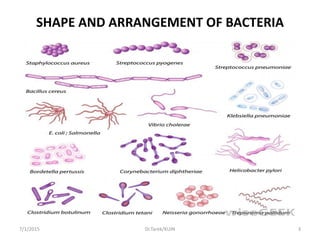
SHAPE AND ARRANGEMENT OF BACTERIA
7/1/2015 3Dr.Tarek/KUIN
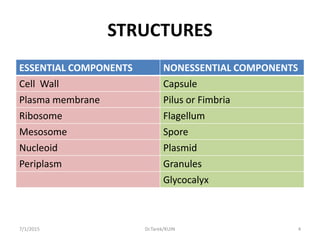
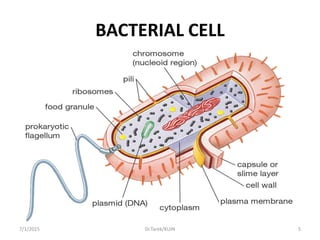
STRUCTURES
ESSENTIAL COMPONENTS NONESSENTIAL COMPONENTS
Cell Wall Capsule
Plasma membrane Pilus or Fimbria
Ribosome Flagellum
Mesosome Spore
Nucleoid Plasmid
Periplasm Granules
Glycocalyx
7/1/2015 4Dr.Tarek/KUIN
BACTERIAL CELL
7/1/2015 5Dr.Tarek/KUIN
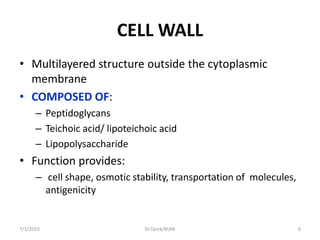
CELL WALL
• Multilayered structure outside the cytoplasmic
membrane
• COMPOSED OF:
– Peptidoglycans
– Teichoic acid/ lipoteichoic acid
– Lipopolysaccharide
• Function provides:
– cell shape, osmotic stability, transportation of molecules,
antigenicity
7/1/2015 6Dr.Tarek/KUIN
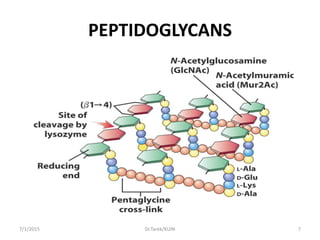
PEPTIDOGLYCANS
7/1/2015 7Dr.Tarek/KUIN
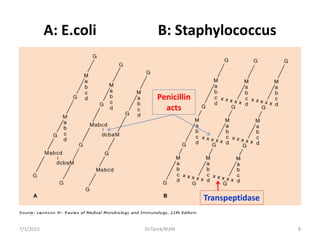
A: E.coli B: Staphylococcus
Penicillin
acts
Transpeptidase
7/1/2015 8Dr.Tarek/KUIN
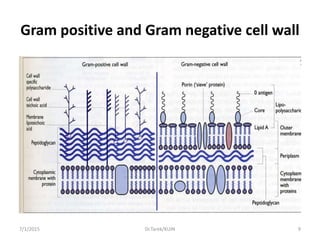
Gram positive and Gram negative cell wall
7/1/2015 9Dr.Tarek/KUIN
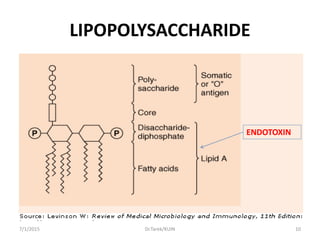
LIPOPOLYSACCHARIDE
ENDOTOXIN
7/1/2015 10Dr.Tarek/KUIN
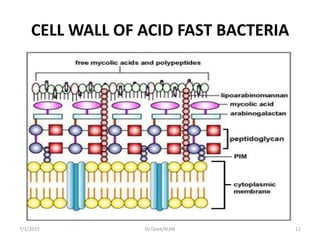
CELL WALL OF ACID FAST BACTERIA
7/1/2015 11Dr.Tarek/KUIN
TEICHOIC ACID
• Present on gram positive bacteria
• Chemically glycerol phosphate or ribitol phosphate
• Glycerol teichoic acid are lipoteichoic acid
• Ribitol teichoic acid attached to NAM acid of CHO
• Functions/effects:
– Septic shock
– Attachment to mucosa (e.g., Staphylococcus)
7/1/2015 12Dr.Tarek/KUIN
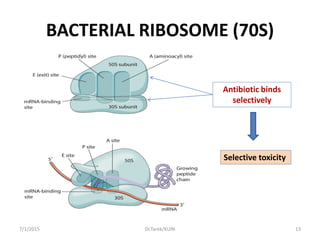
BACTERIAL RIBOSOME (70S)
Antibiotic binds
selectively
Selective toxicity
7/1/2015 13Dr.Tarek/KUIN
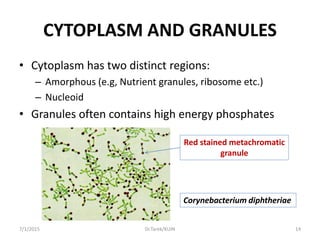
CYTOPLASM AND GRANULES
• Cytoplasm has two distinct regions:
– Amorphous (e.g, Nutrient granules, ribosome etc.)
– Nucleoid
• Granules often contains high energy phosphates
Red stained metachromatic
granule
Corynebacterium diphtheriae
7/1/2015 14Dr.Tarek/KUIN
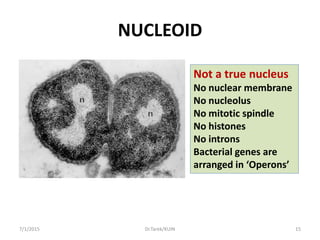
NUCLEOID
Not a true nucleus
No nuclear membrane
No nucleolus
No mitotic spindle
No histones
No introns
Bacterial genes are
arranged in ‘Operons’
7/1/2015 15Dr.Tarek/KUIN
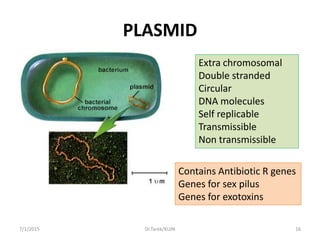
PLASMID
Extra chromosomal
Double stranded
Circular
DNA molecules
Self replicable
Transmissible
Non transmissible
Contains Antibiotic R genes
Genes for sex pilus
Genes for exotoxins
7/1/2015 16Dr.Tarek/KUIN
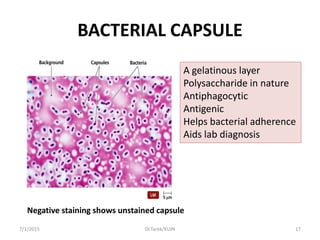
BACTERIAL CAPSULE
A gelatinous layer
Polysaccharide in nature
Antiphagocytic
Antigenic
Helps bacterial adherence
Aids lab diagnosis
Negative staining shows unstained capsule
7/1/2015 17Dr.Tarek/KUIN
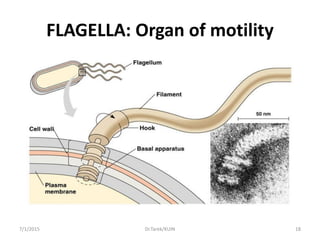
FLAGELLA: Organ of motility
7/1/2015 18Dr.Tarek/KUIN
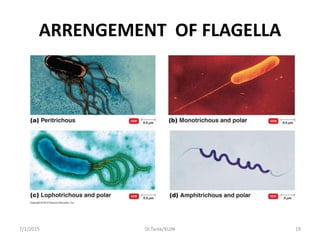
ARRENGEMENT OF FLAGELLA
7/1/2015 19Dr.Tarek/KUIN
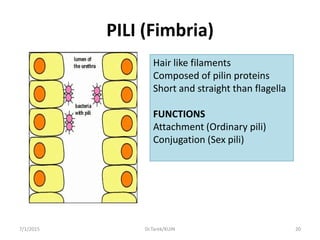
PILI (Fimbria)
Hair like filaments
Composed of pilin proteins
Short and straight than flagella
FUNCTIONS
Attachment (Ordinary pili)
Conjugation (Sex pili)
7/1/2015 20Dr.Tarek/KUIN
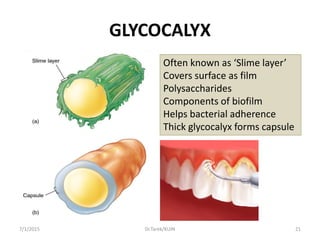
GLYCOCALYX
Often known as ‘Slime layer’
Covers surface as film
Polysaccharides
Components of biofilm
Helps bacterial adherence
Thick glycocalyx forms capsule
7/1/2015 21Dr.Tarek/KUIN
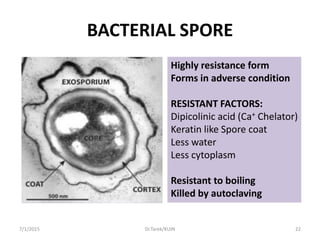
BACTERIAL SPORE
Highly resistance form
Forms in adverse condition
RESISTANT FACTORS:
Dipicolinic acid (Ca+ Chelator)
Keratin like Spore coat
Less water
Less cytoplasm
Resistant to boiling
Killed by autoclaving
7/1/2015 22Dr.Tarek/KUIN
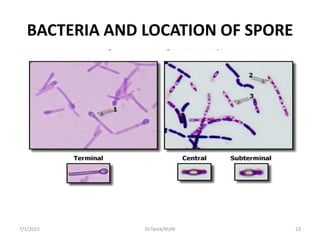
BACTERIA AND LOCATION OF SPORE
7/1/2015 23Dr.Tarek/KUIN
DIRECT OBSERVATION OF A BACTERIUM
• Can not be observed in naked eye
• Microscopy:
• Direct evidence
– Shape
– Arrangement
– Staining characteristics
• Indirect evidence
– Motility
7/1/2015 24Dr.Tarek/KUIN
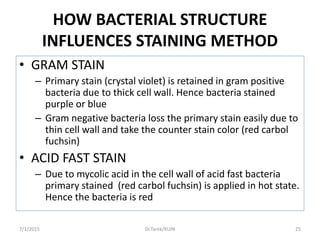
HOW BACTERIAL STRUCTURE
INFLUENCES STAINING METHOD
• GRAM STAIN
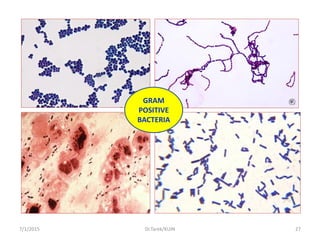
– Primary stain (crystal violet) is retained in gram positive
bacteria due to thick cell wall. Hence bacteria stained
purple or blue
– Gram negative bacteria loss the primary stain easily due to
thin cell wall and take the counter stain color (red carbol
fuchsin)
• ACID FAST STAIN
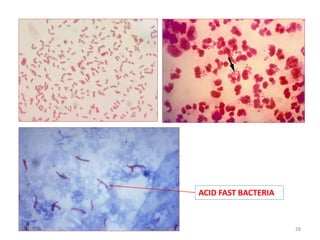
– Due to mycolic acid in the cell wall of acid fast bacteria
primary stained (red carbol fuchsin) is applied in hot state.
Hence the bacteria is red
7/1/2015 25Dr.Tarek/KUIN
7/1/2015 26Dr.Tarek/KUIN
GRAM
POSITIVE
BACTERIA
7/1/2015 27Dr.Tarek/KUIN
ACID FAST BACTERIA
7/1/2015 28Dr.Tarek/KUIN
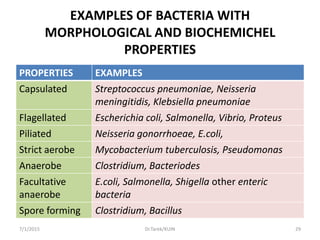
EXAMPLES OF BACTERIA WITH
MORPHOLOGICAL AND BIOCHEMICHEL
PROPERTIES
PROPERTIES EXAMPLES
Capsulated Streptococcus pneumoniae, Neisseria
meningitidis, Klebsiella pneumoniae
Flagellated Escherichia coli, Salmonella, Vibrio, Proteus
Piliated Neisseria gonorrhoeae, E.coli,
Strict aerobe Mycobacterium tuberculosis, Pseudomonas
Anaerobe Clostridium, Bacteriodes
Facultative
anaerobe
E.coli, Salmonella, Shigella other enteric
bacteria
Spore forming Clostridium, Bacillus
7/1/2015 29Dr.Tarek/KUIN
REFERENCE
• Warren Levinson. Review of Medical Microbiology and
Immunology, 11th edition (2010). Appleton and Lange.
• Geo. F. Brooks, Karen C. Carroll, Janet S. Butel, Stephen A.
Morse, Timothy A. Mietzner. Medical Microbiology, 25th
edition (2010). Appleton & Lange.
Dr.Tarek/KUIN7/1/2015 30
7/1/2015 31Dr.Tarek/KUIN

Bacterial morphology I

  • 1.
    BACTERIAL MORPHOLOGY I Dr.Tarek Mahbub Khan MBBS, M.Phil (virology) Senior lecturer Faculty of Medicine Basic Medical Microbiology Semester 3, Year 2 Date: December 30, 2014 Time: 0930-1030 7/1/2015 1Dr.Tarek/KUIN
  • 2.
    TLO (students willbe able to) • describe different morphological form of bacteria and their arrangements. • describe basic structures and functions of a bacterial cell. • explain staining characteristics on the basis of structural components • explain the role of bacterial structure in laboratory identification. 7/1/2015 2Dr.Tarek/KUIN
  • 3.
    SHAPE AND ARRANGEMENTOF BACTERIA 7/1/2015 3Dr.Tarek/KUIN
  • 4.
    STRUCTURES ESSENTIAL COMPONENTS NONESSENTIALCOMPONENTS Cell Wall Capsule Plasma membrane Pilus or Fimbria Ribosome Flagellum Mesosome Spore Nucleoid Plasmid Periplasm Granules Glycocalyx 7/1/2015 4Dr.Tarek/KUIN
  • 5.
  • 6.
    CELL WALL • Multilayeredstructure outside the cytoplasmic membrane • COMPOSED OF: – Peptidoglycans – Teichoic acid/ lipoteichoic acid – Lipopolysaccharide • Function provides: – cell shape, osmotic stability, transportation of molecules, antigenicity 7/1/2015 6Dr.Tarek/KUIN
  • 7.
  • 8.
    A: E.coli B:Staphylococcus Penicillin acts Transpeptidase 7/1/2015 8Dr.Tarek/KUIN
  • 9.
    Gram positive andGram negative cell wall 7/1/2015 9Dr.Tarek/KUIN
  • 10.
  • 11.
    CELL WALL OFACID FAST BACTERIA 7/1/2015 11Dr.Tarek/KUIN
  • 12.
    TEICHOIC ACID • Presenton gram positive bacteria • Chemically glycerol phosphate or ribitol phosphate • Glycerol teichoic acid are lipoteichoic acid • Ribitol teichoic acid attached to NAM acid of CHO • Functions/effects: – Septic shock – Attachment to mucosa (e.g., Staphylococcus) 7/1/2015 12Dr.Tarek/KUIN
  • 13.
    BACTERIAL RIBOSOME (70S) Antibioticbinds selectively Selective toxicity 7/1/2015 13Dr.Tarek/KUIN
  • 14.
    CYTOPLASM AND GRANULES •Cytoplasm has two distinct regions: – Amorphous (e.g, Nutrient granules, ribosome etc.) – Nucleoid • Granules often contains high energy phosphates Red stained metachromatic granule Corynebacterium diphtheriae 7/1/2015 14Dr.Tarek/KUIN
  • 15.
    NUCLEOID Not a truenucleus No nuclear membrane No nucleolus No mitotic spindle No histones No introns Bacterial genes are arranged in ‘Operons’ 7/1/2015 15Dr.Tarek/KUIN
  • 16.
    PLASMID Extra chromosomal Double stranded Circular DNAmolecules Self replicable Transmissible Non transmissible Contains Antibiotic R genes Genes for sex pilus Genes for exotoxins 7/1/2015 16Dr.Tarek/KUIN
  • 17.
    BACTERIAL CAPSULE A gelatinouslayer Polysaccharide in nature Antiphagocytic Antigenic Helps bacterial adherence Aids lab diagnosis Negative staining shows unstained capsule 7/1/2015 17Dr.Tarek/KUIN
  • 18.
    FLAGELLA: Organ ofmotility 7/1/2015 18Dr.Tarek/KUIN
  • 19.
  • 20.
    PILI (Fimbria) Hair likefilaments Composed of pilin proteins Short and straight than flagella FUNCTIONS Attachment (Ordinary pili) Conjugation (Sex pili) 7/1/2015 20Dr.Tarek/KUIN
  • 21.
    GLYCOCALYX Often known as‘Slime layer’ Covers surface as film Polysaccharides Components of biofilm Helps bacterial adherence Thick glycocalyx forms capsule 7/1/2015 21Dr.Tarek/KUIN
  • 22.
    BACTERIAL SPORE Highly resistanceform Forms in adverse condition RESISTANT FACTORS: Dipicolinic acid (Ca+ Chelator) Keratin like Spore coat Less water Less cytoplasm Resistant to boiling Killed by autoclaving 7/1/2015 22Dr.Tarek/KUIN
  • 23.
    BACTERIA AND LOCATIONOF SPORE 7/1/2015 23Dr.Tarek/KUIN
  • 24.
    DIRECT OBSERVATION OFA BACTERIUM • Can not be observed in naked eye • Microscopy: • Direct evidence – Shape – Arrangement – Staining characteristics • Indirect evidence – Motility 7/1/2015 24Dr.Tarek/KUIN
  • 25.
    HOW BACTERIAL STRUCTURE INFLUENCESSTAINING METHOD • GRAM STAIN – Primary stain (crystal violet) is retained in gram positive bacteria due to thick cell wall. Hence bacteria stained purple or blue – Gram negative bacteria loss the primary stain easily due to thin cell wall and take the counter stain color (red carbol fuchsin) • ACID FAST STAIN – Due to mycolic acid in the cell wall of acid fast bacteria primary stained (red carbol fuchsin) is applied in hot state. Hence the bacteria is red 7/1/2015 25Dr.Tarek/KUIN
  • 26.
  • 27.
  • 28.
  • 29.
    EXAMPLES OF BACTERIAWITH MORPHOLOGICAL AND BIOCHEMICHEL PROPERTIES PROPERTIES EXAMPLES Capsulated Streptococcus pneumoniae, Neisseria meningitidis, Klebsiella pneumoniae Flagellated Escherichia coli, Salmonella, Vibrio, Proteus Piliated Neisseria gonorrhoeae, E.coli, Strict aerobe Mycobacterium tuberculosis, Pseudomonas Anaerobe Clostridium, Bacteriodes Facultative anaerobe E.coli, Salmonella, Shigella other enteric bacteria Spore forming Clostridium, Bacillus 7/1/2015 29Dr.Tarek/KUIN
  • 30.
    REFERENCE • Warren Levinson.Review of Medical Microbiology and Immunology, 11th edition (2010). Appleton and Lange. • Geo. F. Brooks, Karen C. Carroll, Janet S. Butel, Stephen A. Morse, Timothy A. Mietzner. Medical Microbiology, 25th edition (2010). Appleton & Lange. Dr.Tarek/KUIN7/1/2015 30
  • 31.