Dr. Vishal L Kulkarni
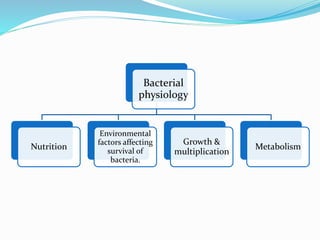
Bacterial
physiology
Nutrition
Environmental
factors affecting
survival of
bacteria.
Growth &
multiplication
Metabolism
 Nutrition-
 It is a process by which, chemical substances called as
nutrients, are obtained from surrounding environment
& used for metabolic activity and growth of the cell.
 Most of medically imp bacteria grow on simple media
with one source of organic material.
 Some bacteria requires more complex media
containing certain organic compounds k/a “fastidious
bacteria”.
 Optimum nutritional requirements
for growth of bacteria.
 Water
 Source of carbon
 Source of nitrogen
 Inorganic salts
 Growth factors
 Source of energy
Water-
 Most imp requirement as it constitute 80% of total
weight.
 Vehicle for entry of the nutrients into the cell.
 Elimination of all waste products.
 Participates in metabolic reaction.
 Is an integral part of protoplasm.
Source of carbon & energy-
Bacteria are divided into 2 groups
Autotrophic/Lithotrophic- Can use CO2 as a sole
source of carbon for synthesis of all their organic
metabolites
 They require water, inorganic salts & CO2 for growth &
derive energy either from
 Light (photolithotrophic) or
 Chemical reaction(chemolithotrophic)
 Are concerned with soil fertility & are medically less
important .e.g. nitrogen fixing bacteria in soil
Heterotrophic/Organotrophic bacteria-
 Unable to use CO2 as a sole source of carbon.
 Require it in various organic form e.g. glucose,
amino acids, nucleotides, lipids.
Source of nitrogen-
 N2 atom of important biomolecules (like amino
acids,purines, pyrimidines) comes from NH4 ions.
 It may comes from
a) Assimilatory nitrate production
b) Dissimilatory nitrate reduction
Certain species are able to fix atmospheric N2 into
usable organic form.e.g.azatobactor, blue green algae,
kleb. pneumoniae
Inorganic salts
 These are required for osmotic regulation
 Are essential for certain enzyme systems.
 The anions- phosphate & sulphate
 The cations- sodium, potassium, magnesium, iron,
calcium, manganese.
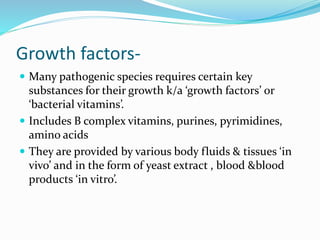
Growth factors-
 Many pathogenic species requires certain key
substances for their growth k/a ‘growth factors’ or
‘bacterial vitamins’.
 Includes B complex vitamins, purines, pyrimidines,
amino acids
 They are provided by various body fluids & tissues ‘in
vivo’ and in the form of yeast extract , blood &blood
products ‘in vitro’.
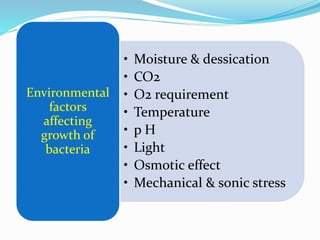
• Moisture & dessication
• CO2
• O2 requirement
• Temperature
• p H
• Light
• Osmotic effect
• Mechanical & sonic stress
Environmental
factors
affecting
growth of
bacteria
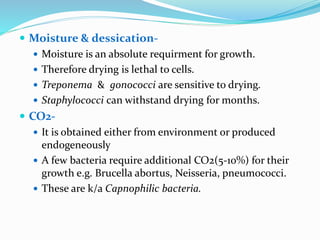
 Moisture & dessication-
 Moisture is an absolute requirment for growth.
 Therefore drying is lethal to cells.
 Treponema & gonococci are sensitive to drying.
 Staphylococci can withstand drying for months.
 CO2-
 It is obtained either from environment or produced
endogeneously
 A few bacteria require additional CO2(5-10%) for their
growth e.g. Brucella abortus, Neisseria, pneumococci.
 These are k/a Capnophilic bacteria.
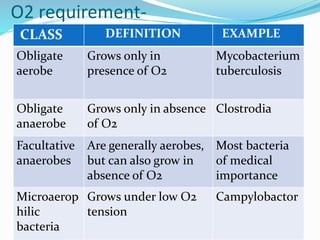
O2 requirement-
CLASS DEFINITION EXAMPLE
Obligate
aerobe
Grows only in
presence of O2
Mycobacterium
tuberculosis
Obligate
anaerobe
Grows only in absence
of O2
Clostrodia
Facultative
anaerobes
Are generally aerobes,
but can also grow in
absence of O2
Most bacteria
of medical
importance
Microaerop
hilic
bacteria
Grows under low O2
tension
Campylobactor
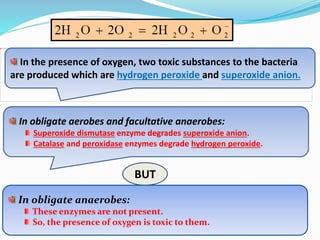
In obligate aerobes and facultative anaerobes:
Superoxide dismutase enzyme degrades superoxide anion.
Catalase and peroxidase enzymes degrade hydrogen peroxide.
BUT
In obligate anaerobes:
These enzymes are not present.
So, the presence of oxygen is toxic to them.
In the presence of oxygen, two toxic substances to the bacteria
are produced which are hydrogen peroxide and superoxide anion.
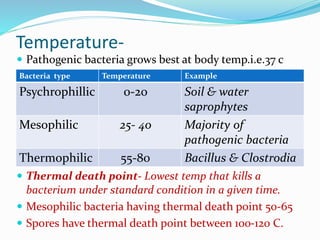
Temperature-
 Pathogenic bacteria grows best at body temp.i.e.37 c
 Thermal death point- Lowest temp that kills a
bacterium under standard condition in a given time.
 Mesophilic bacteria having thermal death point 50-65
 Spores have thermal death point between 100-120 C.
Bacteria type Temperature Example
Psychrophillic 0-20 Soil & water
saprophytes
Mesophilic 25- 40 Majority of
pathogenic bacteria
Thermophilic 55-80 Bacillus & Clostrodia
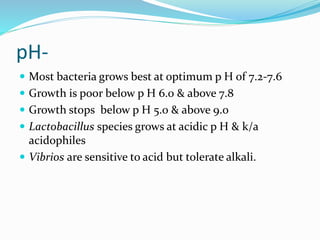
pH-
 Most bacteria grows best at optimum p H of 7.2-7.6
 Growth is poor below p H 6.0 & above 7.8
 Growth stops below p H 5.0 & above 9.0
 Lactobacillus species grows at acidic p H & k/a
acidophiles
 Vibrios are sensitive to acid but tolerate alkali.
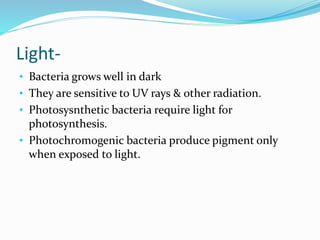
Light-
• Bacteria grows well in dark
• They are sensitive to UV rays & other radiation.
• Photosysnthetic bacteria require light for
photosynthesis.
• Photochromogenic bacteria produce pigment only
when exposed to light.
• Osmotic effect-
• Sudden exposure to hypertonic solution
causes osmotic withdrawl of water &
shrinkage of the cell k/a Plasmolysis.
• Sudden transfer from concentrated solution
to distilled water causes imbibition &
rupture of cell & is k/ a plasmoptysis.
• Mechanical & sonic stress-
• Cell wall may be rupured by grinding &
vigorous shaking.
• It may be disintegrated by exposure to
ultrasonic vibration.
 Growth & Multiplication
of bacteria
Bacterial growth means balanced increase in cell
mass in terms of-
a) Increase in size OR
b) Increase in number of cells
When growth reaches critical mass, cell divides
Bacteria may reproduce by binary fission OR by
budding.
In binary fission nuclear division precedes cell
division.
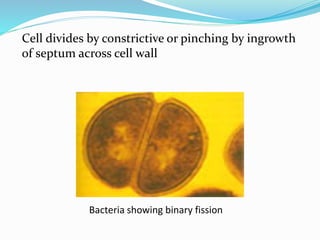
Bacteria showing binary fission
Cell divides by constrictive or pinching by ingrowth
of septum across cell wall
Generation time-
Time required for bacterium to give rise to 2
daughter cells under optimum condition is k/a
‘generation time’ or ‘population doubling
time’. e.g.
Coliform bacteria 20 min
Tubercular bacilli 20 hrs
Lepra bacilli 20 days
Bacterial counts
 Total count- gives total number of cells irrespective of
whether they are living or dead.
 Viable count- gives total number of living cells only.
 Total count can be obtained by
 Direct counting under microscope
 Counting in ‘Coulter chamber’.
 By ‘Absorptiometer’ or ‘Nephalometer’.
 By chemical assay with N2
 Using their wet or dry weight
 Viable count can be obtained by dilution & plating
method
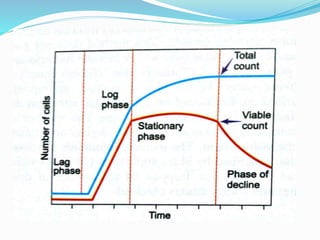
 Bacterial growth curve-
 When bacterium is seeded into a suitable liquid
medium & incubated, its growth follows a definitive
curve & is k/a ‘ bacterial growth curve’.
 In this graph bacterial count is determined at different
intervals & plotted in relation with time.
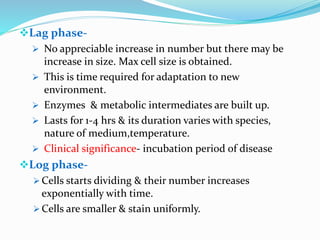
Lag phase-
 No appreciable increase in number but there may be
increase in size. Max cell size is obtained.
 This is time required for adaptation to new
environment.
 Enzymes & metabolic intermediates are built up.
 Lasts for 1-4 hrs & its duration varies with species,
nature of medium,temperature.
 Clinical significance- incubation period of disease
Log phase-
 Cells starts dividing & their number increases
exponentially with time.
 Cells are smaller & stain uniformly.
 No.of newly formed cells >no. of cells dying
 Clinical significance- symptoms & signs appears.
Stationary phase-
 Growth rate slows d/t depletion of nutrients &
accumulation of toxic products.
 No. of newly formed cells=no. of cells dying
 Cells are gram variable & shows irregular staining d/t
presence of storage granules.
 Sporulation occurs.
 Declining phase-
 More nutritional exhaustion & toxin accumulation.
 Death of cells d/t autolytic enzymes.
 Clinical significance- phase of convalescence.
 Bacterial metabolism-
Absorbed food( carbohydrates, fats, proteins) are
utilized & eliminated by certain metabolic pathways.
Aerobic bacteria obtain their energy by oxidation
involving O2 as a ultimate hydrogen acceptor.
In anaerobic bacteria, hydrogen acceptor is other than
O2.
Facultative bacteria can utilize both pathways.
 Oxidation-
 Ultimate electron acceptor is O2
 Carbon & energy source are broken down into CO2 &
H2O
 Energy is generated by oxidative phosphorylation,
i.e production of energy rich phosphate bonds & their
transfer to ADP to form ATP
 Fermentation
 In anaerobic bacteria, growth occurs by process in
which carbon & energy source acts as both- electron
donor & acceptor in a series of oxidoreduction k/a
fermentation.
 e- acceptors are nitrates & sulphites.
 Following products are formed
 Acids -lactic acid, formic acid, Pyruvic acid
 Alcohols
 Gases – H2, CO2
Substrate level phosphorylation-
• During fermentation energy rich phosphate bonds are
produced by introduction of organic phosphate into
intermediate metabolites k/a substrate level
phosphorylation.
• These phosphates bonds are transferred to ADP to
form ATP.
 Redox potential (Eh)-
 Oxidising or reducing condition of system is indicated
by the net readiness of all components in a system to
take up or lose electrons. k/a “redox potential(Eh)”.
 Measured in mV.
 Best estimated by measuring potential diff between
medium & electrode immersed in it.
 More oxidised the system, more is the Eh.
 Methylene blue can detect change in Eh.
THANK YOU!

Bacterial physiology

  • 1.
    Dr. Vishal LKulkarni
  • 2.
  • 3.
     Nutrition-  Itis a process by which, chemical substances called as nutrients, are obtained from surrounding environment & used for metabolic activity and growth of the cell.  Most of medically imp bacteria grow on simple media with one source of organic material.  Some bacteria requires more complex media containing certain organic compounds k/a “fastidious bacteria”.
  • 4.
     Optimum nutritionalrequirements for growth of bacteria.  Water  Source of carbon  Source of nitrogen  Inorganic salts  Growth factors  Source of energy
  • 5.
    Water-  Most imprequirement as it constitute 80% of total weight.  Vehicle for entry of the nutrients into the cell.  Elimination of all waste products.  Participates in metabolic reaction.  Is an integral part of protoplasm.
  • 6.
    Source of carbon& energy- Bacteria are divided into 2 groups Autotrophic/Lithotrophic- Can use CO2 as a sole source of carbon for synthesis of all their organic metabolites  They require water, inorganic salts & CO2 for growth & derive energy either from  Light (photolithotrophic) or  Chemical reaction(chemolithotrophic)  Are concerned with soil fertility & are medically less important .e.g. nitrogen fixing bacteria in soil
  • 7.
    Heterotrophic/Organotrophic bacteria-  Unableto use CO2 as a sole source of carbon.  Require it in various organic form e.g. glucose, amino acids, nucleotides, lipids.
  • 8.
    Source of nitrogen- N2 atom of important biomolecules (like amino acids,purines, pyrimidines) comes from NH4 ions.  It may comes from a) Assimilatory nitrate production b) Dissimilatory nitrate reduction Certain species are able to fix atmospheric N2 into usable organic form.e.g.azatobactor, blue green algae, kleb. pneumoniae
  • 9.
    Inorganic salts  Theseare required for osmotic regulation  Are essential for certain enzyme systems.  The anions- phosphate & sulphate  The cations- sodium, potassium, magnesium, iron, calcium, manganese.
  • 10.
    Growth factors-  Manypathogenic species requires certain key substances for their growth k/a ‘growth factors’ or ‘bacterial vitamins’.  Includes B complex vitamins, purines, pyrimidines, amino acids  They are provided by various body fluids & tissues ‘in vivo’ and in the form of yeast extract , blood &blood products ‘in vitro’.
  • 11.
    • Moisture &dessication • CO2 • O2 requirement • Temperature • p H • Light • Osmotic effect • Mechanical & sonic stress Environmental factors affecting growth of bacteria
  • 12.
     Moisture &dessication-  Moisture is an absolute requirment for growth.  Therefore drying is lethal to cells.  Treponema & gonococci are sensitive to drying.  Staphylococci can withstand drying for months.  CO2-  It is obtained either from environment or produced endogeneously  A few bacteria require additional CO2(5-10%) for their growth e.g. Brucella abortus, Neisseria, pneumococci.  These are k/a Capnophilic bacteria.
  • 13.
    O2 requirement- CLASS DEFINITIONEXAMPLE Obligate aerobe Grows only in presence of O2 Mycobacterium tuberculosis Obligate anaerobe Grows only in absence of O2 Clostrodia Facultative anaerobes Are generally aerobes, but can also grow in absence of O2 Most bacteria of medical importance Microaerop hilic bacteria Grows under low O2 tension Campylobactor
  • 14.
    In obligate aerobesand facultative anaerobes: Superoxide dismutase enzyme degrades superoxide anion. Catalase and peroxidase enzymes degrade hydrogen peroxide. BUT In obligate anaerobes: These enzymes are not present. So, the presence of oxygen is toxic to them. In the presence of oxygen, two toxic substances to the bacteria are produced which are hydrogen peroxide and superoxide anion.
  • 15.
    Temperature-  Pathogenic bacteriagrows best at body temp.i.e.37 c  Thermal death point- Lowest temp that kills a bacterium under standard condition in a given time.  Mesophilic bacteria having thermal death point 50-65  Spores have thermal death point between 100-120 C. Bacteria type Temperature Example Psychrophillic 0-20 Soil & water saprophytes Mesophilic 25- 40 Majority of pathogenic bacteria Thermophilic 55-80 Bacillus & Clostrodia
  • 16.
    pH-  Most bacteriagrows best at optimum p H of 7.2-7.6  Growth is poor below p H 6.0 & above 7.8  Growth stops below p H 5.0 & above 9.0  Lactobacillus species grows at acidic p H & k/a acidophiles  Vibrios are sensitive to acid but tolerate alkali.
  • 17.
    Light- • Bacteria growswell in dark • They are sensitive to UV rays & other radiation. • Photosysnthetic bacteria require light for photosynthesis. • Photochromogenic bacteria produce pigment only when exposed to light.
  • 18.
    • Osmotic effect- •Sudden exposure to hypertonic solution causes osmotic withdrawl of water & shrinkage of the cell k/a Plasmolysis. • Sudden transfer from concentrated solution to distilled water causes imbibition & rupture of cell & is k/ a plasmoptysis. • Mechanical & sonic stress- • Cell wall may be rupured by grinding & vigorous shaking. • It may be disintegrated by exposure to ultrasonic vibration.
  • 19.
     Growth &Multiplication of bacteria Bacterial growth means balanced increase in cell mass in terms of- a) Increase in size OR b) Increase in number of cells When growth reaches critical mass, cell divides Bacteria may reproduce by binary fission OR by budding. In binary fission nuclear division precedes cell division.
  • 20.
    Bacteria showing binaryfission Cell divides by constrictive or pinching by ingrowth of septum across cell wall
  • 21.
    Generation time- Time requiredfor bacterium to give rise to 2 daughter cells under optimum condition is k/a ‘generation time’ or ‘population doubling time’. e.g. Coliform bacteria 20 min Tubercular bacilli 20 hrs Lepra bacilli 20 days
  • 22.
    Bacterial counts  Totalcount- gives total number of cells irrespective of whether they are living or dead.  Viable count- gives total number of living cells only.  Total count can be obtained by  Direct counting under microscope  Counting in ‘Coulter chamber’.  By ‘Absorptiometer’ or ‘Nephalometer’.  By chemical assay with N2  Using their wet or dry weight  Viable count can be obtained by dilution & plating method
  • 23.
     Bacterial growthcurve-  When bacterium is seeded into a suitable liquid medium & incubated, its growth follows a definitive curve & is k/a ‘ bacterial growth curve’.  In this graph bacterial count is determined at different intervals & plotted in relation with time.
  • 25.
    Lag phase-  Noappreciable increase in number but there may be increase in size. Max cell size is obtained.  This is time required for adaptation to new environment.  Enzymes & metabolic intermediates are built up.  Lasts for 1-4 hrs & its duration varies with species, nature of medium,temperature.  Clinical significance- incubation period of disease Log phase-  Cells starts dividing & their number increases exponentially with time.  Cells are smaller & stain uniformly.
  • 26.
     No.of newlyformed cells >no. of cells dying  Clinical significance- symptoms & signs appears. Stationary phase-  Growth rate slows d/t depletion of nutrients & accumulation of toxic products.  No. of newly formed cells=no. of cells dying  Cells are gram variable & shows irregular staining d/t presence of storage granules.  Sporulation occurs.  Declining phase-  More nutritional exhaustion & toxin accumulation.  Death of cells d/t autolytic enzymes.  Clinical significance- phase of convalescence.
  • 27.
     Bacterial metabolism- Absorbedfood( carbohydrates, fats, proteins) are utilized & eliminated by certain metabolic pathways. Aerobic bacteria obtain their energy by oxidation involving O2 as a ultimate hydrogen acceptor. In anaerobic bacteria, hydrogen acceptor is other than O2. Facultative bacteria can utilize both pathways.
  • 28.
     Oxidation-  Ultimateelectron acceptor is O2  Carbon & energy source are broken down into CO2 & H2O  Energy is generated by oxidative phosphorylation, i.e production of energy rich phosphate bonds & their transfer to ADP to form ATP
  • 29.
     Fermentation  Inanaerobic bacteria, growth occurs by process in which carbon & energy source acts as both- electron donor & acceptor in a series of oxidoreduction k/a fermentation.  e- acceptors are nitrates & sulphites.  Following products are formed  Acids -lactic acid, formic acid, Pyruvic acid  Alcohols  Gases – H2, CO2
  • 30.
    Substrate level phosphorylation- •During fermentation energy rich phosphate bonds are produced by introduction of organic phosphate into intermediate metabolites k/a substrate level phosphorylation. • These phosphates bonds are transferred to ADP to form ATP.
  • 31.
     Redox potential(Eh)-  Oxidising or reducing condition of system is indicated by the net readiness of all components in a system to take up or lose electrons. k/a “redox potential(Eh)”.  Measured in mV.  Best estimated by measuring potential diff between medium & electrode immersed in it.  More oxidised the system, more is the Eh.  Methylene blue can detect change in Eh.
  • 32.