
PATHOGENESIS II:
HOST DEFENSE AND PAHOGENICITY
OF THE MICROBES
Dr. Tarek Mahbub Khan
MBBS, M.Phil (virology)
Assistant professor
TLO
• Outline of host defense against infectious disease
• Define normal flora
• Distribution of normal flora
• Protective function and clinical significance of normal flora
• Stages of bacterial pathogenesis
• Mode of transmission
• Routes of transmission
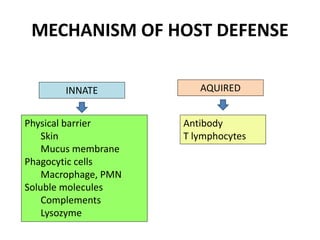
MECHANISM OF HOST DEFENSE
INNATE AQUIRED
Physical barrier
Skin
Mucus membrane
Phagocytic cells
Macrophage, PMN
Soluble molecules
Complements
Lysozyme
Antibody
T lymphocytes
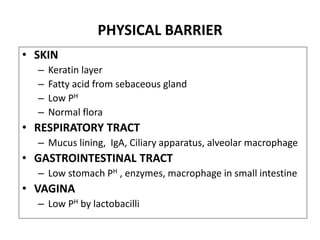
PHYSICAL BARRIER
• SKIN
– Keratin layer
– Fatty acid from sebaceous gland
– Low PH
– Normal flora
• RESPIRATORY TRACT
– Mucus lining, IgA, Ciliary apparatus, alveolar macrophage
• GASTROINTESTINAL TRACT
– Low stomach PH , enzymes, macrophage in small intestine
• VAGINA
– Low PH by lactobacilli
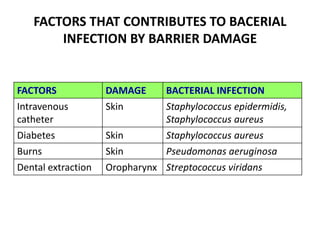
FACTORS THAT CONTRIBUTES TO BACERIAL
INFECTION BY BARRIER DAMAGE
FACTORS DAMAGE BACTERIAL INFECTION
Intravenous
catheter
Skin Staphylococcus epidermidis,
Staphylococcus aureus
Diabetes Skin Staphylococcus aureus
Burns Skin Pseudomonas aeruginosa
Dental extraction Oropharynx Streptococcus viridans
HOST DEFENSE
• INFLAMMATION
• PHAGOCYTOSIS
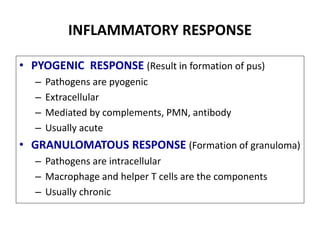
INFLAMMATORY RESPONSE
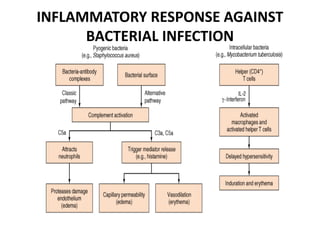
• PYOGENIC RESPONSE (Result in formation of pus)
– Pathogens are pyogenic
– Extracellular
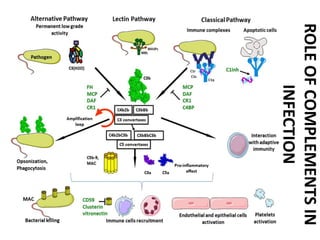
– Mediated by complements, PMN, antibody
– Usually acute
• GRANULOMATOUS RESPONSE (Formation of granuloma)
– Pathogens are intracellular
– Macrophage and helper T cells are the components
– Usually chronic
ROLEOFCOMPLEMENTSIN
INFECTION
INFLAMMATORY RESPONSE AGAINST
BACTERIAL INFECTION
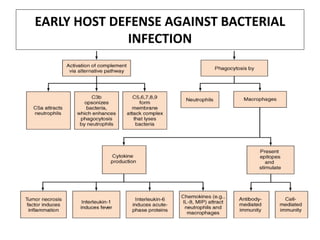
EARLY HOST DEFENSE AGAINST BACTERIAL
INFECTION
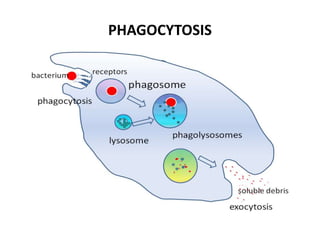
PHAGOCYTOSIS
PROCESS OF PHAGOCYTOSIS
• MIGRATION
– Mediated by IL-8, C5a, Killikrein
– Adhesion is mediated by interactions between PMN cells
with selectin protein of endothelium and integrin of PMN
cells with ICAM
• INGESTION
– Formation of phagosome
– Mediated by IgG, C3b (opsonization)
• KILLING
NORMAL FLORA: role in host defense
Normal flora is the term used to describe the various bacteria
and fungi that are permanent residents of certain body sites,
especially the skin, oropharynx, colon, and vagina
COMMENSALS
Commensals are organisms that derive benefit from
another host but do not damage that host.
The normal flora are often referred as commensals.
SIGNIFICANCE OF THE NORMAL FLORA
• May produce disease in the following conditions:
– In immunocompromised patient
– When organisms travel to an unusual site
• Colonization resistance:
– Occupy receptors of other pathogenic bacteria and
thereby limits infection
• Some has metabolic function:
– Synthesis of vitamin B12 and vitamin K
NORMAL FLORA OF DIFFERENT BODY SITES
• SKIN
– Staphylococcus epidermidis, propionibacterium acnes,
Candida albicans
• RESPIRATORY TRACT
– NOSE: Staphylococcus aureus
– THROAT: Viridans streptococci, Neisseria species
– MOUTH: Eikenella corodens, Bacteroides
• INTESTINAL TRACT
– The small intestine usually contains small numbers of
streptococci, lactobacilli, and yeasts, particularly C.
albicans.
– Escherichia coli
• GENITOURINARY TRACT
– Group B Streptococci
– Candida Albicans
NORMAL FLORA OF DIFFERENT BODY SITES
TYPES OF BACTERIAL INFECTIONS
• TWO major mechanisms:
– Toxin mediated
• Exotoxin
• Endotoxin
– Invasion and inflammation
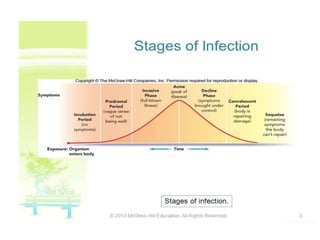
STAGES OF BACTERIAL PATHOGENESIS
1. Transmission into the portal of entry.
2. Evasion of primary host defence
3. Adherence
4. Colonization
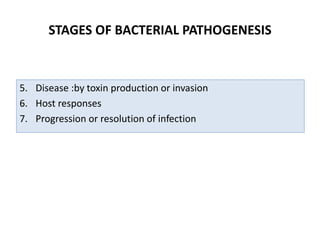
5. Disease :by toxin production or invasion
6. Host responses
7. Progression or resolution of infection
STAGES OF BACTERIAL PATHOGENESIS
SUMMARY
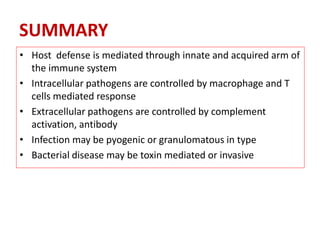
• Host defense is mediated through innate and acquired arm of
the immune system
• Intracellular pathogens are controlled by macrophage and T
cells mediated response
• Extracellular pathogens are controlled by complement
activation, antibody
• Infection may be pyogenic or granulomatous in type
• Bacterial disease may be toxin mediated or invasive
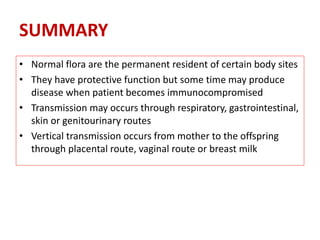
• Normal flora are the permanent resident of certain body sites
• They have protective function but some time may produce
disease when patient becomes immunocompromised
• Transmission may occurs through respiratory, gastrointestinal,
skin or genitourinary routes
• Vertical transmission occurs from mother to the offspring
through placental route, vaginal route or breast milk
SUMMARY
REFERENCE
• Warren Levinson. Review of Medical Microbiology and
Immunology, 11th edition (2010). Appleton and Lange.
• Geo. F. Brooks, Karen C. Carroll, Janet S. Butel, Stephen A.
Morse, Timothy A. Mietzner. Medical Microbiology, 25th
edition (2010). Appleton & Lange.
Pathogenesis II  host defense of microbes

Pathogenesis II host defense of microbes

  • 1.
    PATHOGENESIS II: HOST DEFENSEAND PAHOGENICITY OF THE MICROBES Dr. Tarek Mahbub Khan MBBS, M.Phil (virology) Assistant professor
  • 2.
    TLO • Outline ofhost defense against infectious disease • Define normal flora • Distribution of normal flora • Protective function and clinical significance of normal flora • Stages of bacterial pathogenesis • Mode of transmission • Routes of transmission
  • 3.
    MECHANISM OF HOSTDEFENSE INNATE AQUIRED Physical barrier Skin Mucus membrane Phagocytic cells Macrophage, PMN Soluble molecules Complements Lysozyme Antibody T lymphocytes
  • 4.
    PHYSICAL BARRIER • SKIN –Keratin layer – Fatty acid from sebaceous gland – Low PH – Normal flora • RESPIRATORY TRACT – Mucus lining, IgA, Ciliary apparatus, alveolar macrophage • GASTROINTESTINAL TRACT – Low stomach PH , enzymes, macrophage in small intestine • VAGINA – Low PH by lactobacilli
  • 5.
    FACTORS THAT CONTRIBUTESTO BACERIAL INFECTION BY BARRIER DAMAGE FACTORS DAMAGE BACTERIAL INFECTION Intravenous catheter Skin Staphylococcus epidermidis, Staphylococcus aureus Diabetes Skin Staphylococcus aureus Burns Skin Pseudomonas aeruginosa Dental extraction Oropharynx Streptococcus viridans
  • 6.
  • 7.
    INFLAMMATORY RESPONSE • PYOGENICRESPONSE (Result in formation of pus) – Pathogens are pyogenic – Extracellular – Mediated by complements, PMN, antibody – Usually acute • GRANULOMATOUS RESPONSE (Formation of granuloma) – Pathogens are intracellular – Macrophage and helper T cells are the components – Usually chronic
  • 8.
  • 9.
  • 10.
    EARLY HOST DEFENSEAGAINST BACTERIAL INFECTION
  • 11.
  • 12.
    PROCESS OF PHAGOCYTOSIS •MIGRATION – Mediated by IL-8, C5a, Killikrein – Adhesion is mediated by interactions between PMN cells with selectin protein of endothelium and integrin of PMN cells with ICAM • INGESTION – Formation of phagosome – Mediated by IgG, C3b (opsonization) • KILLING
  • 13.
    NORMAL FLORA: rolein host defense Normal flora is the term used to describe the various bacteria and fungi that are permanent residents of certain body sites, especially the skin, oropharynx, colon, and vagina
  • 14.
    COMMENSALS Commensals are organismsthat derive benefit from another host but do not damage that host. The normal flora are often referred as commensals.
  • 15.
    SIGNIFICANCE OF THENORMAL FLORA • May produce disease in the following conditions: – In immunocompromised patient – When organisms travel to an unusual site • Colonization resistance: – Occupy receptors of other pathogenic bacteria and thereby limits infection • Some has metabolic function: – Synthesis of vitamin B12 and vitamin K
  • 16.
    NORMAL FLORA OFDIFFERENT BODY SITES • SKIN – Staphylococcus epidermidis, propionibacterium acnes, Candida albicans • RESPIRATORY TRACT – NOSE: Staphylococcus aureus – THROAT: Viridans streptococci, Neisseria species – MOUTH: Eikenella corodens, Bacteroides
  • 17.
    • INTESTINAL TRACT –The small intestine usually contains small numbers of streptococci, lactobacilli, and yeasts, particularly C. albicans. – Escherichia coli • GENITOURINARY TRACT – Group B Streptococci – Candida Albicans NORMAL FLORA OF DIFFERENT BODY SITES
  • 18.
    TYPES OF BACTERIALINFECTIONS • TWO major mechanisms: – Toxin mediated • Exotoxin • Endotoxin – Invasion and inflammation
  • 19.
    STAGES OF BACTERIALPATHOGENESIS 1. Transmission into the portal of entry. 2. Evasion of primary host defence 3. Adherence 4. Colonization
  • 20.
    5. Disease :bytoxin production or invasion 6. Host responses 7. Progression or resolution of infection STAGES OF BACTERIAL PATHOGENESIS
  • 22.
    SUMMARY • Host defenseis mediated through innate and acquired arm of the immune system • Intracellular pathogens are controlled by macrophage and T cells mediated response • Extracellular pathogens are controlled by complement activation, antibody • Infection may be pyogenic or granulomatous in type • Bacterial disease may be toxin mediated or invasive
  • 23.
    • Normal floraare the permanent resident of certain body sites • They have protective function but some time may produce disease when patient becomes immunocompromised • Transmission may occurs through respiratory, gastrointestinal, skin or genitourinary routes • Vertical transmission occurs from mother to the offspring through placental route, vaginal route or breast milk SUMMARY
  • 24.
    REFERENCE • Warren Levinson.Review of Medical Microbiology and Immunology, 11th edition (2010). Appleton and Lange. • Geo. F. Brooks, Karen C. Carroll, Janet S. Butel, Stephen A. Morse, Timothy A. Mietzner. Medical Microbiology, 25th edition (2010). Appleton & Lange.