Normal Flora
Anup Muni Bajracharya
Normal flora
• denotes the population of microorganisms that inhabit the skin and
mucous membranes of healthy normal persons without causing any harm
to the host.
• Internal organs such as blood, kidney, heart, lungs, brain etc are sterile in
normal healthy individuals. Therefore, if microorganism is found in these
internal organs it is referred as diseased condition.
• The skin and mucous membranes always harbor a variety of
microorganisms that can be arranged into two groups:
(1) The resident flora
consists of relatively fixed types of microorganisms regularly found
in a given area at a given age.
(2) The transient flora
consists of microorganisms that inhabit the skin or mucous
membranes for hours, days, or weeks which is derived from the
environment, does not produce disease, and does not establish itself
permanently on the surface.
Characteristics of Normal Flora
• Not disease-inducing: They are not typical disease causing
micro-organisms found in and on healthy individuals.
• Very abundant: The normal flora are extremely abundant in
terms of numbers. For instance, an ordinary human has
approximately 1013 body cells and 1014 individual normal
flora.
• All found externally: Normal flora are found more often on
the skin, eyes, nose, oral fissure as well as on the throat and
lower parts of the urethra and the large intestine.
Types of normal flora
• Commensal microflora:
• Mutualistic microflora:
• Opportunistic microflora:
• Commensal microflora:
• These microorganisms gets benefits from human host and give neither
benefits nor harmful effects to host.
• Majority of normal flora are commensal types
• Mutualistic microflora:
• These microorganisms gets benefits from host and at the same time give
benefits to the host.
• Opportunistic microflora:
• These microorganisms, under normal condition live as commensal on host
body but they causes diseases if opportunity is available.
• For example; Normal flora of GI tract ie. E.coli causes urinary tract
infection (UTI), if the site of habitat is changed.
Beneficial roles of normal flora
• 1. Synthesize and excrete vitamins in excess of their own
needs, which can be absorbed as nutrients by their host.
For example, in humans, enteric bacteria secrete Vitamin K
and Vitamin B12, and lactic acid bacteria produce certain B-
vitamins.
• 2. Prevent colonization by pathogens by competing for
attachment sites or for essential nutrients.
•
3. Antagonize other bacteria through the production of
substances which inhibit or kill nonindigenous species. The
intestinal bacteria produce a variety of substances like fatty
acids and peroxides to highly specific bacteriocins, which
inhibit or kill other bacteria.
Beneficial roles of normal flora
• 4. Stimulate the development of certain tissues,
i.e., the caecum and certain lymphatic tissues
(Peyer's patches) in the GI tract.
• 5. Stimulate the production of natural
antibodies. Since the normal flora behave as
antigens in an animal, low levels of antibodies
produced against components of the normal flora
are known to cross react with certain related
pathogens, and thereby prevent infection or
invasion.
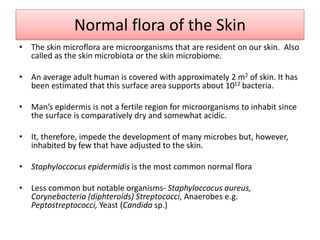
Normal flora of the Skin
• The skin microflora are microorganisms that are resident on our skin. Also
called as the skin microbiota or the skin microbiome.
• An average adult human is covered with approximately 2 m2 of skin. It has
been estimated that this surface area supports about 1012 bacteria.
• Man’s epidermis is not a fertile region for microorganisms to inhabit since
the surface is comparatively dry and somewhat acidic.
• It, therefore, impede the development of many microbes but, however,
inhabited by few that have adjusted to the skin.
• Staphyloccocus epidermidis is the most common normal flora
• Less common but notable organisms- Staphyloccocus aureus,
Corynebacteria (diphteroids) Streptococci, Anaerobes e.g.
Peptostreptococci, Yeast (Candida sp.)
Normal flora of the Skin
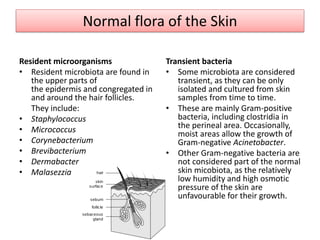
Resident microorganisms
• Resident microbiota are found in
the upper parts of
the epidermis and congregated in
and around the hair follicles.
They include:
• Staphylococcus
• Micrococcus
• Corynebacterium
• Brevibacterium
• Dermabacter
• Malasezzia
Transient bacteria
• Some microbiota are considered
transient, as they can be only
isolated and cultured from skin
samples from time to time.
• These are mainly Gram-positive
bacteria, including clostridia in
the perineal area. Occasionally,
moist areas allow the growth of
Gram-negative Acinetobacter.
• Other Gram-negative bacteria are
not considered part of the normal
skin micobiota, as the relatively
low humidity and high osmotic
pressure of the skin are
unfavourable for their growth.
Skin sites
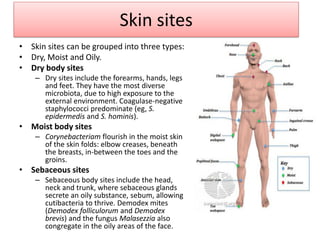
• Skin sites can be grouped into three types:
• Dry, Moist and Oily.
• Dry body sites
– Dry sites include the forearms, hands, legs
and feet. They have the most diverse
microbiota, due to high exposure to the
external environment. Coagulase-negative
staphylococci predominate (eg, S.
epidermedis and S. hominis).
• Moist body sites
– Corynebacteriam flourish in the moist skin
of the skin folds: elbow creases, beneath
the breasts, in-between the toes and the
groins.
• Sebaceous sites
– Sebaceous body sites include the head,
neck and trunk, where sebaceous glands
secrete an oily substance, sebum, allowing
cutibacteria to thrive. Demodex mites
(Demodex folliculorum and Demodex
brevis) and the fungus Malasezzia also
congregate in the oily areas of the face.
Normal Flora of Oral Cavity
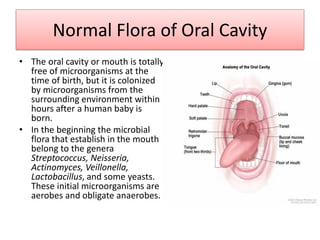
• The oral cavity or mouth is totally
free of microorganisms at the
time of birth, but it is colonized
by microorganisms from the
surrounding environment within
hours after a human baby is
born.
• In the beginning the microbial
flora that establish in the mouth
belong to the genera
Streptococcus, Neisseria,
Actinomyces, Veillonella,
Lactobacillus, and some yeasts.
These initial microorganisms are
aerobes and obligate anaerobes.
Normal Flora of Oral Cavity
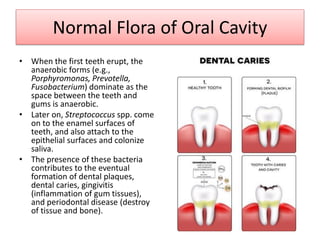
• When the first teeth erupt, the
anaerobic forms (e.g.,
Porphyromonas, Prevotella,
Fusobacterium) dominate as the
space between the teeth and
gums is anaerobic.
• Later on, Streptococcus spp. come
on to the enamel surfaces of
teeth, and also attach to the
epithelial surfaces and colonize
saliva.
• The presence of these bacteria
contributes to the eventual
formation of dental plaques,
dental caries, gingivitis
(inflammation of gum tissues),
and periodontal disease (destroy
of tissue and bone).
Normal flora of respiratory tract
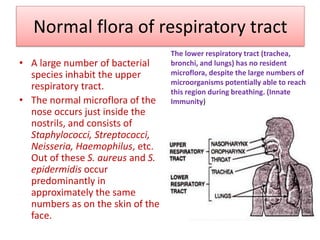
• A large number of bacterial
species inhabit the upper
respiratory tract.
• The normal microflora of the
nose occurs just inside the
nostrils, and consists of
Staphylococci, Streptococci,
Neisseria, Haemophilus, etc.
Out of these S. aureus and S.
epidermidis occur
predominantly in
approximately the same
numbers as on the skin of the
face.
The lower respiratory tract (trachea,
bronchi, and lungs) has no resident
microflora, despite the large numbers of
microorganisms potentially able to reach
this region during breathing. (Innate
Immunity)
Normal flora of the digestive tract
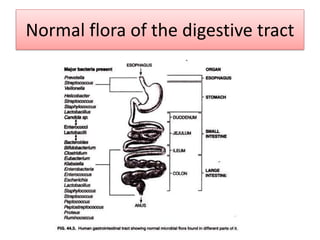
• The stomach contains fewer bacteria due to its high
acidity nature. However, there are some bacteria that
survive there like the Helicobacter Pylori that is currently
proving to be the cause of most cases of gastritis and peptic
ulcers.
• Likewise, the small intestine contains small numbers of
Streptococci, Lactobacilli, and yeasts, particularly Candida
albicans. Nevertheless, bigger numbers of these bacteria
are found in the lower parts of the ileum.
• The colon is the main site for bacteria in the body.
• Several bacteria like Bacteroides, Bifidobacterium,
Eubacterium, Coliforms (e.g. E. coli), Streptococcus,
Lactobacillus and Clostridium reside in the large intestine.
Normal flora of the digestive tract
• The small intestine is anatomically divided into three areas:
the duodenum, jejunum, and ileum.
• The duodenum, adjacent to the stomach, is fairly acidic and
contains few microorganisms (gram- positive cocci and
bacilli bacteria) because of the combined influence of the
acidic fluids of stomach and the inhibitory effect of bile and
pancreatic secretions. Lactobacilly diphtheroids,
Enterococcus faecalis, and Candida albicans (yeast)
occasionally occur in the jejulum.
• In ileum, the distal part of the small intestine, the pH
becomes more alkaline and, as a result, anaerobic gram-
negative bacteria and members of the family
Enterobacteriaceae occur in it.
Normal flora of the digestive tract
Large intestine:
• The large intestine or colon contains the
largest number of bacterial community in
human body.
• The large intestine or colon acts as a
fermentation vessel, and the microflora of it
consists primarily of anaerobic, gram-negative,
nonsporing bacteria and gram-positive, spore-
forming, and nonsporing bacilli.
Normal flora of the Urogenital
(Genitourinary) Tract
• The uninary bladder itself is sterile in both male and female
urogenital tracts, but the epithelial cells lining the urethra are
colonized by gram-negative facultatively aerobic cocci and bacilli
bacteria (e.g., Staphylococcus epidermidis, Enterococcus faecalis,
Corynebacterium spp.)
• The genital tract (vaginal tract) of an adult female, because of its
large surface area and mucous secretions, possesses complex
microflora.
Normal flora of the Urogenital
(Genitourinary) Tract
• It is weakly acidic and contains significant
amounts of the polysaccharide glycogen.
Lactobacillus acidophilus ferments glycogen to
produce lactic acid and maintains the acidic
condition.
• Other microbes such as yeasts (Torulopsis and
Candida species), Streptococci, and E. coli may
also be present.
• Vaginal microflora constantly changes between
puberty and the menopause.
Opportunistic pathogens
• A pathogen is a microorganism that is able to produce disease. Salmonell
typhi cause typhoid disease so it’s a pathogen.
• An infectious microorganism that is normally a commensal or does not
harm its host but can cause disease when the host's resistance is low is
called as opportunistic pathogens.
• In other words, Bacteria which cause a disease in a compromised host
which typically would not occur in a healthy (noncompromised) host are
acting as opportunistic pathogens.
• Examples of opportunistic pathogens are:
• Candida albicans - a causal agent of opportunistic oral
and genital infections in human.
• Staphylococcus aureus - occur as commensal on human skin but may
cause staph infections.
Staphylococcus aureus is an opportunistic
pathogen
• Staphylococcus aureus is an opportunistic pathogens of skin.
• In normal condition S. aureus lives as commensal in skin but it causes
opportunistic wound infection when skin is damaged by burn, wound,
biting, scratching etc. form the damaged skin, bacteria enters into deeper
tissue and multiplies to give pus filled lesions.
• Staphylococcus aureus is also as opportunistic pathogen of upper
respiratory tract.
• in normal condition, S aureus is commensal in nasal chamber but it causes
secondary bacterial pneumonia in immunocompromised host.
• Patient infected with influenza or measles virus infection are at very high
risk of S. aureus infection. Virus infection damages the mucus lining of
respiratory tract so that deeper soft tissue is exposed to commensal flora
ie Streptococcus aureus which penetrates and causes secondary bacterial
infection.
ANY QUERIES ???......

Normal flora

  • 1.
  • 2.
    Normal flora • denotesthe population of microorganisms that inhabit the skin and mucous membranes of healthy normal persons without causing any harm to the host. • Internal organs such as blood, kidney, heart, lungs, brain etc are sterile in normal healthy individuals. Therefore, if microorganism is found in these internal organs it is referred as diseased condition. • The skin and mucous membranes always harbor a variety of microorganisms that can be arranged into two groups: (1) The resident flora consists of relatively fixed types of microorganisms regularly found in a given area at a given age. (2) The transient flora consists of microorganisms that inhabit the skin or mucous membranes for hours, days, or weeks which is derived from the environment, does not produce disease, and does not establish itself permanently on the surface.
  • 3.
    Characteristics of NormalFlora • Not disease-inducing: They are not typical disease causing micro-organisms found in and on healthy individuals. • Very abundant: The normal flora are extremely abundant in terms of numbers. For instance, an ordinary human has approximately 1013 body cells and 1014 individual normal flora. • All found externally: Normal flora are found more often on the skin, eyes, nose, oral fissure as well as on the throat and lower parts of the urethra and the large intestine.
  • 4.
    Types of normalflora • Commensal microflora: • Mutualistic microflora: • Opportunistic microflora: • Commensal microflora: • These microorganisms gets benefits from human host and give neither benefits nor harmful effects to host. • Majority of normal flora are commensal types • Mutualistic microflora: • These microorganisms gets benefits from host and at the same time give benefits to the host. • Opportunistic microflora: • These microorganisms, under normal condition live as commensal on host body but they causes diseases if opportunity is available. • For example; Normal flora of GI tract ie. E.coli causes urinary tract infection (UTI), if the site of habitat is changed.
  • 5.
    Beneficial roles ofnormal flora • 1. Synthesize and excrete vitamins in excess of their own needs, which can be absorbed as nutrients by their host. For example, in humans, enteric bacteria secrete Vitamin K and Vitamin B12, and lactic acid bacteria produce certain B- vitamins. • 2. Prevent colonization by pathogens by competing for attachment sites or for essential nutrients. • 3. Antagonize other bacteria through the production of substances which inhibit or kill nonindigenous species. The intestinal bacteria produce a variety of substances like fatty acids and peroxides to highly specific bacteriocins, which inhibit or kill other bacteria.
  • 6.
    Beneficial roles ofnormal flora • 4. Stimulate the development of certain tissues, i.e., the caecum and certain lymphatic tissues (Peyer's patches) in the GI tract. • 5. Stimulate the production of natural antibodies. Since the normal flora behave as antigens in an animal, low levels of antibodies produced against components of the normal flora are known to cross react with certain related pathogens, and thereby prevent infection or invasion.
  • 7.
    Normal flora ofthe Skin • The skin microflora are microorganisms that are resident on our skin. Also called as the skin microbiota or the skin microbiome. • An average adult human is covered with approximately 2 m2 of skin. It has been estimated that this surface area supports about 1012 bacteria. • Man’s epidermis is not a fertile region for microorganisms to inhabit since the surface is comparatively dry and somewhat acidic. • It, therefore, impede the development of many microbes but, however, inhabited by few that have adjusted to the skin. • Staphyloccocus epidermidis is the most common normal flora • Less common but notable organisms- Staphyloccocus aureus, Corynebacteria (diphteroids) Streptococci, Anaerobes e.g. Peptostreptococci, Yeast (Candida sp.)
  • 8.
    Normal flora ofthe Skin Resident microorganisms • Resident microbiota are found in the upper parts of the epidermis and congregated in and around the hair follicles. They include: • Staphylococcus • Micrococcus • Corynebacterium • Brevibacterium • Dermabacter • Malasezzia Transient bacteria • Some microbiota are considered transient, as they can be only isolated and cultured from skin samples from time to time. • These are mainly Gram-positive bacteria, including clostridia in the perineal area. Occasionally, moist areas allow the growth of Gram-negative Acinetobacter. • Other Gram-negative bacteria are not considered part of the normal skin micobiota, as the relatively low humidity and high osmotic pressure of the skin are unfavourable for their growth.
  • 9.
    Skin sites • Skinsites can be grouped into three types: • Dry, Moist and Oily. • Dry body sites – Dry sites include the forearms, hands, legs and feet. They have the most diverse microbiota, due to high exposure to the external environment. Coagulase-negative staphylococci predominate (eg, S. epidermedis and S. hominis). • Moist body sites – Corynebacteriam flourish in the moist skin of the skin folds: elbow creases, beneath the breasts, in-between the toes and the groins. • Sebaceous sites – Sebaceous body sites include the head, neck and trunk, where sebaceous glands secrete an oily substance, sebum, allowing cutibacteria to thrive. Demodex mites (Demodex folliculorum and Demodex brevis) and the fungus Malasezzia also congregate in the oily areas of the face.
  • 10.
    Normal Flora ofOral Cavity • The oral cavity or mouth is totally free of microorganisms at the time of birth, but it is colonized by microorganisms from the surrounding environment within hours after a human baby is born. • In the beginning the microbial flora that establish in the mouth belong to the genera Streptococcus, Neisseria, Actinomyces, Veillonella, Lactobacillus, and some yeasts. These initial microorganisms are aerobes and obligate anaerobes.
  • 11.
    Normal Flora ofOral Cavity • When the first teeth erupt, the anaerobic forms (e.g., Porphyromonas, Prevotella, Fusobacterium) dominate as the space between the teeth and gums is anaerobic. • Later on, Streptococcus spp. come on to the enamel surfaces of teeth, and also attach to the epithelial surfaces and colonize saliva. • The presence of these bacteria contributes to the eventual formation of dental plaques, dental caries, gingivitis (inflammation of gum tissues), and periodontal disease (destroy of tissue and bone).
  • 12.
    Normal flora ofrespiratory tract • A large number of bacterial species inhabit the upper respiratory tract. • The normal microflora of the nose occurs just inside the nostrils, and consists of Staphylococci, Streptococci, Neisseria, Haemophilus, etc. Out of these S. aureus and S. epidermidis occur predominantly in approximately the same numbers as on the skin of the face. The lower respiratory tract (trachea, bronchi, and lungs) has no resident microflora, despite the large numbers of microorganisms potentially able to reach this region during breathing. (Innate Immunity)
  • 13.
    Normal flora ofthe digestive tract • The stomach contains fewer bacteria due to its high acidity nature. However, there are some bacteria that survive there like the Helicobacter Pylori that is currently proving to be the cause of most cases of gastritis and peptic ulcers. • Likewise, the small intestine contains small numbers of Streptococci, Lactobacilli, and yeasts, particularly Candida albicans. Nevertheless, bigger numbers of these bacteria are found in the lower parts of the ileum. • The colon is the main site for bacteria in the body. • Several bacteria like Bacteroides, Bifidobacterium, Eubacterium, Coliforms (e.g. E. coli), Streptococcus, Lactobacillus and Clostridium reside in the large intestine.
  • 14.
    Normal flora ofthe digestive tract
  • 15.
    Normal flora ofthe digestive tract • The small intestine is anatomically divided into three areas: the duodenum, jejunum, and ileum. • The duodenum, adjacent to the stomach, is fairly acidic and contains few microorganisms (gram- positive cocci and bacilli bacteria) because of the combined influence of the acidic fluids of stomach and the inhibitory effect of bile and pancreatic secretions. Lactobacilly diphtheroids, Enterococcus faecalis, and Candida albicans (yeast) occasionally occur in the jejulum. • In ileum, the distal part of the small intestine, the pH becomes more alkaline and, as a result, anaerobic gram- negative bacteria and members of the family Enterobacteriaceae occur in it.
  • 16.
    Normal flora ofthe digestive tract Large intestine: • The large intestine or colon contains the largest number of bacterial community in human body. • The large intestine or colon acts as a fermentation vessel, and the microflora of it consists primarily of anaerobic, gram-negative, nonsporing bacteria and gram-positive, spore- forming, and nonsporing bacilli.
  • 17.
    Normal flora ofthe Urogenital (Genitourinary) Tract • The uninary bladder itself is sterile in both male and female urogenital tracts, but the epithelial cells lining the urethra are colonized by gram-negative facultatively aerobic cocci and bacilli bacteria (e.g., Staphylococcus epidermidis, Enterococcus faecalis, Corynebacterium spp.) • The genital tract (vaginal tract) of an adult female, because of its large surface area and mucous secretions, possesses complex microflora.
  • 18.
    Normal flora ofthe Urogenital (Genitourinary) Tract • It is weakly acidic and contains significant amounts of the polysaccharide glycogen. Lactobacillus acidophilus ferments glycogen to produce lactic acid and maintains the acidic condition. • Other microbes such as yeasts (Torulopsis and Candida species), Streptococci, and E. coli may also be present. • Vaginal microflora constantly changes between puberty and the menopause.
  • 19.
    Opportunistic pathogens • Apathogen is a microorganism that is able to produce disease. Salmonell typhi cause typhoid disease so it’s a pathogen. • An infectious microorganism that is normally a commensal or does not harm its host but can cause disease when the host's resistance is low is called as opportunistic pathogens. • In other words, Bacteria which cause a disease in a compromised host which typically would not occur in a healthy (noncompromised) host are acting as opportunistic pathogens. • Examples of opportunistic pathogens are: • Candida albicans - a causal agent of opportunistic oral and genital infections in human. • Staphylococcus aureus - occur as commensal on human skin but may cause staph infections.
  • 20.
    Staphylococcus aureus isan opportunistic pathogen • Staphylococcus aureus is an opportunistic pathogens of skin. • In normal condition S. aureus lives as commensal in skin but it causes opportunistic wound infection when skin is damaged by burn, wound, biting, scratching etc. form the damaged skin, bacteria enters into deeper tissue and multiplies to give pus filled lesions. • Staphylococcus aureus is also as opportunistic pathogen of upper respiratory tract. • in normal condition, S aureus is commensal in nasal chamber but it causes secondary bacterial pneumonia in immunocompromised host. • Patient infected with influenza or measles virus infection are at very high risk of S. aureus infection. Virus infection damages the mucus lining of respiratory tract so that deeper soft tissue is exposed to commensal flora ie Streptococcus aureus which penetrates and causes secondary bacterial infection.
  • 21.