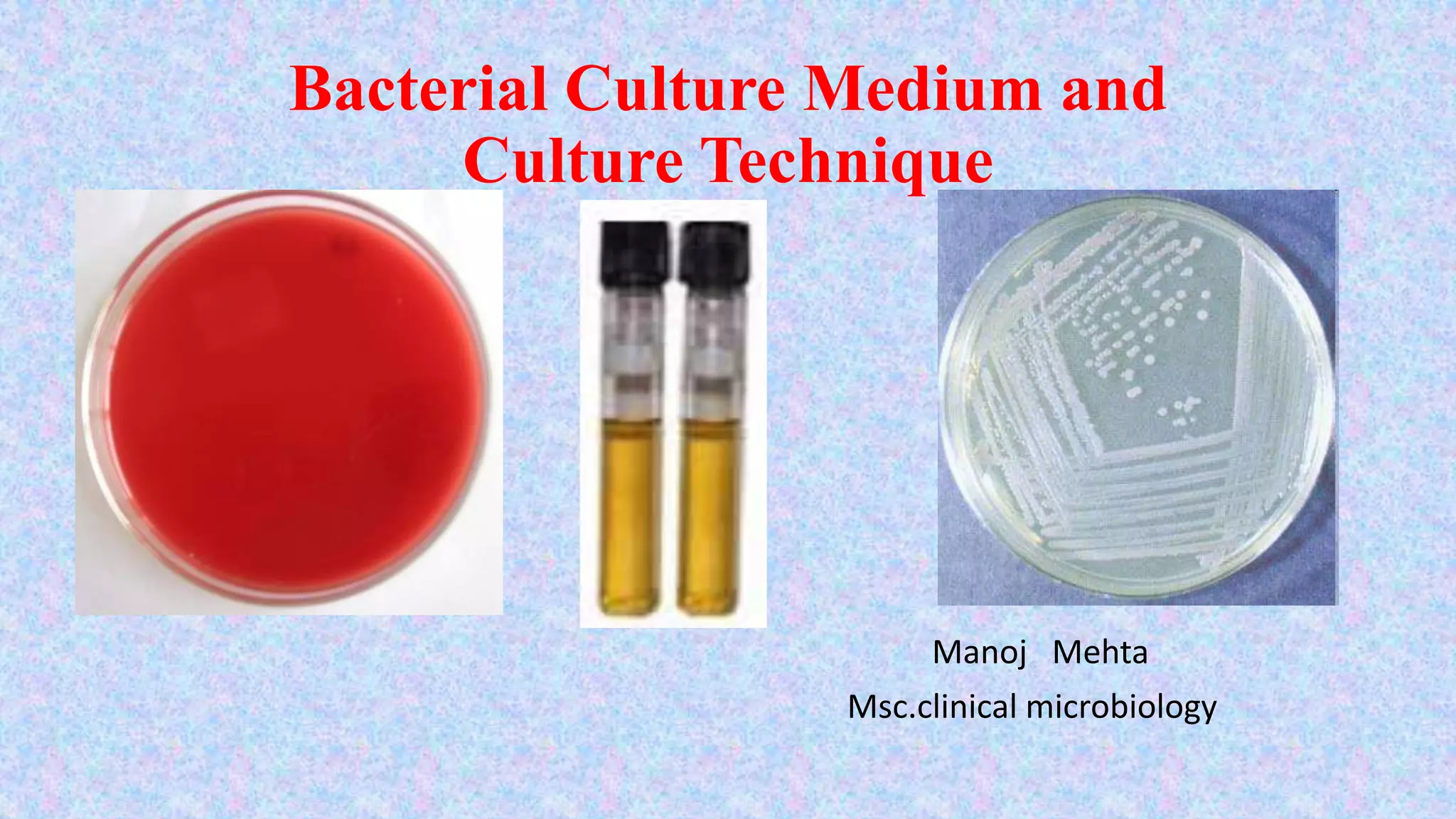
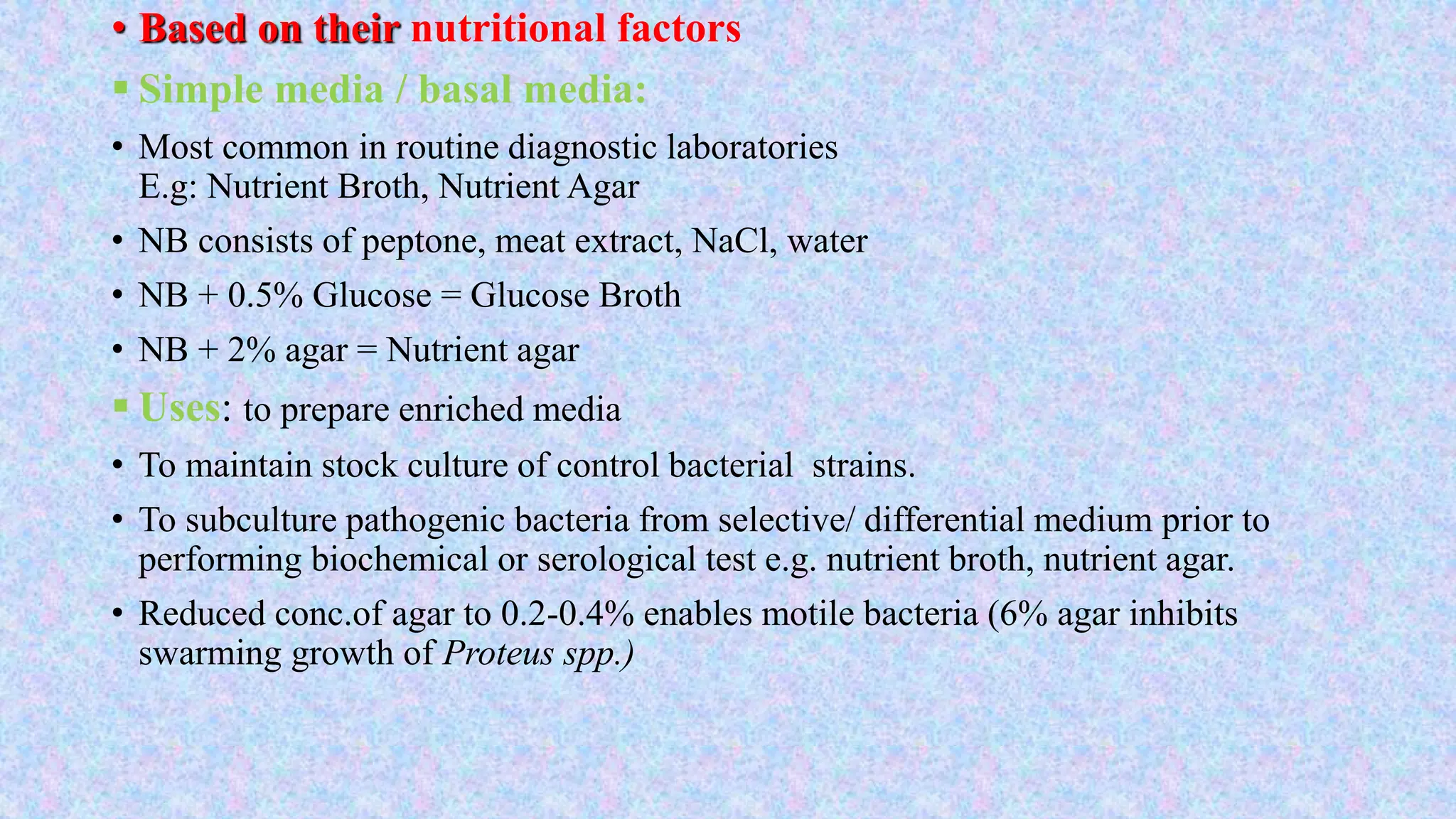
Bacterial Culture Medium and
Culture Technique
Manoj Mehta
Msc.clinical microbiology
CONTENTS
1.INTRODUCTION
2.HISTORY
3.CULTIVATION
4.EQUIPMENT
5.MEDIA CLASSIFICATION AND FUNCTION
6.FREQUENTLY USED MEDIA
7.TYPES OF CULTURE MEDIA
8.CULTURE METHODS
INTRODUCTION
Direct laboratory methods, such as microscopy provide preliminary
information about the bacteria involved in an infection, but bacterial growth is
usually required for definitive identification and characterization,hence the
culture method is needed.
HISTORY
 Louis Pasteur : which states that microorganisms are the
causes of infectious disease and used simple broths to grow;
made up of urine or meat extracts.
 Robert Koch: established that microbes can cause and realized
the importance of solid media and used potato pieces
to grow bacteria
Definition:
 Culture is the term given to microorganisms that are cultivated in the lab for the
purpose of identifying and studying them.
 Medium is the term given to the combination of ingredients that will support the
growth and cultivation of microorganisms by providing all the essential nutrients
required for the growth in order to cultivate these microorganisms in large
numbers to study them
 Cultivation is the process of growing microorganisms in culture by taking
bacteria from the infection site by some means of specimen collection and
growing them in the artificial environment of the laboratory.
Need for Bacterial Culture
• To grow and isolate all bacteria present in a clinical specimen.
• To determine which of the bacteria that grow are most likely causing
infection and which are likely contaminants or colonizers.
• To obtain sufficient growth of clinically relevant bacteria to allow
identification and characterization.
Need for Culture media
• Used to grow bacteria
• Can be used to enrich the numbers of bacteria
• Select for certain bacteria and suppress others
• Differentiate among different kinds of bacteria
• Select for certain bacteria and suppress others
 Differentiate among different kinds of bacteria
EQUIPMENT :
• 1.Petri dish :
2.Bunsen Burner :
3.Inoculating loop :
Composition of culture media
• Water
• Agar
• Casein hydrolysate
• Meat extract
• Yeast extract
• Mineral salt
• Blood / serum
Agar
• Frau Hesse: Idea to use agar as solidification agent instead
of gelatin because gelatin melt at 24*c
Properties of Agar
• Universally used for preparing solid medium
• Obtained from seaweed: Gelidium
• No nutritive value
• Not affected by the growth of the bacteria.
• Melts at 98°C & sets at 42°C
Concentration of Agar
• (2 – 3 )% for solidifying culture media.
• (0.2-0.5)% for Semi-solid,
• (0.05-0.1)% for anaerobes and microaerophiles
Basic requirements
1.Chemical Requirements( Nutritional Requirements)
• Carbon
• Nitrogen, sulfur, and phosphorous
• Trace elements
• Organic growth factor
• Vitamins (e.g. folic acid, vitamin B-12, vitamin K)
• Oxygen
2.Physical Requirements
• Temperature
• PH
• Hydrostatic Pressure
• Osmotic pressure
Types of culture media
1.Based on physical state
• Liquid(broth)
• Semi-solid
• Solid(agar)
• Biphasic
2. Based on presence of molecular oxygen and reducing substances
• Aerobic media
• Anaerobic media
3. Based on nutritional factors
• Simple media
• Complex media
• Special media
• Synthetic media
 Special type of media are further divisible into
• Enriched media
• Enrichment media
• Selective media
• Differential media
• Indicator media
• Transport media and
• Sugar media.
Based on their consistency
 1.Liquid media: No use of agar
• Broth
• Peptoned water
Advantages
• Present small no.of bacteria , they grow only in liquid medium e.g. blood culture.
• Specimens containing inhibitory substances like antibiotics and other antibacterial
substances get diluted by inoculation into the large volume of the fluid medium..
• widely used for biochemical tests.
• useful enrichment media like selenite F broth.
• Presumptive bacterial count in water sample is made in liquid media.
Disadvantages
• Isolation of bacteria in pure culture is not possible.
• Identification of bacteria is not possible.
Solid culture Medium
• Contains 1- 2% agar
 Advantages
• Distinct colony morphology
• Colony microscopically visible There is separate colony
formation.
• Identification of most bacterial species.
• Isolation of bacteria in pure culture
eg.Nutrient agar, Blood agar
Semi-solid culture media:
• Contain (0.2-0.5)% agar
• Use for the observation of bacterial motility
• and preservation of bacteria.
e.g. SIM
Biphasic Blood Culture Media
• Has both liquid phase and solid phase.
• Also known as Casteneda medium has
agar slope with broth medium.
• Recommended if brucellosis is
suspected.
• Based on their nutritional factors
 Simple media / basal media:
• Most common in routine diagnostic laboratories
E.g: Nutrient Broth, Nutrient Agar
• NB consists of peptone, meat extract, NaCl, water
• NB + 0.5% Glucose = Glucose Broth
• NB + 2% agar = Nutrient agar
 Uses: to prepare enriched media
• To maintain stock culture of control bacterial strains.
• To subculture pathogenic bacteria from selective/ differential medium prior to
performing biochemical or serological test e.g. nutrient broth, nutrient agar.
• Reduced conc.of agar to 0.2-0.4% enables motile bacteria (6% agar inhibits
swarming growth of Proteus spp.)
Commonoly used media in lab
• Nutrient Agar
• Contain 2% agar
• commonly used
• Concentration can be increased to 6%
to prevent swarming
• Can be reduced to 0’5%
GREEN PIGMENTED COLONIES
NONPIGMENTED COLONIES
RED PIGMENTED COLONIES
YELLOW PIGMENTED COLONIES
Used to isolate separate colonies for studying
1.colony morphology.
2.pigmentation.
3.biochemical identification tests
Enriched media
• Substances like blood, serum, egg are added to the basal medium.
• Used to grow bacteria that are exacting in their nutritional needs.
• Eg: Blood agar, Chocolate agar,Lowenstein-Jensen’s medium
Chocolate
agar
Blood agar
Blood Agar
• Used to cultivate a wide variety of moderately fastidious bacterial
organisms.
• Blood agar base can be enriched by the addition of 5% to 10%
defibrinated sheep, rabbit, or human blood.
• Provides enrichment for the growth of the bacterial organisms, but also
allows for the detection and characterization of hemolytic activity.
• Heated blood agar
• Prepared by heating blood agar at 75-80 degrees
in a water bath for about 2o mins or until
it becomes chocolate brown in colour.
• Used for the growth of Haemophilus influenzae,
Neisseria, S. pneumoniae etc.
CHOCOLATE AGAR
Lowenstein-Jensen medium
• Used to cultivate Mycobacterium spp.
• Composition
• Malachite green (2%)
• Glycerol
• Asparagine
• Coagulated eggs
• Mineral salt solution
• Potassium dihydrogen phosphate
• Magnesium sulfate
• Sodium citrate
Brain heart infusion broth
• composition
• Calf brain infusion
• Beef heart infusion
• Protease peptone
• Dextrose
• Sodium chloride
• Sodium phosphate ( sodium
polyanethol sulphate)
• Enriched medium suitable for the
cultivation of nonfastidious and
moderately fastidious microorganisms
and used as a blood culture medium.
Enrichment media
• Liquid media used to isolate pathogens from a mixed culture.
• Media is incorporated with inhibitory substances to suppress
the unwanted organism → increase in numbers of desired
bacteria
Eg: Selenite F Broth –for the isolation of salmonella,Shigella
Tetrathionate Broth ( inhibit coliforms)
Alkaline Peptone Water – for Vibrio cholerae
Selective media
• The inhibitory substance is added to a solid media
• Increase in number of colonies of desired bacterium
Eg:
• Desoxycholate citrate medium for dysentery bacilli
• Mac Conkey’s medium for gram negative bacteria
• Thiosulfate citrate bile salts sucrose (TCBS) agar– for V. cholerae
• LJ medium – M. tuberculosis
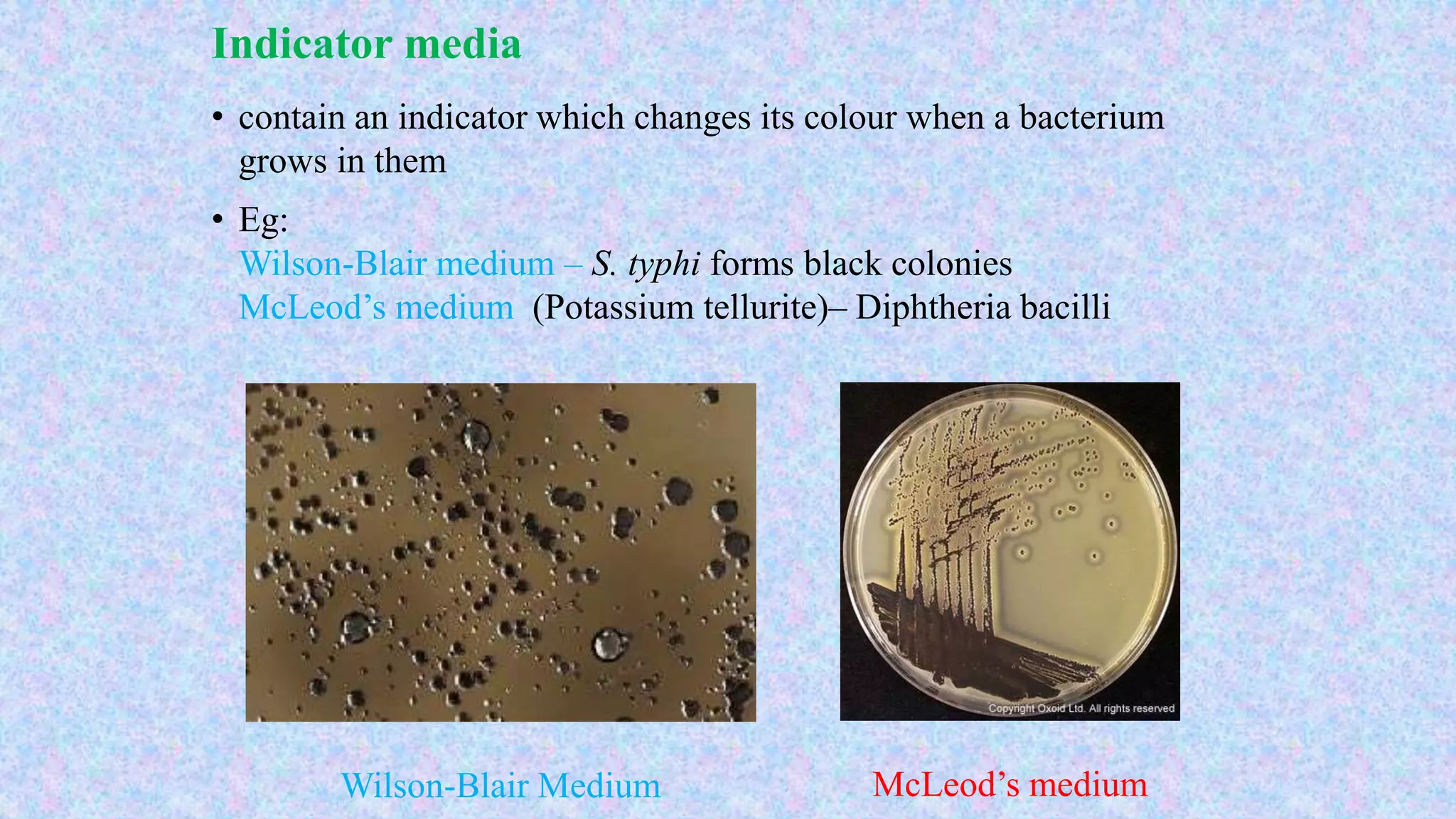
Indicator media
• contain an indicator which changes its colour when a bacterium
grows in them
• Eg:
Wilson-Blair medium – S. typhi forms black colonies
McLeod’s medium (Potassium tellurite)– Diphtheria bacilli
Wilson-Blair Medium McLeod’s medium
 Differential media
 Media to which substances are added to diffential
differentiate bacteria.
Eg: MacConkey agar: Distinguish between lactose
fermenters and non lactose fermenters bacteria's
• Lactose fermenters – Pink colonies
• Non lactose fermenters – colourless colonies
 TCBS agar differentiates sucrose forment blue colonies
of vibrio species
MacConkey Agar
• Is a selective, differential, primary
plating medium.
Composition :
• Peptne
• Lactose
• Agar
• Neutral red
• Bile salt ( Sod. taurocholate)
(Omission of Sod. chloride prevents the
swarming of proteus colonies.)
Cysteine Lactose Electrolyte Deficient (CLED) agar
• CLED agar is now used by most laboratories to isolate urinary pathogens.
• Composition
• Cysteine
• Lactose
• Bromothymol blue
• Agar
• peptone
• No electrolyte so to prevent the swarming growth of Proteus spp.
 Sugar media
• Media containing any fermentable substance
• Eg: glucose, arabinose, lactose, starch etc.
• Media consists:
1% of the sugar in peptone water + Indicator
• Contain a small tube (Durham’s tube) for the detection of gas by the
bacteria
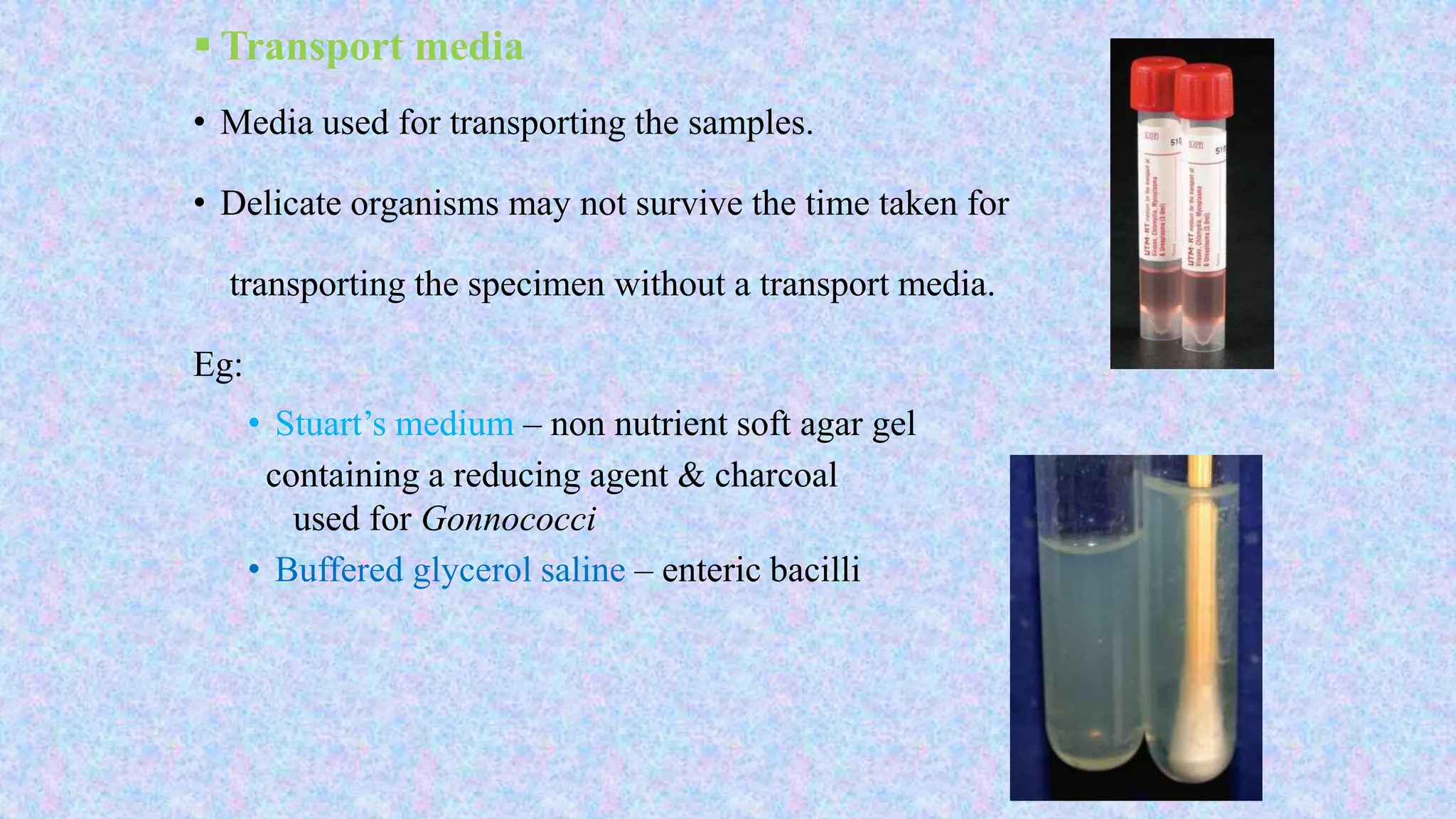
 Transport media
• Media used for transporting the samples.
• Delicate organisms may not survive the time taken for
transporting the specimen without a transport media.
Eg:
• Stuart’s medium – non nutrient soft agar gel
containing a reducing agent & charcoal
used for Gonnococci
• Buffered glycerol saline – enteric bacilli
 Anaerobic media
• These media are used to grow anaerobic organisms.
• Eg: Robertson’s cooked meat medium, Thioglycolate medium.
CULTURE METHODS
 Culture methods employed depend on the purpose for
which they are intended.
 Purposes:
Isolation
Properties of bacteria
To create antigens for laboratory
use
To test for Antibiotic sensitivity
Estimate viable counts
Maintain stock cultures
 Culture methods include:
• Streak culture
• Lawn culture
• Stroke culture
• Stab culture
• Pour plate method
• Liquid culture
• Anaerobic culture methods
 STREAK CULTURE
• Used for the isolation of bacteria in pure
culture from clinical specimens.
• Platinum wire is used.
• One loopful of the specimen is transferred
onto the surface of a well dried plate.
• Spread over a small area at the periphery.
• The inoculum is then distributed thinly over
the plate by streaking it with a loop in a
series of parallel lines in different segments
of the plate.
• On incubation, separated colonies are
obtained over the last series of streaks.
 LAWN CULTURE
oProvides a uniform surface growth
of the bacterium.
oUses
• For bacteriophage typing.
• Antibiotic sensitivity testing.
• In the preparation of bacterial antigens and vaccines.
oLawn cultures are prepared by flooding the surface of the plate with a
liquid suspension of the bacterium.
Antibiotic sensitivity testing
Mueller Hinton agar
• Beef infusion
• Casein hydrolysate
• Starch
• Agar
• Useful in antibiotic susceptibility
testing and also for testing starch
hydrolysis.
Properties of MHA
• Constituents of media is defined.
• Support growth of all types of pathogens.
• No enrichment or selective in nature.
• pH well adjusted at 7.3,isotonic and depth 4mm so antibiotics can
diffuses in media.
• Agar broth version same formula.
• Constituents are not antagonist to any drug.
• Starch is included in the medium for two reasons—it may protect the
organisms against toxic substances and also can serve as an energy
source for some bacteria.
 STROKE CULTURE
• Stroke culture is made in tubes containing agar
slope.
• Uses
• Provide a pure growth of bacterium for slide
agglutination and other diagnostic tests.
 STAB CULTURE
• Prepared by puncturing a suitable medium – gelatin or glucose
agar with a long, straight, charged wire.
• Uses
• Demonstration of gelatin liquefaction.
• Oxygen requirements of the bacterium under study.
• Maintenance of stock cultures.
 LIQUID CULTURES
• Liquid cultures are inoculated by touching with a charged loop or
by adding the inoculum with pipettes or syringes.
 Uses
• Blood culture
• Sterility tests
• Continuous culture methods
 Disadvantage
• It does not provide a pure culture
from mixed inocula
ANAEROBIC CULTURE METHODS
• Anaerobic bacteria differ in their requirement and sensitivity to
oxygen.
• Cl. tetani is a strict anaerobe
• Methods:
• Production of vacuum
• Displacement of oxygen with other gases
• Chemical method
• Biological method
• Reduction of medium
 POUR PLATE CULTURE
• Agar medium is melted (15 ml) and cooled to 45oC.
• 1 ml of the inoculum is added to the molten agar.
• Mix well and pour to a sterile petri dish.
• Allow it to set.
• Incubate at 37oC, colonies will be distributed throughout the depth
of the medium.
 Uses
• Gives an estimate of the viable bacterial count in a suspension.
• For the quantitative urine cultures.
 Displacement of oxygen with other gases
• Displacement of oxygen with hydrogen, nitrogen, helium or CO2.
• Eg: Candle jar
Inoculated plates are placed inside a large airtight container
And a lighted candle kept in it before the lid is sealed
The burning candle is expected to use up all the oxygen inside
Before it is extinguished ,but some oxygen is always left behind.
The candle jar provides a concentration of carbondioxide which
stimulates the growth of most bacteria.
Chemical method
• Alkaline pyrogallol absorbs oxygen.pyrogallic acid added to a solution
of sodium hydroxide in a large test tubes placed inside an airtight jar
povides anaerobic environment but small amount of carbonmonoxide,
which is formed during reaction,may be inhibitory to some bacteria
• Instead of alkaline pyrogallol,anaerobic environment has been
produced within jars with a mixture of Chromium and Sulphuric acid
McIntosh – Fildes’ anaerobic jar
• Consists of a metal jar or glass jar with a metal lid
which can be clamped air tight.
• The lid has 2 tubes – gas inlet and gas outlet
• The lid has two terminals – connected to electrical supply.
• Under the lid – small grooved porcelain spool, wrapped
with a layer of palladinised asbestos.
 Biological method
• Absorption of oxygen by incubation with aerobic bacteria,
germinating seeds or chopped vegetables.
 Reduction of oxygen
• By using reducing agents – 1% glucose, 0.1% Thioglycolate
Bacterial culture media by manoj

Bacterial culture media by manoj

  • 1.
    Bacterial Culture Mediumand Culture Technique Manoj Mehta Msc.clinical microbiology
  • 2.
    CONTENTS 1.INTRODUCTION 2.HISTORY 3.CULTIVATION 4.EQUIPMENT 5.MEDIA CLASSIFICATION ANDFUNCTION 6.FREQUENTLY USED MEDIA 7.TYPES OF CULTURE MEDIA 8.CULTURE METHODS
  • 3.
    INTRODUCTION Direct laboratory methods,such as microscopy provide preliminary information about the bacteria involved in an infection, but bacterial growth is usually required for definitive identification and characterization,hence the culture method is needed.
  • 4.
    HISTORY  Louis Pasteur: which states that microorganisms are the causes of infectious disease and used simple broths to grow; made up of urine or meat extracts.  Robert Koch: established that microbes can cause and realized the importance of solid media and used potato pieces to grow bacteria
  • 5.
    Definition:  Culture isthe term given to microorganisms that are cultivated in the lab for the purpose of identifying and studying them.  Medium is the term given to the combination of ingredients that will support the growth and cultivation of microorganisms by providing all the essential nutrients required for the growth in order to cultivate these microorganisms in large numbers to study them  Cultivation is the process of growing microorganisms in culture by taking bacteria from the infection site by some means of specimen collection and growing them in the artificial environment of the laboratory.
  • 6.
    Need for BacterialCulture • To grow and isolate all bacteria present in a clinical specimen. • To determine which of the bacteria that grow are most likely causing infection and which are likely contaminants or colonizers. • To obtain sufficient growth of clinically relevant bacteria to allow identification and characterization. Need for Culture media • Used to grow bacteria • Can be used to enrich the numbers of bacteria • Select for certain bacteria and suppress others • Differentiate among different kinds of bacteria • Select for certain bacteria and suppress others  Differentiate among different kinds of bacteria
  • 7.
    EQUIPMENT : • 1.Petridish : 2.Bunsen Burner : 3.Inoculating loop :
  • 8.
    Composition of culturemedia • Water • Agar • Casein hydrolysate • Meat extract • Yeast extract • Mineral salt • Blood / serum
  • 9.
    Agar • Frau Hesse:Idea to use agar as solidification agent instead of gelatin because gelatin melt at 24*c Properties of Agar • Universally used for preparing solid medium • Obtained from seaweed: Gelidium • No nutritive value • Not affected by the growth of the bacteria. • Melts at 98°C & sets at 42°C Concentration of Agar • (2 – 3 )% for solidifying culture media. • (0.2-0.5)% for Semi-solid, • (0.05-0.1)% for anaerobes and microaerophiles
  • 10.
    Basic requirements 1.Chemical Requirements(Nutritional Requirements) • Carbon • Nitrogen, sulfur, and phosphorous • Trace elements • Organic growth factor • Vitamins (e.g. folic acid, vitamin B-12, vitamin K) • Oxygen 2.Physical Requirements • Temperature • PH • Hydrostatic Pressure • Osmotic pressure
  • 11.
    Types of culturemedia 1.Based on physical state • Liquid(broth) • Semi-solid • Solid(agar) • Biphasic 2. Based on presence of molecular oxygen and reducing substances • Aerobic media • Anaerobic media 3. Based on nutritional factors • Simple media • Complex media • Special media • Synthetic media
  • 12.
     Special typeof media are further divisible into • Enriched media • Enrichment media • Selective media • Differential media • Indicator media • Transport media and • Sugar media.
  • 13.
    Based on theirconsistency  1.Liquid media: No use of agar • Broth • Peptoned water Advantages • Present small no.of bacteria , they grow only in liquid medium e.g. blood culture. • Specimens containing inhibitory substances like antibiotics and other antibacterial substances get diluted by inoculation into the large volume of the fluid medium.. • widely used for biochemical tests. • useful enrichment media like selenite F broth. • Presumptive bacterial count in water sample is made in liquid media. Disadvantages • Isolation of bacteria in pure culture is not possible. • Identification of bacteria is not possible.
  • 14.
    Solid culture Medium •Contains 1- 2% agar  Advantages • Distinct colony morphology • Colony microscopically visible There is separate colony formation. • Identification of most bacterial species. • Isolation of bacteria in pure culture eg.Nutrient agar, Blood agar Semi-solid culture media: • Contain (0.2-0.5)% agar • Use for the observation of bacterial motility • and preservation of bacteria. e.g. SIM
  • 15.
    Biphasic Blood CultureMedia • Has both liquid phase and solid phase. • Also known as Casteneda medium has agar slope with broth medium. • Recommended if brucellosis is suspected.
  • 16.
    • Based ontheir nutritional factors  Simple media / basal media: • Most common in routine diagnostic laboratories E.g: Nutrient Broth, Nutrient Agar • NB consists of peptone, meat extract, NaCl, water • NB + 0.5% Glucose = Glucose Broth • NB + 2% agar = Nutrient agar  Uses: to prepare enriched media • To maintain stock culture of control bacterial strains. • To subculture pathogenic bacteria from selective/ differential medium prior to performing biochemical or serological test e.g. nutrient broth, nutrient agar. • Reduced conc.of agar to 0.2-0.4% enables motile bacteria (6% agar inhibits swarming growth of Proteus spp.)
  • 17.
    Commonoly used mediain lab • Nutrient Agar • Contain 2% agar • commonly used • Concentration can be increased to 6% to prevent swarming • Can be reduced to 0’5%
  • 18.
    GREEN PIGMENTED COLONIES NONPIGMENTEDCOLONIES RED PIGMENTED COLONIES YELLOW PIGMENTED COLONIES Used to isolate separate colonies for studying 1.colony morphology. 2.pigmentation. 3.biochemical identification tests
  • 19.
    Enriched media • Substanceslike blood, serum, egg are added to the basal medium. • Used to grow bacteria that are exacting in their nutritional needs. • Eg: Blood agar, Chocolate agar,Lowenstein-Jensen’s medium Chocolate agar Blood agar
  • 20.
    Blood Agar • Usedto cultivate a wide variety of moderately fastidious bacterial organisms. • Blood agar base can be enriched by the addition of 5% to 10% defibrinated sheep, rabbit, or human blood. • Provides enrichment for the growth of the bacterial organisms, but also allows for the detection and characterization of hemolytic activity.
  • 22.
    • Heated bloodagar • Prepared by heating blood agar at 75-80 degrees in a water bath for about 2o mins or until it becomes chocolate brown in colour. • Used for the growth of Haemophilus influenzae, Neisseria, S. pneumoniae etc. CHOCOLATE AGAR
  • 23.
    Lowenstein-Jensen medium • Usedto cultivate Mycobacterium spp. • Composition • Malachite green (2%) • Glycerol • Asparagine • Coagulated eggs • Mineral salt solution • Potassium dihydrogen phosphate • Magnesium sulfate • Sodium citrate
  • 24.
    Brain heart infusionbroth • composition • Calf brain infusion • Beef heart infusion • Protease peptone • Dextrose • Sodium chloride • Sodium phosphate ( sodium polyanethol sulphate) • Enriched medium suitable for the cultivation of nonfastidious and moderately fastidious microorganisms and used as a blood culture medium.
  • 25.
    Enrichment media • Liquidmedia used to isolate pathogens from a mixed culture. • Media is incorporated with inhibitory substances to suppress the unwanted organism → increase in numbers of desired bacteria Eg: Selenite F Broth –for the isolation of salmonella,Shigella Tetrathionate Broth ( inhibit coliforms) Alkaline Peptone Water – for Vibrio cholerae
  • 26.
    Selective media • Theinhibitory substance is added to a solid media • Increase in number of colonies of desired bacterium Eg: • Desoxycholate citrate medium for dysentery bacilli • Mac Conkey’s medium for gram negative bacteria • Thiosulfate citrate bile salts sucrose (TCBS) agar– for V. cholerae • LJ medium – M. tuberculosis
  • 27.
    Indicator media • containan indicator which changes its colour when a bacterium grows in them • Eg: Wilson-Blair medium – S. typhi forms black colonies McLeod’s medium (Potassium tellurite)– Diphtheria bacilli Wilson-Blair Medium McLeod’s medium
  • 28.
     Differential media Media to which substances are added to diffential differentiate bacteria. Eg: MacConkey agar: Distinguish between lactose fermenters and non lactose fermenters bacteria's • Lactose fermenters – Pink colonies • Non lactose fermenters – colourless colonies  TCBS agar differentiates sucrose forment blue colonies of vibrio species
  • 29.
    MacConkey Agar • Isa selective, differential, primary plating medium. Composition : • Peptne • Lactose • Agar • Neutral red • Bile salt ( Sod. taurocholate) (Omission of Sod. chloride prevents the swarming of proteus colonies.)
  • 30.
    Cysteine Lactose ElectrolyteDeficient (CLED) agar • CLED agar is now used by most laboratories to isolate urinary pathogens. • Composition • Cysteine • Lactose • Bromothymol blue • Agar • peptone • No electrolyte so to prevent the swarming growth of Proteus spp.
  • 31.
     Sugar media •Media containing any fermentable substance • Eg: glucose, arabinose, lactose, starch etc. • Media consists: 1% of the sugar in peptone water + Indicator • Contain a small tube (Durham’s tube) for the detection of gas by the bacteria
  • 32.
     Transport media •Media used for transporting the samples. • Delicate organisms may not survive the time taken for transporting the specimen without a transport media. Eg: • Stuart’s medium – non nutrient soft agar gel containing a reducing agent & charcoal used for Gonnococci • Buffered glycerol saline – enteric bacilli
  • 33.
     Anaerobic media •These media are used to grow anaerobic organisms. • Eg: Robertson’s cooked meat medium, Thioglycolate medium.
  • 34.
    CULTURE METHODS  Culturemethods employed depend on the purpose for which they are intended.  Purposes: Isolation Properties of bacteria To create antigens for laboratory use To test for Antibiotic sensitivity Estimate viable counts Maintain stock cultures
  • 35.
     Culture methodsinclude: • Streak culture • Lawn culture • Stroke culture • Stab culture • Pour plate method • Liquid culture • Anaerobic culture methods
  • 36.
     STREAK CULTURE •Used for the isolation of bacteria in pure culture from clinical specimens. • Platinum wire is used. • One loopful of the specimen is transferred onto the surface of a well dried plate. • Spread over a small area at the periphery. • The inoculum is then distributed thinly over the plate by streaking it with a loop in a series of parallel lines in different segments of the plate. • On incubation, separated colonies are obtained over the last series of streaks.
  • 37.
     LAWN CULTURE oProvidesa uniform surface growth of the bacterium. oUses • For bacteriophage typing. • Antibiotic sensitivity testing. • In the preparation of bacterial antigens and vaccines. oLawn cultures are prepared by flooding the surface of the plate with a liquid suspension of the bacterium. Antibiotic sensitivity testing
  • 38.
    Mueller Hinton agar •Beef infusion • Casein hydrolysate • Starch • Agar • Useful in antibiotic susceptibility testing and also for testing starch hydrolysis.
  • 39.
    Properties of MHA •Constituents of media is defined. • Support growth of all types of pathogens. • No enrichment or selective in nature. • pH well adjusted at 7.3,isotonic and depth 4mm so antibiotics can diffuses in media. • Agar broth version same formula. • Constituents are not antagonist to any drug. • Starch is included in the medium for two reasons—it may protect the organisms against toxic substances and also can serve as an energy source for some bacteria.
  • 40.
     STROKE CULTURE •Stroke culture is made in tubes containing agar slope. • Uses • Provide a pure growth of bacterium for slide agglutination and other diagnostic tests.
  • 41.
     STAB CULTURE •Prepared by puncturing a suitable medium – gelatin or glucose agar with a long, straight, charged wire. • Uses • Demonstration of gelatin liquefaction. • Oxygen requirements of the bacterium under study. • Maintenance of stock cultures.
  • 42.
     LIQUID CULTURES •Liquid cultures are inoculated by touching with a charged loop or by adding the inoculum with pipettes or syringes.  Uses • Blood culture • Sterility tests • Continuous culture methods  Disadvantage • It does not provide a pure culture from mixed inocula
  • 43.
    ANAEROBIC CULTURE METHODS •Anaerobic bacteria differ in their requirement and sensitivity to oxygen. • Cl. tetani is a strict anaerobe • Methods: • Production of vacuum • Displacement of oxygen with other gases • Chemical method • Biological method • Reduction of medium
  • 44.
     POUR PLATECULTURE • Agar medium is melted (15 ml) and cooled to 45oC. • 1 ml of the inoculum is added to the molten agar. • Mix well and pour to a sterile petri dish. • Allow it to set. • Incubate at 37oC, colonies will be distributed throughout the depth of the medium.  Uses • Gives an estimate of the viable bacterial count in a suspension. • For the quantitative urine cultures.
  • 45.
     Displacement ofoxygen with other gases • Displacement of oxygen with hydrogen, nitrogen, helium or CO2. • Eg: Candle jar Inoculated plates are placed inside a large airtight container And a lighted candle kept in it before the lid is sealed The burning candle is expected to use up all the oxygen inside Before it is extinguished ,but some oxygen is always left behind. The candle jar provides a concentration of carbondioxide which stimulates the growth of most bacteria.
  • 46.
    Chemical method • Alkalinepyrogallol absorbs oxygen.pyrogallic acid added to a solution of sodium hydroxide in a large test tubes placed inside an airtight jar povides anaerobic environment but small amount of carbonmonoxide, which is formed during reaction,may be inhibitory to some bacteria • Instead of alkaline pyrogallol,anaerobic environment has been produced within jars with a mixture of Chromium and Sulphuric acid McIntosh – Fildes’ anaerobic jar • Consists of a metal jar or glass jar with a metal lid which can be clamped air tight. • The lid has 2 tubes – gas inlet and gas outlet • The lid has two terminals – connected to electrical supply. • Under the lid – small grooved porcelain spool, wrapped with a layer of palladinised asbestos.
  • 47.
     Biological method •Absorption of oxygen by incubation with aerobic bacteria, germinating seeds or chopped vegetables.  Reduction of oxygen • By using reducing agents – 1% glucose, 0.1% Thioglycolate