Mycobacteria
• To know various species of the Mycobacteria
• To know the various diseases caused by the Mycobacteria
• To know the pathogenesis of Mycobacteria
• To know various tests for diagnosis of diseases caused by
Mycobacteria
• To know the treatment of diseases caused by Mycobacteria
Mycobacteria
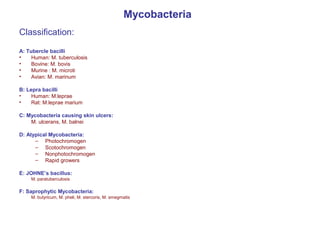
Classification:
A: Tubercle bacilli
• Human: M. tuberculosis
• Bovine: M. bovis
• Murine : M. microti
• Avian: M. marinum
B: Lepra bacilli
• Human: M.leprae
• Rat: M.leprae marium
C: Mycobacteria causing skin ulcers:
M. ulcerans, M. balnei
D: Atypical Mycobacteria:
– Photochromogen
– Scotochromogen
– Nonphotochromogen
– Rapid growers
E: JOHNE’s bacillus:
M. paratuberculosis
F: Saprophytic Mycobacteria:
M. butyricum, M. pheli, M. stercoris, M. smegmatis
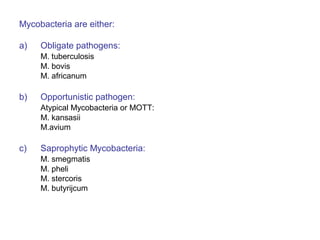
Mycobacteria are either:
a) Obligate pathogens:
M. tuberculosis
M. bovis
M. africanum
b) Opportunistic pathogen:
Atypical Mycobacteria or MOTT:
M. kansasii
M.avium
c) Saprophytic Mycobacteria:
M. smegmatis
M. pheli
M. stercoris
M. butyrijcum
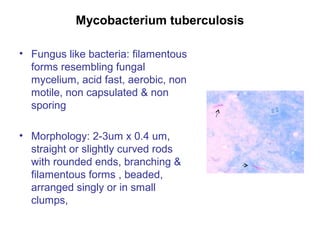
Mycobacterium tuberculosis
• Fungus like bacteria: filamentous
forms resembling fungal
mycelium, acid fast, aerobic, non
motile, non capsulated & non
sporing
• Morphology: 2-3um x 0.4 um,
straight or slightly curved rods
with rounded ends, branching &
filamentous forms , beaded,
arranged singly or in small
clumps,
Cultural characteristic:
– an obligate aerobe,
– 370
c, pH- 7,
– slow growth – take 2-8 weeks to grow
– generation time- 14-15 hrs,
– grows well on enriched media containing
serum, potato, blood & egg
– M. bovis is microaerophilic
1) Solid media:
LJ, Dorset egg medium
• Containing blood: Tarshis medium
• Containing serum: Loeffler’s serum slope
• Containing potato: Pawolosky’s medium
2) Liquid medium:
Dubbo’s, Middle brook’s(7H-10 & H-12) , proskaur’s medium
Colony characters:
on solid media: dry, rough, raised wrinkled, irregular
• Liquid media:
growth occurs as bottom creeps up the sides, forms prominent
surface pellicle, extends along sides above the medium
• New technique: BACTEC system
Biochemical tests:
• Niacin test
• Neutral red test
• Aryl sulphtase test
• Nitrate reduction test
• Amidase test
• Catalase & peroxidase test
• Susceptibility to pyrazinamide
• Susceptibility to thiophen 2-carboxylic acid hydrazide
• Tween 80 hydrolysis
Resistance:
• viable in sputum for 20-30 hrs
• in droplet nuclei for 8-10 hrs
• in culture for 6-8 months
• resistant to disinfectant
• sensitive to formaldehyde & Glutaraldehyde
• killed by sunlight for 2-3 hrs exposure
• sensitive to ethanol
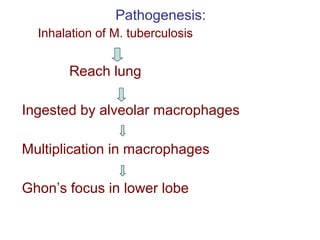
Pathogenesis:
Inhalation of M. tuberculosis
Reach lung
Ingested by alveolar macrophages
Multiplication in macrophages
Ghon’s focus in lower lobe
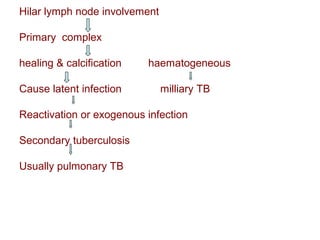
Hilar lymph node involvement
Primary complex
healing & calcification haematogeneous
Cause latent infection milliary TB
Reactivation or exogenous infection
Secondary tuberculosis
Usually pulmonary TB
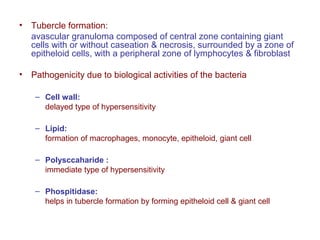
• Tubercle formation:
avascular granuloma composed of central zone containing giant
cells with or without caseation & necrosis, surrounded by a zone of
epitheloid cells, with a peripheral zone of lymphocytes & fibroblast
• Pathogenicity due to biological activities of the bacteria
– Cell wall:
delayed type of hypersensitivity
– Lipid:
formation of macrophages, monocyte, epitheloid, giant cell
– Polysccaharide :
immediate type of hypersensitivity
– Phospitidase:
helps in tubercle formation by forming epitheloid cell & giant cell
• Tubercle lesion :
1) exudative
2) productive
• Infection depends on:
– dose of organism
– virulence
– mode of entry
– age
– resistance
– hypersensitivity of patient
• Antigens present in mycobacterium spp:
– Group specific polysaccharide antigen
– Type specific protein antigen : used in detection of antibodies
• Phage types of mycobacterium: A, B, C, type I
Various systems involved in TB:
• Pulmonary ,renal, tubercular meningitis, bone
marrow & joint , miliary, intestinal, skin
tuberculosis
• Clinical symptoms:
fever, cough with expectoration, haemoptysis,
weight loss, loss of appetite, signs of pleural
effusion/consolidation/cavity
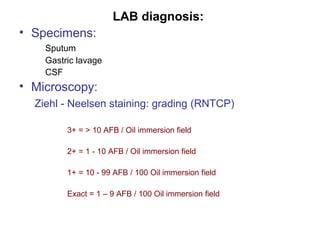
LAB diagnosis:
• Specimens:
Sputum
Gastric lavage
CSF
• Microscopy:
Ziehl - Neelsen staining: grading (RNTCP)
3+ = > 10 AFB / Oil immersion field
2+ = 1 - 10 AFB / Oil immersion field
1+ = 10 - 99 AFB / 100 Oil immersion field
Exact = 1 – 9 AFB / 100 Oil immersion field
• Petroff’s method for sputum and oxalic acid for urine
• Culture on Lowenstein Jensen (LJ) medium
• ELISA, RIA, latex agglutination
• Nucleic acid detection: PCR,LCR,DNA probes
• BACTEC, VersaTrek, MGIT
• Animal inoculation in guinea pig
• Antibiotic Sensitivity test
Tuberculin test: Mantoux test
• Type IV hypersensitivity test
• Purified protein derivative (PPD) intradermal inoculation on forearm
• Site observed after 72 hrs for erythema & induration
• Interpretation:
– 10 mm indicates positive
– 5 mm negative,
– between 5-9 mm indicates doubtful
• Use: to diagnose active infection in infants
Treatment :
• Bactericidal : rifampicin, isoniazide, pyrizinamide, streptomycin
• Bacteriostatic: ethambutol, cycloserine, capreomycin, kanamycin, ciprofloxacin
• DOTS,RNTCP
Prophylaxis:
– BCG: live attenuated vaccine
– Strains used: M.bovis
– Route of inoculation: intradermal
– Age: at birth,shedule: single dose
• Immunity: 10- 12 yrs, protects individuals from complicated forms of tuberculosis
• Adverse effects : local, regional, systemic
• Contraindicated in AIDS, measles
Thought for dental professionals
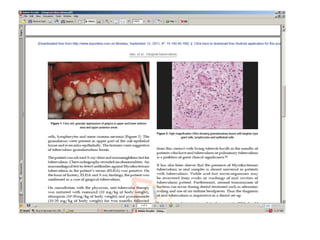
 38 yr Female with non painful swelling of the gingiva right upper side since 2
years
 Gradually increasing in size with time
 Experienced weight loss since 4/5 months
 There was a cough and weakness since 15 days
 Medical history reveals non systemic problem except cough and
expectoration since 15 days
 Patient never visited dentist in her lifetime no dental trauma history or
surgery
 Intra oral exmn showed gingival enlargement especially in upper and lower
anterior labial and upper posterior buccal areas
 Gingiva was fiery red, irregular, papillary, pebbled and granular in
appearance
 Lesion was slightly painful on touch with spontaneous bleeding on
provocation
 No significant lymphadenopathy, swelling on lips, CBC was normal, HIV
negative, elevated ESR, CXR normal
• Gingival tuberculosis Published in J
Ind Soc Periodontol Aug 2009
• Conclusion:
– It can be occupational risk for dentists
– It is rare entity
– Consider for diff diagnosis
– Diff Diag :
• Gingival enlargement due to drugs
• Infections (bacerial, fungal and viral)
• Malignancy – leukemia
• Traumatic ulcer
• Squamous cell carcinoma
• A major concern for dentists so Infection prevention practices
meticulously
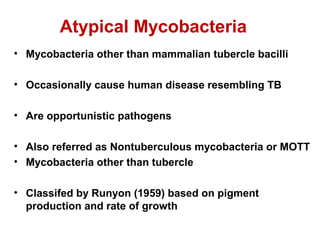
Atypical Mycobacteria
• Mycobacteria other than mammalian tubercle bacilli
• Occasionally cause human disease resembling TB
• Are opportunistic pathogens
• Also referred as Nontuberculous mycobacteria or MOTT
• Mycobacteria other than tubercle
• Classifed by Runyon (1959) based on pigment
production and rate of growth
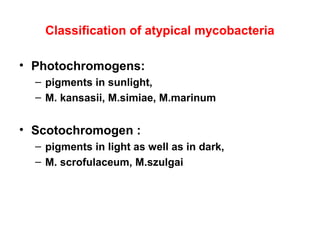
Classification of atypical mycobacteria
• Photochromogens:
– pigments in sunlight,
– M. kansasii, M.simiae, M.marinum
• Scotochromogen :
– pigments in light as well as in dark,
– M. scrofulaceum, M.szulgai
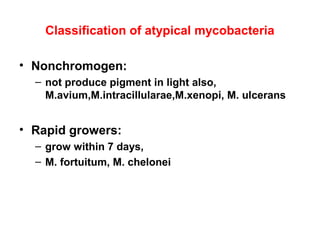
Classification of atypical mycobacteria
• Nonchromogen:
– not produce pigment in light also,
M.avium,M.intracillularae,M.xenopi, M. ulcerans
• Rapid growers:
– grow within 7 days,
– M. fortuitum, M. chelonei
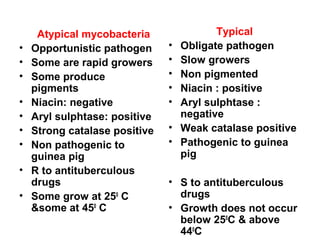
Atypical mycobacteria
• Opportunistic pathogen
• Some are rapid growers
• Some produce
pigments
• Niacin: negative
• Aryl sulphtase: positive
• Strong catalase positive
• Non pathogenic to
guinea pig
• R to antituberculous
drugs
• Some grow at 250
C
&some at 450
C
Typical
• Obligate pathogen
• Slow growers
• Non pigmented
• Niacin : positive
• Aryl sulphtase :
negative
• Weak catalase positive
• Pathogenic to guinea
pig
• S to antituberculous
drugs
• Growth does not occur
below 250
C & above
440
C
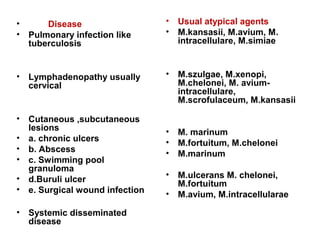
• Disease
• Pulmonary infection like
tuberculosis
• Lymphadenopathy usually
cervical
• Cutaneous ,subcutaneous
lesions
• a. chronic ulcers
• b. Abscess
• c. Swimming pool
granuloma
• d.Buruli ulcer
• e. Surgical wound infection
• Systemic disseminated
disease
• Usual atypical agents
• M.kansasii, M.avium, M.
intracellulare, M.simiae
• M.szulgae, M.xenopi,
M.chelonei, M. avium-
intracellulare,
M.scrofulaceum, M.kansasii
• M. marinum
• M.fortuitum, M.chelonei
• M.marinum
• M.ulcerans M. chelonei,
M.fortuitum
• M.avium, M.intracellularae
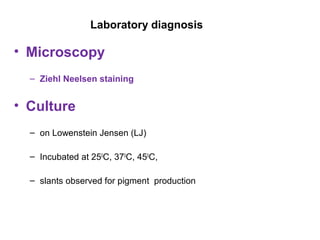
Laboratory diagnosis
• Microscopy
– Ziehl Neelsen staining
• Culture
– on Lowenstein Jensen (LJ)
– Incubated at 250
C, 370
C, 450
C,
– slants observed for pigment production
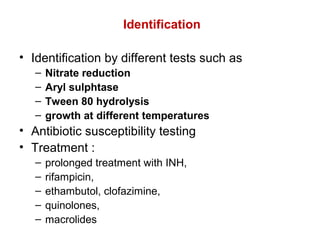
Identification
• Identification by different tests such as
– Nitrate reduction
– Aryl sulphtase
– Tween 80 hydrolysis
– growth at different temperatures
• Antibiotic susceptibility testing
• Treatment :
– prolonged treatment with INH,
– rifampicin,
– ethambutol, clofazimine,
– quinolones,
– macrolides
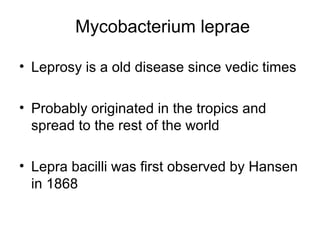
Mycobacterium leprae
• Leprosy is a old disease since vedic times
• Probably originated in the tropics and
spread to the rest of the world
• Lepra bacilli was first observed by Hansen
in 1868
Morphology
• L. leprae is a straight or slightly curved rod
• 1-8 um x 0.2-0.5 um in size
• Polar bodies and other intracellular elements
present
• Clubbed forms, lateral buds or branching
• It is Gram positive readily stain than Tb bacilli
• Acid fast but less than M. tuberculosis
• 5% H2SO4 is used as decolorizer
• Bacilli are seen singly and in groups intracellular or
lying free outside the cells
Cultivation:
• Not been able to cultivate in artificial media
• Can be cultivated in mice, nine banded armadillo
• Generation time 12-13 days
Resistance:
 Remain viable in warm humid envt. For 9-16 days
 For 46 days in moist soils
 Survive exposure to direct sunlight for 2 hrs and UV rays for
30 min
Leprosy
• Is a chronic granulomatous disease primarily of skin,
peripheral nerves and nasal mucosa
• Classified as
– Lepromatous
– Tuberculoid
– Dimorphous
– Indeterminate
 Type of disease is reflection of immune status of the host
Lepromatous:
• Lepromatous is seen in where the host immune response os
low
• Bacilli are seen in large numbers (multibacillary stage)
• Bacilli invade nose, mouth and upper respiratory tract and
are shed in large numbers in nasal and oral secretions
• More infective and prognosis is very poor
• Cell mediated immunity is deficient and lepromin test is
negative
• Humoral immunity is more
Tuberculoid:
 Seen in patients with high degree of resistance
 Skin lesions are few and sharply demarcated
 Bacilli are scanty (paucibacillary)
 Cell mediated immunity is adequate
 Lepromin test is positive
 Prognosis is good but humoral immune response is poor
Borderline or dimorphous:
 Lesions possessing both tuberculoid and lepromatous
typesI
Indeterminate:
 Is early unstable tissue reaction
 Which is not characteristics of either
 It may undergo healing spontaneously
Ridely and jopling classification
• 1966
• Five groups
1. Tuberculoid (TT)
2. Borderline tuberculoid (BT)
3. Borderline (BT)
4. Borderline lepromatous (BL)
5. Lepromatous (LL)
epidemiology
• Exclusively human disease
• Source – patient
• Mode of transmission is still not clear
• Large no. of bacilli shed in nasal secretions
• Patients may discharge 8x10⁸
bacilli in one nose blow
• Mode of entry
– Respiratory tract
– Skin
 It is not highly communicable
 Disease develops in 5% in spouses
 Incubation period is 2-5 yrs
 Worldwide in distribution
 India – Orisa and Bihar (highest prevalence)
• Lepromin test:
– skin test for delayed hypersensitivity & used to study immunity in
leprosy patients, antigen is Mitsuda’s Ag or bacillary lepromin
• Procedure : 0.1ml injected intradermally on forearm
• Two reactions:
1. early or Fernandez reaction: is an acute inflammatory area of more than
10 mm in diameter appearing in 24-48 hrs & disappears in 3-4 days
2. Late or Mitsuda’s reaction: appears 3-4 weeks after injection in the form
of nodule,may ulcerate or subside in few weeks
• Mitsuda’s reaction is more meaningful is a manifestation of
CMI,induced by lepromin while Fernandez reaction indicates past
reaction
• Uses:
1. classify lesions of leprosy
2. to assess prognosis & response to treatment
3. to assess resistance of an individual to leprosy
4. to verify candidate lepra bacillus
Lab diagnosis:
• Specimens: skin clippings, nasal samples,skin
nerve biopsy, lymph node puncture
• Microscopy:
– ZN staining with 5% sulphuric acid
• Gradings: Ridely scale
• 1+: 1-10 bacilli/ 100field
• 2+: 1-10 bacilli/ 10 field
• 3+: 1-10 bacilli/field
• 4+: 10-100/ field
• 5+: 100-1000/field
• 6+: more than 1000, clumps/field
• Morphological & bacteriological index calculated
• Culture: footpads of mouse, granuloma developes in 1-6
months
• Serological: latex agglutination, ELISA
• Lepromin test not for diagnosis but to resitance of patient
• Treatment:
– for paucibacillary leprosy: rifampicin 600mg once in a month &
Dapsone (4’,4’- diaminodiphenyl sulphone,DDS)100mg daily for 6
months
– For multibacillary leprosy : rifampicin, 600mg once a month
Dapsone 100mg daily &clofazimine 50mg daily for 2 years
Department of Microbiology
Mr. Mukhit Kazi, Lecturer

Mycobacteria

  • 1.
    Mycobacteria • To knowvarious species of the Mycobacteria • To know the various diseases caused by the Mycobacteria • To know the pathogenesis of Mycobacteria • To know various tests for diagnosis of diseases caused by Mycobacteria • To know the treatment of diseases caused by Mycobacteria
  • 2.
    Mycobacteria Classification: A: Tubercle bacilli •Human: M. tuberculosis • Bovine: M. bovis • Murine : M. microti • Avian: M. marinum B: Lepra bacilli • Human: M.leprae • Rat: M.leprae marium C: Mycobacteria causing skin ulcers: M. ulcerans, M. balnei D: Atypical Mycobacteria: – Photochromogen – Scotochromogen – Nonphotochromogen – Rapid growers E: JOHNE’s bacillus: M. paratuberculosis F: Saprophytic Mycobacteria: M. butyricum, M. pheli, M. stercoris, M. smegmatis
  • 3.
    Mycobacteria are either: a)Obligate pathogens: M. tuberculosis M. bovis M. africanum b) Opportunistic pathogen: Atypical Mycobacteria or MOTT: M. kansasii M.avium c) Saprophytic Mycobacteria: M. smegmatis M. pheli M. stercoris M. butyrijcum
  • 4.
    Mycobacterium tuberculosis • Funguslike bacteria: filamentous forms resembling fungal mycelium, acid fast, aerobic, non motile, non capsulated & non sporing • Morphology: 2-3um x 0.4 um, straight or slightly curved rods with rounded ends, branching & filamentous forms , beaded, arranged singly or in small clumps,
  • 5.
    Cultural characteristic: – anobligate aerobe, – 370 c, pH- 7, – slow growth – take 2-8 weeks to grow – generation time- 14-15 hrs, – grows well on enriched media containing serum, potato, blood & egg – M. bovis is microaerophilic
  • 6.
    1) Solid media: LJ,Dorset egg medium • Containing blood: Tarshis medium • Containing serum: Loeffler’s serum slope • Containing potato: Pawolosky’s medium 2) Liquid medium: Dubbo’s, Middle brook’s(7H-10 & H-12) , proskaur’s medium Colony characters: on solid media: dry, rough, raised wrinkled, irregular • Liquid media: growth occurs as bottom creeps up the sides, forms prominent surface pellicle, extends along sides above the medium • New technique: BACTEC system
  • 7.
    Biochemical tests: • Niacintest • Neutral red test • Aryl sulphtase test • Nitrate reduction test • Amidase test • Catalase & peroxidase test • Susceptibility to pyrazinamide • Susceptibility to thiophen 2-carboxylic acid hydrazide • Tween 80 hydrolysis
  • 8.
    Resistance: • viable insputum for 20-30 hrs • in droplet nuclei for 8-10 hrs • in culture for 6-8 months • resistant to disinfectant • sensitive to formaldehyde & Glutaraldehyde • killed by sunlight for 2-3 hrs exposure • sensitive to ethanol
  • 9.
    Pathogenesis: Inhalation of M.tuberculosis Reach lung Ingested by alveolar macrophages Multiplication in macrophages Ghon’s focus in lower lobe
  • 10.
    Hilar lymph nodeinvolvement Primary complex healing & calcification haematogeneous Cause latent infection milliary TB Reactivation or exogenous infection Secondary tuberculosis Usually pulmonary TB
  • 11.
    • Tubercle formation: avasculargranuloma composed of central zone containing giant cells with or without caseation & necrosis, surrounded by a zone of epitheloid cells, with a peripheral zone of lymphocytes & fibroblast • Pathogenicity due to biological activities of the bacteria – Cell wall: delayed type of hypersensitivity – Lipid: formation of macrophages, monocyte, epitheloid, giant cell – Polysccaharide : immediate type of hypersensitivity – Phospitidase: helps in tubercle formation by forming epitheloid cell & giant cell
  • 12.
    • Tubercle lesion: 1) exudative 2) productive • Infection depends on: – dose of organism – virulence – mode of entry – age – resistance – hypersensitivity of patient • Antigens present in mycobacterium spp: – Group specific polysaccharide antigen – Type specific protein antigen : used in detection of antibodies • Phage types of mycobacterium: A, B, C, type I
  • 13.
    Various systems involvedin TB: • Pulmonary ,renal, tubercular meningitis, bone marrow & joint , miliary, intestinal, skin tuberculosis • Clinical symptoms: fever, cough with expectoration, haemoptysis, weight loss, loss of appetite, signs of pleural effusion/consolidation/cavity
  • 14.
    LAB diagnosis: • Specimens: Sputum Gastriclavage CSF • Microscopy: Ziehl - Neelsen staining: grading (RNTCP) 3+ = > 10 AFB / Oil immersion field 2+ = 1 - 10 AFB / Oil immersion field 1+ = 10 - 99 AFB / 100 Oil immersion field Exact = 1 – 9 AFB / 100 Oil immersion field
  • 15.
    • Petroff’s methodfor sputum and oxalic acid for urine • Culture on Lowenstein Jensen (LJ) medium • ELISA, RIA, latex agglutination • Nucleic acid detection: PCR,LCR,DNA probes • BACTEC, VersaTrek, MGIT • Animal inoculation in guinea pig • Antibiotic Sensitivity test
  • 16.
    Tuberculin test: Mantouxtest • Type IV hypersensitivity test • Purified protein derivative (PPD) intradermal inoculation on forearm • Site observed after 72 hrs for erythema & induration • Interpretation: – 10 mm indicates positive – 5 mm negative, – between 5-9 mm indicates doubtful • Use: to diagnose active infection in infants
  • 17.
    Treatment : • Bactericidal: rifampicin, isoniazide, pyrizinamide, streptomycin • Bacteriostatic: ethambutol, cycloserine, capreomycin, kanamycin, ciprofloxacin • DOTS,RNTCP Prophylaxis: – BCG: live attenuated vaccine – Strains used: M.bovis – Route of inoculation: intradermal – Age: at birth,shedule: single dose • Immunity: 10- 12 yrs, protects individuals from complicated forms of tuberculosis • Adverse effects : local, regional, systemic • Contraindicated in AIDS, measles
  • 18.
    Thought for dentalprofessionals  38 yr Female with non painful swelling of the gingiva right upper side since 2 years  Gradually increasing in size with time  Experienced weight loss since 4/5 months  There was a cough and weakness since 15 days  Medical history reveals non systemic problem except cough and expectoration since 15 days  Patient never visited dentist in her lifetime no dental trauma history or surgery  Intra oral exmn showed gingival enlargement especially in upper and lower anterior labial and upper posterior buccal areas  Gingiva was fiery red, irregular, papillary, pebbled and granular in appearance  Lesion was slightly painful on touch with spontaneous bleeding on provocation  No significant lymphadenopathy, swelling on lips, CBC was normal, HIV negative, elevated ESR, CXR normal
  • 20.
    • Gingival tuberculosisPublished in J Ind Soc Periodontol Aug 2009 • Conclusion: – It can be occupational risk for dentists – It is rare entity – Consider for diff diagnosis – Diff Diag : • Gingival enlargement due to drugs • Infections (bacerial, fungal and viral) • Malignancy – leukemia • Traumatic ulcer • Squamous cell carcinoma • A major concern for dentists so Infection prevention practices meticulously
  • 21.
    Atypical Mycobacteria • Mycobacteriaother than mammalian tubercle bacilli • Occasionally cause human disease resembling TB • Are opportunistic pathogens • Also referred as Nontuberculous mycobacteria or MOTT • Mycobacteria other than tubercle • Classifed by Runyon (1959) based on pigment production and rate of growth
  • 22.
    Classification of atypicalmycobacteria • Photochromogens: – pigments in sunlight, – M. kansasii, M.simiae, M.marinum • Scotochromogen : – pigments in light as well as in dark, – M. scrofulaceum, M.szulgai
  • 23.
    Classification of atypicalmycobacteria • Nonchromogen: – not produce pigment in light also, M.avium,M.intracillularae,M.xenopi, M. ulcerans • Rapid growers: – grow within 7 days, – M. fortuitum, M. chelonei
  • 24.
    Atypical mycobacteria • Opportunisticpathogen • Some are rapid growers • Some produce pigments • Niacin: negative • Aryl sulphtase: positive • Strong catalase positive • Non pathogenic to guinea pig • R to antituberculous drugs • Some grow at 250 C &some at 450 C Typical • Obligate pathogen • Slow growers • Non pigmented • Niacin : positive • Aryl sulphtase : negative • Weak catalase positive • Pathogenic to guinea pig • S to antituberculous drugs • Growth does not occur below 250 C & above 440 C
  • 25.
    • Disease • Pulmonaryinfection like tuberculosis • Lymphadenopathy usually cervical • Cutaneous ,subcutaneous lesions • a. chronic ulcers • b. Abscess • c. Swimming pool granuloma • d.Buruli ulcer • e. Surgical wound infection • Systemic disseminated disease • Usual atypical agents • M.kansasii, M.avium, M. intracellulare, M.simiae • M.szulgae, M.xenopi, M.chelonei, M. avium- intracellulare, M.scrofulaceum, M.kansasii • M. marinum • M.fortuitum, M.chelonei • M.marinum • M.ulcerans M. chelonei, M.fortuitum • M.avium, M.intracellularae
  • 26.
    Laboratory diagnosis • Microscopy –Ziehl Neelsen staining • Culture – on Lowenstein Jensen (LJ) – Incubated at 250 C, 370 C, 450 C, – slants observed for pigment production
  • 27.
    Identification • Identification bydifferent tests such as – Nitrate reduction – Aryl sulphtase – Tween 80 hydrolysis – growth at different temperatures • Antibiotic susceptibility testing • Treatment : – prolonged treatment with INH, – rifampicin, – ethambutol, clofazimine, – quinolones, – macrolides
  • 28.
    Mycobacterium leprae • Leprosyis a old disease since vedic times • Probably originated in the tropics and spread to the rest of the world • Lepra bacilli was first observed by Hansen in 1868
  • 29.
    Morphology • L. lepraeis a straight or slightly curved rod • 1-8 um x 0.2-0.5 um in size • Polar bodies and other intracellular elements present • Clubbed forms, lateral buds or branching • It is Gram positive readily stain than Tb bacilli • Acid fast but less than M. tuberculosis • 5% H2SO4 is used as decolorizer • Bacilli are seen singly and in groups intracellular or lying free outside the cells
  • 30.
    Cultivation: • Not beenable to cultivate in artificial media • Can be cultivated in mice, nine banded armadillo • Generation time 12-13 days Resistance:  Remain viable in warm humid envt. For 9-16 days  For 46 days in moist soils  Survive exposure to direct sunlight for 2 hrs and UV rays for 30 min
  • 31.
    Leprosy • Is achronic granulomatous disease primarily of skin, peripheral nerves and nasal mucosa • Classified as – Lepromatous – Tuberculoid – Dimorphous – Indeterminate  Type of disease is reflection of immune status of the host
  • 32.
    Lepromatous: • Lepromatous isseen in where the host immune response os low • Bacilli are seen in large numbers (multibacillary stage) • Bacilli invade nose, mouth and upper respiratory tract and are shed in large numbers in nasal and oral secretions • More infective and prognosis is very poor • Cell mediated immunity is deficient and lepromin test is negative • Humoral immunity is more
  • 33.
    Tuberculoid:  Seen inpatients with high degree of resistance  Skin lesions are few and sharply demarcated  Bacilli are scanty (paucibacillary)  Cell mediated immunity is adequate  Lepromin test is positive  Prognosis is good but humoral immune response is poor
  • 34.
    Borderline or dimorphous: Lesions possessing both tuberculoid and lepromatous typesI Indeterminate:  Is early unstable tissue reaction  Which is not characteristics of either  It may undergo healing spontaneously
  • 35.
    Ridely and joplingclassification • 1966 • Five groups 1. Tuberculoid (TT) 2. Borderline tuberculoid (BT) 3. Borderline (BT) 4. Borderline lepromatous (BL) 5. Lepromatous (LL)
  • 36.
    epidemiology • Exclusively humandisease • Source – patient • Mode of transmission is still not clear • Large no. of bacilli shed in nasal secretions • Patients may discharge 8x10⁸ bacilli in one nose blow • Mode of entry – Respiratory tract – Skin  It is not highly communicable  Disease develops in 5% in spouses  Incubation period is 2-5 yrs  Worldwide in distribution  India – Orisa and Bihar (highest prevalence)
  • 37.
    • Lepromin test: –skin test for delayed hypersensitivity & used to study immunity in leprosy patients, antigen is Mitsuda’s Ag or bacillary lepromin • Procedure : 0.1ml injected intradermally on forearm • Two reactions: 1. early or Fernandez reaction: is an acute inflammatory area of more than 10 mm in diameter appearing in 24-48 hrs & disappears in 3-4 days 2. Late or Mitsuda’s reaction: appears 3-4 weeks after injection in the form of nodule,may ulcerate or subside in few weeks • Mitsuda’s reaction is more meaningful is a manifestation of CMI,induced by lepromin while Fernandez reaction indicates past reaction • Uses: 1. classify lesions of leprosy 2. to assess prognosis & response to treatment 3. to assess resistance of an individual to leprosy 4. to verify candidate lepra bacillus
  • 38.
    Lab diagnosis: • Specimens:skin clippings, nasal samples,skin nerve biopsy, lymph node puncture • Microscopy: – ZN staining with 5% sulphuric acid • Gradings: Ridely scale • 1+: 1-10 bacilli/ 100field • 2+: 1-10 bacilli/ 10 field • 3+: 1-10 bacilli/field • 4+: 10-100/ field • 5+: 100-1000/field • 6+: more than 1000, clumps/field
  • 39.
    • Morphological &bacteriological index calculated • Culture: footpads of mouse, granuloma developes in 1-6 months • Serological: latex agglutination, ELISA • Lepromin test not for diagnosis but to resitance of patient • Treatment: – for paucibacillary leprosy: rifampicin 600mg once in a month & Dapsone (4’,4’- diaminodiphenyl sulphone,DDS)100mg daily for 6 months – For multibacillary leprosy : rifampicin, 600mg once a month Dapsone 100mg daily &clofazimine 50mg daily for 2 years
  • 40.
    Department of Microbiology Mr.Mukhit Kazi, Lecturer