© Boardworks Ltd 2005
1 of 49
KS4 Chemistry
Atomic Structure
© Boardworks Ltd 2005
2 of 49
Atomic Structure
Electron configuration
Summary activities
Isotopes
Introducing atoms
Atomic number and mass number
Contents
© Boardworks Ltd 2005
3 of 49
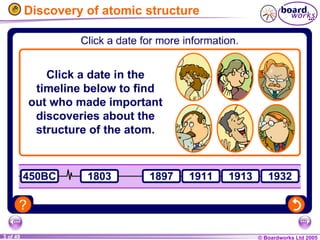
Discovery of atomic structure
© Boardworks Ltd 2005
4 of 49
Atoms – the building blocks
All substances are made from very tiny particles called atoms.
John Dalton had ideas about the
existence of atoms about 200 years
ago but only relatively recently have
special microscopes (called
electron microscopes) been
invented that can ‘see’ atoms.
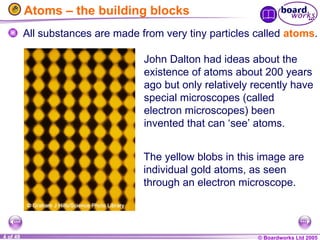
The yellow blobs in this image are
individual gold atoms, as seen
through an electron microscope.
© Boardworks Ltd 2005
5 of 49
Elements – different types of atom
Elements are the simplest substances. There are about
100 different elements.
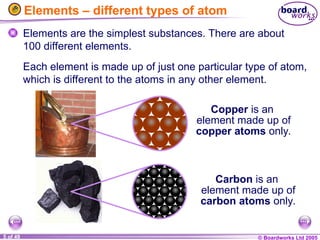
Each element is made up of just one particular type of atom,
which is different to the atoms in any other element.
Copper is an
element made up of
copper atoms only.
Carbon is an
element made up of
carbon atoms only.
© Boardworks Ltd 2005
6 of 49
How small is an atom?
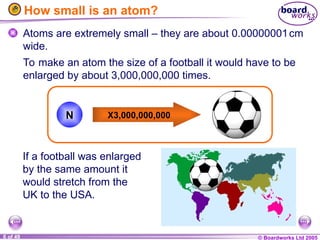
Atoms are extremely small – they are about 0.00000001cm
wide.
N X3,000,000,000
If a football was enlarged
by the same amount it
would stretch from the
UK to the USA.
To make an atom the size of a football it would have to be
enlarged by about 3,000,000,000 times.
© Boardworks Ltd 2005
7 of 49
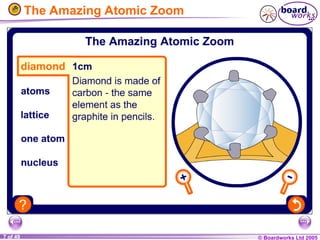
The Amazing Atomic Zoom
© Boardworks Ltd 2005
8 of 49
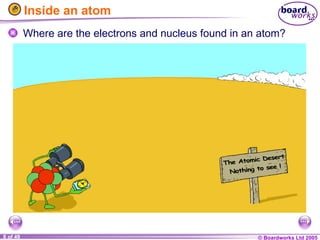
Inside an atom
Where are the electrons and nucleus found in an atom?
© Boardworks Ltd 2005
9 of 49
Atomic Structure
Electron configuration
Summary activities
Isotopes
Introducing atoms
Atomic number and mass number
Contents
© Boardworks Ltd 2005
10 of 49
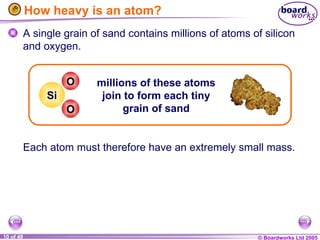
How heavy is an atom?
A single grain of sand contains millions of atoms of silicon
and oxygen.
Each atom must therefore have an extremely small mass.
millions of these atoms
join to form each tiny
grain of sand
Si
O
O
© Boardworks Ltd 2005
11 of 49
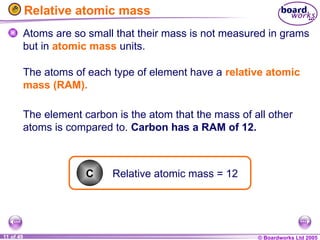
Relative atomic mass
Atoms are so small that their mass is not measured in grams
but in atomic mass units.
Relative atomic mass = 12
C
The element carbon is the atom that the mass of all other
atoms is compared to. Carbon has a RAM of 12.
The atoms of each type of element have a relative atomic
mass (RAM).
© Boardworks Ltd 2005
12 of 49
Relative atomic mass – examples
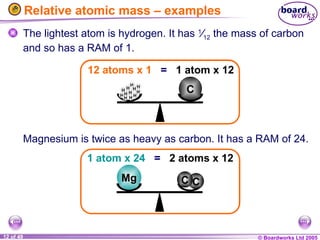
The lightest atom is hydrogen. It has 1
⁄12 the mass of carbon
and so has a RAM of 1.
Mg
Magnesium is twice as heavy as carbon. It has a RAM of 24.
H
H H H
H H
H
H
H
H H
H
H
H H H
H H
H
H
H
H H
H C
12 atoms x 1 = 1 atom x 12
C
C
Mg
1 atom x 24 = 2 atoms x 12
© Boardworks Ltd 2005
13 of 49
Even smaller particles
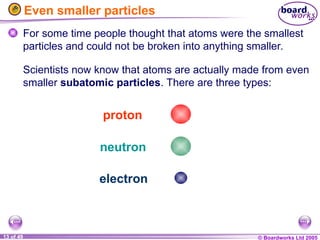
For some time people thought that atoms were the smallest
particles and could not be broken into anything smaller.
proton
neutron
electron
Scientists now know that atoms are actually made from even
smaller subatomic particles. There are three types:
© Boardworks Ltd 2005
14 of 49
Where are subatomic particles found?
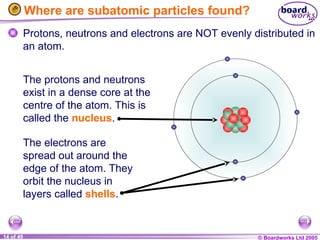
Protons, neutrons and electrons are NOT evenly distributed in
an atom.
The electrons are
spread out around the
edge of the atom. They
orbit the nucleus in
layers called shells.
The protons and neutrons
exist in a dense core at the
centre of the atom. This is
called the nucleus.
© Boardworks Ltd 2005
15 of 49
The atom: check it out!
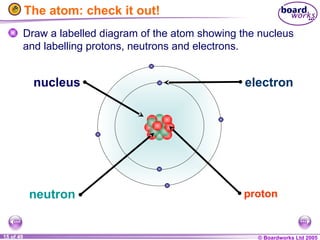
Draw a labelled diagram of the atom showing the nucleus
and labelling protons, neutrons and electrons.
nucleus
neutron proton
electron
© Boardworks Ltd 2005
16 of 49
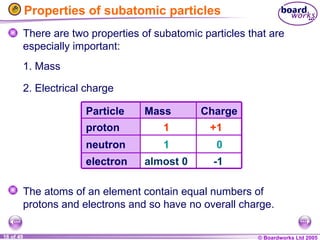
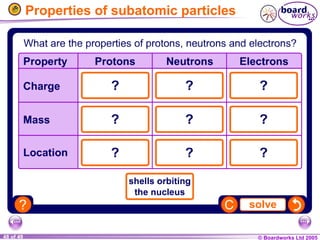
Particle Mass Charge
proton 1 +1
neutron 1 0
electron almost 0 -1
Properties of subatomic particles
There are two properties of subatomic particles that are
especially important:
1. Mass
2. Electrical charge
The atoms of an element contain equal numbers of
protons and electrons and so have no overall charge.
© Boardworks Ltd 2005
17 of 49
How many protons?
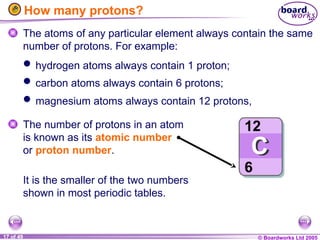
The atoms of any particular element always contain the same
number of protons. For example:
The number of protons in an atom
is known as its atomic number
or proton number.
It is the smaller of the two numbers
shown in most periodic tables.
 hydrogen atoms always contain 1 proton;
 carbon atoms always contain 6 protons;
 magnesium atoms always contain 12 protons,
© Boardworks Ltd 2005
18 of 49
What’s the atomic number?
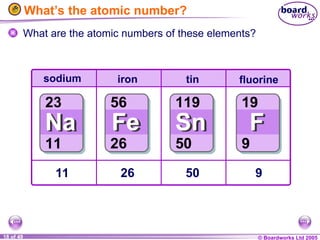
What are the atomic numbers of these elements?
11
sodium
26
iron
50
tin
9
fluorine
© Boardworks Ltd 2005
19 of 49
More about atomic number
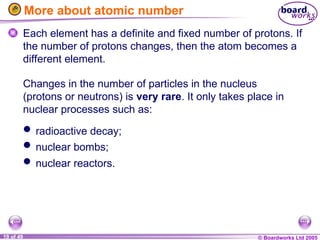
Each element has a definite and fixed number of protons. If
the number of protons changes, then the atom becomes a
different element.
Changes in the number of particles in the nucleus
(protons or neutrons) is very rare. It only takes place in
nuclear processes such as:
 radioactive decay;
 nuclear bombs;
 nuclear reactors.
© Boardworks Ltd 2005
20 of 49
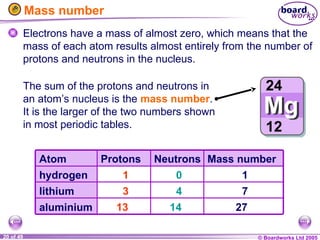
Atom Protons Neutrons Mass number
hydrogen 1 0 1
lithium 3 4 7
aluminium 13 14 27
Mass number
Electrons have a mass of almost zero, which means that the
mass of each atom results almost entirely from the number of
protons and neutrons in the nucleus.
The sum of the protons and neutrons in
an atom’s nucleus is the mass number.
It is the larger of the two numbers shown
in most periodic tables.
© Boardworks Ltd 2005
21 of 49
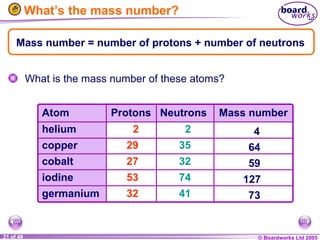
127
What’s the mass number?
What is the mass number of these atoms?
73
59
64
4
Mass number = number of protons + number of neutrons
Atom Protons Neutrons Mass number
helium 2 2
copper 29 35
cobalt 27 32
iodine 53 74
germanium 32 41
© Boardworks Ltd 2005
22 of 49
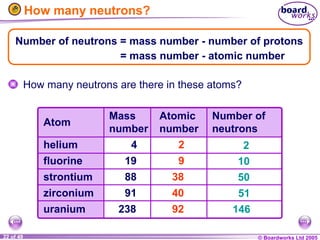
How many neutrons?
How many neutrons are there in these atoms?
Atom
Mass
number
Atomic
number
Number of
neutrons
helium 4 2
fluorine 19 9
strontium 88 38
zirconium 91 40
uranium 238 92
51
146
50
10
2
Number of neutrons = mass number - number of protons
= mass number - atomic number
© Boardworks Ltd 2005
23 of 49
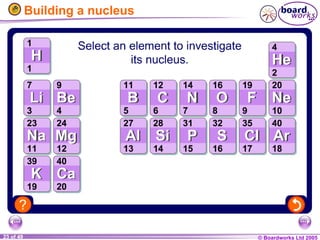
Building a nucleus
© Boardworks Ltd 2005
24 of 49
Atomic Structure
Electron configuration
Summary activities
Isotopes
Introducing atoms
Atomic number and mass number
Contents
© Boardworks Ltd 2005
25 of 49
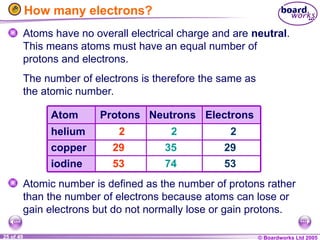
Atom Protons Neutrons Electrons
helium 2 2 2
copper 29 35 29
iodine 53 74 53
How many electrons?
Atoms have no overall electrical charge and are neutral.
This means atoms must have an equal number of
protons and electrons.
The number of electrons is therefore the same as
the atomic number.
Atomic number is defined as the number of protons rather
than the number of electrons because atoms can lose or
gain electrons but do not normally lose or gain protons.
© Boardworks Ltd 2005
26 of 49
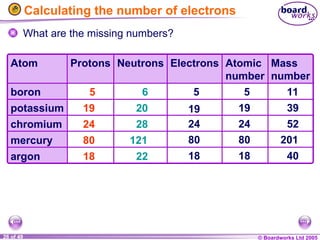
Atom Protons Neutrons Electrons Atomic
number
Mass
number
boron 5 6
potassium 19 20
chromium 24 28
mercury 80 121
argon 18 22
Calculating the number of electrons
5
19
18
24
80
5
19
18
24
80
11
39
40
52
201
What are the missing numbers?
© Boardworks Ltd 2005
27 of 49
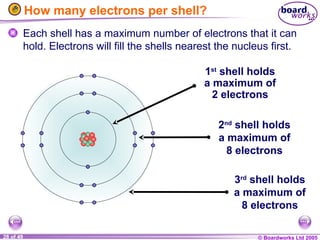
How are electrons arranged?
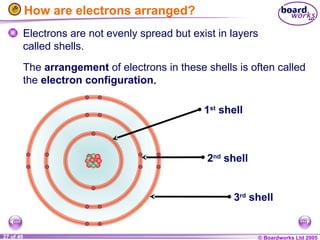
Electrons are not evenly spread but exist in layers
called shells.
3rd
shell
2nd
shell
1st
shell
The arrangement of electrons in these shells is often called
the electron configuration.
.
© Boardworks Ltd 2005
28 of 49
How many electrons per shell?
Each shell has a maximum number of electrons that it can
hold. Electrons will fill the shells nearest the nucleus first.
3rd
shell holds
a maximum of
8 electrons
2nd
shell holds
a maximum of
8 electrons
1st
shell holds
a maximum of
2 electrons
© Boardworks Ltd 2005
29 of 49
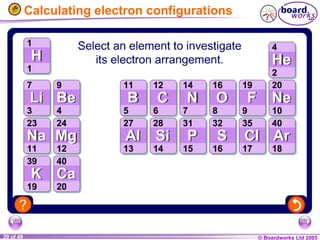
Calculating electron configurations
© Boardworks Ltd 2005
30 of 49
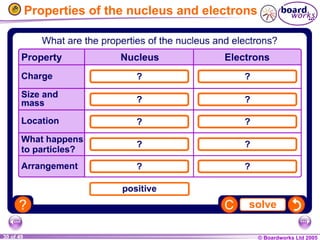
Properties of the nucleus and electrons
© Boardworks Ltd 2005
31 of 49
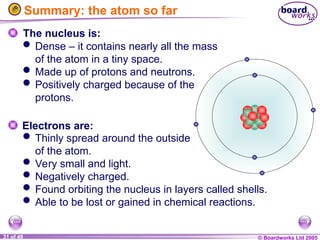
 Thinly spread around the outside
of the atom.
 Very small and light.
 Negatively charged.
 Found orbiting the nucleus in layers called shells.
 Able to be lost or gained in chemical reactions.
Summary: the atom so far
The nucleus is:
Electrons are:
 Dense – it contains nearly all the mass
of the atom in a tiny space.
 Made up of protons and neutrons.
 Positively charged because of the
protons.
© Boardworks Ltd 2005
32 of 49
Atomic Structure
Electron configuration
Summary activities
Isotopes
Introducing atoms
Atomic number and mass number
Contents
© Boardworks Ltd 2005
33 of 49
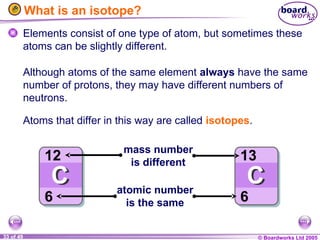
What is an isotope?
Elements consist of one type of atom, but sometimes these
atoms can be slightly different.
mass number
is different
atomic number
is the same
Atoms that differ in this way are called isotopes.
Although atoms of the same element always have the same
number of protons, they may have different numbers of
neutrons.
© Boardworks Ltd 2005
34 of 49
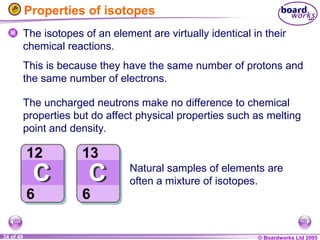
Properties of isotopes
The isotopes of an element are virtually identical in their
chemical reactions.
The uncharged neutrons make no difference to chemical
properties but do affect physical properties such as melting
point and density.
Natural samples of elements are
often a mixture of isotopes.
This is because they have the same number of protons and
the same number of electrons.
© Boardworks Ltd 2005
35 of 49
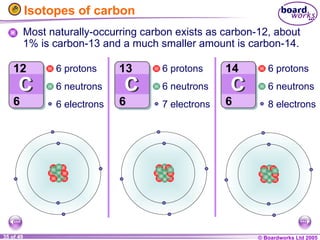
Isotopes of carbon
Most naturally-occurring carbon exists as carbon-12, about
1% is carbon-13 and a much smaller amount is carbon-14.
6 protons
6 neutrons
7 electrons
6 protons
6 neutrons
8 electrons
6 protons
6 neutrons
6 electrons
© Boardworks Ltd 2005
36 of 49
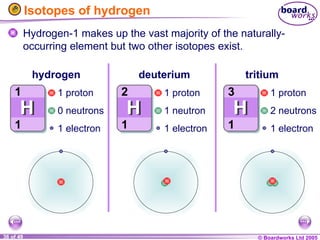
Isotopes of hydrogen
Hydrogen-1 makes up the vast majority of the naturally-
occurring element but two other isotopes exist.
hydrogen deuterium tritium
1 proton
0 neutrons
1 electron
1 proton
1 neutron
1 electron
1 proton
2 neutrons
1 electron
© Boardworks Ltd 2005
37 of 49
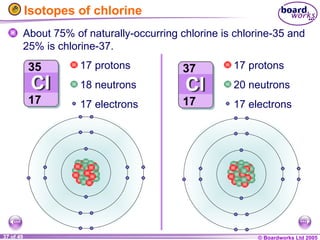
Isotopes of chlorine
About 75% of naturally-occurring chlorine is chlorine-35 and
25% is chlorine-37.
17 protons
18 neutrons
17 electrons
17 protons
20 neutrons
17 electrons
© Boardworks Ltd 2005
38 of 49
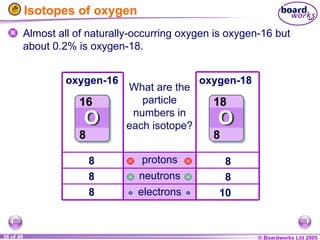
What are the
particle
numbers in
each isotope?
10
8
8
8
8
8
oxygen-16 oxygen-18
protons
neutrons
electrons
Isotopes of oxygen
Almost all of naturally-occurring oxygen is oxygen-16 but
about 0.2% is oxygen-18.
© Boardworks Ltd 2005
39 of 49
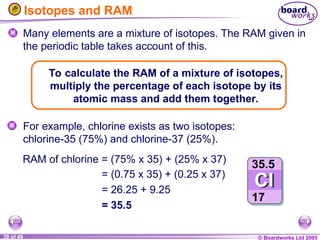
Isotopes and RAM
Many elements are a mixture of isotopes. The RAM given in
the periodic table takes account of this.
For example, chlorine exists as two isotopes:
chlorine-35 (75%) and chlorine-37 (25%).
To calculate the RAM of a mixture of isotopes,
multiply the percentage of each isotope by its
atomic mass and add them together.
= (0.75 x 35) + (0.25 x 37)
= 26.25 + 9.25
= 35.5
RAM of chlorine = (75% x 35) + (25% x 37)
© Boardworks Ltd 2005
40 of 49
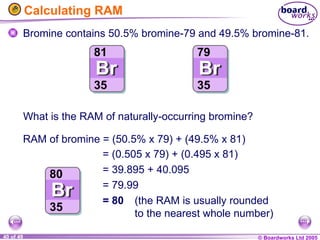
Calculating RAM
Bromine contains 50.5% bromine-79 and 49.5% bromine-81.
= (0.505 x 79) + (0.495 x 81)
= 39.895 + 40.095
= 79.99
= 80 (the RAM is usually rounded
to the nearest whole number)
RAM of bromine = (50.5% x 79) + (49.5% x 81)
What is the RAM of naturally-occurring bromine?
© Boardworks Ltd 2005
41 of 49
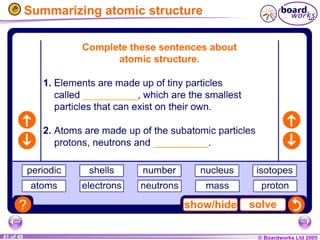
Summarizing atomic structure
© Boardworks Ltd 2005
42 of 49
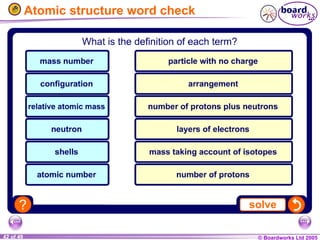
Atomic structure word check
© Boardworks Ltd 2005
43 of 49
Atomic Structure
Electron configuration
Summary activities
Isotopes
Introducing atoms
Atomic number and mass number
Contents
© Boardworks Ltd 2005
44 of 49
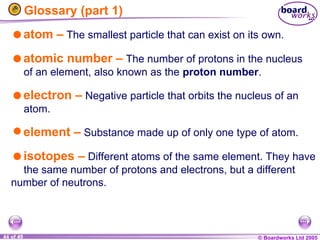
Glossary (part 1)
atom – The smallest particle that can exist on its own.
atomic number – The number of protons in the nucleus
of an element, also known as the proton number.
electron – Negative particle that orbits the nucleus of an
atom.
element – Substance made up of only one type of atom.
isotopes – Different atoms of the same element. They have
the same number of protons and electrons, but a different
number of neutrons.
© Boardworks Ltd 2005
45 of 49
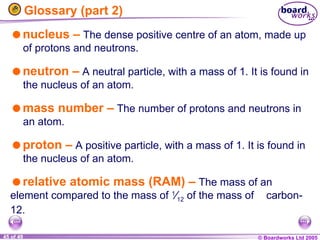
Glossary (part 2)
nucleus – The dense positive centre of an atom, made up
of protons and neutrons.
neutron – A neutral particle, with a mass of 1. It is found in
the nucleus of an atom.
mass number – The number of protons and neutrons in
an atom.
proton – A positive particle, with a mass of 1. It is found in
the nucleus of an atom.
relative atomic mass (RAM) – The mass of an
element compared to the mass of 1
⁄12 of the mass of carbon-
12.
© Boardworks Ltd 2005
46 of 49
Anagrams
© Boardworks Ltd 2005
47 of 49
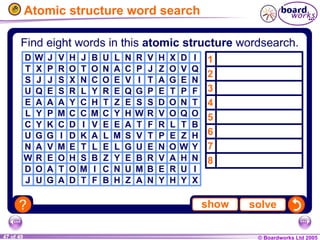
Atomic structure word search
© Boardworks Ltd 2005
48 of 49
Properties of subatomic particles
© Boardworks Ltd 2005
49 of 49
Multiple-choice quiz

Atomic Structure3.ppt.Atomic Structure11

  • 1.
    © Boardworks Ltd2005 1 of 49 KS4 Chemistry Atomic Structure
  • 2.
    © Boardworks Ltd2005 2 of 49 Atomic Structure Electron configuration Summary activities Isotopes Introducing atoms Atomic number and mass number Contents
  • 3.
    © Boardworks Ltd2005 3 of 49 Discovery of atomic structure
  • 4.
    © Boardworks Ltd2005 4 of 49 Atoms – the building blocks All substances are made from very tiny particles called atoms. John Dalton had ideas about the existence of atoms about 200 years ago but only relatively recently have special microscopes (called electron microscopes) been invented that can ‘see’ atoms. The yellow blobs in this image are individual gold atoms, as seen through an electron microscope.
  • 5.
    © Boardworks Ltd2005 5 of 49 Elements – different types of atom Elements are the simplest substances. There are about 100 different elements. Each element is made up of just one particular type of atom, which is different to the atoms in any other element. Copper is an element made up of copper atoms only. Carbon is an element made up of carbon atoms only.
  • 6.
    © Boardworks Ltd2005 6 of 49 How small is an atom? Atoms are extremely small – they are about 0.00000001cm wide. N X3,000,000,000 If a football was enlarged by the same amount it would stretch from the UK to the USA. To make an atom the size of a football it would have to be enlarged by about 3,000,000,000 times.
  • 7.
    © Boardworks Ltd2005 7 of 49 The Amazing Atomic Zoom
  • 8.
    © Boardworks Ltd2005 8 of 49 Inside an atom Where are the electrons and nucleus found in an atom?
  • 9.
    © Boardworks Ltd2005 9 of 49 Atomic Structure Electron configuration Summary activities Isotopes Introducing atoms Atomic number and mass number Contents
  • 10.
    © Boardworks Ltd2005 10 of 49 How heavy is an atom? A single grain of sand contains millions of atoms of silicon and oxygen. Each atom must therefore have an extremely small mass. millions of these atoms join to form each tiny grain of sand Si O O
  • 11.
    © Boardworks Ltd2005 11 of 49 Relative atomic mass Atoms are so small that their mass is not measured in grams but in atomic mass units. Relative atomic mass = 12 C The element carbon is the atom that the mass of all other atoms is compared to. Carbon has a RAM of 12. The atoms of each type of element have a relative atomic mass (RAM).
  • 12.
    © Boardworks Ltd2005 12 of 49 Relative atomic mass – examples The lightest atom is hydrogen. It has 1 ⁄12 the mass of carbon and so has a RAM of 1. Mg Magnesium is twice as heavy as carbon. It has a RAM of 24. H H H H H H H H H H H H H H H H H H H H H H H H C 12 atoms x 1 = 1 atom x 12 C C Mg 1 atom x 24 = 2 atoms x 12
  • 13.
    © Boardworks Ltd2005 13 of 49 Even smaller particles For some time people thought that atoms were the smallest particles and could not be broken into anything smaller. proton neutron electron Scientists now know that atoms are actually made from even smaller subatomic particles. There are three types:
  • 14.
    © Boardworks Ltd2005 14 of 49 Where are subatomic particles found? Protons, neutrons and electrons are NOT evenly distributed in an atom. The electrons are spread out around the edge of the atom. They orbit the nucleus in layers called shells. The protons and neutrons exist in a dense core at the centre of the atom. This is called the nucleus.
  • 15.
    © Boardworks Ltd2005 15 of 49 The atom: check it out! Draw a labelled diagram of the atom showing the nucleus and labelling protons, neutrons and electrons. nucleus neutron proton electron
  • 16.
    © Boardworks Ltd2005 16 of 49 Particle Mass Charge proton 1 +1 neutron 1 0 electron almost 0 -1 Properties of subatomic particles There are two properties of subatomic particles that are especially important: 1. Mass 2. Electrical charge The atoms of an element contain equal numbers of protons and electrons and so have no overall charge.
  • 17.
    © Boardworks Ltd2005 17 of 49 How many protons? The atoms of any particular element always contain the same number of protons. For example: The number of protons in an atom is known as its atomic number or proton number. It is the smaller of the two numbers shown in most periodic tables.  hydrogen atoms always contain 1 proton;  carbon atoms always contain 6 protons;  magnesium atoms always contain 12 protons,
  • 18.
    © Boardworks Ltd2005 18 of 49 What’s the atomic number? What are the atomic numbers of these elements? 11 sodium 26 iron 50 tin 9 fluorine
  • 19.
    © Boardworks Ltd2005 19 of 49 More about atomic number Each element has a definite and fixed number of protons. If the number of protons changes, then the atom becomes a different element. Changes in the number of particles in the nucleus (protons or neutrons) is very rare. It only takes place in nuclear processes such as:  radioactive decay;  nuclear bombs;  nuclear reactors.
  • 20.
    © Boardworks Ltd2005 20 of 49 Atom Protons Neutrons Mass number hydrogen 1 0 1 lithium 3 4 7 aluminium 13 14 27 Mass number Electrons have a mass of almost zero, which means that the mass of each atom results almost entirely from the number of protons and neutrons in the nucleus. The sum of the protons and neutrons in an atom’s nucleus is the mass number. It is the larger of the two numbers shown in most periodic tables.
  • 21.
    © Boardworks Ltd2005 21 of 49 127 What’s the mass number? What is the mass number of these atoms? 73 59 64 4 Mass number = number of protons + number of neutrons Atom Protons Neutrons Mass number helium 2 2 copper 29 35 cobalt 27 32 iodine 53 74 germanium 32 41
  • 22.
    © Boardworks Ltd2005 22 of 49 How many neutrons? How many neutrons are there in these atoms? Atom Mass number Atomic number Number of neutrons helium 4 2 fluorine 19 9 strontium 88 38 zirconium 91 40 uranium 238 92 51 146 50 10 2 Number of neutrons = mass number - number of protons = mass number - atomic number
  • 23.
    © Boardworks Ltd2005 23 of 49 Building a nucleus
  • 24.
    © Boardworks Ltd2005 24 of 49 Atomic Structure Electron configuration Summary activities Isotopes Introducing atoms Atomic number and mass number Contents
  • 25.
    © Boardworks Ltd2005 25 of 49 Atom Protons Neutrons Electrons helium 2 2 2 copper 29 35 29 iodine 53 74 53 How many electrons? Atoms have no overall electrical charge and are neutral. This means atoms must have an equal number of protons and electrons. The number of electrons is therefore the same as the atomic number. Atomic number is defined as the number of protons rather than the number of electrons because atoms can lose or gain electrons but do not normally lose or gain protons.
  • 26.
    © Boardworks Ltd2005 26 of 49 Atom Protons Neutrons Electrons Atomic number Mass number boron 5 6 potassium 19 20 chromium 24 28 mercury 80 121 argon 18 22 Calculating the number of electrons 5 19 18 24 80 5 19 18 24 80 11 39 40 52 201 What are the missing numbers?
  • 27.
    © Boardworks Ltd2005 27 of 49 How are electrons arranged? Electrons are not evenly spread but exist in layers called shells. 3rd shell 2nd shell 1st shell The arrangement of electrons in these shells is often called the electron configuration. .
  • 28.
    © Boardworks Ltd2005 28 of 49 How many electrons per shell? Each shell has a maximum number of electrons that it can hold. Electrons will fill the shells nearest the nucleus first. 3rd shell holds a maximum of 8 electrons 2nd shell holds a maximum of 8 electrons 1st shell holds a maximum of 2 electrons
  • 29.
    © Boardworks Ltd2005 29 of 49 Calculating electron configurations
  • 30.
    © Boardworks Ltd2005 30 of 49 Properties of the nucleus and electrons
  • 31.
    © Boardworks Ltd2005 31 of 49  Thinly spread around the outside of the atom.  Very small and light.  Negatively charged.  Found orbiting the nucleus in layers called shells.  Able to be lost or gained in chemical reactions. Summary: the atom so far The nucleus is: Electrons are:  Dense – it contains nearly all the mass of the atom in a tiny space.  Made up of protons and neutrons.  Positively charged because of the protons.
  • 32.
    © Boardworks Ltd2005 32 of 49 Atomic Structure Electron configuration Summary activities Isotopes Introducing atoms Atomic number and mass number Contents
  • 33.
    © Boardworks Ltd2005 33 of 49 What is an isotope? Elements consist of one type of atom, but sometimes these atoms can be slightly different. mass number is different atomic number is the same Atoms that differ in this way are called isotopes. Although atoms of the same element always have the same number of protons, they may have different numbers of neutrons.
  • 34.
    © Boardworks Ltd2005 34 of 49 Properties of isotopes The isotopes of an element are virtually identical in their chemical reactions. The uncharged neutrons make no difference to chemical properties but do affect physical properties such as melting point and density. Natural samples of elements are often a mixture of isotopes. This is because they have the same number of protons and the same number of electrons.
  • 35.
    © Boardworks Ltd2005 35 of 49 Isotopes of carbon Most naturally-occurring carbon exists as carbon-12, about 1% is carbon-13 and a much smaller amount is carbon-14. 6 protons 6 neutrons 7 electrons 6 protons 6 neutrons 8 electrons 6 protons 6 neutrons 6 electrons
  • 36.
    © Boardworks Ltd2005 36 of 49 Isotopes of hydrogen Hydrogen-1 makes up the vast majority of the naturally- occurring element but two other isotopes exist. hydrogen deuterium tritium 1 proton 0 neutrons 1 electron 1 proton 1 neutron 1 electron 1 proton 2 neutrons 1 electron
  • 37.
    © Boardworks Ltd2005 37 of 49 Isotopes of chlorine About 75% of naturally-occurring chlorine is chlorine-35 and 25% is chlorine-37. 17 protons 18 neutrons 17 electrons 17 protons 20 neutrons 17 electrons
  • 38.
    © Boardworks Ltd2005 38 of 49 What are the particle numbers in each isotope? 10 8 8 8 8 8 oxygen-16 oxygen-18 protons neutrons electrons Isotopes of oxygen Almost all of naturally-occurring oxygen is oxygen-16 but about 0.2% is oxygen-18.
  • 39.
    © Boardworks Ltd2005 39 of 49 Isotopes and RAM Many elements are a mixture of isotopes. The RAM given in the periodic table takes account of this. For example, chlorine exists as two isotopes: chlorine-35 (75%) and chlorine-37 (25%). To calculate the RAM of a mixture of isotopes, multiply the percentage of each isotope by its atomic mass and add them together. = (0.75 x 35) + (0.25 x 37) = 26.25 + 9.25 = 35.5 RAM of chlorine = (75% x 35) + (25% x 37)
  • 40.
    © Boardworks Ltd2005 40 of 49 Calculating RAM Bromine contains 50.5% bromine-79 and 49.5% bromine-81. = (0.505 x 79) + (0.495 x 81) = 39.895 + 40.095 = 79.99 = 80 (the RAM is usually rounded to the nearest whole number) RAM of bromine = (50.5% x 79) + (49.5% x 81) What is the RAM of naturally-occurring bromine?
  • 41.
    © Boardworks Ltd2005 41 of 49 Summarizing atomic structure
  • 42.
    © Boardworks Ltd2005 42 of 49 Atomic structure word check
  • 43.
    © Boardworks Ltd2005 43 of 49 Atomic Structure Electron configuration Summary activities Isotopes Introducing atoms Atomic number and mass number Contents
  • 44.
    © Boardworks Ltd2005 44 of 49 Glossary (part 1) atom – The smallest particle that can exist on its own. atomic number – The number of protons in the nucleus of an element, also known as the proton number. electron – Negative particle that orbits the nucleus of an atom. element – Substance made up of only one type of atom. isotopes – Different atoms of the same element. They have the same number of protons and electrons, but a different number of neutrons.
  • 45.
    © Boardworks Ltd2005 45 of 49 Glossary (part 2) nucleus – The dense positive centre of an atom, made up of protons and neutrons. neutron – A neutral particle, with a mass of 1. It is found in the nucleus of an atom. mass number – The number of protons and neutrons in an atom. proton – A positive particle, with a mass of 1. It is found in the nucleus of an atom. relative atomic mass (RAM) – The mass of an element compared to the mass of 1 ⁄12 of the mass of carbon- 12.
  • 46.
    © Boardworks Ltd2005 46 of 49 Anagrams
  • 47.
    © Boardworks Ltd2005 47 of 49 Atomic structure word search
  • 48.
    © Boardworks Ltd2005 48 of 49 Properties of subatomic particles
  • 49.
    © Boardworks Ltd2005 49 of 49 Multiple-choice quiz

Editor's Notes

  • #4 Acknowledgment The image is a false-colour high-resolution transmission electron micrograph (HREM) of the atomic lattice of a thin gold crystal. Magnified 16 million times at 35mm size, each yellow blob represents an individual gold atom. The micrograph has been enhanced by optical image- processing techniques. The centre to centre spacing of the atoms is 2.04 angstroms (0. 204 nanometres); this represents the practical limit of resolution of the modern electron microscope. Credit: Graham J Hills/Science Photo Library