Atoms, Quarks and Molecules OH!!!!!! MY!!!!! For my sweet Brittany and her Chemistry Friends!
Sometimes in Chemistry the teacher forgets to tell you some of the most important concepts because they think you already know it This power point is to help organize the ideas of the basics of what atoms are and how they are organized
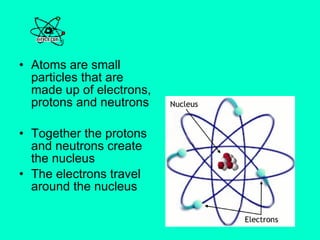
Atoms are small particles that are made up of electrons, protons and neutrons Together the protons and neutrons create the nucleus The electrons travel around the nucleus
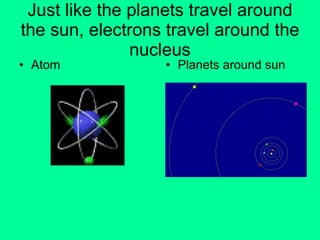
Just like the planets travel around the sun, electrons travel around the nucleus Atom Planets around sun
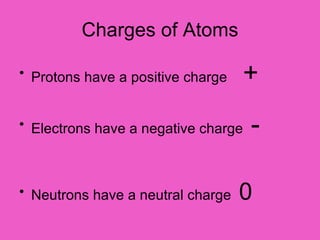
Charges of Atoms Protons have a positive charge  + Electrons have a negative charge  - Neutrons have a neutral charge  0
Subatomic Particles Subatomic particles are a fancy name for the small particles that make up atoms. For example:  electrons, protons, neutrons
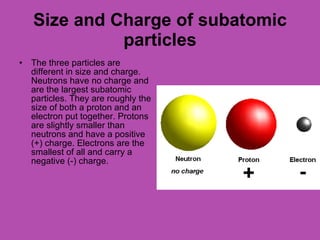
Size and Charge of subatomic particles The three particles are different in size and charge. Neutrons have no charge and are the largest subatomic particles. They are roughly the size of both a proton and an electron put together. Protons are slightly smaller than neutrons and have a positive (+) charge. Electrons are the smallest of all and carry a negative (-) charge.
That’s right! Protons = + Positive Electrons =  - Negative Neutrons = 0 Neutral
In an atom(element)  # protons = # electrons If the # protons = # electrons  And protons are positive and electrons are negative   And Neutrons are neutral charge  An Atom or Element have a net neutral 0 Charge
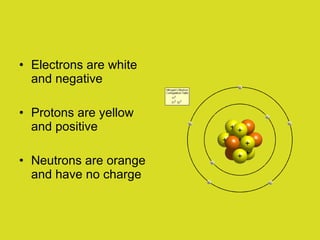
Electrons are white and negative Protons are yellow and positive Neutrons are orange and have no charge
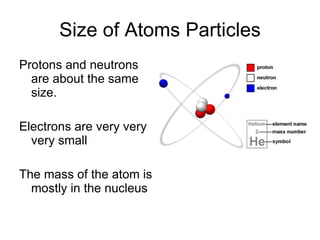
Size of Atoms Particles Protons and neutrons are about the same size. Electrons are very very very small The mass of the atom is mostly in the nucleus
Remember: The Nucleus is the protons and the neutrons together.
The words Atoms and Elements mean the same thing
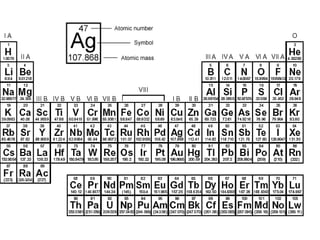
The periodic chart is a chart that organizes the properties of atoms (elements) The periodic chart can tell you a lot about the properties of the atom (element)
The Periodic Chart can tell you: How much the atom’s mass is How many electrons an atom has How many protons an atom has How many neutrons an atom has It can also tell you how reactive the atoms are to one another. This reactivity helps atoms to form with one another.
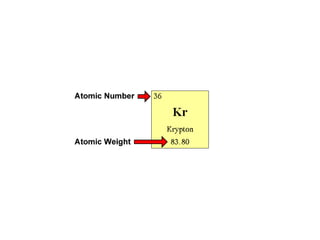
A periodic chart has two numbers on each element Atomic Number   = The number of protons and the number of electrons Atomic Mass  = What the mass of one mole of the element is equal to (a mole is 6 x 10 to the 23 rd  atoms)
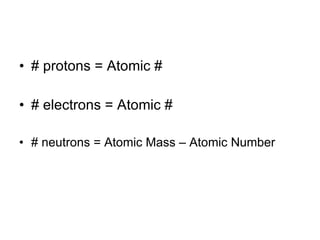
# protons = Atomic # # electrons = Atomic # # neutrons = Atomic Mass – Atomic Number
 
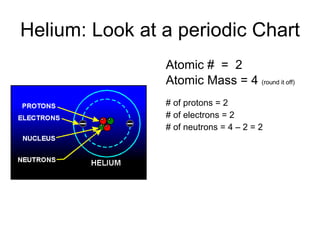
Helium: Look at a periodic Chart Atomic #  =  2 Atomic Mass = 4  (round it off) # of protons = 2 # of electrons = 2 # of neutrons = 4 – 2 = 2
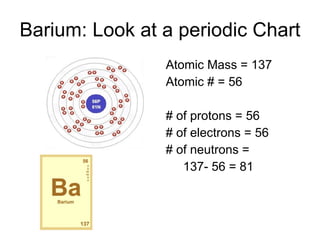
Barium: Look at a periodic Chart Atomic Mass = 137 Atomic # = 56 # of protons = 56 # of electrons = 56 # of neutrons =  137- 56 = 81
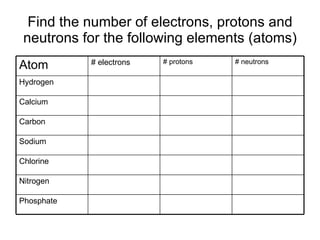
Find the number of electrons, protons and neutrons for the following elements (atoms) Phosphate Nitrogen Chlorine Sodium Carbon Calcium Hydrogen # neutrons # protons # electrons Atom
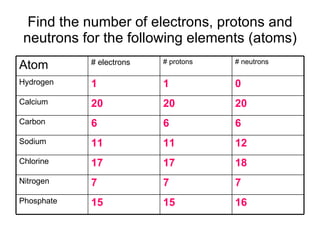
Find the number of electrons, protons and neutrons for the following elements (atoms) 16 15 15 Phosphate 7 7 7 Nitrogen 18 17 17 Chlorine 12 11 11 Sodium 6 6 6 Carbon 20 20 20 Calcium 0 1 1 Hydrogen # neutrons # protons # electrons Atom
A good interactive website that describes what atoms are built up of http://www.chemistryland.com/ElementarySchool/BuildingBlocks/BuildingElements.html Click here to see atom website
This website is an interactive website that will teach you about finding # of electrons, neutrons, protons Website to learn number of protons neutrons and electrons http://chemistry2.csudh.edu/lecture_help/protons.html
Website to teach element reactivity http://www.webelements.com/
Demonstration of atoms forming a bond http://faculty.ucc.edu/chemistry-pankuch/BaF2/BaF2.dcr
 
How to find number of electrons in orbitals Website to show number of electrons in  orbitals http://education.jlab.org/qa/electron_number.html http://education.jlab.org/qa/electron_number.html

atoms

  • 1.
    Atoms, Quarks andMolecules OH!!!!!! MY!!!!! For my sweet Brittany and her Chemistry Friends!
  • 2.
    Sometimes in Chemistrythe teacher forgets to tell you some of the most important concepts because they think you already know it This power point is to help organize the ideas of the basics of what atoms are and how they are organized
  • 3.
    Atoms are smallparticles that are made up of electrons, protons and neutrons Together the protons and neutrons create the nucleus The electrons travel around the nucleus
  • 4.
    Just like theplanets travel around the sun, electrons travel around the nucleus Atom Planets around sun
  • 5.
    Charges of AtomsProtons have a positive charge + Electrons have a negative charge - Neutrons have a neutral charge 0
  • 6.
    Subatomic Particles Subatomicparticles are a fancy name for the small particles that make up atoms. For example: electrons, protons, neutrons
  • 7.
    Size and Chargeof subatomic particles The three particles are different in size and charge. Neutrons have no charge and are the largest subatomic particles. They are roughly the size of both a proton and an electron put together. Protons are slightly smaller than neutrons and have a positive (+) charge. Electrons are the smallest of all and carry a negative (-) charge.
  • 8.
    That’s right! Protons= + Positive Electrons = - Negative Neutrons = 0 Neutral
  • 9.
    In an atom(element) # protons = # electrons If the # protons = # electrons And protons are positive and electrons are negative And Neutrons are neutral charge An Atom or Element have a net neutral 0 Charge
  • 10.
    Electrons are whiteand negative Protons are yellow and positive Neutrons are orange and have no charge
  • 11.
    Size of AtomsParticles Protons and neutrons are about the same size. Electrons are very very very small The mass of the atom is mostly in the nucleus
  • 12.
    Remember: The Nucleusis the protons and the neutrons together.
  • 13.
    The words Atomsand Elements mean the same thing
  • 14.
    The periodic chartis a chart that organizes the properties of atoms (elements) The periodic chart can tell you a lot about the properties of the atom (element)
  • 15.
    The Periodic Chartcan tell you: How much the atom’s mass is How many electrons an atom has How many protons an atom has How many neutrons an atom has It can also tell you how reactive the atoms are to one another. This reactivity helps atoms to form with one another.
  • 16.
    A periodic charthas two numbers on each element Atomic Number = The number of protons and the number of electrons Atomic Mass = What the mass of one mole of the element is equal to (a mole is 6 x 10 to the 23 rd atoms)
  • 17.
    # protons =Atomic # # electrons = Atomic # # neutrons = Atomic Mass – Atomic Number
  • 18.
  • 19.
    Helium: Look ata periodic Chart Atomic # = 2 Atomic Mass = 4 (round it off) # of protons = 2 # of electrons = 2 # of neutrons = 4 – 2 = 2
  • 20.
    Barium: Look ata periodic Chart Atomic Mass = 137 Atomic # = 56 # of protons = 56 # of electrons = 56 # of neutrons = 137- 56 = 81
  • 21.
    Find the numberof electrons, protons and neutrons for the following elements (atoms) Phosphate Nitrogen Chlorine Sodium Carbon Calcium Hydrogen # neutrons # protons # electrons Atom
  • 22.
    Find the numberof electrons, protons and neutrons for the following elements (atoms) 16 15 15 Phosphate 7 7 7 Nitrogen 18 17 17 Chlorine 12 11 11 Sodium 6 6 6 Carbon 20 20 20 Calcium 0 1 1 Hydrogen # neutrons # protons # electrons Atom
  • 23.
    A good interactivewebsite that describes what atoms are built up of http://www.chemistryland.com/ElementarySchool/BuildingBlocks/BuildingElements.html Click here to see atom website
  • 24.
    This website isan interactive website that will teach you about finding # of electrons, neutrons, protons Website to learn number of protons neutrons and electrons http://chemistry2.csudh.edu/lecture_help/protons.html
  • 25.
    Website to teachelement reactivity http://www.webelements.com/
  • 26.
    Demonstration of atomsforming a bond http://faculty.ucc.edu/chemistry-pankuch/BaF2/BaF2.dcr
  • 27.
  • 28.
    How to findnumber of electrons in orbitals Website to show number of electrons in orbitals http://education.jlab.org/qa/electron_number.html http://education.jlab.org/qa/electron_number.html