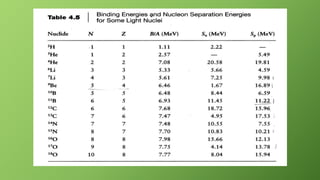
1
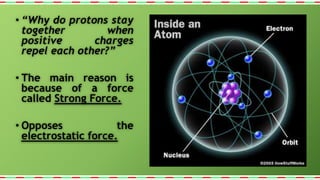
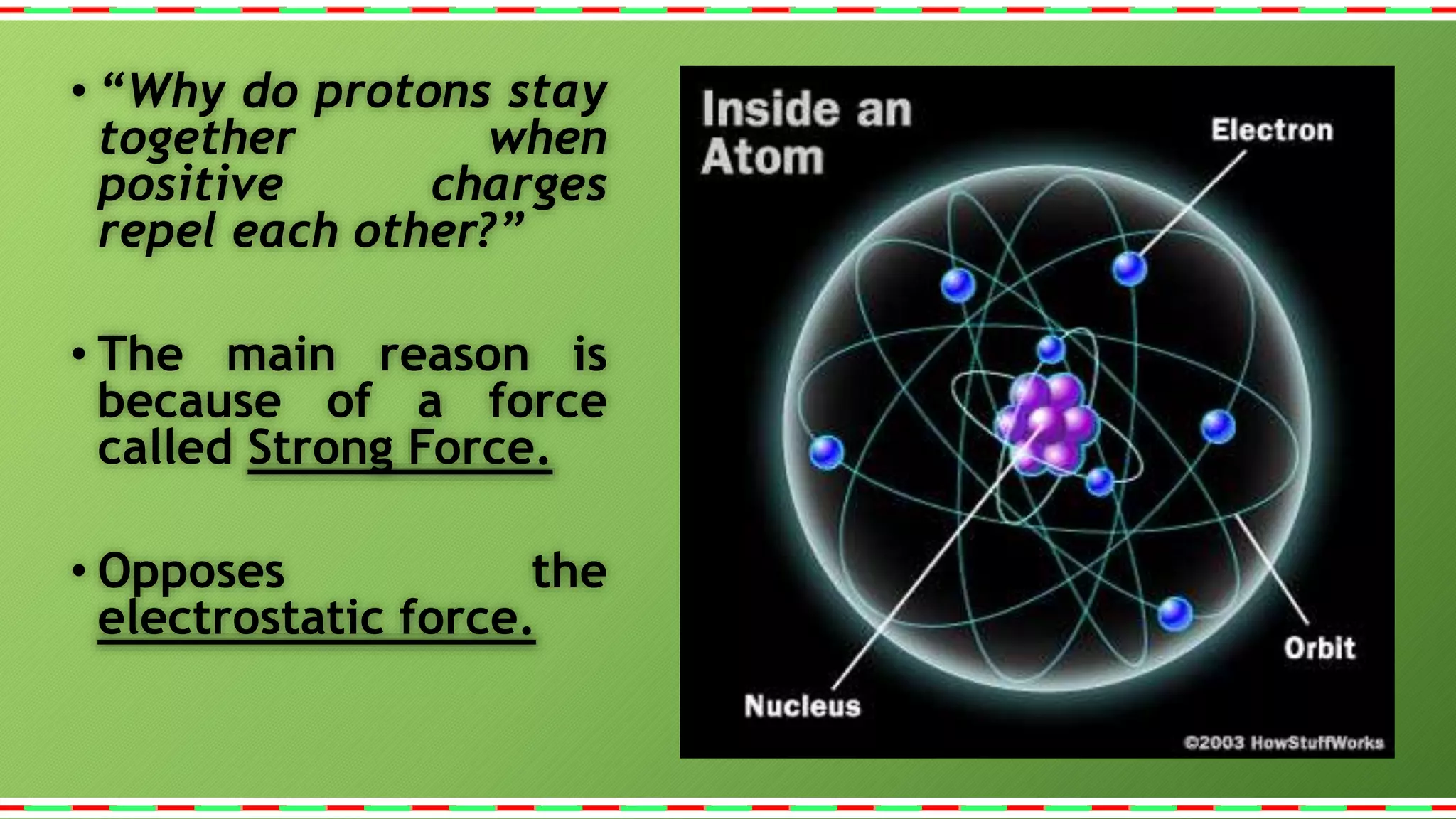
• “Why do protons stay
together when
positive charges
repel each other?”
• The main reason is
because of a force
called Strong Force.
• Opposes the
electrostatic force.
Chemical Reactions
New substances are made through the
formation of new nanoscopic “units” by
making and/or breaking chemical bonds
(Dalton)
All the “action” is outside of the nuclei
Nuclei remain unchanged!
Chemical Bonding involves moving electrons,
not nuclei
*
Nuclear Reactions
It’s all about changing the nucleus!
Independent of any “standard”
chemical reactions
*
NUCLEAR STABILITY &
BINDING ENERGY
SHIELA MARIE B. SIBAYAN©
Two kinds of STABILITY
• One refers to whether a nuclide will undergo
spontaneous nuclear decay.
• Does the nuclide decay (unstable, radioactive) or not
(stable)?
• The “valley of stability”
Kinetic
Stability
Thermo-
dynamic
Stability
*
• One refers to how stable one nuclide is
compared to another, in terms of “overall
configuration of nucleons”
–Applies to all nuclides, radioactive or not
–Assessed by Binding energy per nucleon
Ex. 206Pb is a stable
nuclide. 238U is radioactive
Ex. 56Fe is more stable than 206Pb or 2H
6
Nuclear Stability
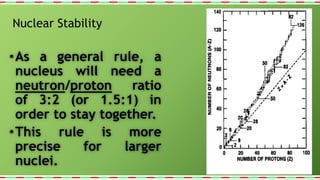
•As a general rule, a
nucleus will need a
neutron/proton ratio
of 3:2 (or 1.5:1) in
order to stay together.
•This rule is more
precise for larger
nuclei.
7
Nuclear Stability
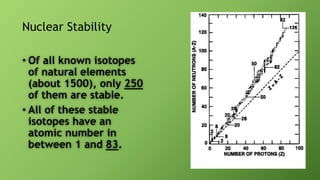
• Of all known isotopes
of natural elements
(about 1500), only 250
of them are stable.
• All of these stable
isotopes have an
atomic number in
between 1 and 83.
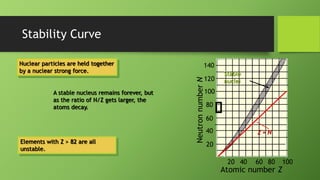
Stability Curve
Atomic number Z
Neutron
number
N
Stable
nuclei
Z = N
20 40 60 80 100
40
100
140
20
60
80
120
Nuclear particles are held together
by a nuclear strong force.
A stable nucleus remains forever, but
as the ratio of N/Z gets larger, the
atoms decay.
Elements with Z > 82 are all
unstable.
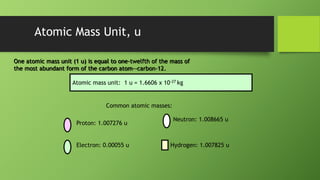
Atomic Mass Unit, u
One atomic mass unit (1 u) is equal to one-twelfth of the mass of
the most abundant form of the carbon atom--carbon-12.
Atomic mass unit: 1 u = 1.6606 x 10⁻²⁷ kg
Common atomic masses:
Proton: 1.007276 u
Neutron: 1.008665 u
Electron: 0.00055 u Hydrogen: 1.007825 u
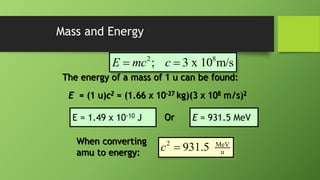
2 8
; 3 x 10 m/s
E mc c
 
Mass and Energy
The energy of a mass of 1 u can be found:
E = (1 u)c2 = (1.66 x 10⁻²⁷ kg)(3 x 10⁸ m/s)2
E = 1.49 x 10⁻¹⁰ J Or E = 931.5 MeV
When converting
amu to energy:
2 MeV
u
931.5
c 
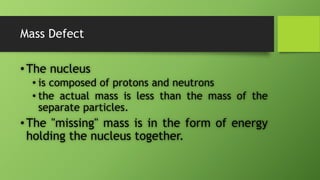
Mass Defect
•The nucleus
• is composed of protons and neutrons
• the actual mass is less than the mass of the
separate particles.
•The "missing" mass is in the form of energy
holding the nucleus together.
Mass Defect
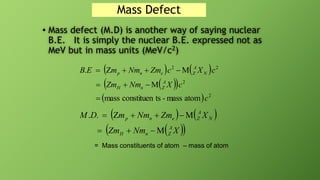
• Mass defect (M.D) is another way of saying nuclear
B.E. It is simply the nuclear B.E. expressed not as
MeV but in mass units (MeV/c2)
   
 
 
M
M
Z
.
.
X
Nm
Zm
X
Zm
Nm
m
D
M
A
Z
n
H
N
A
Z
e
n
p







   
 
 
  2
2
2
2
atom
mass
-
ts
constituen
mass
M
M
Z
.
c
c
X
Nm
Zm
c
X
c
Zm
Nm
m
E
B
A
Z
n
H
N
A
Z
e
n
p








= Mass constituents of atom – mass of atom
Uranium-238
238U
92
A proton is 1.00728 amu
A neutron is 1.00867 amu
atomic number
(protons)
nucleons
(protons & neutrons)
The nuclear mass
of uranium-238 is
238.0003 amu
Uranium-238
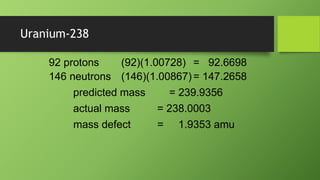
(92)(1.00728) = 92.6698
(146)(1.00867)= 147.2658
92 protons
146 neutrons
predicted mass = 239.9356
actual mass = 238.0003
mass defect = 1.9353 amu
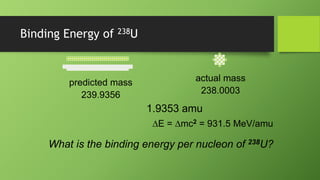
Binding Energy of 238U
predicted mass
239.9356
actual mass
238.0003
1.9353 amu
DE = Dmc2 = 931.5 MeV/amu
What is the binding energy per nucleon of 238U?
Binding Energy of 238U
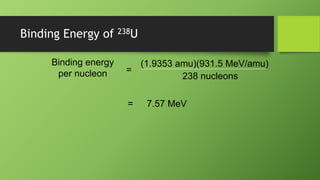
Binding energy
per nucleon =
(1.9353 amu)(931.5 MeV/amu)
238 nucleons
= 7.57 MeV
Binding Energy
•The mass defect indicates the total energy
involved in holding the nucleus together.
•To determine the stability of the nucleus,
the binding energy per nuclear particle is a
better measure.
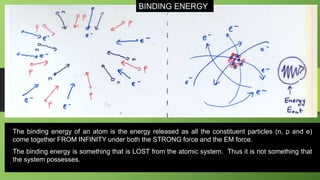
The binding energy of an atom is the energy released as all the constituent particles (n, p and e)
come together FROM INFINITY under both the STRONG force and the EM force.
The binding energy is something that is LOST from the atomic system. Thus it is not something that
the system possesses.
BINDING ENERGY
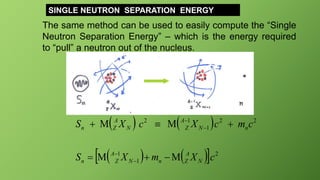
SINGLE NEUTRON SEPARATION ENERGY
The same method can be used to easily compute the “Single
Neutron Separation Energy” – which is the energy required
to “pull” a neutron out of the nucleus.
   
   
  2
1
1
2
2
1
1
2
M
M
M
M
c
X
m
X
S
c
m
c
X
c
X
S
N
A
Z
n
N
A
Z
n
n
N
A
Z
N
A
Z
n










SINGLE PROTON SEPARATION ENERGY
The same clever strategy applies to finding the “Single Proton Separation
Energy” Sp. But note here there is a difference – we must be careful in
counting electron mass.
    2
2
2
1
1
2
M
M c
m
c
m
c
Y
c
X
S e
p
N
A
Z
N
A
Z
p 


 

   
 
   
  2
1
1
2
1
1
M
M
M
M
c
X
m
Y
c
X
m
m
Y
S
N
A
Z
H
N
A
Z
N
A
Z
e
p
N
A
Z
p












p
S [Mass of Final Products – Mass of Initial atom] c2
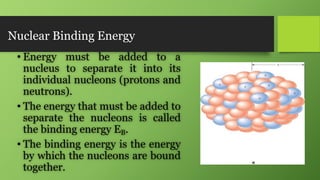
Nuclear Binding Energy
• Energy must be added to a
nucleus to separate it into its
individual nucleons (protons and
neutrons).
• The energy that must be added to
separate the nucleons is called
the binding energy EB.
• The binding energy is the energy
by which the nucleons are bound
together.
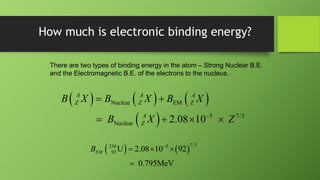
How much is electronic binding energy?
There are two types of binding energy in the atom – Strong Nuclear B.E.
and the Electromagnetic B.E. of the electrons to the nucleus.
     
 
Nuclear EM
5 7/3
Nuclear 2.08 10
A A A
Z Z Z
A
Z
B X B X B X
B X Z

 
   
   
7/3
238 5
92 U 2.08 10 92
0.795MeV
EM
B 
  


NUCLEAR STABILITY.pptx

  • 1.
    1 • “Why doprotons stay together when positive charges repel each other?” • The main reason is because of a force called Strong Force. • Opposes the electrostatic force.
  • 2.
    Chemical Reactions New substancesare made through the formation of new nanoscopic “units” by making and/or breaking chemical bonds (Dalton) All the “action” is outside of the nuclei Nuclei remain unchanged! Chemical Bonding involves moving electrons, not nuclei *
  • 3.
    Nuclear Reactions It’s allabout changing the nucleus! Independent of any “standard” chemical reactions *
  • 4.
    NUCLEAR STABILITY & BINDINGENERGY SHIELA MARIE B. SIBAYAN©
  • 5.
    Two kinds ofSTABILITY • One refers to whether a nuclide will undergo spontaneous nuclear decay. • Does the nuclide decay (unstable, radioactive) or not (stable)? • The “valley of stability” Kinetic Stability Thermo- dynamic Stability * • One refers to how stable one nuclide is compared to another, in terms of “overall configuration of nucleons” –Applies to all nuclides, radioactive or not –Assessed by Binding energy per nucleon Ex. 206Pb is a stable nuclide. 238U is radioactive Ex. 56Fe is more stable than 206Pb or 2H
  • 6.
    6 Nuclear Stability •As ageneral rule, a nucleus will need a neutron/proton ratio of 3:2 (or 1.5:1) in order to stay together. •This rule is more precise for larger nuclei.
  • 7.
    7 Nuclear Stability • Ofall known isotopes of natural elements (about 1500), only 250 of them are stable. • All of these stable isotopes have an atomic number in between 1 and 83.
  • 8.
    Stability Curve Atomic numberZ Neutron number N Stable nuclei Z = N 20 40 60 80 100 40 100 140 20 60 80 120 Nuclear particles are held together by a nuclear strong force. A stable nucleus remains forever, but as the ratio of N/Z gets larger, the atoms decay. Elements with Z > 82 are all unstable.
  • 9.
    Atomic Mass Unit,u One atomic mass unit (1 u) is equal to one-twelfth of the mass of the most abundant form of the carbon atom--carbon-12. Atomic mass unit: 1 u = 1.6606 x 10⁻²⁷ kg Common atomic masses: Proton: 1.007276 u Neutron: 1.008665 u Electron: 0.00055 u Hydrogen: 1.007825 u
  • 10.
    2 8 ; 3x 10 m/s E mc c   Mass and Energy The energy of a mass of 1 u can be found: E = (1 u)c2 = (1.66 x 10⁻²⁷ kg)(3 x 10⁸ m/s)2 E = 1.49 x 10⁻¹⁰ J Or E = 931.5 MeV When converting amu to energy: 2 MeV u 931.5 c 
  • 11.
    Mass Defect •The nucleus •is composed of protons and neutrons • the actual mass is less than the mass of the separate particles. •The "missing" mass is in the form of energy holding the nucleus together.
  • 12.
    Mass Defect • Massdefect (M.D) is another way of saying nuclear B.E. It is simply the nuclear B.E. expressed not as MeV but in mass units (MeV/c2)         M M Z . . X Nm Zm X Zm Nm m D M A Z n H N A Z e n p                  2 2 2 2 atom mass - ts constituen mass M M Z . c c X Nm Zm c X c Zm Nm m E B A Z n H N A Z e n p         = Mass constituents of atom – mass of atom
  • 13.
    Uranium-238 238U 92 A proton is1.00728 amu A neutron is 1.00867 amu atomic number (protons) nucleons (protons & neutrons) The nuclear mass of uranium-238 is 238.0003 amu
  • 14.
    Uranium-238 (92)(1.00728) = 92.6698 (146)(1.00867)=147.2658 92 protons 146 neutrons predicted mass = 239.9356 actual mass = 238.0003 mass defect = 1.9353 amu
  • 15.
    Binding Energy of238U predicted mass 239.9356 actual mass 238.0003 1.9353 amu DE = Dmc2 = 931.5 MeV/amu What is the binding energy per nucleon of 238U?
  • 16.
    Binding Energy of238U Binding energy per nucleon = (1.9353 amu)(931.5 MeV/amu) 238 nucleons = 7.57 MeV
  • 17.
    Binding Energy •The massdefect indicates the total energy involved in holding the nucleus together. •To determine the stability of the nucleus, the binding energy per nuclear particle is a better measure.
  • 18.
    The binding energyof an atom is the energy released as all the constituent particles (n, p and e) come together FROM INFINITY under both the STRONG force and the EM force. The binding energy is something that is LOST from the atomic system. Thus it is not something that the system possesses. BINDING ENERGY
  • 19.
    SINGLE NEUTRON SEPARATIONENERGY The same method can be used to easily compute the “Single Neutron Separation Energy” – which is the energy required to “pull” a neutron out of the nucleus.           2 1 1 2 2 1 1 2 M M M M c X m X S c m c X c X S N A Z n N A Z n n N A Z N A Z n          
  • 20.
    SINGLE PROTON SEPARATIONENERGY The same clever strategy applies to finding the “Single Proton Separation Energy” Sp. But note here there is a difference – we must be careful in counting electron mass.     2 2 2 1 1 2 M M c m c m c Y c X S e p N A Z N A Z p                   2 1 1 2 1 1 M M M M c X m Y c X m m Y S N A Z H N A Z N A Z e p N A Z p             p S [Mass of Final Products – Mass of Initial atom] c2
  • 21.
    Nuclear Binding Energy •Energy must be added to a nucleus to separate it into its individual nucleons (protons and neutrons). • The energy that must be added to separate the nucleons is called the binding energy EB. • The binding energy is the energy by which the nucleons are bound together.
  • 23.
    How much iselectronic binding energy? There are two types of binding energy in the atom – Strong Nuclear B.E. and the Electromagnetic B.E. of the electrons to the nucleus.         Nuclear EM 5 7/3 Nuclear 2.08 10 A A A Z Z Z A Z B X B X B X B X Z            7/3 238 5 92 U 2.08 10 92 0.795MeV EM B     