Atomic Structure
Unit 2—Part III
What is an atom?
• Atom: the smallest unit of matter
that retains the identity of the
substance
• First proposed by Democratus
Atomic Structure
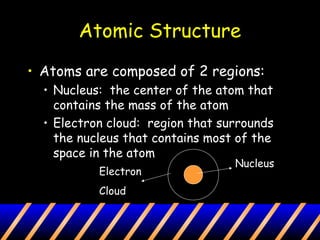
• Atoms are composed of 2 regions:
• Nucleus: the center of the atom that
contains the mass of the atom
• Electron cloud: region that surrounds
the nucleus that contains most of the
space in the atom
Nucleus
Electron
Cloud
What’s in the Nucleus?
• The nucleus contains 2 of the 3
subatomic particles:
• Protons: positively charged subatomic
particles
• Neutrons: neutrally charged subatomic
particles
What’s in the Electron Cloud?
• The 3rd
subatomic particle resides
outside of the nucleus in the electron
cloud
• Electron: the subatomic particle with a
negative charge and relatively no mass
How do these particles
interact?
• Protons and neutrons live compacted
in the tiny positively charged nucleus
accounting for most of the mass of
the atom
• The negatively charged electrons are
small and have a relatively small mass
but occupy a large volume of space
outside the nucleus
How do the subatomic particles
balance each other?
• In an atom:
• The protons = the electrons
• If 20 protons are present in an atom then 20
electrons are there to balance the overall
charge of the atom—atoms are neutral
• The neutrons have no charge; therefore
they do not have to equal the number of
protons or electrons
How do we know the number of
subatomic particles in an atom?
• Atomic number: this number indicates the
number of protons in an atom
• Ex: Hydrogen’s atomic number is 1
• So hydrogen has 1 proton
• Ex: Carbon’s atomic number is 6
• So carbon has 6 protons
**The number of protons identifies the atom.
Ex. 2 protons = He, 29 protons = Cu
• Mass number: the number of protons
and neutrons in the nucleus
• Ex: hydrogen can have a mass of 3.
Since it has 1 proton it must have 2
neutrons
• # of neutrons = mass # - atomic #
How do we know the number of
subatomic particles in an atom?
Determining the number of
protons and neutrons
• Li has a mass number of 7 and an
atomic number of 3
• Protons = 3 (same as atomic #)
• Neutrons= 7-3 = 4 (mass # - atomic #)
• Ne has a mass number of 20 and an
atomic number of 10
• Protons = 10
• Neutrons = 20 - 10= 10
What about the electrons?
• The electrons are equal to the
number of protons
• So e-
= p = atomic #
• Ex: He has a mass # of 4 and an
atomic # of 2
• p+
= 2
• no
= 2
• e-
=2
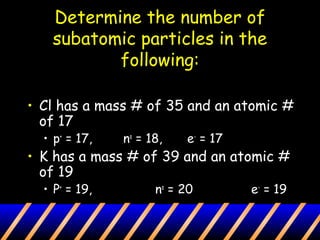
Determine the number of
subatomic particles in the
following:
• Cl has a mass # of 35 and an atomic #
of 17
• p+
= 17, no
= 18, e-
= 17
• K has a mass # of 39 and an atomic #
of 19
• P+
= 19, no
= 20 e-
= 19
How exactly are the particles
arranged?
• Bohr Model of the atom:
All of the
protons and
the neutrons
All of the
electrons
What does carbon look like?
Mass # = 12 atomic # = 6
p+
= 6 no
= 6 e-
= 6
6 p and 6 n live
in the nucleus

8th unit 2- atomic structure part iii

  • 1.
  • 2.
    What is anatom? • Atom: the smallest unit of matter that retains the identity of the substance • First proposed by Democratus
  • 3.
    Atomic Structure • Atomsare composed of 2 regions: • Nucleus: the center of the atom that contains the mass of the atom • Electron cloud: region that surrounds the nucleus that contains most of the space in the atom Nucleus Electron Cloud
  • 4.
    What’s in theNucleus? • The nucleus contains 2 of the 3 subatomic particles: • Protons: positively charged subatomic particles • Neutrons: neutrally charged subatomic particles
  • 5.
    What’s in theElectron Cloud? • The 3rd subatomic particle resides outside of the nucleus in the electron cloud • Electron: the subatomic particle with a negative charge and relatively no mass
  • 6.
    How do theseparticles interact? • Protons and neutrons live compacted in the tiny positively charged nucleus accounting for most of the mass of the atom • The negatively charged electrons are small and have a relatively small mass but occupy a large volume of space outside the nucleus
  • 7.
    How do thesubatomic particles balance each other? • In an atom: • The protons = the electrons • If 20 protons are present in an atom then 20 electrons are there to balance the overall charge of the atom—atoms are neutral • The neutrons have no charge; therefore they do not have to equal the number of protons or electrons
  • 8.
    How do weknow the number of subatomic particles in an atom? • Atomic number: this number indicates the number of protons in an atom • Ex: Hydrogen’s atomic number is 1 • So hydrogen has 1 proton • Ex: Carbon’s atomic number is 6 • So carbon has 6 protons **The number of protons identifies the atom. Ex. 2 protons = He, 29 protons = Cu
  • 9.
    • Mass number:the number of protons and neutrons in the nucleus • Ex: hydrogen can have a mass of 3. Since it has 1 proton it must have 2 neutrons • # of neutrons = mass # - atomic # How do we know the number of subatomic particles in an atom?
  • 10.
    Determining the numberof protons and neutrons • Li has a mass number of 7 and an atomic number of 3 • Protons = 3 (same as atomic #) • Neutrons= 7-3 = 4 (mass # - atomic #) • Ne has a mass number of 20 and an atomic number of 10 • Protons = 10 • Neutrons = 20 - 10= 10
  • 11.
    What about theelectrons? • The electrons are equal to the number of protons • So e- = p = atomic # • Ex: He has a mass # of 4 and an atomic # of 2 • p+ = 2 • no = 2 • e- =2
  • 12.
    Determine the numberof subatomic particles in the following: • Cl has a mass # of 35 and an atomic # of 17 • p+ = 17, no = 18, e- = 17 • K has a mass # of 39 and an atomic # of 19 • P+ = 19, no = 20 e- = 19
  • 13.
    How exactly arethe particles arranged? • Bohr Model of the atom: All of the protons and the neutrons All of the electrons
  • 14.
    What does carbonlook like? Mass # = 12 atomic # = 6 p+ = 6 no = 6 e- = 6 6 p and 6 n live in the nucleus