1
Research Seminar for
Educational Sciences
Prof. Dr. Chang Zhu
Department of Educational Sciences
Analysing qualitative data
2
2
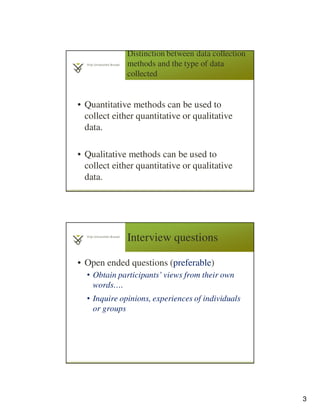
Qualitative data
• Non-numeric
• Texts (descriptive-narrative), transcripts,
documents
• Visual data, video
• Verbal data, audio
(Flick, 2007)
3
Qualitative data collection
• Qualitative interviewing
• Questionnaire: open ended questions
• Focus groups
• Observations
• Documents, reports, records, journals,
field notes…
4
3
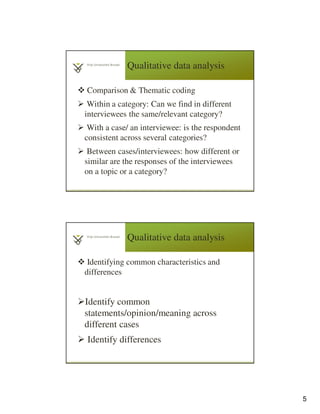
Distinction between data collection
methods and the type of data
collected
• Quantitative methods can be used to
collect either quantitative or qualitative
data.
• Qualitative methods can be used to
collect either quantitative or qualitative
data.
5
Interview questions
• Open ended questions (preferable)
• Obtain participants’ views from their own
words….
• Inquire opinions, experiences of individuals
or groups
6
4
Qualitative data analysis
Coding and categorizing
Search for relevant data
Comparing them with other data
Naming and classifying them
Building a hierarchy between categories
Identify a structure in the data
Develop an understanding of the issue and the
data7
Qualitative data analysis
The aim of qualitative analysis is often to
develop a theory or to identify patterns and
structure
The categories for coding are often developed
from the material/data, rather than from
existing theories
But it is possible and usual as well to start
from existing theories, and modify and
add/complement…
8
5
Qualitative data analysis
Comparison & Thematic coding
Within a category: Can we find in different
interviewees the same/relevant category?
With a case/ an interviewee: is the respondent
consistent across several categories?
Between cases/interviewees: how different or
similar are the responses of the interviewees
on a topic or a category?
9
Qualitative data analysis
Identifying common characteristics and
differences
Identify common
statements/opinion/meaning across
different cases
Identify differences
1
0
6
Qualitative data analysis
Triangulation
Combine qualitative and quantitative
standardized data
Refer to different sorts and sources of
qualitative data
Seek for respondent validation (integrate
participants perspectives on the data) (Gibbs,
2007)
1
1
Qualitative data analysis
Quality
Researchers be reflective (assessing their own
role as well as the data)
Checking the transcripts and the codes by
different researchers reliability
1
2
7
Iterative steps: Step 1
Reading
1
3
Step 2
Memoing
Underlining important issues
Writing memos to yourself as you develop
the coding scheme
These notes help the researcher recall ideas
for coding and developing concepts
1
4
8
Step 3
Describing
Comprehensive descriptions of the
setting, participants, etc.
1
5
Iterative steps: Step 4
Keep your research questions in mind when
conducting the data analysis
Can I find answers to the research questions?
What results can be found corresponding to
the research questions?
1
6
9
Iterative steps: Step 5
Coding
Give a label or a code to the same or similar
text/meaning
1
7
• Open coding
• The researcher begins with “open coding,” the
process of creating many codes as one takes an
initial look at the data.
• Focus primarily on the text to define concepts
and categories
1
8
10
• Axial coding (themes/categories/coding
families)
• Open coding is followed by “axial coding,” or
the process of selecting the key codes and
concepts of interest. Axial coding involves a
regrouping of the data into the main coding
scheme.
• Connections are made amongst the categories
and the subcategories.
1
9
Iterative steps: Step 6
Categorizing/Classifying
Breaking data into analytic units
Categories
Grouping into themes (common themes
that emerge, repeating themselves)
You can also work with predetermined
categories
2
0
11
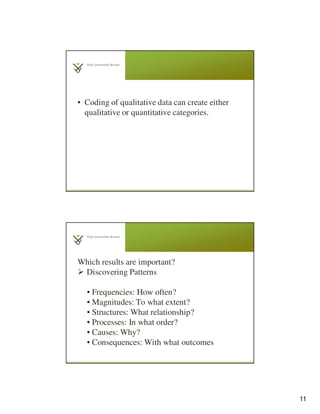
• Coding of qualitative data can create either
qualitative or quantitative categories.
2
1
Which results are important?
Discovering Patterns
• Frequencies: How often?
• Magnitudes: To what extent?
• Structures: What relationship?
• Processes: In what order?
• Causes: Why?
• Consequences: With what outcomes
2
2
12
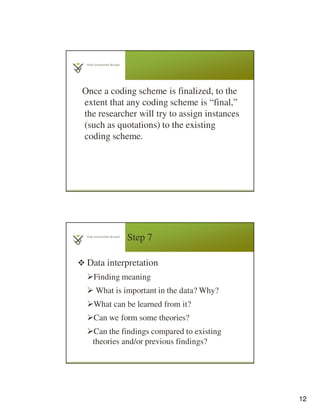
Once a coding scheme is finalized, to the
extent that any coding scheme is “final,”
the researcher will try to assign instances
(such as quotations) to the existing
coding scheme.
2
3
Step 7
Data interpretation
Finding meaning
What is important in the data? Why?
What can be learned from it?
Can we form some theories?
Can the findings compared to existing
theories and/or previous findings?
2
4
13
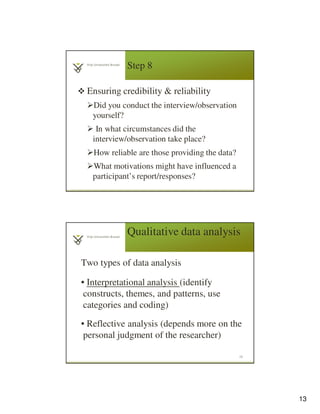
Step 8
Ensuring credibility & reliability
Did you conduct the interview/observation
yourself?
In what circumstances did the
interview/observation take place?
How reliable are those providing the data?
What motivations might have influenced a
participant’s report/responses?
2
5
Qualitative data analysis
Two types of data analysis
• Interpretational analysis (identify
constructs, themes, and patterns, use
categories and coding)
• Reflective analysis (depends more on the
personal judgment of the researcher)
26
14
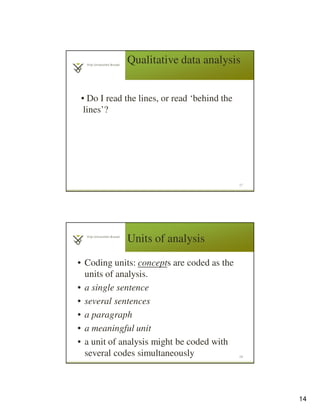
Qualitative data analysis
• Do I read the lines, or read ‘behind the
lines’?
27
Units of analysis
• Coding units: concepts are coded as the
units of analysis.
• a single sentence
• several sentences
• a paragraph
• a meaningful unit
• a unit of analysis might be coded with
several codes simultaneously 28
15
Qualitative data analysis
Using software for qualitative data
analysis
e.g. Atlas.ti, Nvivo
Help you to organize your data
Develop the scheme, theme, category,
coding, etc.
29
Coding Qualitative Data
• https://www.youtube.com/watch?v=GZKZKU
ycqFU
3
0
16
Software for qualitative data
analysis
• Atlas.ti
• Nvivo
• MAXQDA
• The Ethnograph
• HyperQual
• HyperResearch
• HyperSoft
• Qualrus
• QUALOG
• Textbase Alpha3
1
• It is important to note that qualitative
analysis and quantitative analysis are
neither competing nor incompatible.
• Learn to conduct both types of analysis
3
2

Research seminar lecture_10_analysing_qualitative_data

  • 1.
    1 Research Seminar for EducationalSciences Prof. Dr. Chang Zhu Department of Educational Sciences Analysing qualitative data 2
  • 2.
    2 Qualitative data • Non-numeric •Texts (descriptive-narrative), transcripts, documents • Visual data, video • Verbal data, audio (Flick, 2007) 3 Qualitative data collection • Qualitative interviewing • Questionnaire: open ended questions • Focus groups • Observations • Documents, reports, records, journals, field notes… 4
  • 3.
    3 Distinction between datacollection methods and the type of data collected • Quantitative methods can be used to collect either quantitative or qualitative data. • Qualitative methods can be used to collect either quantitative or qualitative data. 5 Interview questions • Open ended questions (preferable) • Obtain participants’ views from their own words…. • Inquire opinions, experiences of individuals or groups 6
  • 4.
    4 Qualitative data analysis Codingand categorizing Search for relevant data Comparing them with other data Naming and classifying them Building a hierarchy between categories Identify a structure in the data Develop an understanding of the issue and the data7 Qualitative data analysis The aim of qualitative analysis is often to develop a theory or to identify patterns and structure The categories for coding are often developed from the material/data, rather than from existing theories But it is possible and usual as well to start from existing theories, and modify and add/complement… 8
  • 5.
    5 Qualitative data analysis Comparison& Thematic coding Within a category: Can we find in different interviewees the same/relevant category? With a case/ an interviewee: is the respondent consistent across several categories? Between cases/interviewees: how different or similar are the responses of the interviewees on a topic or a category? 9 Qualitative data analysis Identifying common characteristics and differences Identify common statements/opinion/meaning across different cases Identify differences 1 0
  • 6.
    6 Qualitative data analysis Triangulation Combinequalitative and quantitative standardized data Refer to different sorts and sources of qualitative data Seek for respondent validation (integrate participants perspectives on the data) (Gibbs, 2007) 1 1 Qualitative data analysis Quality Researchers be reflective (assessing their own role as well as the data) Checking the transcripts and the codes by different researchers reliability 1 2
  • 7.
    7 Iterative steps: Step1 Reading 1 3 Step 2 Memoing Underlining important issues Writing memos to yourself as you develop the coding scheme These notes help the researcher recall ideas for coding and developing concepts 1 4
  • 8.
    8 Step 3 Describing Comprehensive descriptionsof the setting, participants, etc. 1 5 Iterative steps: Step 4 Keep your research questions in mind when conducting the data analysis Can I find answers to the research questions? What results can be found corresponding to the research questions? 1 6
  • 9.
    9 Iterative steps: Step5 Coding Give a label or a code to the same or similar text/meaning 1 7 • Open coding • The researcher begins with “open coding,” the process of creating many codes as one takes an initial look at the data. • Focus primarily on the text to define concepts and categories 1 8
  • 10.
    10 • Axial coding(themes/categories/coding families) • Open coding is followed by “axial coding,” or the process of selecting the key codes and concepts of interest. Axial coding involves a regrouping of the data into the main coding scheme. • Connections are made amongst the categories and the subcategories. 1 9 Iterative steps: Step 6 Categorizing/Classifying Breaking data into analytic units Categories Grouping into themes (common themes that emerge, repeating themselves) You can also work with predetermined categories 2 0
  • 11.
    11 • Coding ofqualitative data can create either qualitative or quantitative categories. 2 1 Which results are important? Discovering Patterns • Frequencies: How often? • Magnitudes: To what extent? • Structures: What relationship? • Processes: In what order? • Causes: Why? • Consequences: With what outcomes 2 2
  • 12.
    12 Once a codingscheme is finalized, to the extent that any coding scheme is “final,” the researcher will try to assign instances (such as quotations) to the existing coding scheme. 2 3 Step 7 Data interpretation Finding meaning What is important in the data? Why? What can be learned from it? Can we form some theories? Can the findings compared to existing theories and/or previous findings? 2 4
  • 13.
    13 Step 8 Ensuring credibility& reliability Did you conduct the interview/observation yourself? In what circumstances did the interview/observation take place? How reliable are those providing the data? What motivations might have influenced a participant’s report/responses? 2 5 Qualitative data analysis Two types of data analysis • Interpretational analysis (identify constructs, themes, and patterns, use categories and coding) • Reflective analysis (depends more on the personal judgment of the researcher) 26
  • 14.
    14 Qualitative data analysis •Do I read the lines, or read ‘behind the lines’? 27 Units of analysis • Coding units: concepts are coded as the units of analysis. • a single sentence • several sentences • a paragraph • a meaningful unit • a unit of analysis might be coded with several codes simultaneously 28
  • 15.
    15 Qualitative data analysis Usingsoftware for qualitative data analysis e.g. Atlas.ti, Nvivo Help you to organize your data Develop the scheme, theme, category, coding, etc. 29 Coding Qualitative Data • https://www.youtube.com/watch?v=GZKZKU ycqFU 3 0
  • 16.
    16 Software for qualitativedata analysis • Atlas.ti • Nvivo • MAXQDA • The Ethnograph • HyperQual • HyperResearch • HyperSoft • Qualrus • QUALOG • Textbase Alpha3 1 • It is important to note that qualitative analysis and quantitative analysis are neither competing nor incompatible. • Learn to conduct both types of analysis 3 2