Research Seminar for
Educational Sciences
Prof. Dr. Chang Zhu
Department of Educational Sciences
Céline Cocquyt
Outline
• Structure of research proposal
• Main types of research methods
What is a research proposal?
1. Why this research?
2. What are you going to research?
3. How are you going to do this research?
3
Research proposal
7 steps
of doing
research
Research proposal
1.Why this research?
 Step 1. Selection of/identifying a problem
• Defining your research problem (status of an
educational phenomenon, actor, process;
problem or interests in knowing…)
• Purpose of the study
• Justification of the study
5
Research proposal
1.Why this research?
Step 2. Review of literature
• Review of related literature (existing theory
and research, theoretical and empirical
background)
(eg., what has been done, how and what
results, what knowledge and theory…)
6
Research proposal
Specific steps for literature review
• Best descriptors
• Choose important primary and secondary
sources
• Critically reflect on the research results,
including the research methodology
• Consider contrary findings and alternative
interpretations
• Make connections and synthesis
7
Research proposal
2: What are you going to research?
Step 3. Statement of research questions (RQ)
• Specific
• One question in one RQ
• Can have several specific research questions
in one research
Research proposal
Specific steps:
 Identify a research problem
 Choose a research topic
 Narrow a research topic
 Formulate specific research questions
9
Research proposal
3: How to do this research?
Step 4. Choose a research method
• Quantitative research methods
• Qualitative research methods
• Mixed research methods
10
Research proposal
3: How to do this research?
Step 5. Research design and data
collection (evidence from participants)
From whom? (selecting sample/ participants)
How?
What questions?
11
Research proposal
3: How to do this research?
 Step 6. Data analysis
Methods of data analysis (how to analyze
and interpret your data)
12
Research proposal
 Step 7. Presentation of results
Analyzing and interpreting data
 Write/report your findings
 Discussions and conclusions
13
Major sections of a research
proposal
14
Title
Summary
Research problem
Literature review
Research questions
Research methods
Expected results &
significance
Planning
Major sections of a research
report/article
15
Title
Summary
Research problem
Literature review
Research questions
Research methods
Results & conclusions
Implications, limitations…
Online resource
• Research proposal
• http://www.youtube.com/watch?v=zJ8Vfx472
1M
1
Research method
 Types of research
 Main research methods
Types of research by
approach
 Quantitative research
 Qualitative research
 Mixed methods research
Quantitative research
• Collection and analysis of numerical data
to describe, explain, predict or control…
• A concept/construct that can be
measured…
• Can test hypotheses
• Control over contextual factors
• Sample: representative, large enough
Qualitative research
• Collection, analysis and interpretation of
narrative and nonnumerical data to gain
insights into a phenomenon…
• Concepts to be observed, interviewed…
• Often no hypothesis
• Context not controlled
• Sample: smaller
Quantitative & Qualitative
research
• The two research approaches can be
applied depending on the nature of the
topic, question/problem to be
investigated…
• Can be combined.
• More details regarding mixed-methods
research will be introduced later
Up to you!
Characteristics of quantitative and
qualitative research
23
Quantitative Qualitative
Numerical data Nonnumerical, narrative, visual data
Hypothesis and research
procedures stated before
beginning the study
Research methods and procedures
evolve as understanding of the topic
deepens
Can manipulate the context not manipulate the context
Larger sample size Smaller sample size
Focus on statistical analysis Rely on categorizing and organizing
data into patterns to produce a
descriptive, narrative synthesis
Limited interaction with
participants
Extensive interaction with
participants
Main research methods
24
Quantitative Qualitative
Survey Interviews
Correlational research Focus groups
Group-comparative Case study
Experimental Grounded theory
Quasi-experimental Content analysis
Single-subject Narrative research
Delphi Method Historical research
Ethnographic research
Quantitative Qualitative
Survey Interviews
Correlational research Focus groups
Group-comparative Case study
Experimental Grounded theory
Quasi-experimental Content analysis
Delphi Method Narrative research
Main research methods
25
Generalizable results In-depth understandings
Survey research (Quan)
 Describe and understand current conditions
(practices, preferences, attitudes, interests,
concerns…)
 Collecting numeric data
 Test hypothesis or answer questions
 Via questionnaires…
 Often development of measuring instrument is
needed.
 Response rate: is it valid?
26
Correlational research (Quan)
 Investigate the relations between two or
more variables.
 To establish relations (whether or not, to
what degree a relation exists)
 Use existing relations to make predictions
(eg. One variable increases, the other also
increases)
 Do not suggest cause-effect relations
27
Correlational research
 Example:
• The relationship between school culture
and student achievement
28
Group-comparative research
(Quan)
 Examine the reason for differences between
groups (e.g. gender, public/private school… )
 The grouping variable is pre-existing, not
controlled (or cannot be controlled).
 The presumed cause: independent variable; the
presumed effect: dependent variable.
 Practical, feasible, however, a clear cause-
effect link can be affected by other
(extraneous) variables…
29
Group-comparative research
 Examples:
• Gender differences in academic achievement
of secondary students
• Class management of novice teachers and
experienced teachers
30
Experimental research (Quan)
 At least one independent variable is experimental
 Other variables to be controlled;
 The effect of the experimental variable on one or
more dependent variables is observed.
 Provides strongest results/evidence for linking
variables (draw conclusions about cause and
effect)
 Stringent control conditions needed, sometimes
not feasible
31
Experimental research
 Example:
• The effect of interactive multimedia on the
achievement of 10th grade Biology students
32
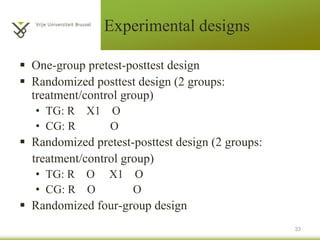
Experimental designs
 One-group pretest-posttest design
 Randomized posttest design (2 groups:
treatment/control group)
• TG: R X1 O
• CG: R O
 Randomized pretest-posttest design (2 groups:
treatment/control group)
• TG: R O X1 O
• CG: R O O
 Randomized four-group design
33
Quasi-Experimental designs
 When random assignment of participants is not
possible;
 Static-Group Comparison Design:
• X O
• O
 Nonequivalent control-Group Design:
• O X O
• O O
34
Single-subject research (Quan)
 Instead of comparing effects on different
groups (treatment vs. no treatment), it
compares a subject/group before and after
or during the treatment.
 Focus on studying the behavior change of
an individual/group as a result of an
intervention.
35
Delphi Method (Quan)
• The Delphi method surveys the opinions of
"expert panels".
• The research is usually conducted in three
rounds, where the information is gathered,
refined and then feed back to the expert
participants. The aim of the Delphi method is
to enable the group of experts to arrive at a
consensus forecast or policy making on the
subject being discussed.
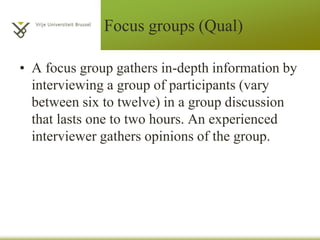
Focus groups (Qual)
• A focus group gathers in-depth information by
interviewing a group of participants (vary
between six to twelve) in a group discussion
that lasts one to two hours. An experienced
interviewer gathers opinions of the group.
Focus groups
Benefits of Focus Groups
• Opinions are focused on specific topics
• Immediate feedback or additional questions are
possible
• Can help identify key issues quickly
Problems Using Focus Groups
• The group can be dominated by a particular person or
viewpoint
• Only a limited number of questions can be dealt with
• The interviewer could bias the results.
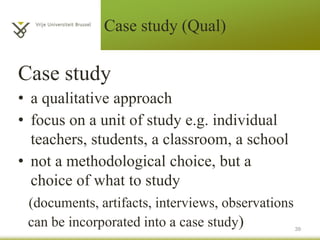
Case study (Qual)
Case study
• a qualitative approach
• focus on a unit of study e.g. individual
teachers, students, a classroom, a school
• not a methodological choice, but a
choice of what to study
(documents, artifacts, interviews, observations
can be incorporated into a case study) 39
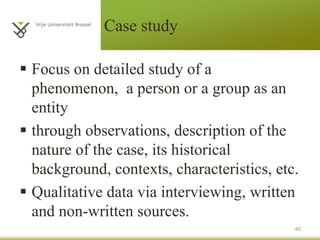
Case study
 Focus on detailed study of a
phenomenon, a person or a group as an
entity
 through observations, description of the
nature of the case, its historical
background, contexts, characteristics, etc.
 Qualitative data via interviewing, written
and non-written sources.
40
Case study
Designing case study
• a single case study
• a multiple case study
• a collective case study
• decision about the number of cases (no
strict rules, based on the needs of the study and
particularity of cases)
41
Content analysis (Qual)
• A research methodology that builds on
procedures to make valid inferences from text
(Anderson, Rourke, Garrison & Archer, 2001)
• Studying the content of communication
• E.g. transcript analysis
online discussion analysis
Grounded theory research (Qual)
 The aim is theory generating
 12 steps for grounded theory research,
Gilgun (1990)
 Identifying patterns
 “theoretical saturation”
 Emerging theories are grounded in data
43
Narrative research (Qual)
 Study “story lives”
 The researcher constructs a narrative (written
account) about one’s experiences and the
meanings this person attributes to the experiences.
 Increase understanding of issues related to
teaching and learning through the telling and
retelling of teachers’ stories.
 Close relationship between researcher and
participant
44
Ethnographic research (Qual)
 Study of cultural patterns and
perspectives of participants in their
natural settings.
 Study both the setting and the
participants.
 Presents a holistic description and
cultural interpretation of the participants’
everyday activities, values and events.
45
Up to you!
Types of research by purpose
 Basic research
 Applied research
• Evaluation research
• Action research
47
Basic and applied research
48
Basic Research Applied Research
The educational research continuum
Basic research
 Develop and refine theory
 Main motivation is to expand knowledge
 Provides the theory that produces the
concepts for solving educational
problems
49
Applied research
 Aim to solve practical problems, e.g.
educational problems
 Aim to improve practices
 Can provide data, feedback that help support
and revise the development of theory
50
Action research
• Systematic inquiry by educational actors in the
teaching and learning environment to gather
information about the ways in which their school
operate, the teachers teach and the students learn.
• The purpose is to provide a method for solving
everyday problems in their own setting.
• Main goal: solution for a given problem, not
contribution to science.
• Often a teacher conducts in his/her own
class/school
51
Evaluation research
• Evaluation: programmes, products or
practices
• Monitor progress
• Judge impact
• Make decisions
52
Possible research topics for
group projects
5
Possible research groups
 You can choose to work in a research group
 You can also opt for an individual exercise/
individual track
5
Research Groups
 Enrol in research groups online in Pointcarré
 You can discuss in the “Group Forum” with
your group members
 Questions related to the research topic
 Who will do what
 How to work together
 Issues and problems during this process
5
Group research
 Step 1: Discuss and identify a research topic (
specific, ‘small’ topic)
 Step 2: Read relevant literature (literature
review state-of-art related to the research
topic)
5
Assignment
 Read course material Theme 2 and 3
5
Questions & Feedback
Group F2F feedback
Not compulsory; if you have questions and
would like to have a face-to-face
consultation, you or a representative of
your group can have a short meeting in
office room 3B 253A on 24 October
(10-12am)
5

Research seminar lecture_2_research_proposal__types_of_research_methods_students_full

  • 1.
    Research Seminar for EducationalSciences Prof. Dr. Chang Zhu Department of Educational Sciences Céline Cocquyt
  • 2.
    Outline • Structure ofresearch proposal • Main types of research methods
  • 3.
    What is aresearch proposal? 1. Why this research? 2. What are you going to research? 3. How are you going to do this research? 3 Research proposal
  • 4.
  • 5.
    Research proposal 1.Why thisresearch?  Step 1. Selection of/identifying a problem • Defining your research problem (status of an educational phenomenon, actor, process; problem or interests in knowing…) • Purpose of the study • Justification of the study 5
  • 6.
    Research proposal 1.Why thisresearch? Step 2. Review of literature • Review of related literature (existing theory and research, theoretical and empirical background) (eg., what has been done, how and what results, what knowledge and theory…) 6
  • 7.
    Research proposal Specific stepsfor literature review • Best descriptors • Choose important primary and secondary sources • Critically reflect on the research results, including the research methodology • Consider contrary findings and alternative interpretations • Make connections and synthesis 7
  • 8.
    Research proposal 2: Whatare you going to research? Step 3. Statement of research questions (RQ) • Specific • One question in one RQ • Can have several specific research questions in one research
  • 9.
    Research proposal Specific steps: Identify a research problem  Choose a research topic  Narrow a research topic  Formulate specific research questions 9
  • 10.
    Research proposal 3: Howto do this research? Step 4. Choose a research method • Quantitative research methods • Qualitative research methods • Mixed research methods 10
  • 11.
    Research proposal 3: Howto do this research? Step 5. Research design and data collection (evidence from participants) From whom? (selecting sample/ participants) How? What questions? 11
  • 12.
    Research proposal 3: Howto do this research?  Step 6. Data analysis Methods of data analysis (how to analyze and interpret your data) 12
  • 13.
    Research proposal  Step7. Presentation of results Analyzing and interpreting data  Write/report your findings  Discussions and conclusions 13
  • 14.
    Major sections ofa research proposal 14 Title Summary Research problem Literature review Research questions Research methods Expected results & significance Planning
  • 15.
    Major sections ofa research report/article 15 Title Summary Research problem Literature review Research questions Research methods Results & conclusions Implications, limitations…
  • 16.
    Online resource • Researchproposal • http://www.youtube.com/watch?v=zJ8Vfx472 1M 1
  • 17.
    Research method  Typesof research  Main research methods
  • 18.
    Types of researchby approach  Quantitative research  Qualitative research  Mixed methods research
  • 19.
    Quantitative research • Collectionand analysis of numerical data to describe, explain, predict or control… • A concept/construct that can be measured… • Can test hypotheses • Control over contextual factors • Sample: representative, large enough
  • 20.
    Qualitative research • Collection,analysis and interpretation of narrative and nonnumerical data to gain insights into a phenomenon… • Concepts to be observed, interviewed… • Often no hypothesis • Context not controlled • Sample: smaller
  • 21.
    Quantitative & Qualitative research •The two research approaches can be applied depending on the nature of the topic, question/problem to be investigated… • Can be combined. • More details regarding mixed-methods research will be introduced later
  • 22.
  • 23.
    Characteristics of quantitativeand qualitative research 23 Quantitative Qualitative Numerical data Nonnumerical, narrative, visual data Hypothesis and research procedures stated before beginning the study Research methods and procedures evolve as understanding of the topic deepens Can manipulate the context not manipulate the context Larger sample size Smaller sample size Focus on statistical analysis Rely on categorizing and organizing data into patterns to produce a descriptive, narrative synthesis Limited interaction with participants Extensive interaction with participants
  • 24.
    Main research methods 24 QuantitativeQualitative Survey Interviews Correlational research Focus groups Group-comparative Case study Experimental Grounded theory Quasi-experimental Content analysis Single-subject Narrative research Delphi Method Historical research Ethnographic research
  • 25.
    Quantitative Qualitative Survey Interviews Correlationalresearch Focus groups Group-comparative Case study Experimental Grounded theory Quasi-experimental Content analysis Delphi Method Narrative research Main research methods 25 Generalizable results In-depth understandings
  • 26.
    Survey research (Quan) Describe and understand current conditions (practices, preferences, attitudes, interests, concerns…)  Collecting numeric data  Test hypothesis or answer questions  Via questionnaires…  Often development of measuring instrument is needed.  Response rate: is it valid? 26
  • 27.
    Correlational research (Quan) Investigate the relations between two or more variables.  To establish relations (whether or not, to what degree a relation exists)  Use existing relations to make predictions (eg. One variable increases, the other also increases)  Do not suggest cause-effect relations 27
  • 28.
    Correlational research  Example: •The relationship between school culture and student achievement 28
  • 29.
    Group-comparative research (Quan)  Examinethe reason for differences between groups (e.g. gender, public/private school… )  The grouping variable is pre-existing, not controlled (or cannot be controlled).  The presumed cause: independent variable; the presumed effect: dependent variable.  Practical, feasible, however, a clear cause- effect link can be affected by other (extraneous) variables… 29
  • 30.
    Group-comparative research  Examples: •Gender differences in academic achievement of secondary students • Class management of novice teachers and experienced teachers 30
  • 31.
    Experimental research (Quan) At least one independent variable is experimental  Other variables to be controlled;  The effect of the experimental variable on one or more dependent variables is observed.  Provides strongest results/evidence for linking variables (draw conclusions about cause and effect)  Stringent control conditions needed, sometimes not feasible 31
  • 32.
    Experimental research  Example: •The effect of interactive multimedia on the achievement of 10th grade Biology students 32
  • 33.
    Experimental designs  One-grouppretest-posttest design  Randomized posttest design (2 groups: treatment/control group) • TG: R X1 O • CG: R O  Randomized pretest-posttest design (2 groups: treatment/control group) • TG: R O X1 O • CG: R O O  Randomized four-group design 33
  • 34.
    Quasi-Experimental designs  Whenrandom assignment of participants is not possible;  Static-Group Comparison Design: • X O • O  Nonequivalent control-Group Design: • O X O • O O 34
  • 35.
    Single-subject research (Quan) Instead of comparing effects on different groups (treatment vs. no treatment), it compares a subject/group before and after or during the treatment.  Focus on studying the behavior change of an individual/group as a result of an intervention. 35
  • 36.
    Delphi Method (Quan) •The Delphi method surveys the opinions of "expert panels". • The research is usually conducted in three rounds, where the information is gathered, refined and then feed back to the expert participants. The aim of the Delphi method is to enable the group of experts to arrive at a consensus forecast or policy making on the subject being discussed.
  • 37.
    Focus groups (Qual) •A focus group gathers in-depth information by interviewing a group of participants (vary between six to twelve) in a group discussion that lasts one to two hours. An experienced interviewer gathers opinions of the group.
  • 38.
    Focus groups Benefits ofFocus Groups • Opinions are focused on specific topics • Immediate feedback or additional questions are possible • Can help identify key issues quickly Problems Using Focus Groups • The group can be dominated by a particular person or viewpoint • Only a limited number of questions can be dealt with • The interviewer could bias the results.
  • 39.
    Case study (Qual) Casestudy • a qualitative approach • focus on a unit of study e.g. individual teachers, students, a classroom, a school • not a methodological choice, but a choice of what to study (documents, artifacts, interviews, observations can be incorporated into a case study) 39
  • 40.
    Case study  Focuson detailed study of a phenomenon, a person or a group as an entity  through observations, description of the nature of the case, its historical background, contexts, characteristics, etc.  Qualitative data via interviewing, written and non-written sources. 40
  • 41.
    Case study Designing casestudy • a single case study • a multiple case study • a collective case study • decision about the number of cases (no strict rules, based on the needs of the study and particularity of cases) 41
  • 42.
    Content analysis (Qual) •A research methodology that builds on procedures to make valid inferences from text (Anderson, Rourke, Garrison & Archer, 2001) • Studying the content of communication • E.g. transcript analysis online discussion analysis
  • 43.
    Grounded theory research(Qual)  The aim is theory generating  12 steps for grounded theory research, Gilgun (1990)  Identifying patterns  “theoretical saturation”  Emerging theories are grounded in data 43
  • 44.
    Narrative research (Qual) Study “story lives”  The researcher constructs a narrative (written account) about one’s experiences and the meanings this person attributes to the experiences.  Increase understanding of issues related to teaching and learning through the telling and retelling of teachers’ stories.  Close relationship between researcher and participant 44
  • 45.
    Ethnographic research (Qual) Study of cultural patterns and perspectives of participants in their natural settings.  Study both the setting and the participants.  Presents a holistic description and cultural interpretation of the participants’ everyday activities, values and events. 45
  • 46.
  • 47.
    Types of researchby purpose  Basic research  Applied research • Evaluation research • Action research 47
  • 48.
    Basic and appliedresearch 48 Basic Research Applied Research The educational research continuum
  • 49.
    Basic research  Developand refine theory  Main motivation is to expand knowledge  Provides the theory that produces the concepts for solving educational problems 49
  • 50.
    Applied research  Aimto solve practical problems, e.g. educational problems  Aim to improve practices  Can provide data, feedback that help support and revise the development of theory 50
  • 51.
    Action research • Systematicinquiry by educational actors in the teaching and learning environment to gather information about the ways in which their school operate, the teachers teach and the students learn. • The purpose is to provide a method for solving everyday problems in their own setting. • Main goal: solution for a given problem, not contribution to science. • Often a teacher conducts in his/her own class/school 51
  • 52.
    Evaluation research • Evaluation:programmes, products or practices • Monitor progress • Judge impact • Make decisions 52
  • 53.
    Possible research topicsfor group projects 5
  • 54.
    Possible research groups You can choose to work in a research group  You can also opt for an individual exercise/ individual track 5
  • 55.
    Research Groups  Enrolin research groups online in Pointcarré  You can discuss in the “Group Forum” with your group members  Questions related to the research topic  Who will do what  How to work together  Issues and problems during this process 5
  • 56.
    Group research  Step1: Discuss and identify a research topic ( specific, ‘small’ topic)  Step 2: Read relevant literature (literature review state-of-art related to the research topic) 5
  • 57.
    Assignment  Read coursematerial Theme 2 and 3 5
  • 58.
    Questions & Feedback GroupF2F feedback Not compulsory; if you have questions and would like to have a face-to-face consultation, you or a representative of your group can have a short meeting in office room 3B 253A on 24 October (10-12am) 5