1
Research Seminar for
Educational Sciences
Prof. Dr. Chang Zhu
Department of Educational Sciences
Getting to know each other
2
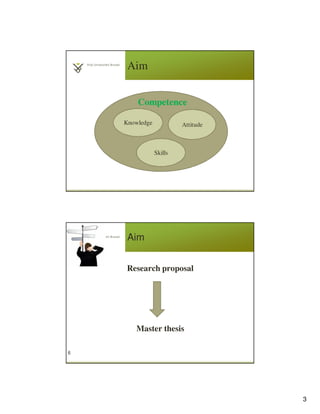
Planning
• Please see the document course schedule
3
Aim
• Competence to make scientific research
design in educational sciences
• Competence to conduct scientific
research in educational sciences
• Competence to critically analyze and
evaluate research reports
• Competence to develop a research
proposal
3
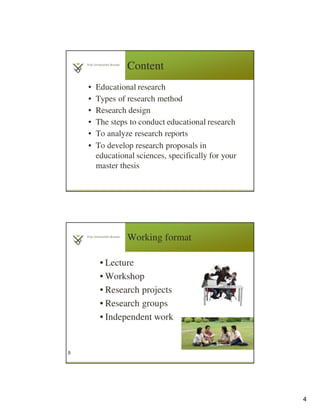
Aim
Competence
Knowledge
Skills
Attitude
Aim
Research proposal
Master thesis
6
4
Content
• Educational research
• Types of research method
• Research design
• The steps to conduct educational research
• To analyze research reports
• To develop research proposals in
educational sciences, specifically for your
master thesis
Working format
• Lecture
• Workshop
• Research projects
• Research groups
• Independent work
8
5
Introduction to educational
research
9
Why research?
Research
Search for knowledge
Where does your knowledge come from?
• teacher, parent, another person, an authority
• book
• existing theory
• your own experience
• inductive and deductive reasoning
• ……..
10
6
Why research?
However,
each of these approaches to understanding has
limitations when used in isolation.
Research and evidence is needed to deepen our
knowledge by using different approaches together
11
What is research?
Formal, systematic application of the scientific
method to the study of problems
Search for knowledge
Systematic investigation (process of collecting and
analyzing information) to increase our understanding
of the phenomenon under study.
Contribute to the (increased) understanding of the
phenomenon and communicate to others/public
12
7
What research can do?
description
explanation
prediction
improvement
Knowledge
theory
practices
Increased
knowledge
enhanced
theories
improved
practices
13
Educational Research
Formal, systematic application of the scientific
method to the study of educational problems.
Describe, explain, predict educational
phenomena…
14
8
Example
• The aim of this research is to investigate how a
university has responded to the widening
participation agenda by rethinking teaching
and learning through blended learning.
(Jones & Lau, 2010)
Describe Explain
Example
• There is a need for more in-depth research studies
investigating the complex issues of psychological
distance and its effects on student perceptions in
distance learning contexts. This study, therefore, has
the aim of examining how student perceptions of
collaborative learning, social presence, and overall
satisfaction are related, as well as identifying critical
factors affecting the different levels of students’
perceptions with those variables
(So & Brush, 2008)
Describe Explain
9
Examples
What salient characteristics of self-regulation in
learning can be distinguished in diverse disciplines?
This study also predicted that the contributions of
thinking styles to academic achievement would surpass
those of abilities, personality traits, and achievement
motivation (Zhang, 2000).
PredictExplain
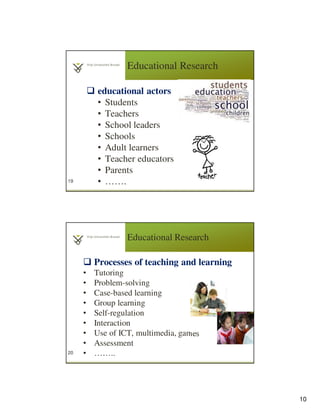
Educational Research
• Educational research can be conducted
involving actors & processes in teaching
and learning
18
10
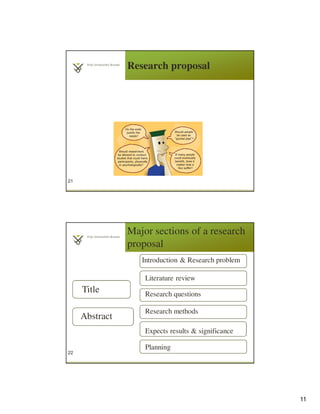
Educational Research
educational actors
• Students
• Teachers
• School leaders
• Schools
• Adult learners
• Teacher educators
• Parents
• …….19
Educational Research
Processes of teaching and learning
• Tutoring
• Problem-solving
• Case-based learning
• Group learning
• Self-regulation
• Interaction
• Use of ICT, multimedia, games
• Assessment
• ……..20
11
Research proposal
21
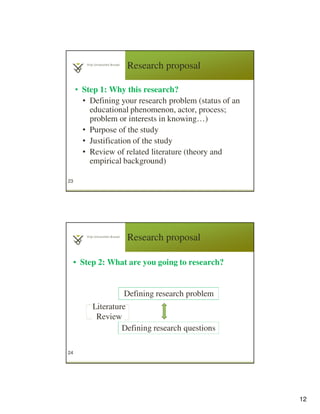
Major sections of a research
proposal
22
Title
Abstract
Introduction & Research problem
Literature review
Research questions
Research methods
Expects results & significance
Planning
12
Research proposal
• Step 1: Why this research?
• Defining your research problem (status of an
educational phenomenon, actor, process;
problem or interests in knowing…)
• Purpose of the study
• Justification of the study
• Review of related literature (theory and
empirical background)
23
Research proposal
• Step 2: What are you going to research?
24
Defining research problem
Defining research questions
Literature
Review
13
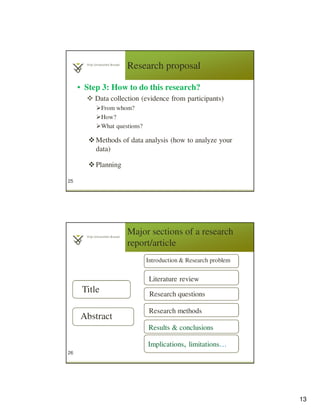
Research proposal
• Step 3: How to do this research?
Data collection (evidence from participants)
From whom?
How?
What questions?
Methods of data analysis (how to analyze your
data)
Planning
25
Major sections of a research
report/article
26
Title
Abstract
Introduction & Research problem
Literature review
Research questions
Research methods
Results & conclusions
Implications, limitations…
14
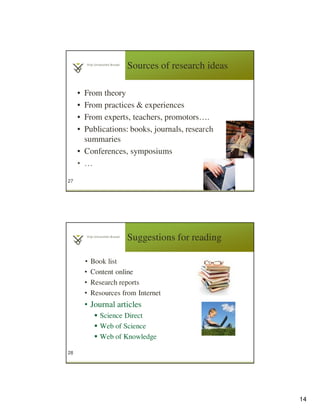
Sources of research ideas
• From theory
• From practices & experiences
• From experts, teachers, promotors….
• Publications: books, journals, research
summaries
• Conferences, symposiums
• …
27
Suggestions for reading
• Book list
• Content online
• Research reports
• Resources from Internet
• Journal articles
Science Direct
Web of Science
Web of Knowledge
28
15
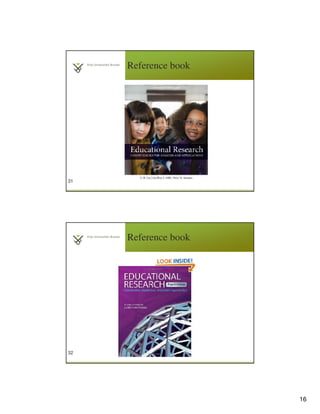
Reference book
29
Reference book
30
16
Reference book
31
Reference book
32
17
APA
Formatting and Writing Style
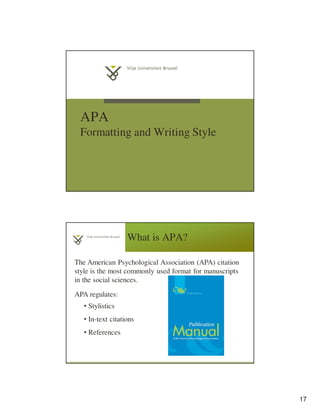
What is APA?
3
4
The American Psychological Association (APA) citation
style is the most commonly used format for manuscripts
in the social sciences.
APA regulates:
• Stylistics
• In-text citations
• References
18
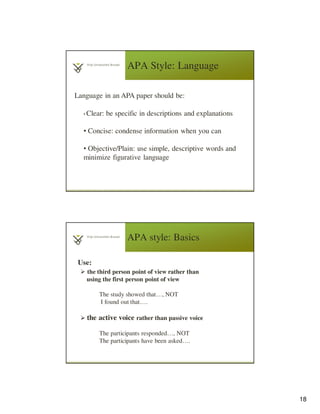
APA Style: Language
3
5
• Clear: be specific in descriptions and explanations
• Concise: condense information when you can
• Objective/Plain: use simple, descriptive words and
minimize figurative language
Language in an APA paper should be:
APA style: Basics
the third person point of view rather than
using the first person point of view
The study showed that…, NOT
I found out that….
the active voice rather than passive voice
The participants responded…, NOT
The participants have been asked….
Use:
19
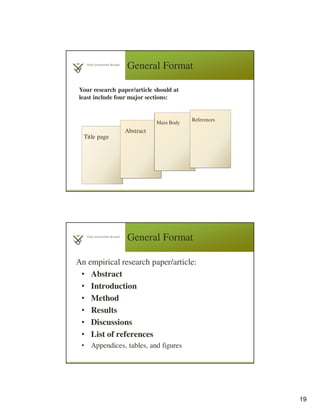
General Format
3
7
Title page
Your research paper/article should at
least include four major sections:
Abstract
Main Body
References
General Format
An empirical research paper/article:
• Abstract
• Introduction
• Method
• Results
• Discussions
• List of references
• Appendices, tables, and figures
3
8
20
3
9
4
0
21
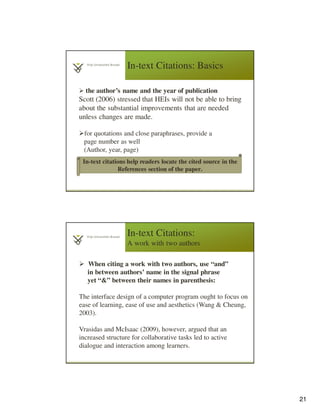
In-text Citations: Basics
the author’s name and the year of publication
Scott (2006) stressed that HEIs will not be able to bring
about the substantial improvements that are needed
unless changes are made.
for quotations and close paraphrases, provide a
page number as well
(Author, year, page)
In-text citations help readers locate the cited source in the
References section of the paper.
In-text Citations:
A work with two authors
When citing a work with two authors, use “and”
in between authors’ name in the signal phrase
yet “&” between their names in parenthesis:
The interface design of a computer program ought to focus on
ease of learning, ease of use and aesthetics (Wang & Cheung,
2003).
Vrasidas and McIsaac (2009), however, argued that an
increased structure for collaborative tasks led to active
dialogue and interaction among learners.
22
In-text Citations:
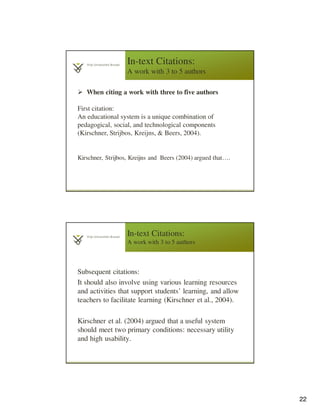
A work with 3 to 5 authors
When citing a work with three to five authors
First citation:
An educational system is a unique combination of
pedagogical, social, and technological components
(Kirschner, Strijbos, Kreijns, & Beers, 2004).
Kirschner, Strijbos, Kreijns and Beers (2004) argued that….
In-text Citations:
A work with 3 to 5 authors
Subsequent citations:
It should also involve using various learning resources
and activities that support students’ learning, and allow
teachers to facilitate learning (Kirschner et al., 2004).
Kirschner et al. (2004) argued that a useful system
should meet two primary conditions: necessary utility
and high usability.
23
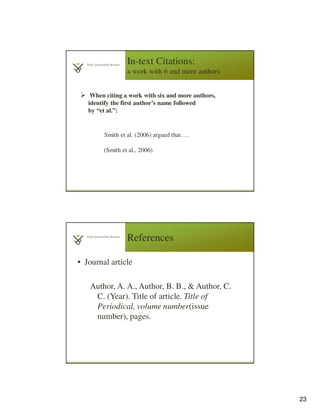
In-text Citations:
a work with 6 and more authors
When citing a work with six and more authors,
identify the first author’s name followed
by “et al.”:
Smith et al. (2006) argued that….
(Smith et al., 2006)
References
• Journal article
4
6
Author, A. A., Author, B. B., & Author, C.
C. (Year). Title of article. Title of
Periodical, volume number(issue
number), pages.
24
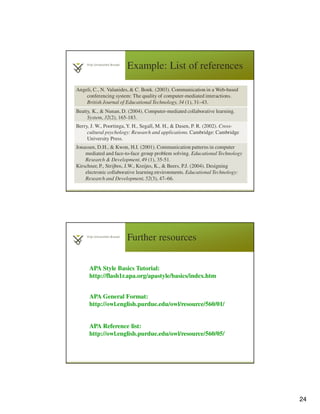
Example: List of references
4
7
Angeli, C., N. Valanides, & C. Bonk. (2003). Communication in a Web-based
conferencing system: The quality of computer-mediated interactions.
British Journal of Educational Technology, 34 (1), 31–43.
Beatty, K., & Nunan, D. (2004). Computer-mediated collaborative learning.
System, 32(2), 165-183.
Berry, J. W., Poortinga, Y. H., Segall, M. H., & Dasen, P. R. (2002). Cross-
cultural psychology: Research and applications. Cambridge: Cambridge
University Press.
Jonassen, D.H., & Kwon, H.I. (2001). Communication patterns in computer
mediated and face-to-face group problem solving. Educational Technology
Research & Development, 49 (1), 35-51.
Kirschner, P., Strijbos, J.W., Kreijns, K., & Beers, P.J. (2004). Designing
electronic collaborative learning environments. Educational Technology:
Research and Development, 52(3), 47–66.
Further resources
4
8
APA Style Basics Tutorial:
http://flash1r.apa.org/apastyle/basics/index.htm
APA Reference list:
http://owl.english.purdue.edu/owl/resource/560/05/
APA General Format:
http://owl.english.purdue.edu/owl/resource/560/01/
25
more online resources
Online video
http://www.apastyle.org/learn/tutorials/basi
cs-tutorial.aspx
4
9
more online resources
• http://www.easybib.com/
• http://research.easybib.com/
26
more online resources
5
1
APA Style Basics Tutorial:
http://flash1r.apa.org/apastyle/basics/index.htm
APA Reference list:
http://owl.english.purdue.edu/owl/resource/560/05/
APA General Format:
http://owl.english.purdue.edu/owl/resource/560/01/
more online resources
• http://content.easybib.com/citation-guides/apa-
format/
• APA Style guides for citations.
• Links to the most popular and helpful guides
so that you can get started on citing your
research
27
Reading
Read course material “Theme 1”
Read APA Academic Writing Style
document
Self-test of Theme 1
53
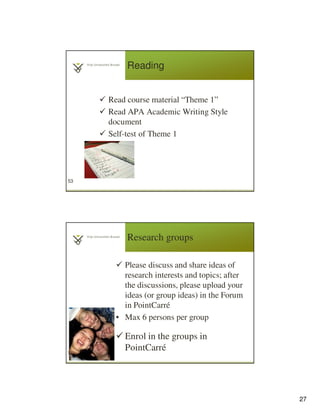
Research groups
Please discuss and share ideas of
research interests and topics; after
the discussions, please upload your
ideas (or group ideas) in the Forum
in PointCarré
• Max 6 persons per group
Enrol in the groups in
PointCarré54
28
Questions?
55

Research seminar lecture_1_educational_research_proposal_&_apa

  • 1.
    1 Research Seminar for EducationalSciences Prof. Dr. Chang Zhu Department of Educational Sciences Getting to know each other
  • 2.
    2 Planning • Please seethe document course schedule 3 Aim • Competence to make scientific research design in educational sciences • Competence to conduct scientific research in educational sciences • Competence to critically analyze and evaluate research reports • Competence to develop a research proposal
  • 3.
  • 4.
    4 Content • Educational research •Types of research method • Research design • The steps to conduct educational research • To analyze research reports • To develop research proposals in educational sciences, specifically for your master thesis Working format • Lecture • Workshop • Research projects • Research groups • Independent work 8
  • 5.
    5 Introduction to educational research 9 Whyresearch? Research Search for knowledge Where does your knowledge come from? • teacher, parent, another person, an authority • book • existing theory • your own experience • inductive and deductive reasoning • …….. 10
  • 6.
    6 Why research? However, each ofthese approaches to understanding has limitations when used in isolation. Research and evidence is needed to deepen our knowledge by using different approaches together 11 What is research? Formal, systematic application of the scientific method to the study of problems Search for knowledge Systematic investigation (process of collecting and analyzing information) to increase our understanding of the phenomenon under study. Contribute to the (increased) understanding of the phenomenon and communicate to others/public 12
  • 7.
    7 What research cando? description explanation prediction improvement Knowledge theory practices Increased knowledge enhanced theories improved practices 13 Educational Research Formal, systematic application of the scientific method to the study of educational problems. Describe, explain, predict educational phenomena… 14
  • 8.
    8 Example • The aimof this research is to investigate how a university has responded to the widening participation agenda by rethinking teaching and learning through blended learning. (Jones & Lau, 2010) Describe Explain Example • There is a need for more in-depth research studies investigating the complex issues of psychological distance and its effects on student perceptions in distance learning contexts. This study, therefore, has the aim of examining how student perceptions of collaborative learning, social presence, and overall satisfaction are related, as well as identifying critical factors affecting the different levels of students’ perceptions with those variables (So & Brush, 2008) Describe Explain
  • 9.
    9 Examples What salient characteristicsof self-regulation in learning can be distinguished in diverse disciplines? This study also predicted that the contributions of thinking styles to academic achievement would surpass those of abilities, personality traits, and achievement motivation (Zhang, 2000). PredictExplain Educational Research • Educational research can be conducted involving actors & processes in teaching and learning 18
  • 10.
    10 Educational Research educational actors •Students • Teachers • School leaders • Schools • Adult learners • Teacher educators • Parents • …….19 Educational Research Processes of teaching and learning • Tutoring • Problem-solving • Case-based learning • Group learning • Self-regulation • Interaction • Use of ICT, multimedia, games • Assessment • ……..20
  • 11.
    11 Research proposal 21 Major sectionsof a research proposal 22 Title Abstract Introduction & Research problem Literature review Research questions Research methods Expects results & significance Planning
  • 12.
    12 Research proposal • Step1: Why this research? • Defining your research problem (status of an educational phenomenon, actor, process; problem or interests in knowing…) • Purpose of the study • Justification of the study • Review of related literature (theory and empirical background) 23 Research proposal • Step 2: What are you going to research? 24 Defining research problem Defining research questions Literature Review
  • 13.
    13 Research proposal • Step3: How to do this research? Data collection (evidence from participants) From whom? How? What questions? Methods of data analysis (how to analyze your data) Planning 25 Major sections of a research report/article 26 Title Abstract Introduction & Research problem Literature review Research questions Research methods Results & conclusions Implications, limitations…
  • 14.
    14 Sources of researchideas • From theory • From practices & experiences • From experts, teachers, promotors…. • Publications: books, journals, research summaries • Conferences, symposiums • … 27 Suggestions for reading • Book list • Content online • Research reports • Resources from Internet • Journal articles Science Direct Web of Science Web of Knowledge 28
  • 15.
  • 16.
  • 17.
    17 APA Formatting and WritingStyle What is APA? 3 4 The American Psychological Association (APA) citation style is the most commonly used format for manuscripts in the social sciences. APA regulates: • Stylistics • In-text citations • References
  • 18.
    18 APA Style: Language 3 5 •Clear: be specific in descriptions and explanations • Concise: condense information when you can • Objective/Plain: use simple, descriptive words and minimize figurative language Language in an APA paper should be: APA style: Basics the third person point of view rather than using the first person point of view The study showed that…, NOT I found out that…. the active voice rather than passive voice The participants responded…, NOT The participants have been asked…. Use:
  • 19.
    19 General Format 3 7 Title page Yourresearch paper/article should at least include four major sections: Abstract Main Body References General Format An empirical research paper/article: • Abstract • Introduction • Method • Results • Discussions • List of references • Appendices, tables, and figures 3 8
  • 20.
  • 21.
    21 In-text Citations: Basics theauthor’s name and the year of publication Scott (2006) stressed that HEIs will not be able to bring about the substantial improvements that are needed unless changes are made. for quotations and close paraphrases, provide a page number as well (Author, year, page) In-text citations help readers locate the cited source in the References section of the paper. In-text Citations: A work with two authors When citing a work with two authors, use “and” in between authors’ name in the signal phrase yet “&” between their names in parenthesis: The interface design of a computer program ought to focus on ease of learning, ease of use and aesthetics (Wang & Cheung, 2003). Vrasidas and McIsaac (2009), however, argued that an increased structure for collaborative tasks led to active dialogue and interaction among learners.
  • 22.
    22 In-text Citations: A workwith 3 to 5 authors When citing a work with three to five authors First citation: An educational system is a unique combination of pedagogical, social, and technological components (Kirschner, Strijbos, Kreijns, & Beers, 2004). Kirschner, Strijbos, Kreijns and Beers (2004) argued that…. In-text Citations: A work with 3 to 5 authors Subsequent citations: It should also involve using various learning resources and activities that support students’ learning, and allow teachers to facilitate learning (Kirschner et al., 2004). Kirschner et al. (2004) argued that a useful system should meet two primary conditions: necessary utility and high usability.
  • 23.
    23 In-text Citations: a workwith 6 and more authors When citing a work with six and more authors, identify the first author’s name followed by “et al.”: Smith et al. (2006) argued that…. (Smith et al., 2006) References • Journal article 4 6 Author, A. A., Author, B. B., & Author, C. C. (Year). Title of article. Title of Periodical, volume number(issue number), pages.
  • 24.
    24 Example: List ofreferences 4 7 Angeli, C., N. Valanides, & C. Bonk. (2003). Communication in a Web-based conferencing system: The quality of computer-mediated interactions. British Journal of Educational Technology, 34 (1), 31–43. Beatty, K., & Nunan, D. (2004). Computer-mediated collaborative learning. System, 32(2), 165-183. Berry, J. W., Poortinga, Y. H., Segall, M. H., & Dasen, P. R. (2002). Cross- cultural psychology: Research and applications. Cambridge: Cambridge University Press. Jonassen, D.H., & Kwon, H.I. (2001). Communication patterns in computer mediated and face-to-face group problem solving. Educational Technology Research & Development, 49 (1), 35-51. Kirschner, P., Strijbos, J.W., Kreijns, K., & Beers, P.J. (2004). Designing electronic collaborative learning environments. Educational Technology: Research and Development, 52(3), 47–66. Further resources 4 8 APA Style Basics Tutorial: http://flash1r.apa.org/apastyle/basics/index.htm APA Reference list: http://owl.english.purdue.edu/owl/resource/560/05/ APA General Format: http://owl.english.purdue.edu/owl/resource/560/01/
  • 25.
    25 more online resources Onlinevideo http://www.apastyle.org/learn/tutorials/basi cs-tutorial.aspx 4 9 more online resources • http://www.easybib.com/ • http://research.easybib.com/
  • 26.
    26 more online resources 5 1 APAStyle Basics Tutorial: http://flash1r.apa.org/apastyle/basics/index.htm APA Reference list: http://owl.english.purdue.edu/owl/resource/560/05/ APA General Format: http://owl.english.purdue.edu/owl/resource/560/01/ more online resources • http://content.easybib.com/citation-guides/apa- format/ • APA Style guides for citations. • Links to the most popular and helpful guides so that you can get started on citing your research
  • 27.
    27 Reading Read course material“Theme 1” Read APA Academic Writing Style document Self-test of Theme 1 53 Research groups Please discuss and share ideas of research interests and topics; after the discussions, please upload your ideas (or group ideas) in the Forum in PointCarré • Max 6 persons per group Enrol in the groups in PointCarré54
  • 28.