Research Seminar for
Educational Sciences
Prof. Dr. Chang Zhu
Department of Educational Sciences
Review
A short review
What we’ve learned in the 1st
semester
2
Review
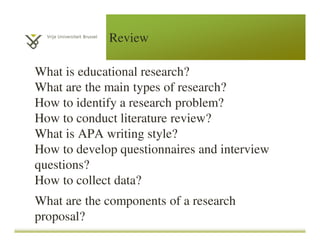
What is educational research?
What are the main types of research?
How to identify a research problem?
How to conduct literature review?
What is APA writing style?
How to develop questionnaires and interview
questions?
How to collect data?
What are the components of a research
proposal?
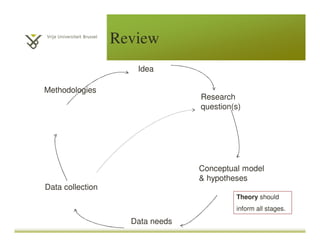
Idea
Research
question(s)
Conceptual model
& hypotheses
Data needs
Data collection
Methodologies
Theory should
inform all stages.
Review
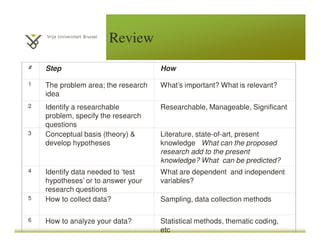
# Step How
1 The problem area; the research
idea
What’s important? What is relevant?
2 Identify a researchable
problem, specify the research
questions
Researchable, Manageable, Significant
3 Conceptual basis (theory) &
develop hypotheses
Literature, state-of-art, present
knowledge What can the proposed
research add to the present
knowledge? What can be predicted?
4 Identify data needed to ‘test
hypotheses’ or to answer your
research questions
What are dependent and independent
variables?
5 How to collect data? Sampling, data collection methods
6 How to analyze your data? Statistical methods, thematic coding,
etc
Review
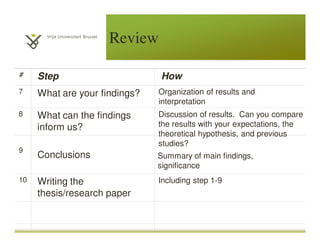
# Step How
7 What are your findings? Organization of results and
interpretation
8 What can the findings
inform us?
Discussion of results. Can you compare
the results with your expectations, the
theoretical hypothesis, and previous
studies?
9
Conclusions Summary of main findings,
significance
10 Writing the
thesis/research paper
Including step 1-9
Review
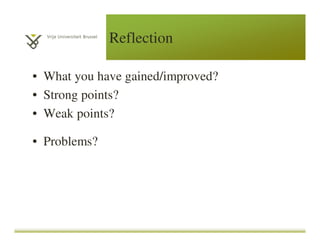
Reflection
• What you have gained/improved?
• Strong points?
• Weak points?
• Problems?
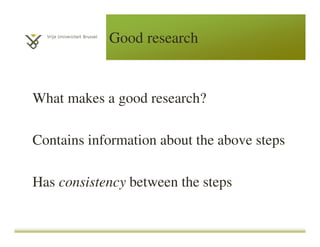
Good research
What makes a good research?
Contains information about the above steps
Has consistency between the steps
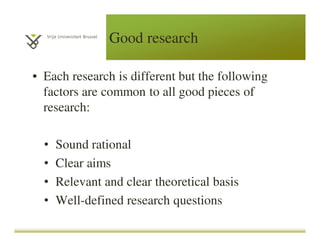
Good research
• Each research is different but the following
factors are common to all good pieces of
research:
• Sound rational
• Clear aims
• Relevant and clear theoretical basis
• Well-defined research questions
A good research idea
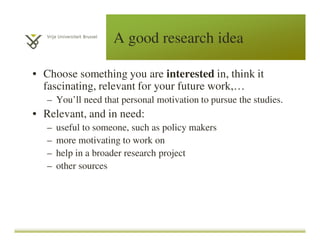
• Choose something you are interested in, think it
fascinating, relevant for your future work,…
– You’ll need that personal motivation to pursue the studies.
• Relevant, and in need:
– useful to someone, such as policy makers
– more motivating to work on
– help in a broader research project
– other sources
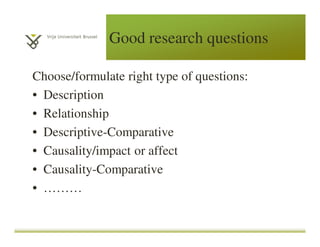
Good research questions
Choose/formulate right type of questions:
• Description
• Relationship
• Descriptive-Comparative
• Causality/impact or affect
• Causality-Comparative
• ………
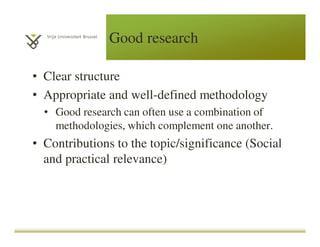
Good research
• Clear structure
• Appropriate and well-defined methodology
• Good research can often use a combination of
methodologies, which complement one another.
• Contributions to the topic/significance (Social
and practical relevance)
Good research
• Good education research is a matter not only of sound
procedures but also of beneficial aims and results;
our ultimate aim as researchers and educators is to
serve people’s well-being.
• For their research to be deemed good in a strong
sense, education researchers must be able to articulate
some sound connection between their work and a
robust and justifiable conception of human well-being
(Hostetler, 2005)
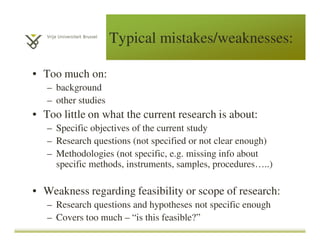
Typical mistakes/weaknesses:
• Too much on:
– background
– other studies
• Too little on what the current research is about:
– Specific objectives of the current study
– Research questions (not specified or not clear enough)
– Methodologies (not specific, e.g. missing info about
specific methods, instruments, samples, procedures…..)
• Weakness regarding feasibility or scope of research:
– Research questions and hypotheses not specific enough
– Covers too much – “is this feasible?”
• Quantitative vs. qualitative research
http://www.youtube.com/watch?v=ddx9PshVWXI
Examples
• Examples quantitative research articles
• Examples qualitative research articles
Group discussions
Work with example research articles:
Which research methodologies are used?
How the research questions are formulated?
…..
Questions
• Questions about your assignment of 1st
semester?

Research seminar lecture_7_criteria_good_research

  • 1.
    Research Seminar for EducationalSciences Prof. Dr. Chang Zhu Department of Educational Sciences
  • 2.
    Review A short review Whatwe’ve learned in the 1st semester 2
  • 3.
    Review What is educationalresearch? What are the main types of research? How to identify a research problem? How to conduct literature review? What is APA writing style? How to develop questionnaires and interview questions? How to collect data? What are the components of a research proposal?
  • 4.
    Idea Research question(s) Conceptual model & hypotheses Dataneeds Data collection Methodologies Theory should inform all stages. Review
  • 5.
    # Step How 1The problem area; the research idea What’s important? What is relevant? 2 Identify a researchable problem, specify the research questions Researchable, Manageable, Significant 3 Conceptual basis (theory) & develop hypotheses Literature, state-of-art, present knowledge What can the proposed research add to the present knowledge? What can be predicted? 4 Identify data needed to ‘test hypotheses’ or to answer your research questions What are dependent and independent variables? 5 How to collect data? Sampling, data collection methods 6 How to analyze your data? Statistical methods, thematic coding, etc Review
  • 6.
    # Step How 7What are your findings? Organization of results and interpretation 8 What can the findings inform us? Discussion of results. Can you compare the results with your expectations, the theoretical hypothesis, and previous studies? 9 Conclusions Summary of main findings, significance 10 Writing the thesis/research paper Including step 1-9 Review
  • 7.
    Reflection • What youhave gained/improved? • Strong points? • Weak points? • Problems?
  • 8.
    Good research What makesa good research? Contains information about the above steps Has consistency between the steps
  • 9.
    Good research • Eachresearch is different but the following factors are common to all good pieces of research: • Sound rational • Clear aims • Relevant and clear theoretical basis • Well-defined research questions
  • 10.
    A good researchidea • Choose something you are interested in, think it fascinating, relevant for your future work,… – You’ll need that personal motivation to pursue the studies. • Relevant, and in need: – useful to someone, such as policy makers – more motivating to work on – help in a broader research project – other sources
  • 11.
    Good research questions Choose/formulateright type of questions: • Description • Relationship • Descriptive-Comparative • Causality/impact or affect • Causality-Comparative • ………
  • 12.
    Good research • Clearstructure • Appropriate and well-defined methodology • Good research can often use a combination of methodologies, which complement one another. • Contributions to the topic/significance (Social and practical relevance)
  • 13.
    Good research • Goodeducation research is a matter not only of sound procedures but also of beneficial aims and results; our ultimate aim as researchers and educators is to serve people’s well-being. • For their research to be deemed good in a strong sense, education researchers must be able to articulate some sound connection between their work and a robust and justifiable conception of human well-being (Hostetler, 2005)
  • 14.
    Typical mistakes/weaknesses: • Toomuch on: – background – other studies • Too little on what the current research is about: – Specific objectives of the current study – Research questions (not specified or not clear enough) – Methodologies (not specific, e.g. missing info about specific methods, instruments, samples, procedures…..) • Weakness regarding feasibility or scope of research: – Research questions and hypotheses not specific enough – Covers too much – “is this feasible?”
  • 15.
    • Quantitative vs.qualitative research http://www.youtube.com/watch?v=ddx9PshVWXI
  • 16.
    Examples • Examples quantitativeresearch articles • Examples qualitative research articles
  • 17.
    Group discussions Work withexample research articles: Which research methodologies are used? How the research questions are formulated? …..
  • 18.
    Questions • Questions aboutyour assignment of 1st semester?