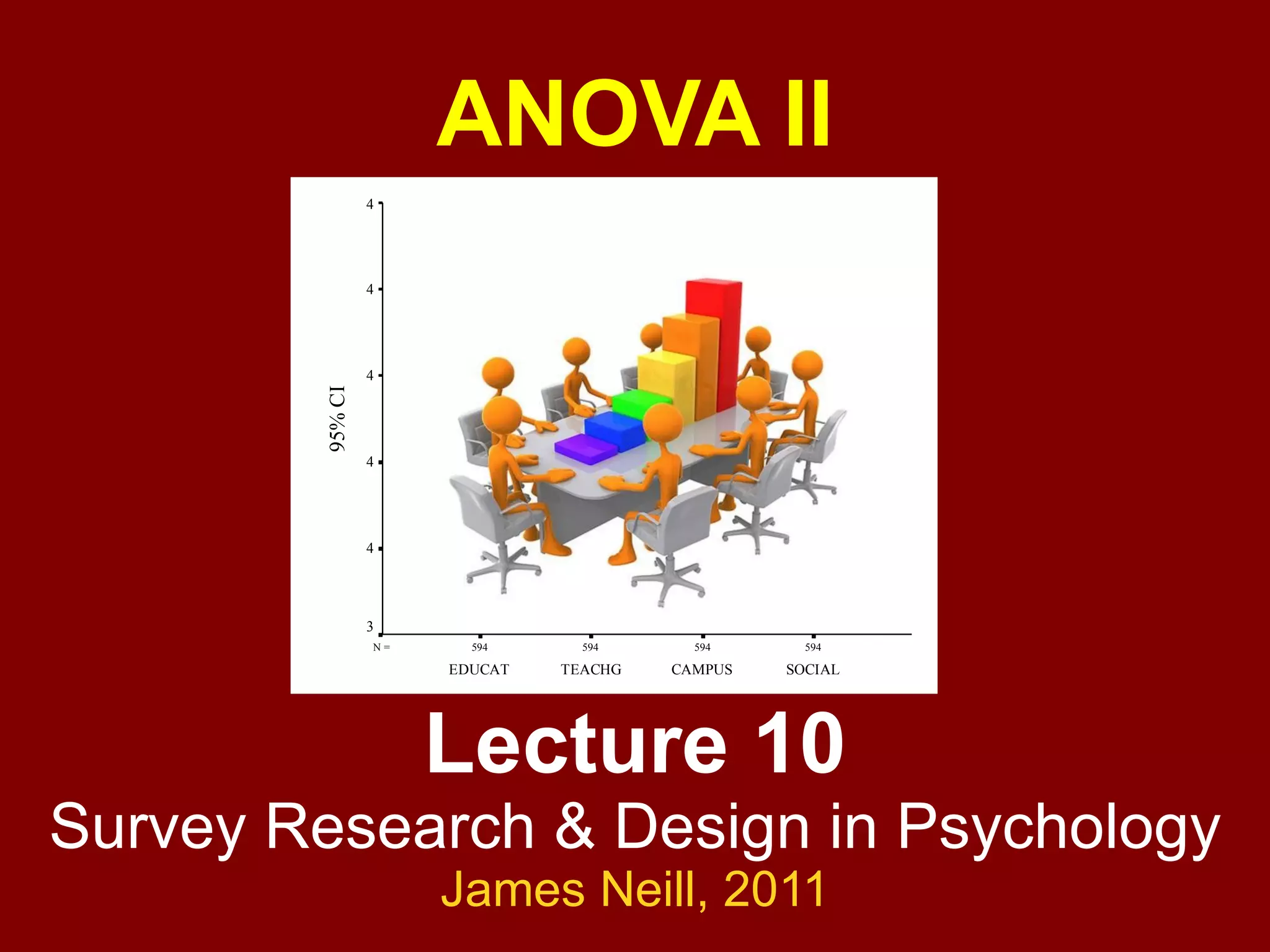
Lecture 10 Survey Research & Design in Psychology James Neill,  2011 ANOVA II
Overview One-sample  t -test
Independent samples  t -test
Paired samples  t -test
One-way ANOVA
One-way repeated measures ANOVA
Factorial ANOVA
Mixed design ANOVA
ANCOVA
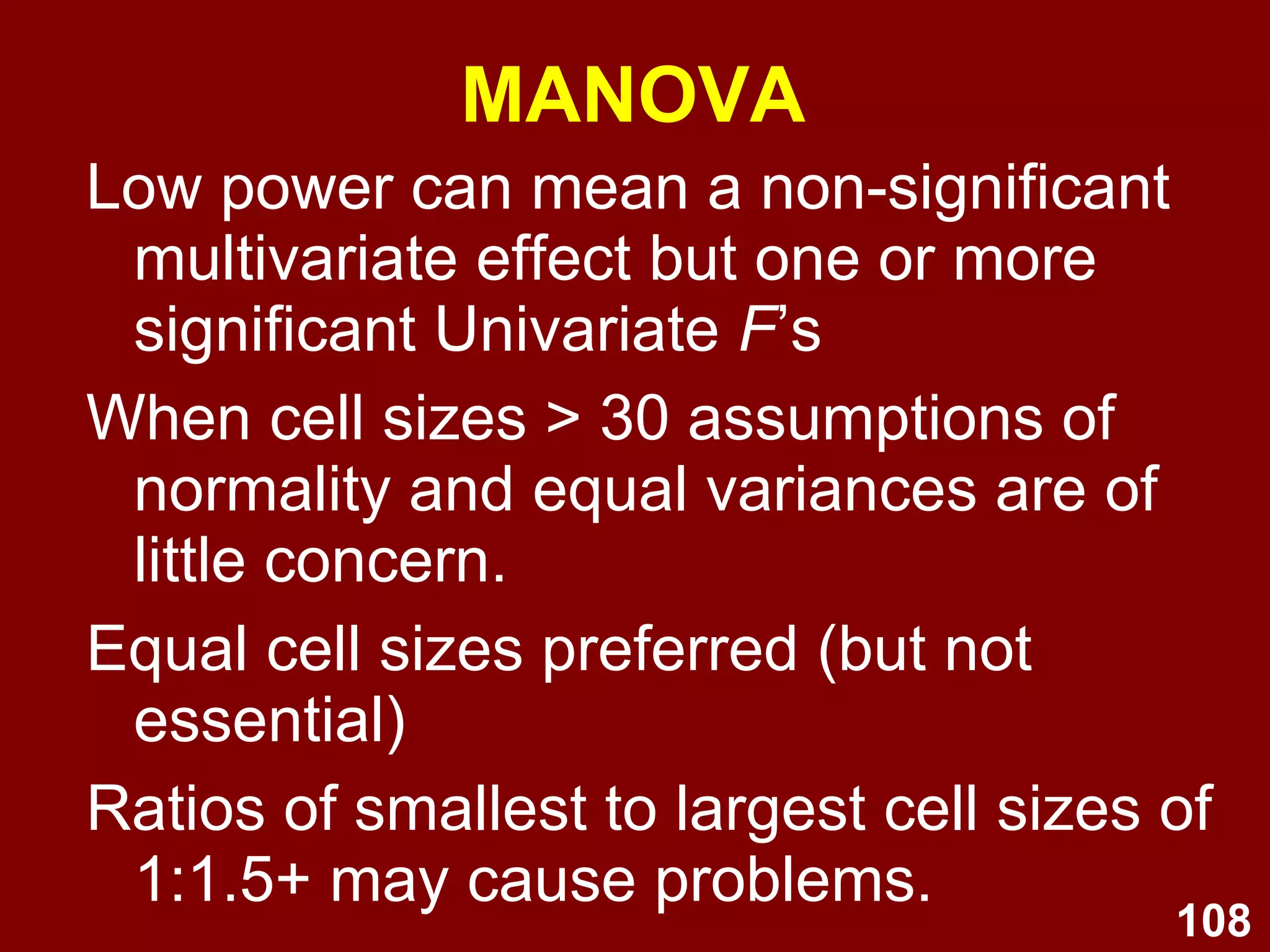
MANOVA
Howell (2010): Ch11 Simple Analysis of Variance
Ch12 Multiple Comparisons Among Treatment Means
Ch13 Factorial Analysis of Variance
Ch14 Repeated-Measures Designs
Ch16 Analyses of Variance and Covariance as General Linear Models Readings See also:  Inferential statistics decision-making tree
Difference between a set value and a variable ->  one-sample  t -test
Difference between two independent groups ->  independent samples  t -test   = BETWEEN-SUBJECTS
Difference between two related measures (e.g., repeated over time or two related measures at one time) ->  paired samples  t -test   = WITHIN-SUBJECTS Previous lecture
Are the differences in a sample  generalisable  to a population?
Introduction to ANOVA (Analysis of Variance) Extension of a  t -test to assess differences in the central tendency ( M ) of several groups or variables.
Overall variance is partitioned into  between-group and within-group variance
Levels of measurement: Single DV: metric,
1 or more IVs: categorical
Example ANOVA research questions Are there differences in the degree of  religious commitment  between  countries  ( UK, USA, and Australia) ? 1-way ANOVA
1-way repeated measures ANOVA
Factorial ANOVA
Mixed ANOVA
ANCOVA
MANOVA
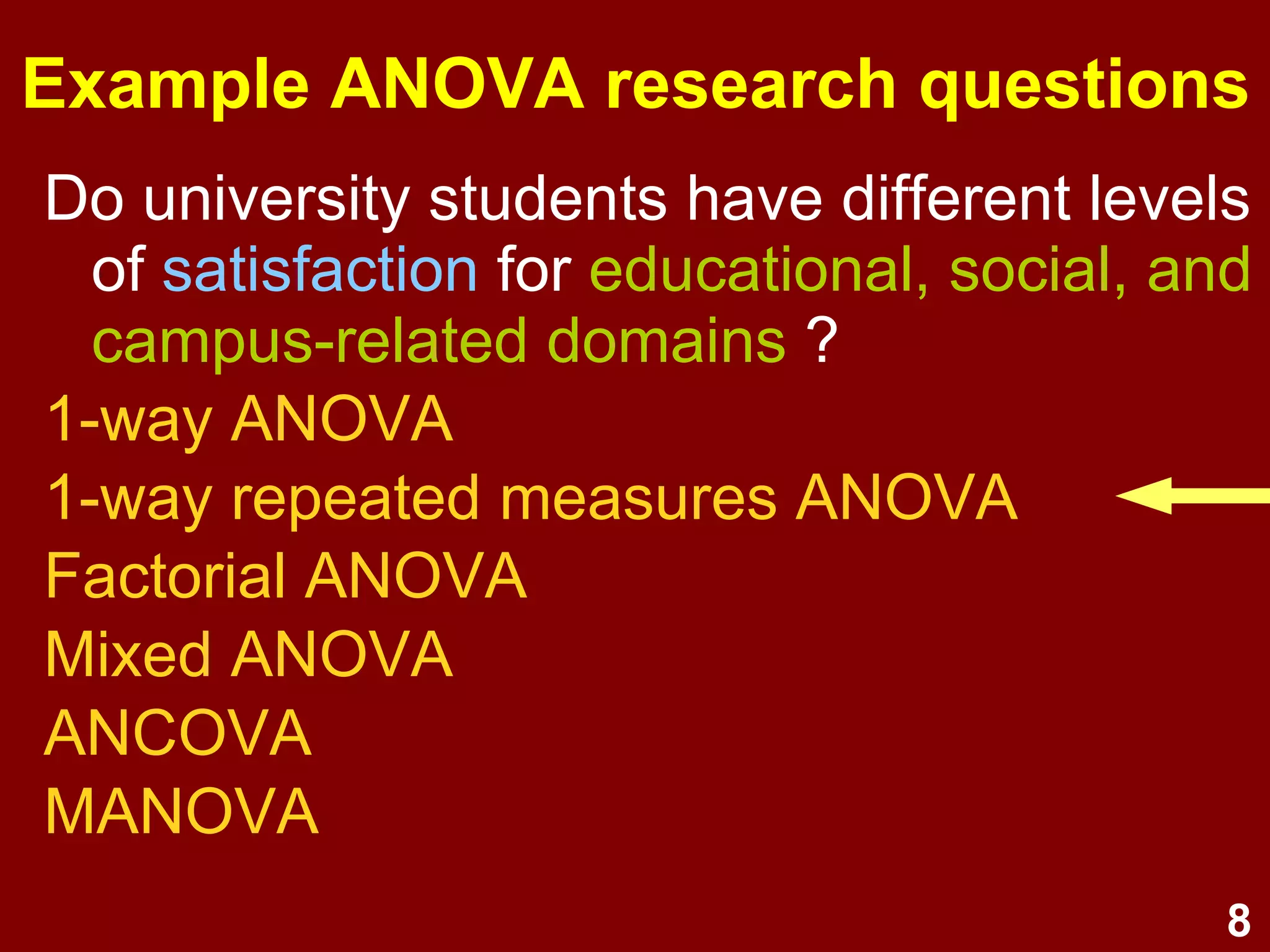
Example ANOVA research questions Do university students have different levels of  satisfaction  for  educational, social, and campus-related domains  ? 1-way ANOVA
1-way repeated measures ANOVA
Factorial ANOVA
Mixed ANOVA
ANCOVA
MANOVA
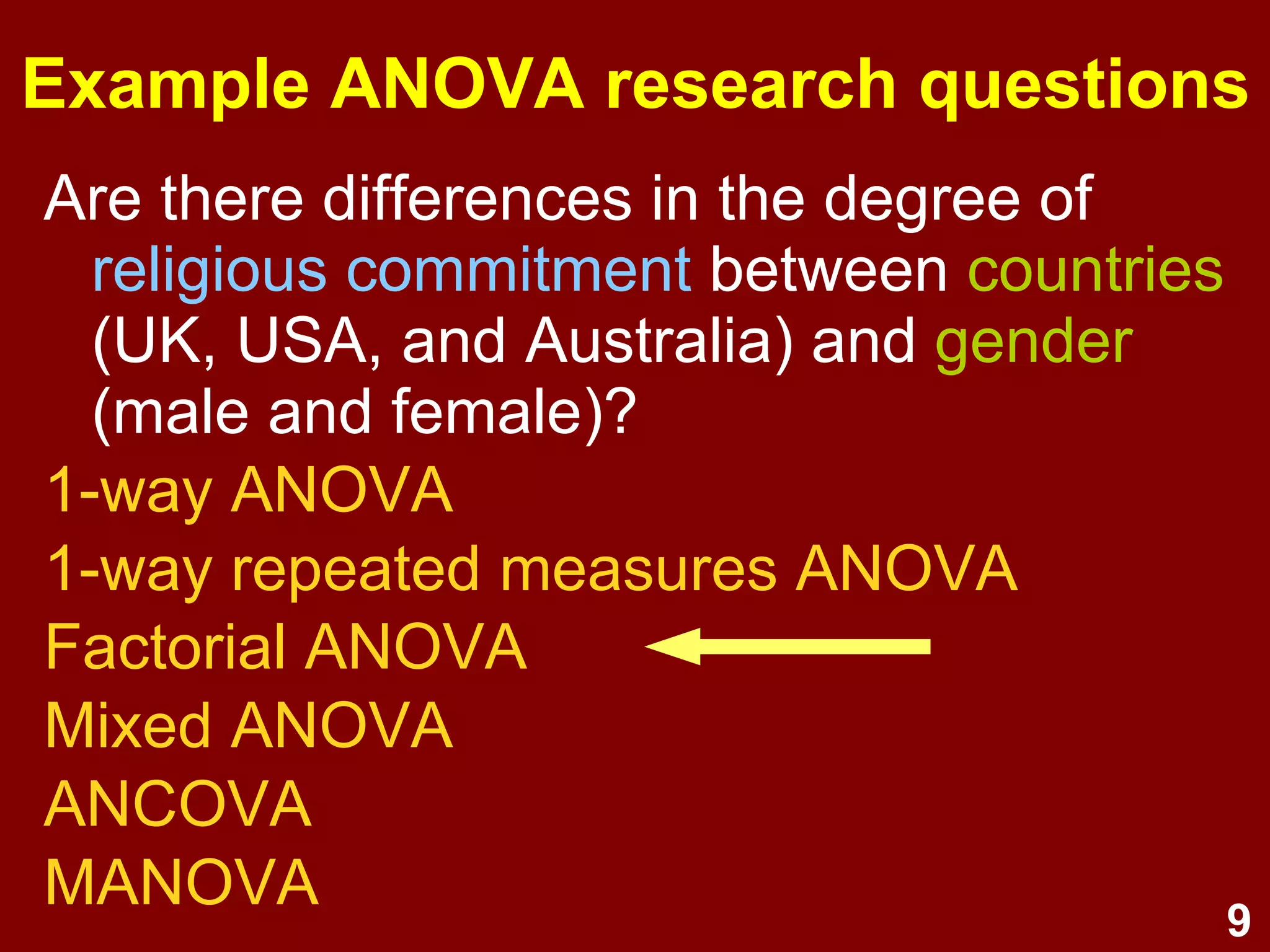
Example ANOVA research questions Are there differences in the degree of  religious commitment  between  countries  (UK, USA, and Australia) and  gender  (male and female)? 1-way ANOVA
1-way repeated measures ANOVA
Factorial ANOVA
Mixed ANOVA
ANCOVA
MANOVA
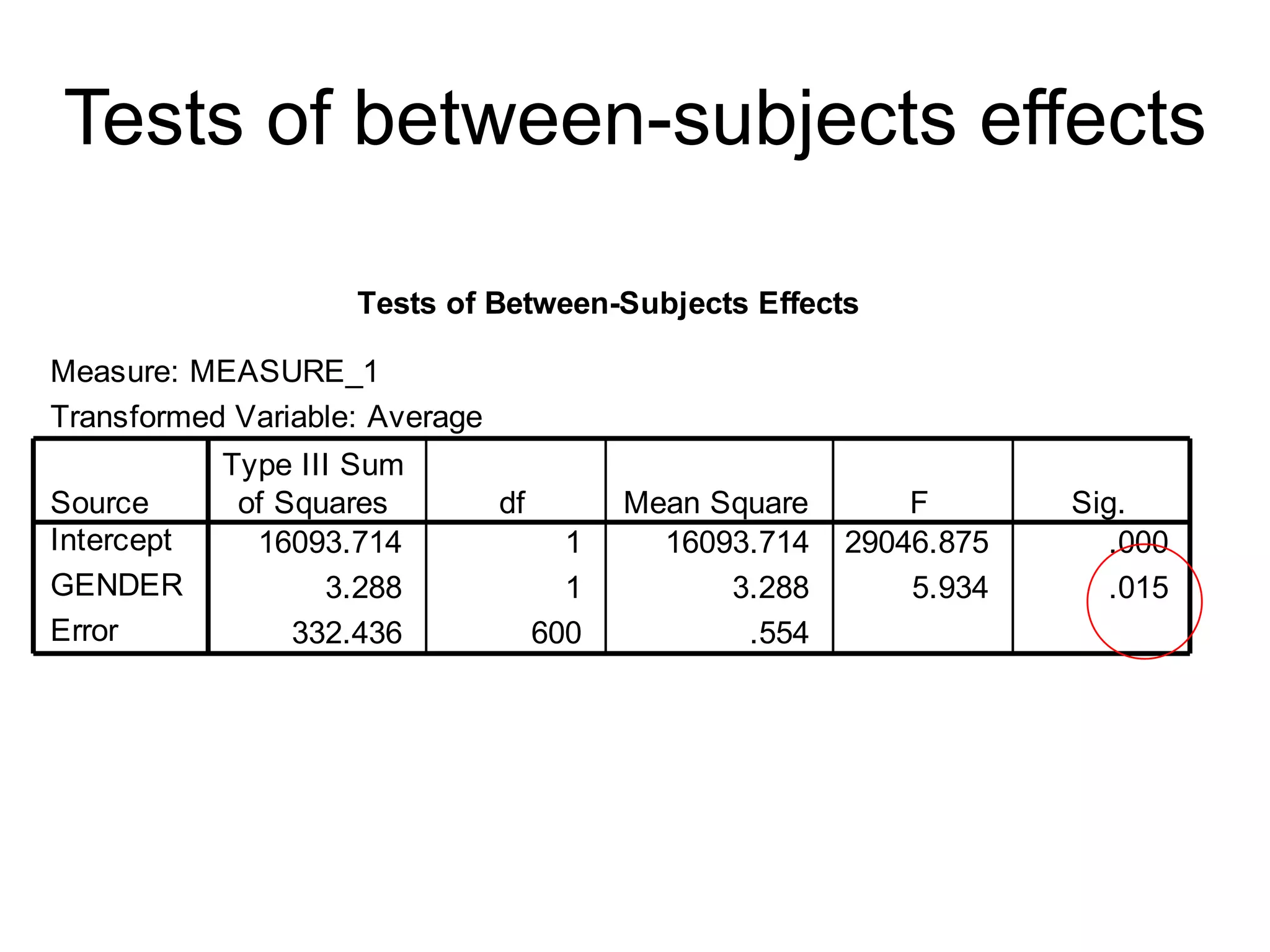
Example ANOVA research questions Does couples'  relationship satisfaction  differ between  males and females  and  before and after having children ? 1-way ANOVA
1-way repeated measures ANOVA
Factorial ANOVA
Mixed ANOVA
ANCOVA
MANOVA
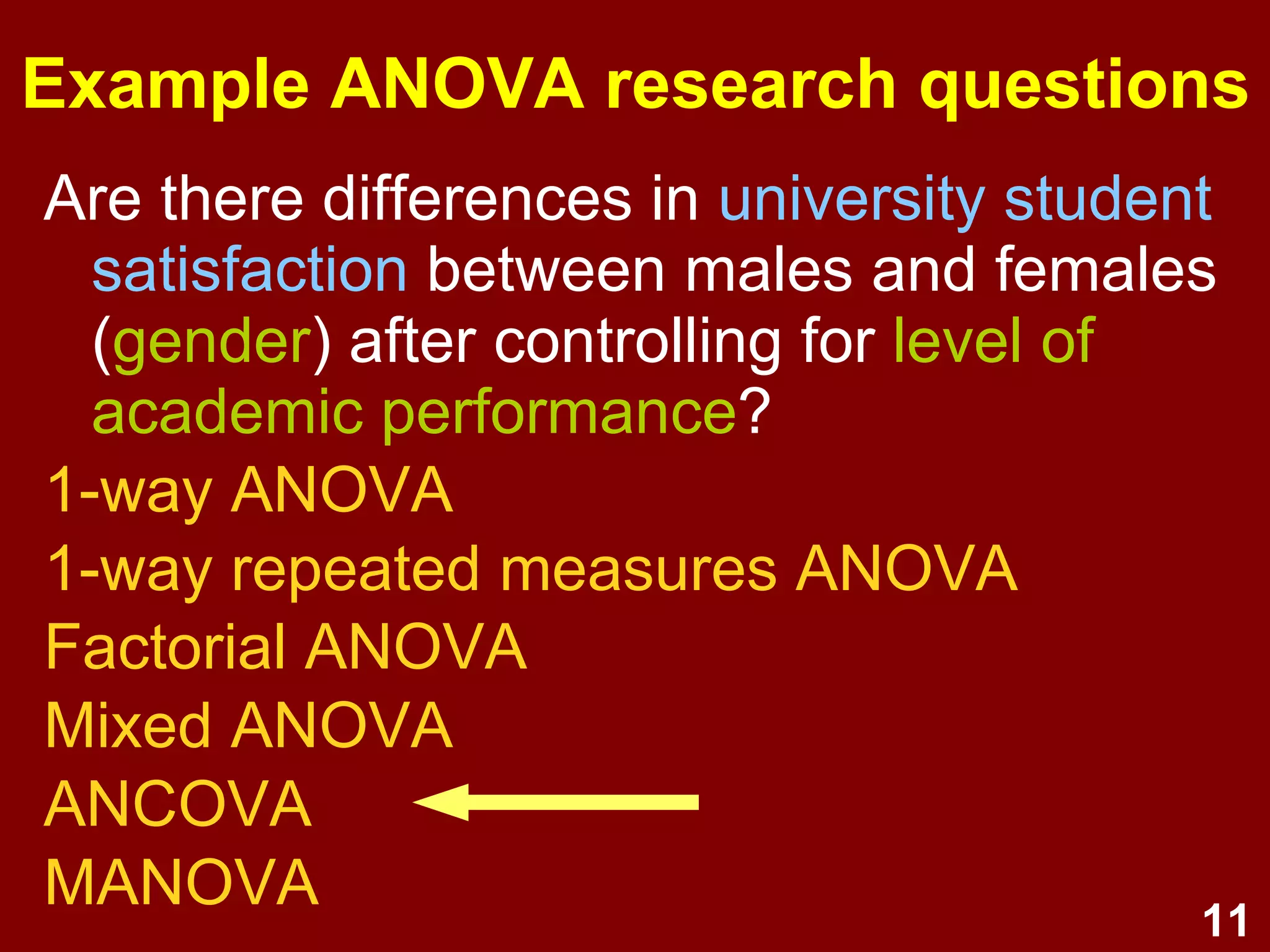
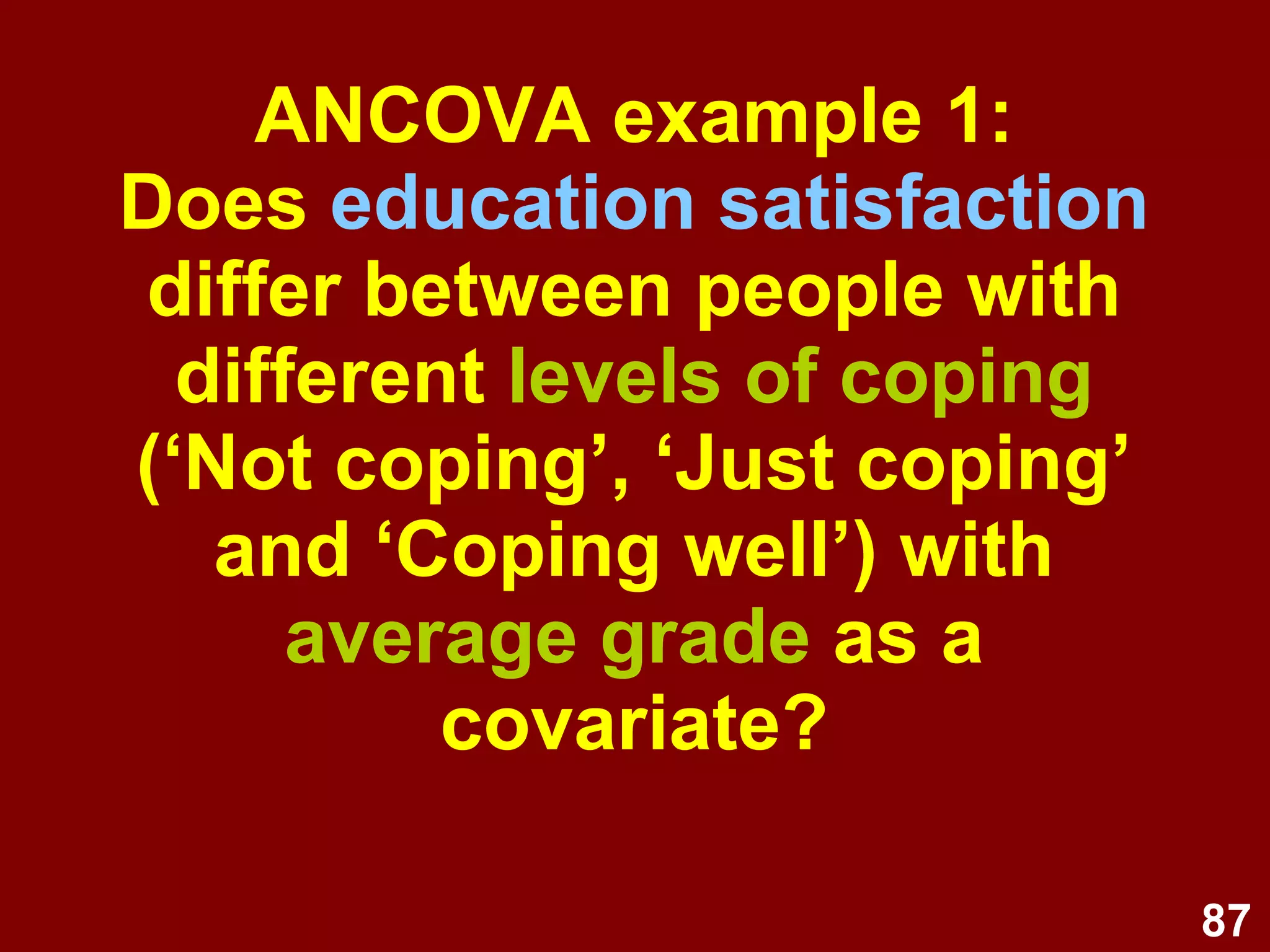
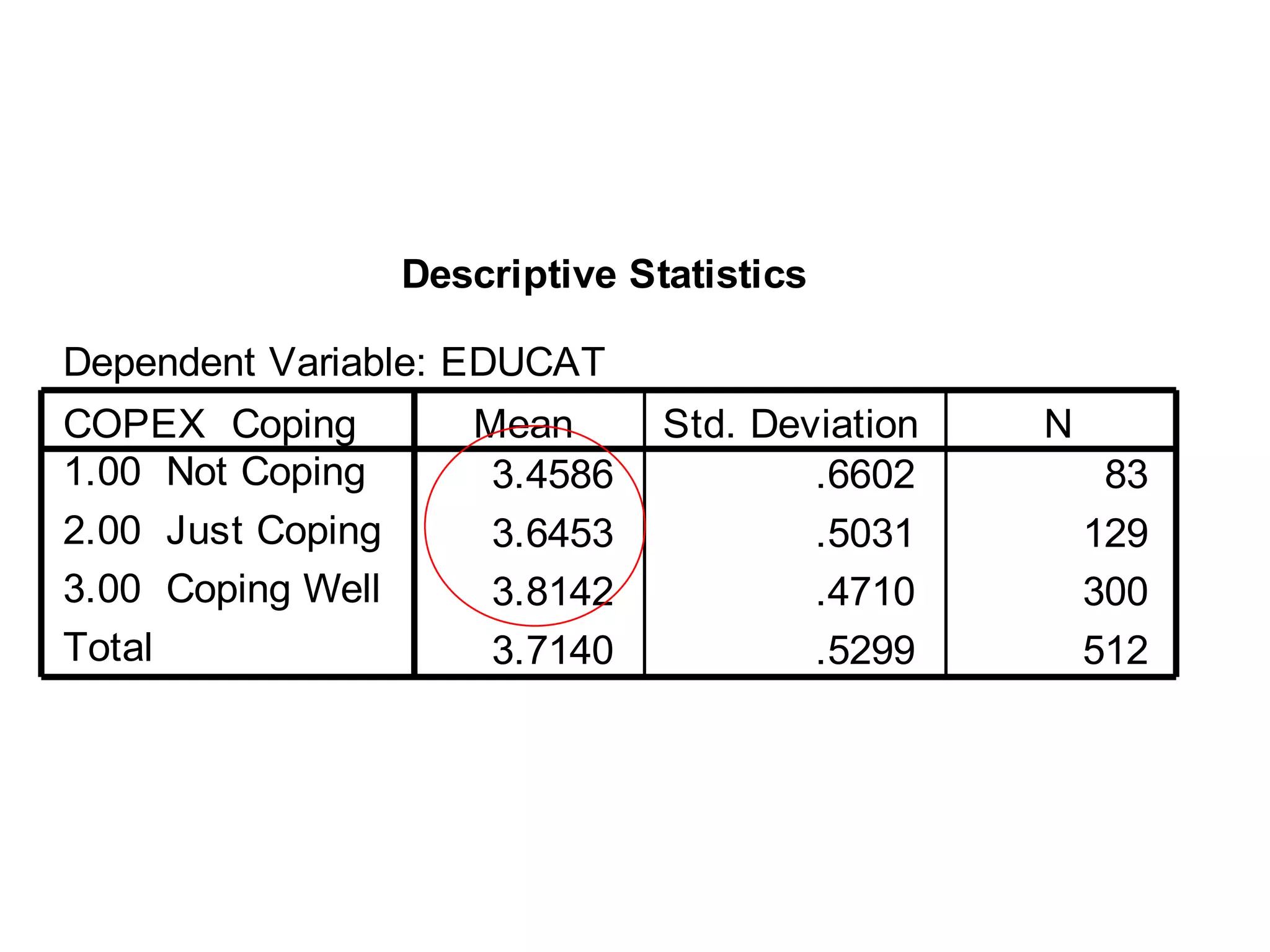
Example ANOVA research questions Are there differences in  university student satisfaction  between males and females ( gender ) after controlling for  level of academic performance ? 1-way ANOVA
1-way repeated measures ANOVA
Factorial ANOVA
Mixed ANOVA
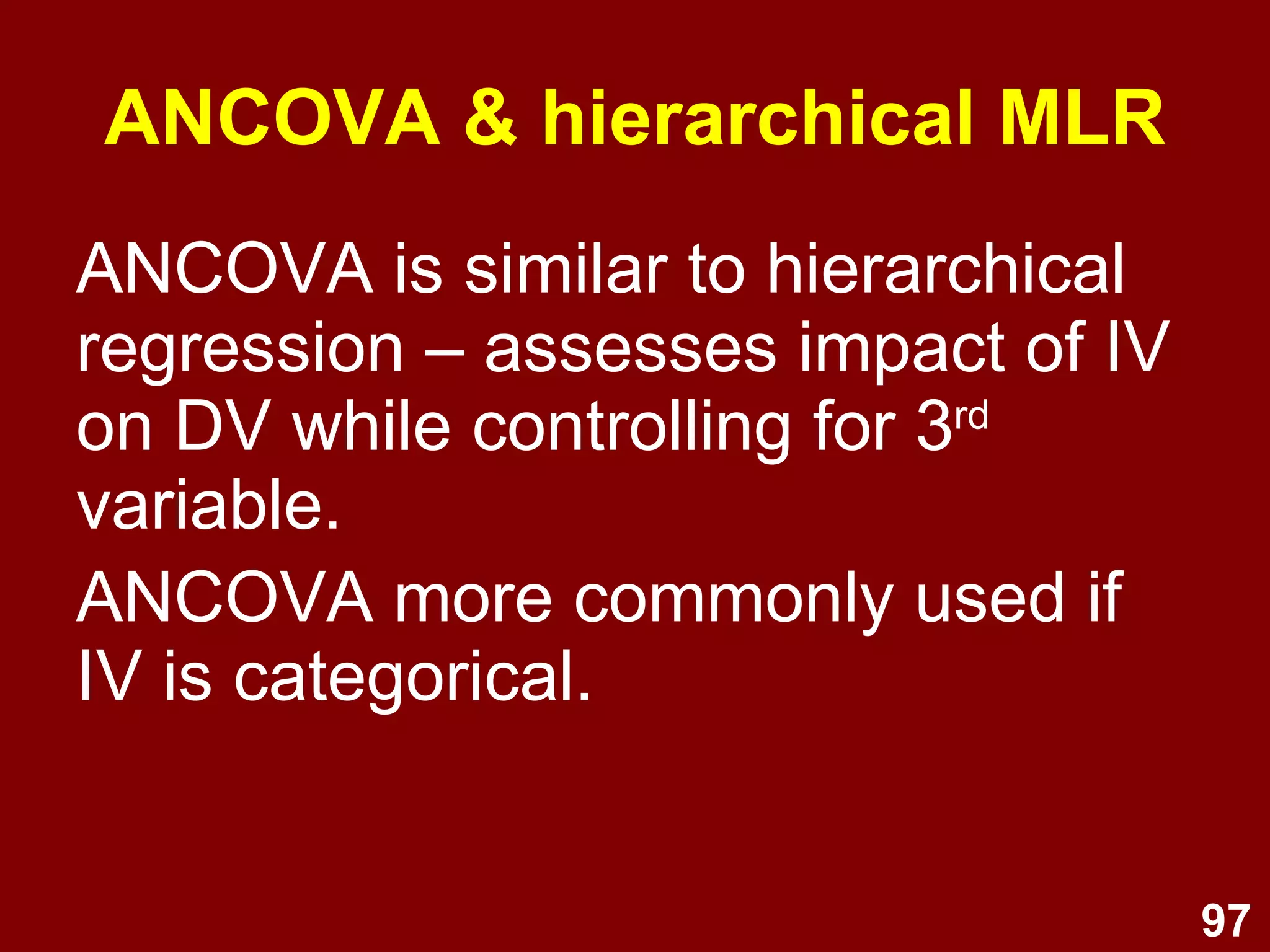
ANCOVA
MANOVA
Example ANOVA research questions Does  personality  (5 factors) change over  time  (10 years old, 20 years old, and 50 years old)? 1-way ANOVA
1-way repeated measures ANOVA
Factorial ANOVA
Mixed ANOVA
ANCOVA
MANOVA
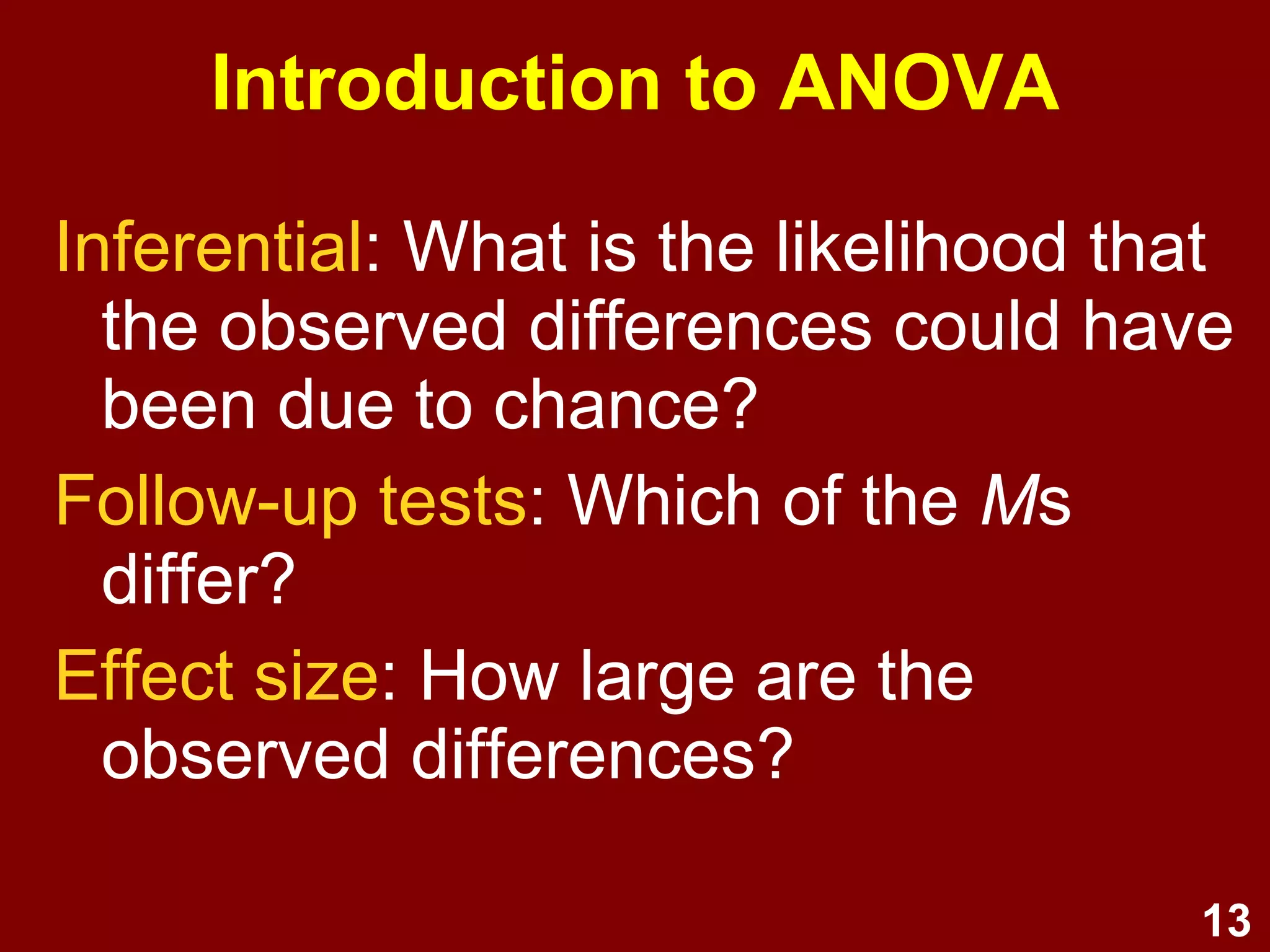
Introduction to ANOVA Inferential : What is the likelihood that the observed differences could have been due to chance?
Follow-up tests : Which of the  M s differ?
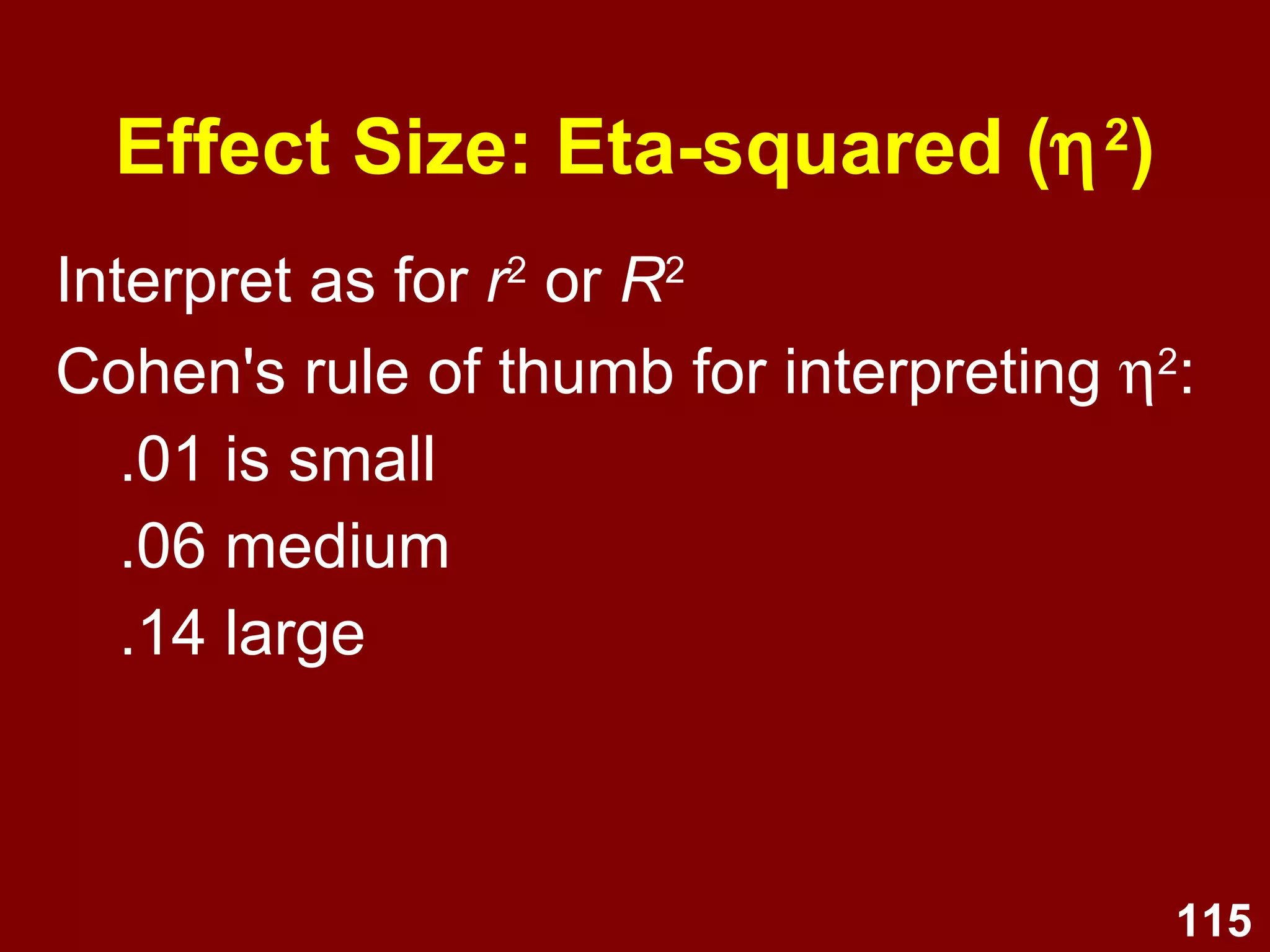
Effect size : How large are the observed differences?
F  test ANOVA partitions the  sums of squares  (variance from the mean) into: Explained variance  (between groups)
Unexplained variance  (within groups) – or error variance F   = ratio between explained & unexplained variance
p   = probability that the observed mean differences between groups could be attributable to chance
F  is the ratio of  between-group : within-group variance
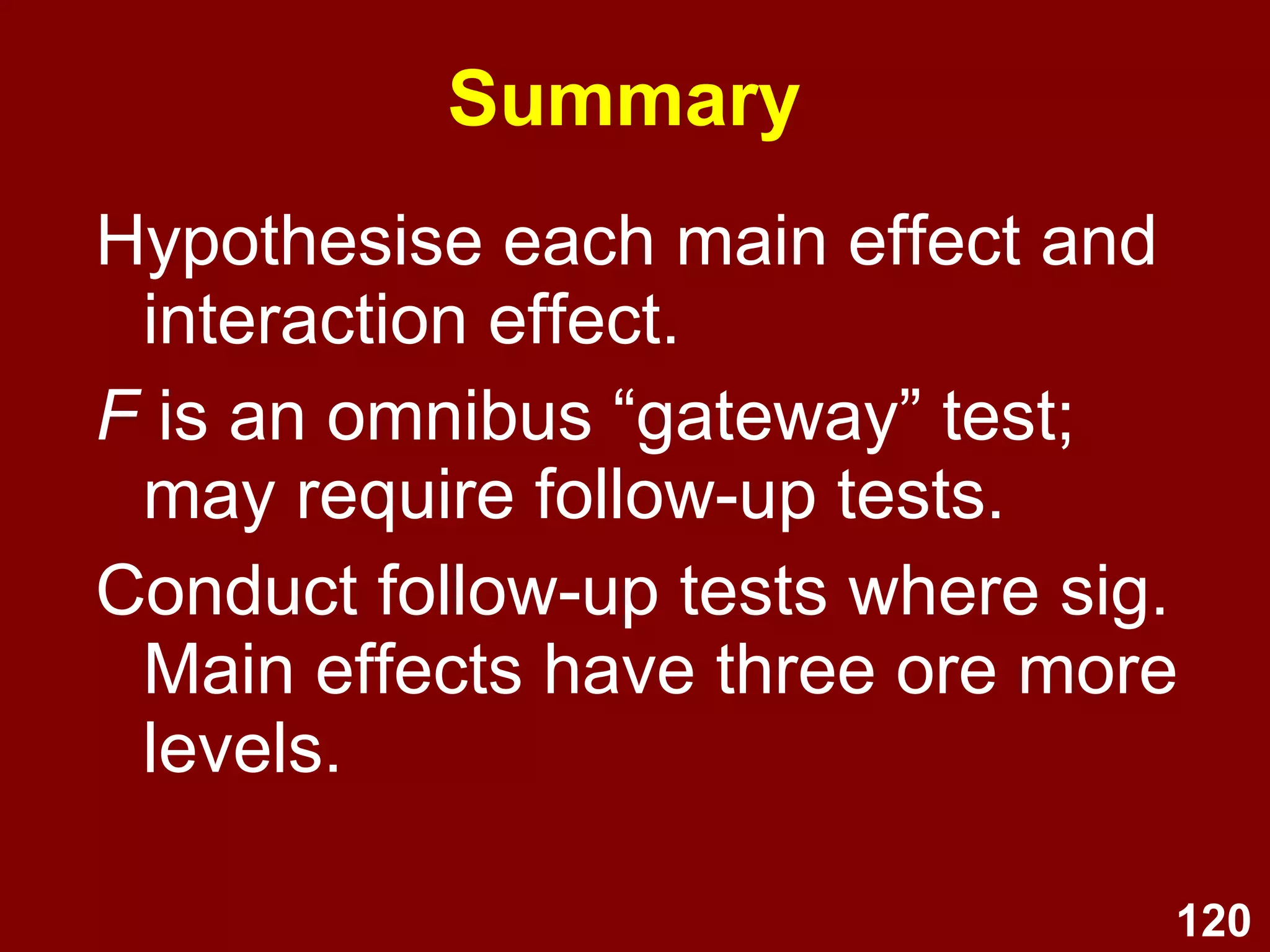
ANOVA  F -tests are a "gateway". If  F  is significant, then... Follow-up tests interpret  (main and interaction) effects and
consider whether to conduct  follow-up tests planned comparisons
post-hoc contrasts .
One-way ANOVA
Assumptions – One-way ANOVA Dependent variable  (DV) must be:  LOM : Measured at interval or ratio level
Normality : Normally distributed for all IV groups  (robust to violations of this assumption if  N s are large and approximately equal e.g., >15 cases per group)
Variance : Equal variance across for all IV groups (homogeneity of variance)
Independence : Participants' data should be independent of others' data
One-way ANOVA:  Are there differences in  satisfaction  levels between students who get different  grades ?
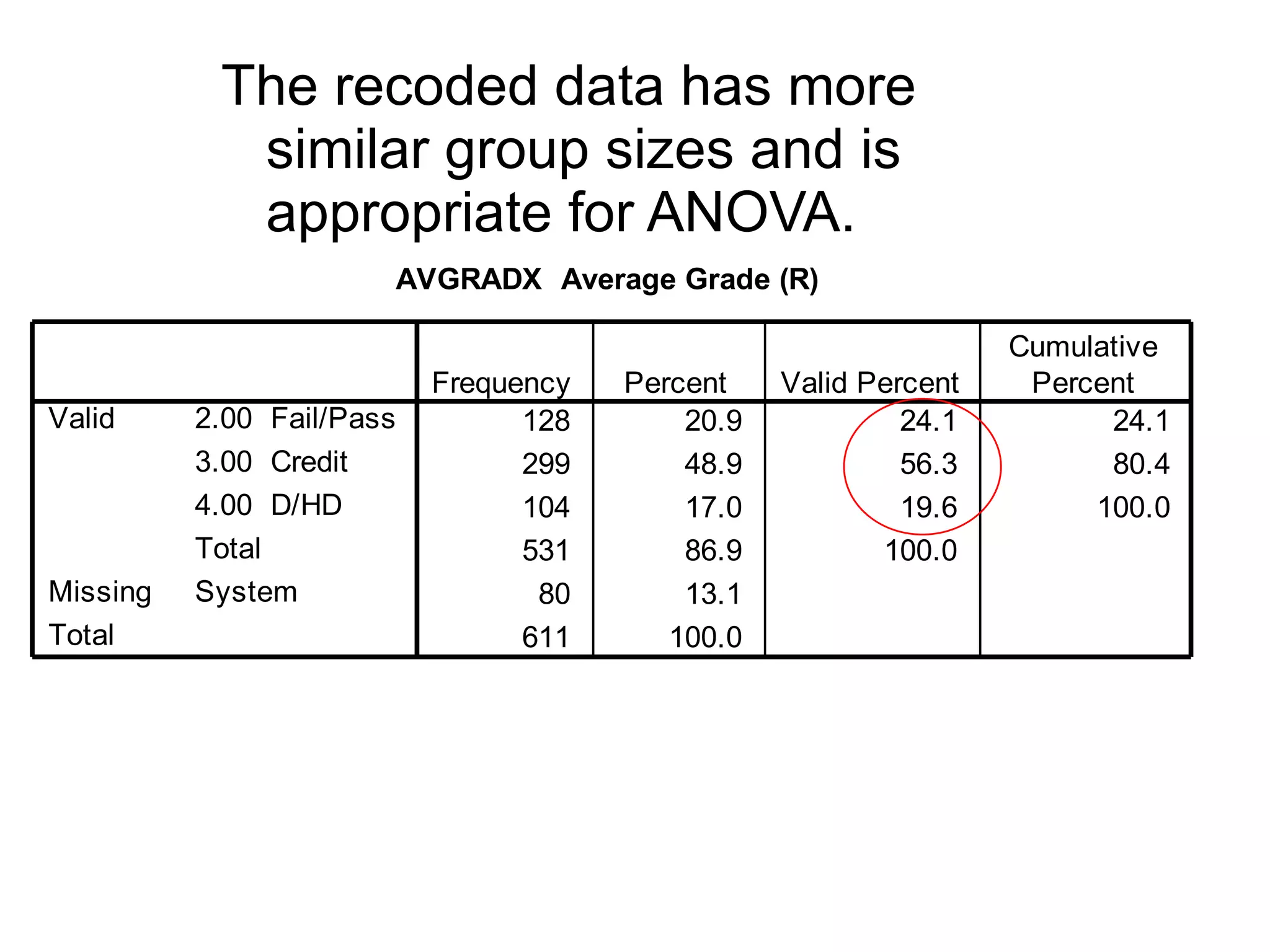
Recoding needed to achieve min. 15 per group.
These groups could be combined.
The recoded data has more similar group sizes and is appropriate for ANOVA.
SD s are similar (homogeneity of variance).  M s suggest that higher grade groups are more satisfied.
Levene's test indicates homogeneity of variance.
Follow-up tests should then be conducted because the effect of Grade is statistically significant ( p  < .05).
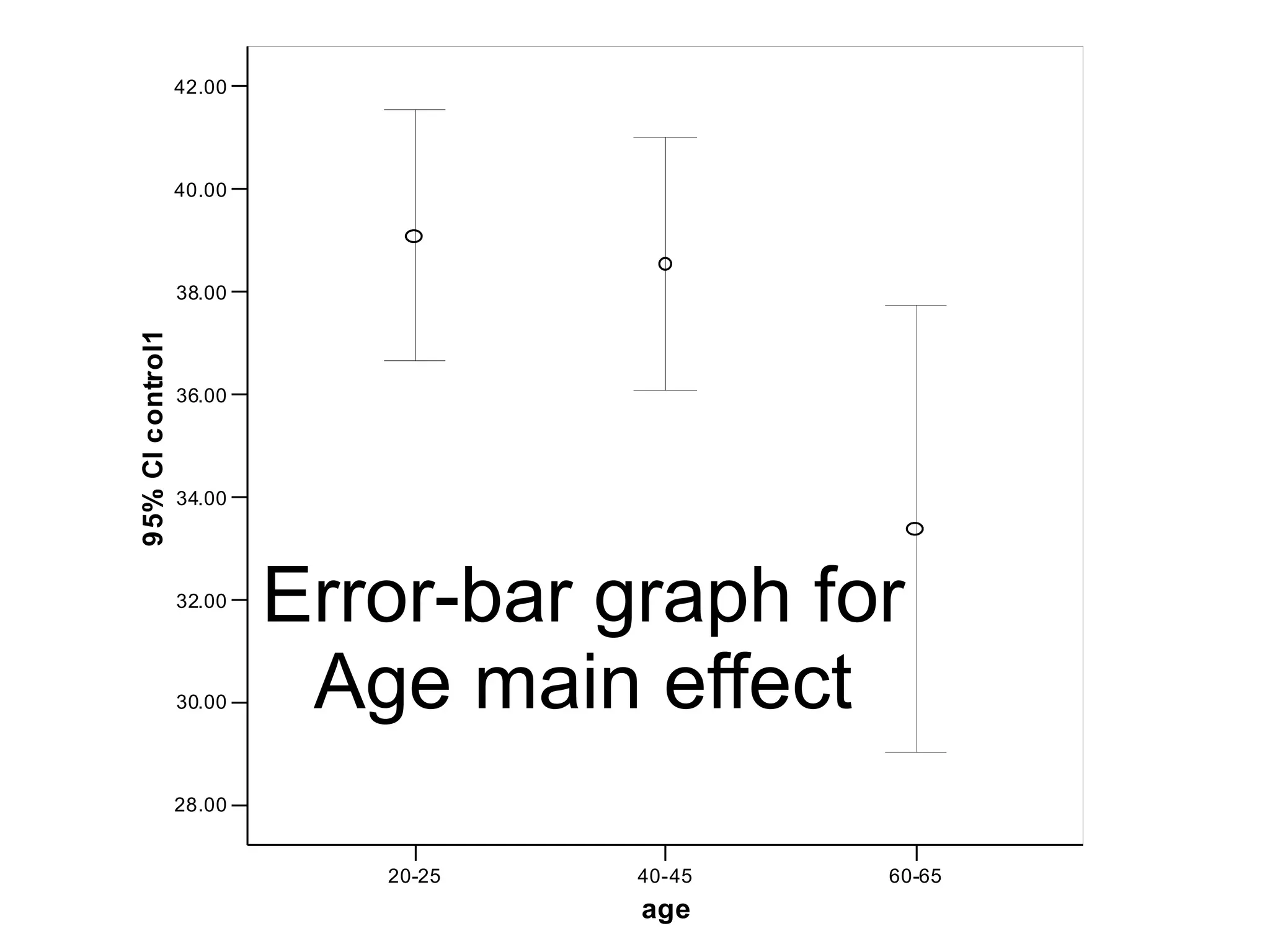
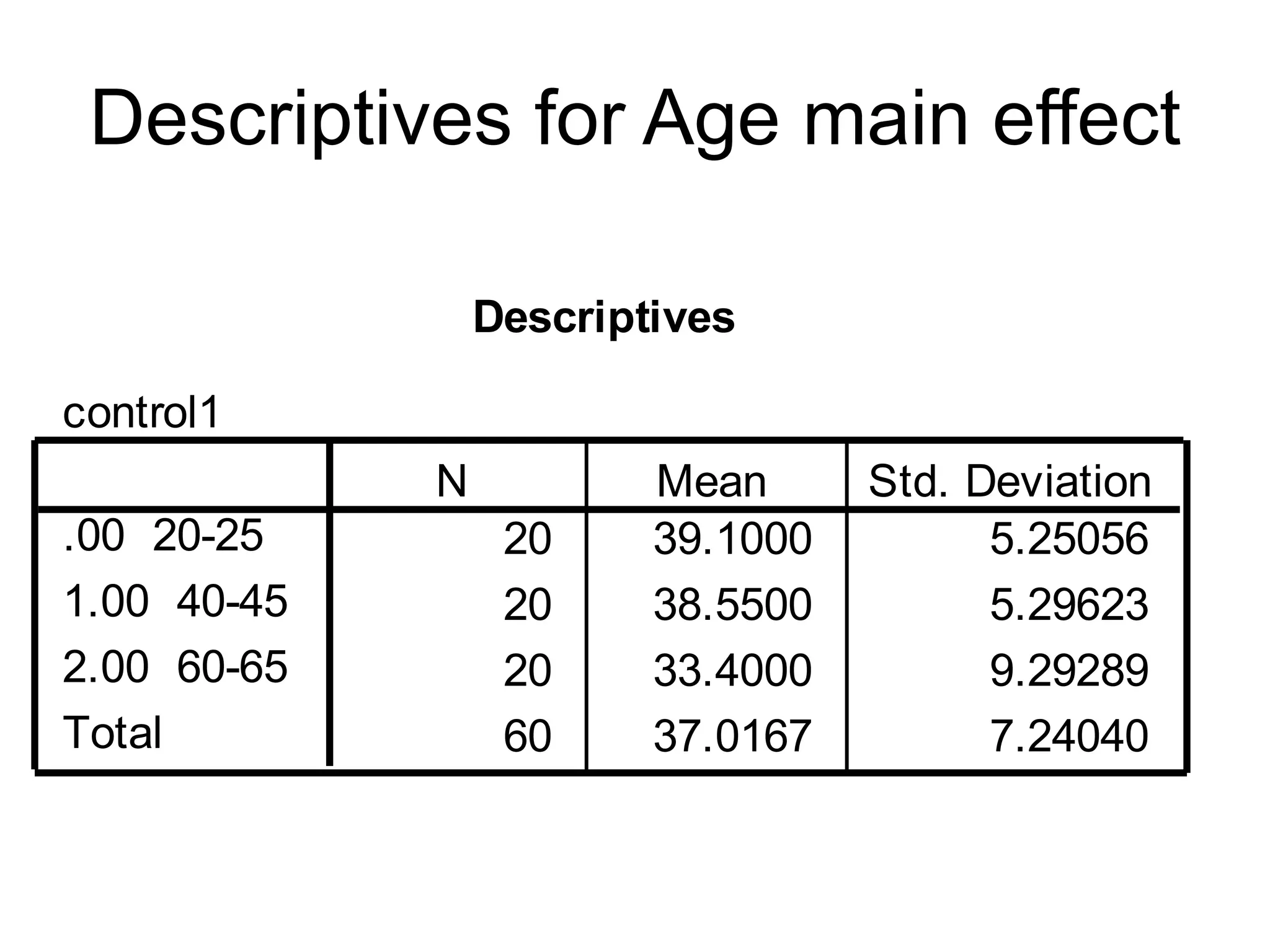
One-way ANOVA:  Does  locus of control  differ between three  age  groups? Age 20-25 year-olds
40-45 year olds
60-65 year-olds Locus of Control Lower = internal
Higher =  external
60-65 year-olds appear to be more internal, but the overlapping confidence intervals indicate that this may not be statistically significant.
The  SD s vary between groups (the third group has almost double the  SD  of the younger group). Levene's test is significant (variances are not homogenous).
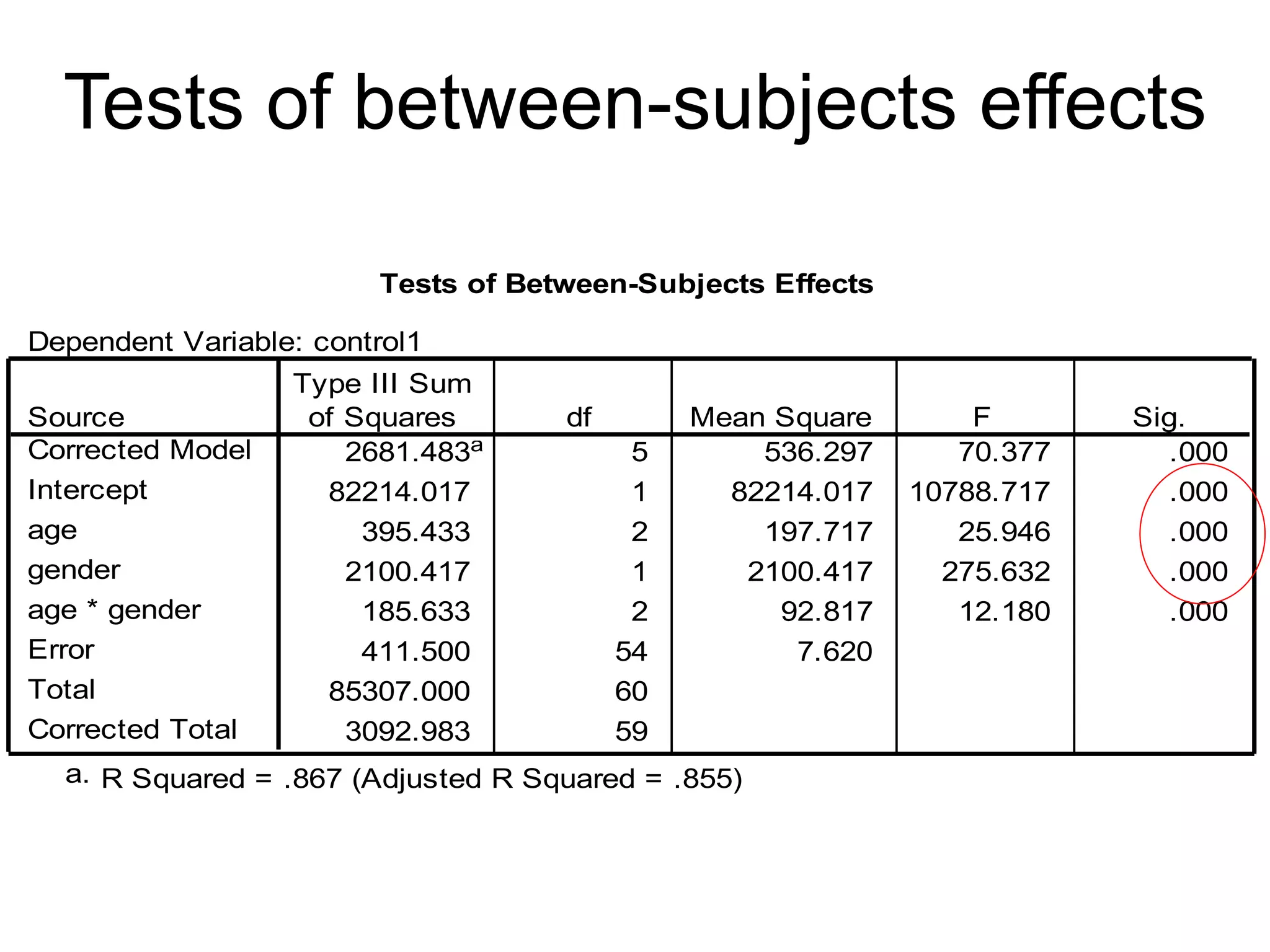
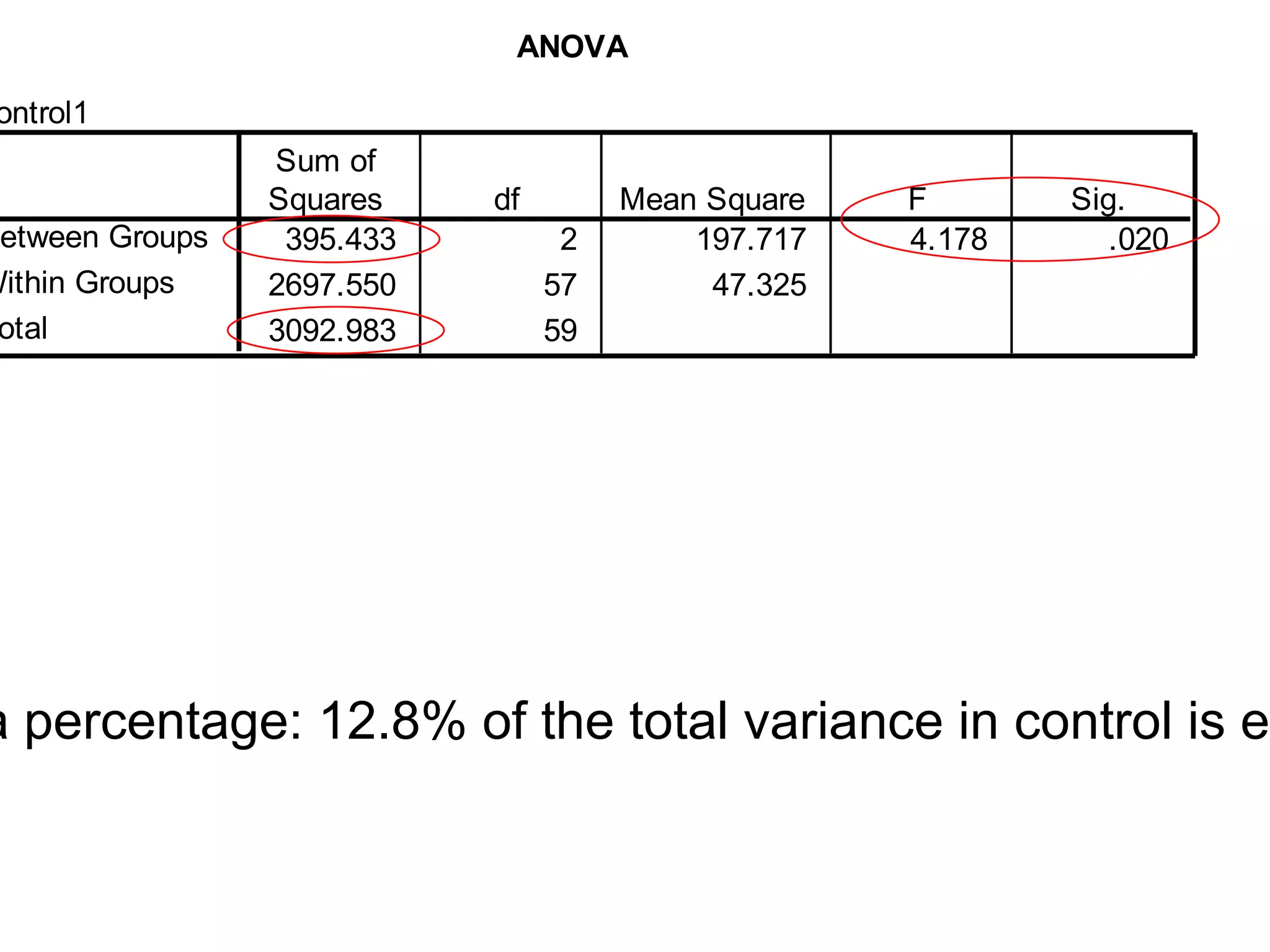
There is a significant effect for Age ( F  (2, 59) = 4.18, p = .02). In other words, the three age groups are unlikely to be drawn from a population with the same central tendency for LOC.
Which age groups differ in their mean locus of control scores? (Post hoc tests). Conclude: Gps 0 differs from 2; 1 differs from 2
Follow-up (pairwise) tests Post hoc : Compares every possible combination
Planned : Compares specific combinations (Do one or the other; not both)
Post hoc Control for Type I error rate
Scheffe, Bonferroni, Tukey’s HSD, or Student-Newman-Keuls
Keeps experiment-wise error rate to a fixed limit
Planned Need hypothesis before you start
Specify contrast coefficients to weight the comparisons (e.g., 1 st  two vs. last one)
Tests each contrast at critical  
Assumptions -  Repeated measures ANOVA Repeated measures designs have the additional assumption of  Sphericity: Variance of the population difference scores for any two conditions should be the same as the variance of the population difference scores for any other two conditions
Test using Mauchly's test of sphericity (If Mauchly’s W Statistic is p < .05 then assumption of sphericity is violated.)
Assumptions -  Repeated measures ANOVA Sphericity is commonly violated, however the multivariate test (provided by default in PASW output) does not require the assumption of sphericity and may be used as an alternative.
The obtained F ratio must then be evaluated against new degrees of freedom calculated from the  Greenhouse-Geisser , or Huynh-Feld, Epsilon values.
Example: Repeated measures ANOVA  Does  LOC  vary over  time ? Baseline
6 months
12 months
Mean LOC scores (with 95% C.I.s) across 3 measurement occasions Not much variation between means.
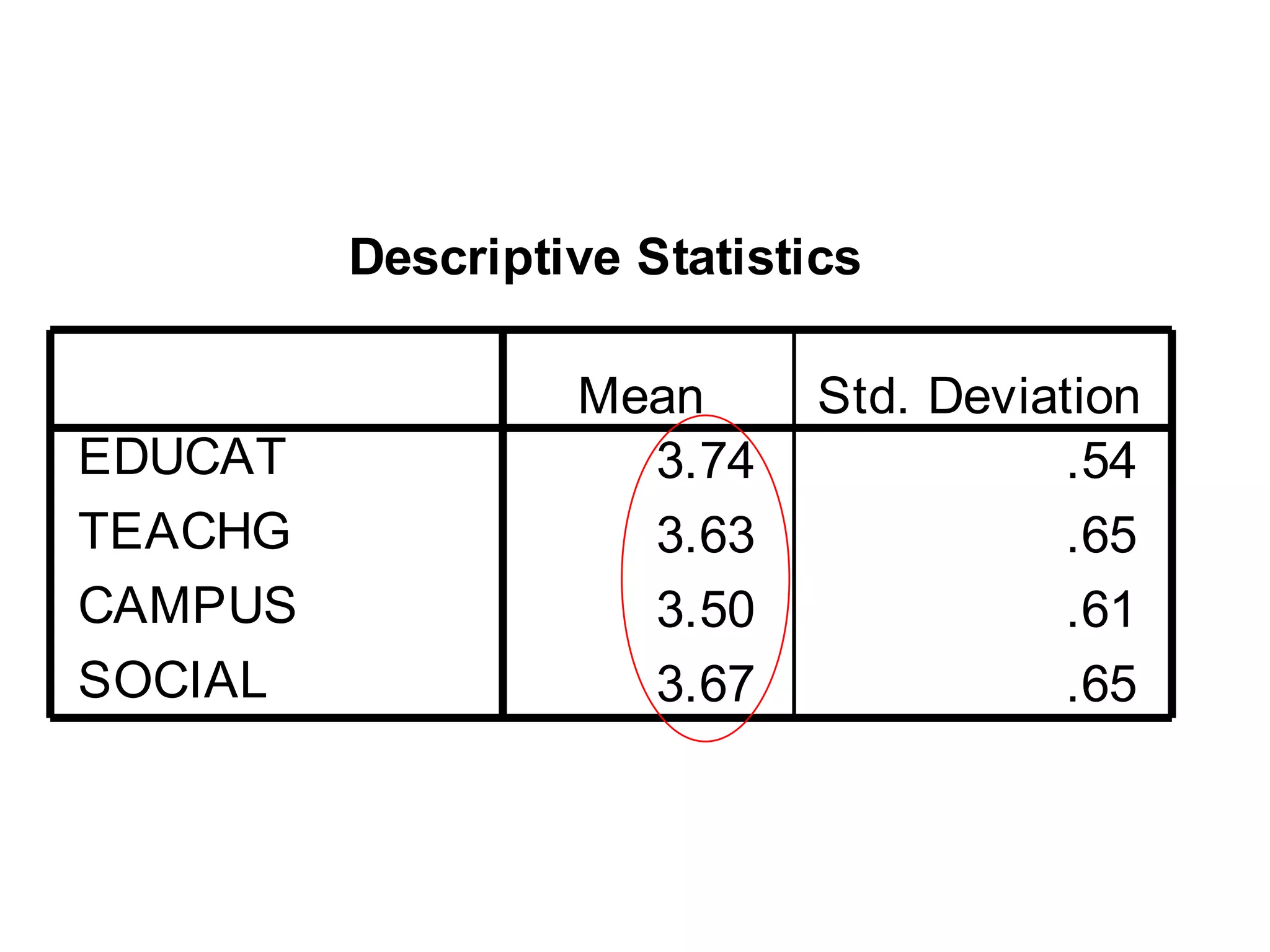
Descriptive statistics Not much variation between means.
Mauchly's test of sphericity Mauchly's test is not significant, therefore sphericity can be assumed.
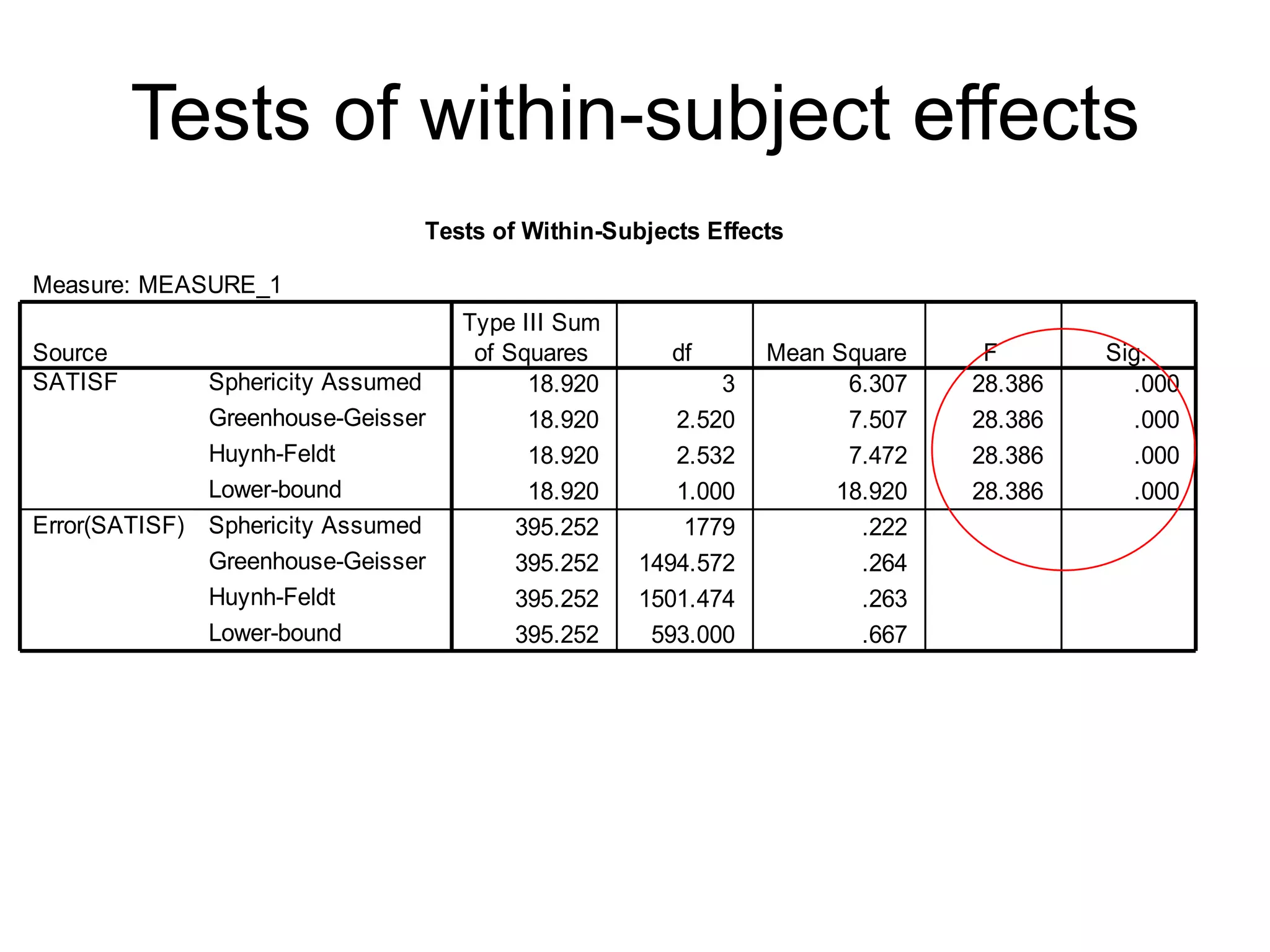
Tests of within-subject effects Conclude: Observed differences in means could have occurred by chance ( F  (2, 118) = 2.79,  p  = .06) if critical alpha = .05
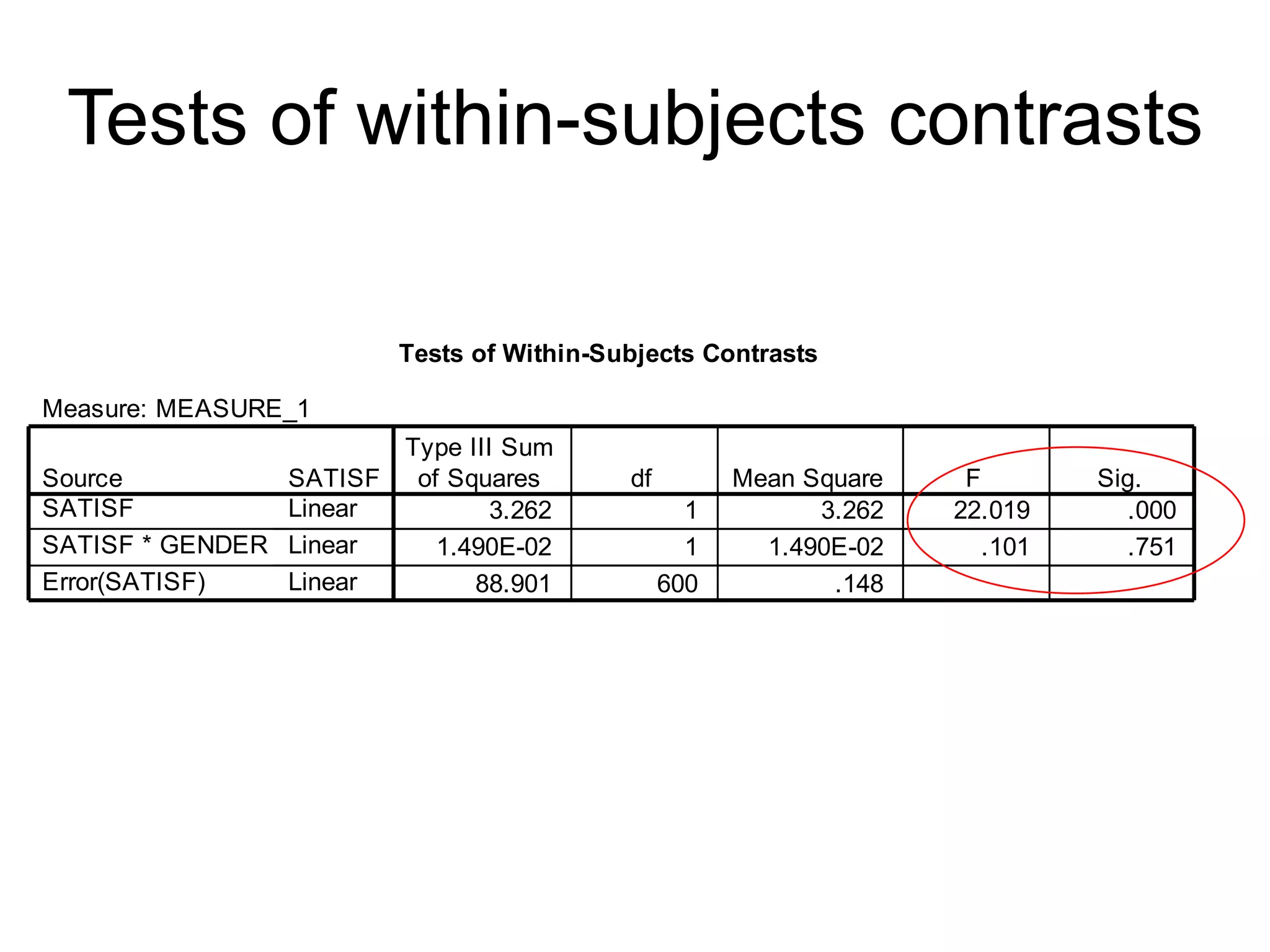
1-way repeated measures ANOVA  Do  satisfaction  levels vary between  Education, Teaching, Social and Campus  aspects of university life?
 
 
Tests of within-subject effects
Factorial ANOVA (2-way): Are there differences in  satisfaction  levels between  gender  and  age ?
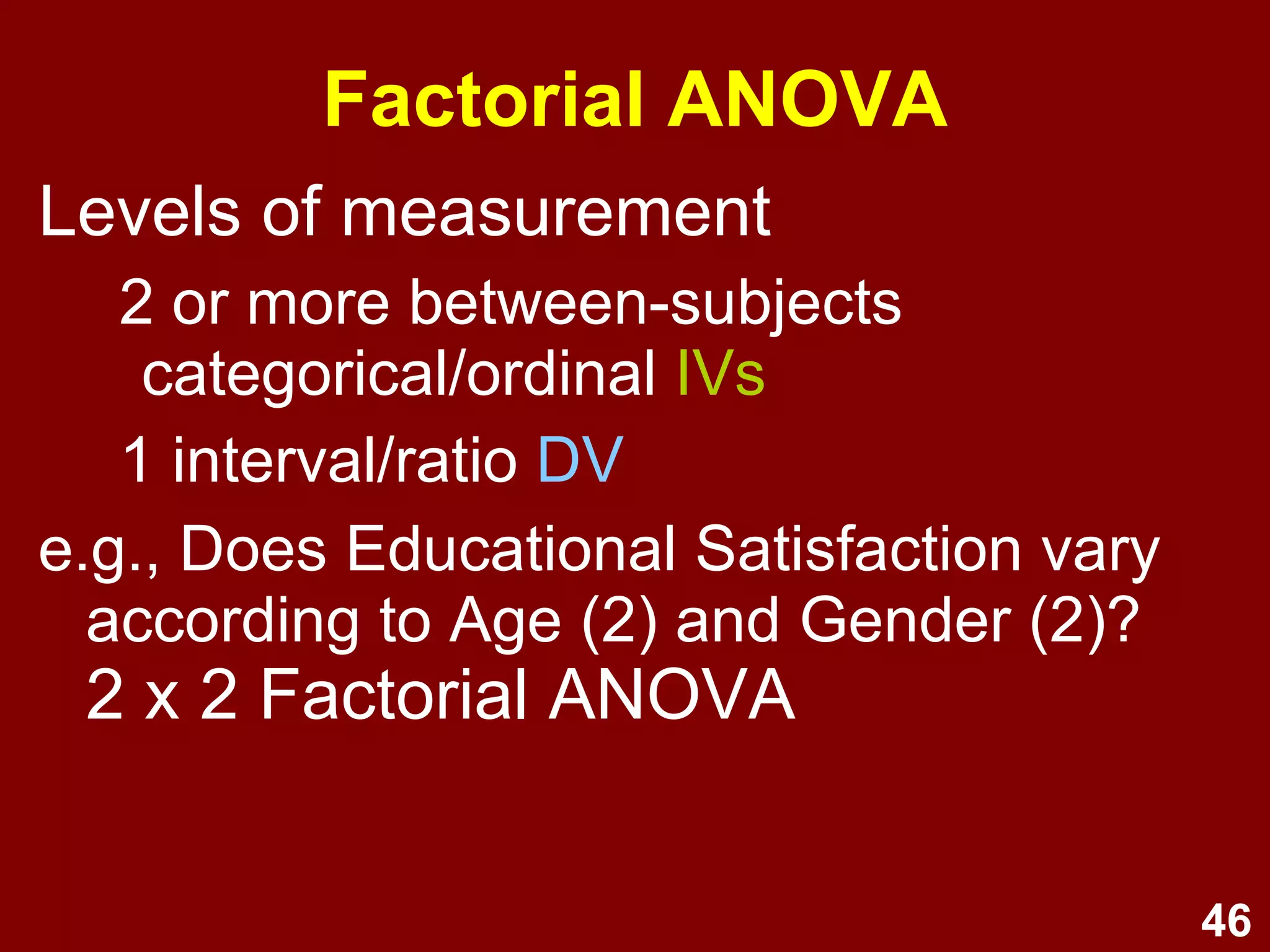
Factorial ANOVA Levels of measurement 2 or more between-subjects categorical/ordinal  IVs
1 interval/ratio  DV e.g., Does Educational Satisfaction vary according to Age (2) and Gender (2)? 2 x 2 Factorial ANOVA
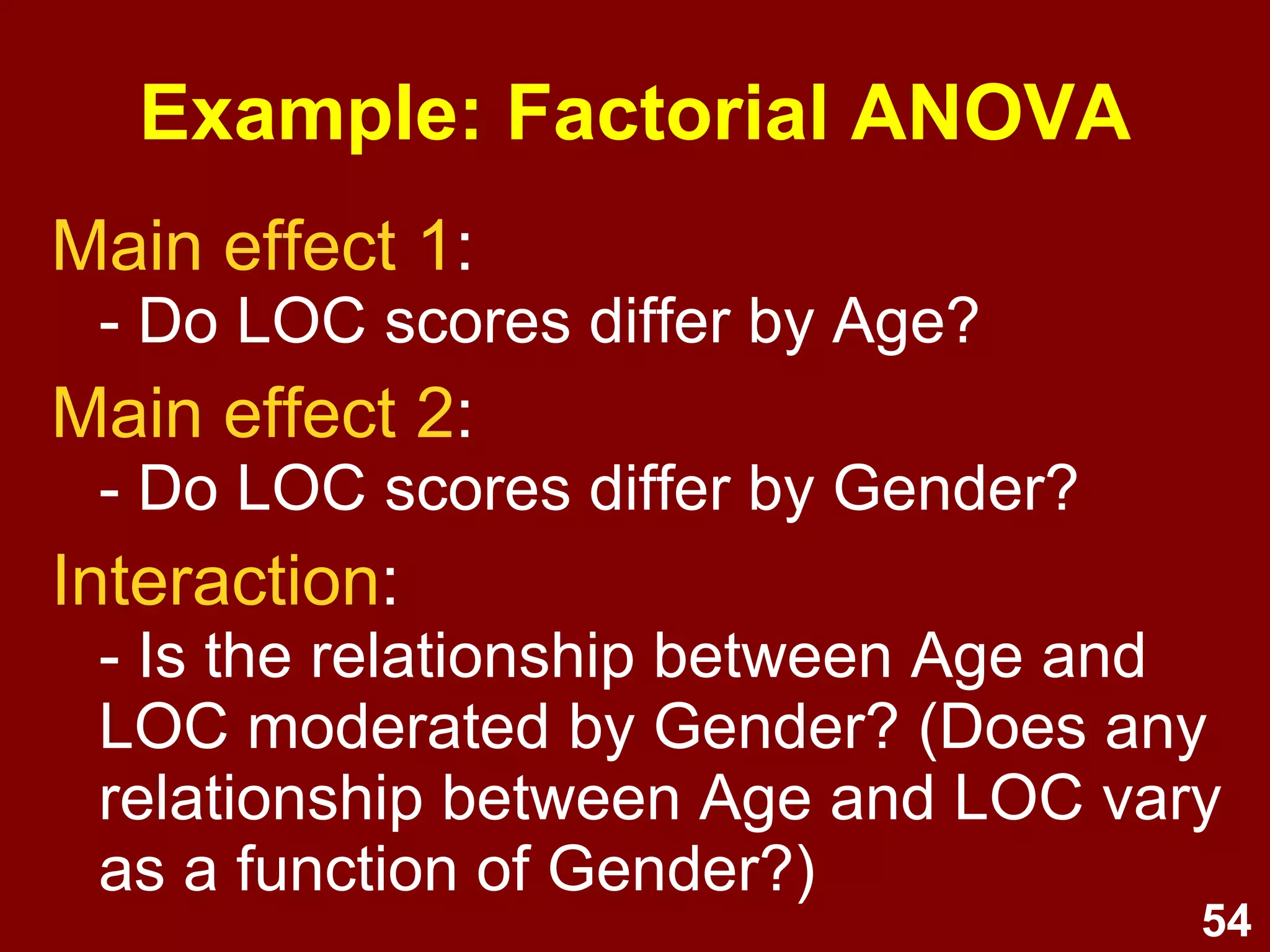
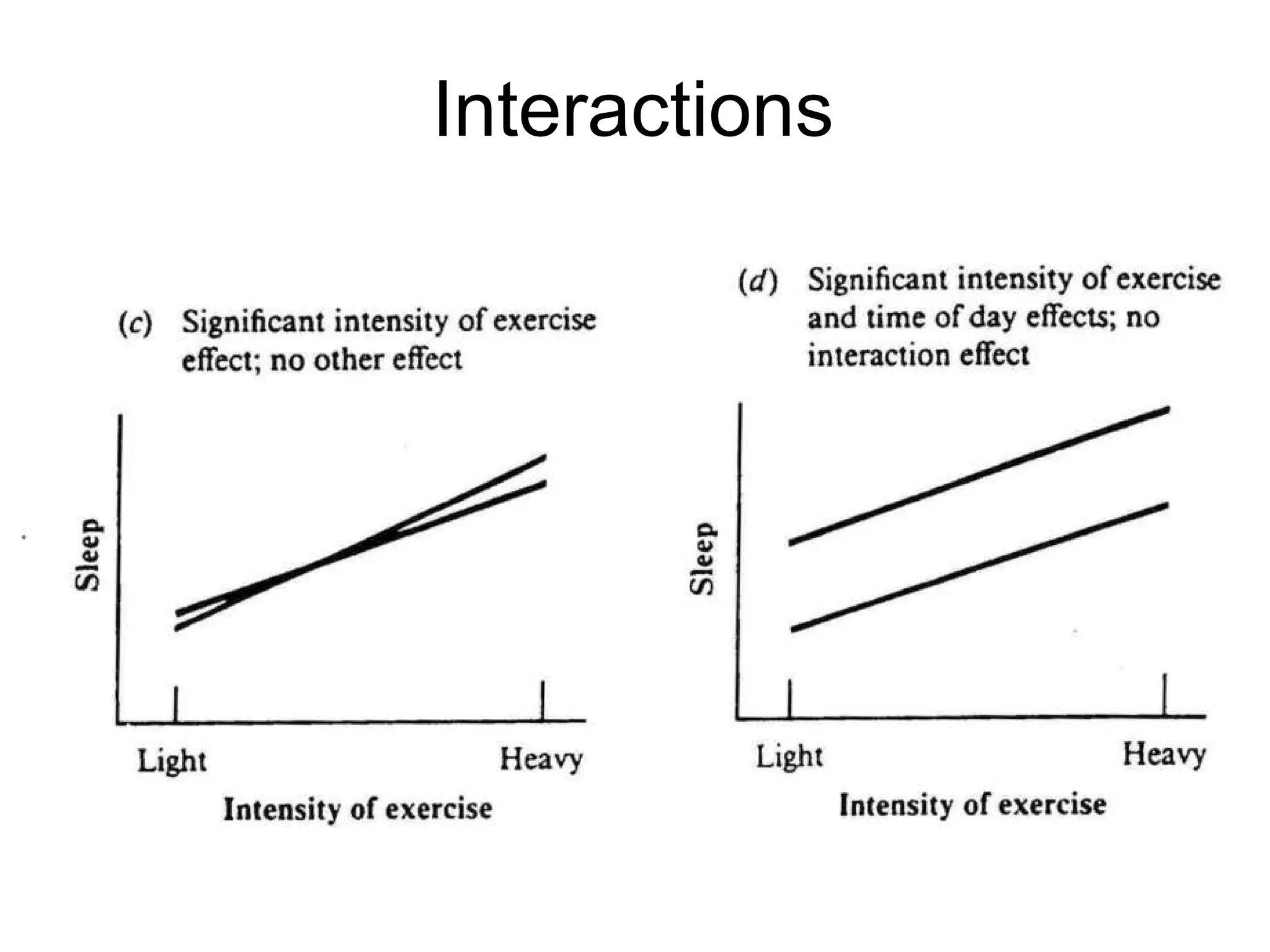
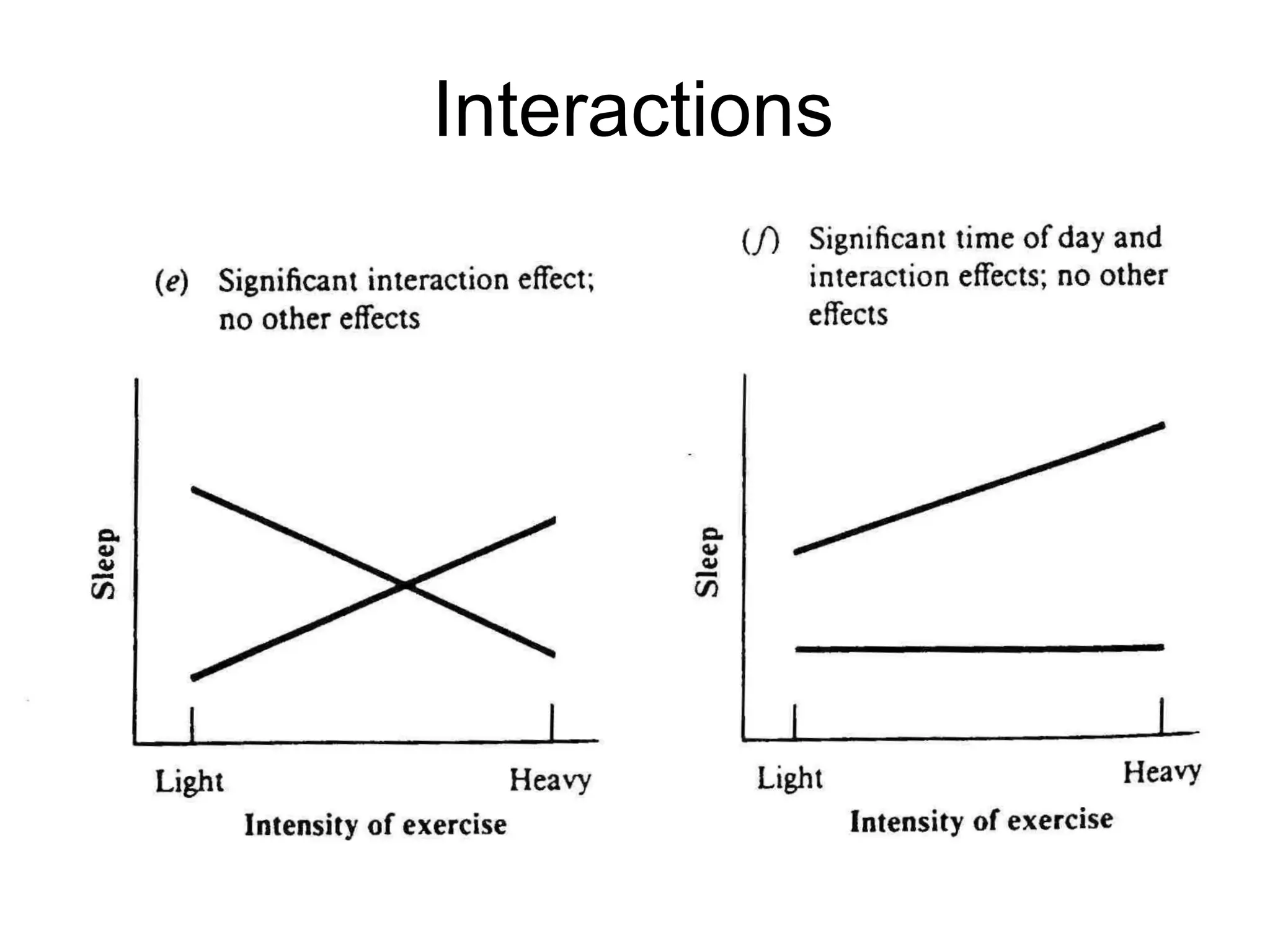
Factorial designs test  Main Effects  and  Interactions . For a 2-way design: Main effect of IV1
Main effect of IV2
Interaction between IV1 and IV2 If  significant effects are found and
there are more than 2 levels of an IV are involved then follow-up tests are required. Factorial ANOVA


ANOVA II

Editor's Notes

  • #2 7126/6667 Survey Research &amp; Design in Psychology Semester 1, 2009, University of Canberra, ACT, Australia James T. Neill Home page: http://ucspace.canberra.edu.au/display/7126 Lecture page: http://ucspace.canberra.edu.au/pages/viewpage.action?pageId=43549230 http://en.wikiversity.org/wiki/ANOVA Image source: James Neill, Creative Commons Attribution-Share Alike 2.5 Australia, http://creativecommons.org/licenses/by-sa/2.5/au/ Description: Explains the use of advanced ANOVAs. This lecture is accompanied by a computer-lab based tutorial, the notes for which are available here: http://ucspace.canberra.edu.au/display/7126/Tutorial+-+Multiple+linear+regression