Chapter 4 Aqueous Reactions and Solution Stoichiometry John D. Bookstaver St. Charles Community College Cottleville, MO Chemistry, The Central Science , 11th edition Theodore L. Brown; H. Eugene LeMay, Jr.; and Bruce E. Bursten
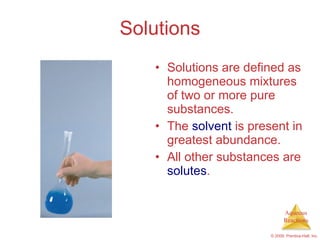
Solutions Solutions are defined as homogeneous mixtures of two or more pure substances. The  solvent  is present in greatest abundance. All other substances are  solutes .
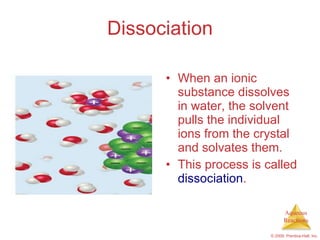
Dissociation When an ionic substance dissolves in water, the solvent pulls the individual ions from the crystal and solvates them. This process is called  dissociation .
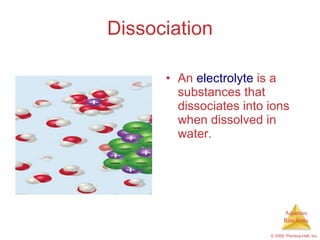
Dissociation An  electrolyte  is a  substances that dissociates into ions when dissolved in water.
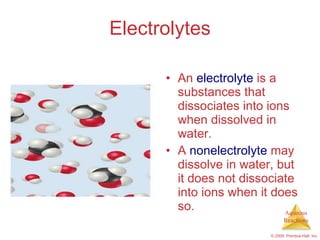
Electrolytes An  electrolyte  is a  substances that dissociates into ions when dissolved in water. A   nonelectrolyte  may dissolve in water, but it does not dissociate into ions when it does so.
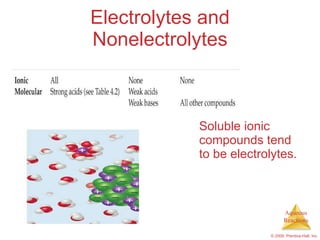
Electrolytes and Nonelectrolytes Soluble ionic compounds tend to be electrolytes.
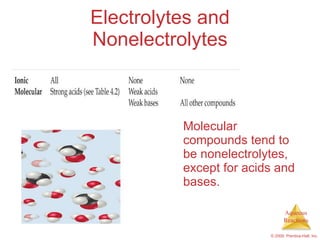
Electrolytes and Nonelectrolytes Molecular compounds tend to be nonelectrolytes, except for acids and bases.
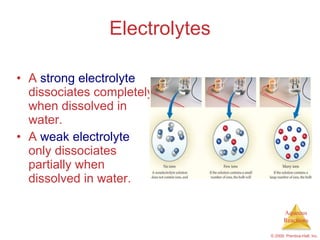
Electrolytes A  strong electrolyte  dissociates completely when dissolved in water. A  weak electrolyte  only dissociates partially when dissolved in water.
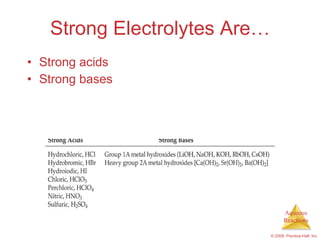
Strong Electrolytes Are… Strong acids Strong bases
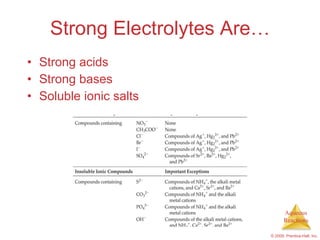
Strong Electrolytes Are… Strong acids Strong bases Soluble ionic salts
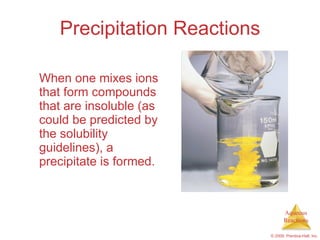
Precipitation Reactions When one mixes ions that form compounds that are insoluble (as could be predicted by the solubility guidelines), a precipitate is formed.
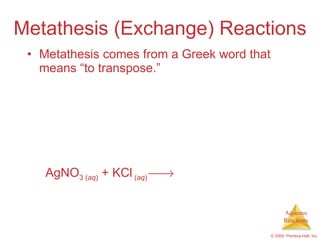
Metathesis (Exchange) Reactions Metathesis comes from a Greek word that means “to transpose.” AgNO 3 ( aq )  + KCl  ( aq )     AgCl  ( s )  + KNO 3 ( aq )
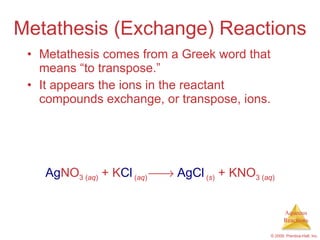
Metathesis (Exchange) Reactions Metathesis comes from a Greek word that means “to transpose.” It appears the ions in the reactant compounds exchange, or transpose, ions. Ag NO 3 ( aq )  + K Cl  ( aq )     AgCl  ( s )  + KNO 3 ( aq )
Solution Chemistry It is helpful to pay attention to  exactly  what species are present in a reaction mixture (i.e., solid, liquid, gas, aqueous solution). If we are to understand reactivity, we must be aware of just what is changing during the course of a reaction.
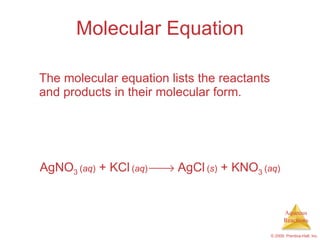
Molecular Equation The molecular equation lists the reactants and products in their molecular form. AgNO 3  ( aq )  + KCl   ( aq )     AgCl   ( s )  + KNO 3  ( aq )
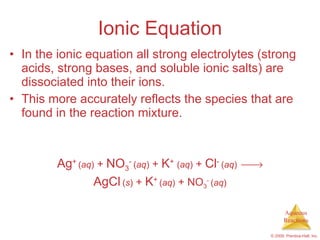
Ionic Equation In the ionic equation all strong electrolytes (strong acids, strong bases, and soluble ionic salts) are dissociated into their ions. This more accurately reflects the species that are found in the reaction mixture. Ag +   ( aq )  +  NO 3 -  ( aq )  +  K +   ( aq )  +  Cl -  ( aq )    AgCl   ( s )  +  K +   ( aq )  + NO 3 -  ( aq )
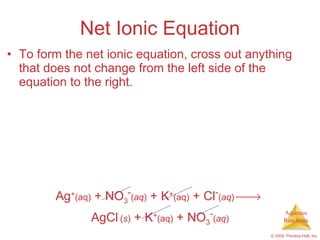
Net Ionic Equation To form the net ionic equation, cross out anything that does not change from the left side of the equation to the right. Ag + (aq)  + NO 3 - ( aq )  + K + (aq)  + Cl - ( aq )      AgCl   ( s )  + K + (aq)  + NO 3 - ( aq )
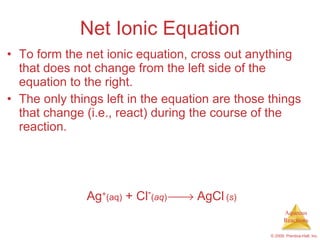
Net Ionic Equation To form the net ionic equation, cross out anything that does not change from the left side of the equation to the right. The only things left in the equation are those things that change (i.e., react) during the course of the reaction. Ag + (aq)  + Cl - ( aq )     AgCl   ( s )
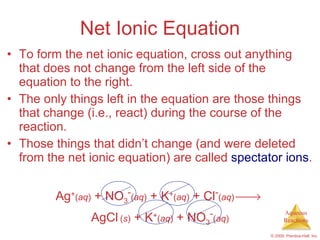
Net Ionic Equation To form the net ionic equation, cross out anything that does not change from the left side of the equation to the right. The only things left in the equation are those things that change (i.e., react) during the course of the reaction. Those things that didn’t change (and were deleted from the net ionic equation) are called  spectator   ions . Ag + ( aq )  + NO 3 - ( aq )  + K + ( aq )  + Cl - ( aq )      AgCl   ( s )  + K + ( aq )  + NO 3 - ( aq )
Writing Net Ionic Equations Write a balanced molecular equation. Dissociate all strong electrolytes. Cross out anything that remains unchanged from the left side to the right side of the equation. Write the net ionic equation with the species that remain.
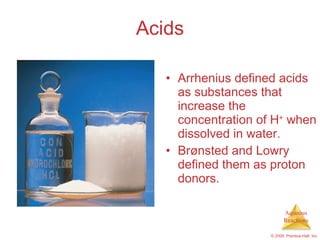
Acids Arrhenius defined acids as substances that increase the concentration of H +  when dissolved in water. Brønsted  and  Lowry defined them as proton donors.
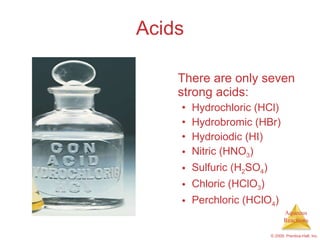
Acids There are only seven strong acids: Hydrochloric (HCl) Hydrobromic (HBr) Hydroiodic (HI) Nitric (HNO 3 ) Sulfuric (H 2 SO 4 ) Chloric (HClO 3 ) Perchloric (HClO 4 )
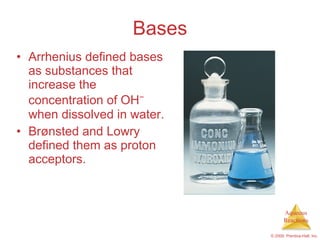
Bases Arrhenius defined bases as substances that increase the concentration of OH −  when dissolved in water. Brønsted  and  Lowry defined them as proton acceptors.
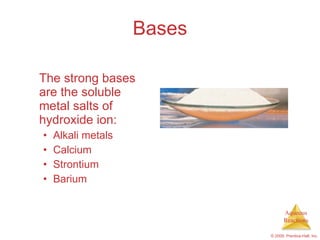
Bases The strong bases are the soluble metal salts of hydroxide ion: Alkali metals Calcium Strontium Barium
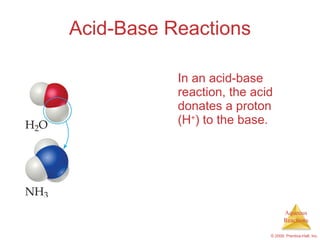
Acid-Base Reactions In an acid-base reaction, the acid donates a proton (H + ) to the base.
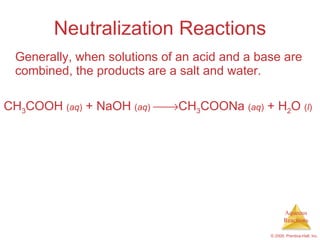
Neutralization Reactions Generally, when solutions of an acid and a base are combined, the products are a salt and water. CH 3 COOH  ( aq )  + NaOH  ( aq )    CH 3 COONa  ( aq )  + H 2 O  ( l )
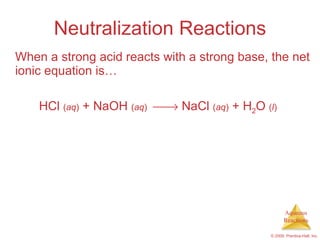
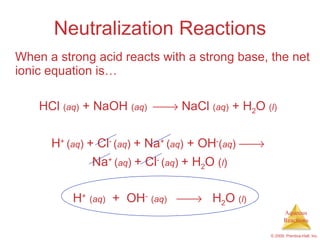
Neutralization Reactions When a strong acid reacts with a strong base, the net ionic equation is… HCl  ( aq )  + NaOH  ( aq )     NaCl  ( aq )  + H 2 O  ( l )
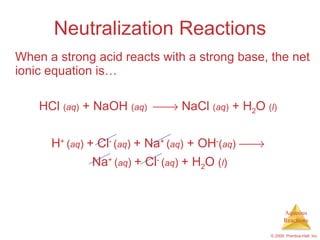
Neutralization Reactions When a strong acid reacts with a strong base, the net ionic equation is… HCl  ( aq )  + NaOH  ( aq )     NaCl  ( aq )  + H 2 O  ( l )   H +  ( aq )  + Cl -  ( aq )  + Na +  ( aq )  + OH - ( aq )      Na +  ( aq )  + Cl -  ( aq )  + H 2 O  ( l )
Neutralization Reactions When a strong acid reacts with a strong base, the net ionic equation is… HCl  ( aq )  + NaOH  ( aq )     NaCl  ( aq )  + H 2 O  ( l )   H +  ( aq )  + Cl -  ( aq )  + Na +  ( aq )  + OH - ( aq )      Na +  ( aq )  + Cl -  ( aq )  + H 2 O  ( l ) H +   ( aq )   +  OH -   ( aq )      H 2 O  ( l )
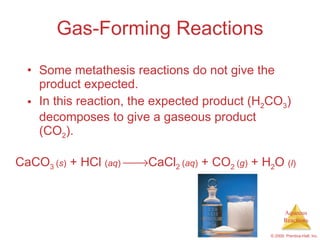
Gas-Forming Reactions Some metathesis reactions do not give the product expected. In this reaction, the expected product (H 2 CO 3 ) decomposes to give a gaseous product (CO 2 ). CaCO 3  ( s )  + HCl  ( aq )    CaCl 2  ( aq )  + CO 2  ( g )  + H 2 O  ( l )
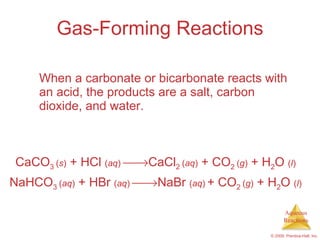
Gas-Forming Reactions When a carbonate or bicarbonate reacts with an acid, the products are a salt, carbon dioxide, and water. CaCO 3  ( s )  + HCl  ( aq )    CaCl 2  ( aq )  + CO 2  ( g )  + H 2 O  ( l )   NaHCO 3  ( aq )  + HBr  ( aq )    NaBr  ( aq )   + CO 2  ( g )  + H 2 O  ( l )
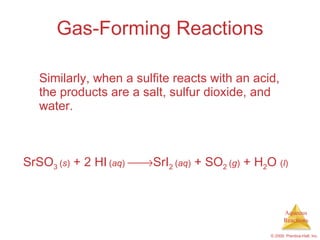
Gas-Forming Reactions Similarly, when a sulfite reacts with an acid, the products are a salt, sulfur dioxide, and water. SrSO 3  ( s )  + 2 HI   ( aq )    SrI 2  ( aq )  + SO 2  ( g )  + H 2 O  ( l )
Gas-Forming Reactions This reaction gives the predicted product, but you had better carry it out in the hood, or you will be  very  unpopular! But just as in the previous examples, a gas is formed as a product of this reaction. Na 2 S  ( aq )  + H 2 SO 4  ( aq )     Na 2 SO 4  ( aq )  + H 2 S  ( g )
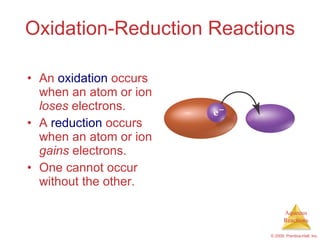
Oxidation-Reduction Reactions An  oxidation  occurs when an atom or ion  loses  electrons. A  reduction  occurs when an atom or ion  gains  electrons. One cannot occur without the other.
Oxidation Numbers To determine if an oxidation-reduction reaction has occurred, we assign an  oxidation number  to each element in a neutral compound or charged entity.
Oxidation Numbers Elements in their elemental form have an oxidation number of 0. The oxidation number of a monatomic ion is the same as its charge.
Oxidation Numbers Nonmetals tend to have negative oxidation numbers, although some are positive in certain compounds or ions. Oxygen has an oxidation number of  − 2, except in the peroxide ion in which it has an oxidation number of  − 1. Hydrogen is  − 1 when bonded to a metal, +1 when bonded to a nonmetal.
Oxidation Numbers Nonmetals tend to have negative oxidation numbers, although some are positive in certain compounds or ions. Fluorine always has an oxidation number of  − 1. The other halogens have an oxidation number of  − 1 when they are negative; they can have positive oxidation numbers, however, most notably in oxyanions.
Oxidation Numbers The sum of the oxidation numbers in a neutral compound is 0. The sum of the oxidation numbers in a polyatomic ion is the charge on the ion.
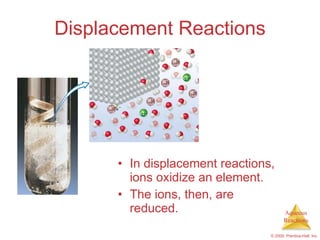
Displacement Reactions In displacement reactions, ions oxidize an element. The ions, then, are reduced.
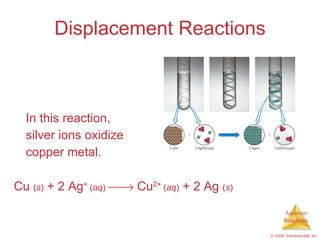
Displacement Reactions In this reaction,  silver ions oxidize  copper metal. Cu  ( s )  + 2 Ag +  ( aq )     Cu 2+  ( aq )  + 2 Ag  ( s )
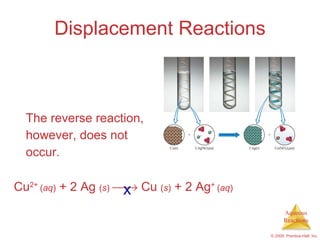
Displacement Reactions The reverse reaction,  however, does not  occur. Cu 2+  ( aq )  + 2 Ag  ( s )     Cu  ( s )  + 2 Ag +  ( aq )   x
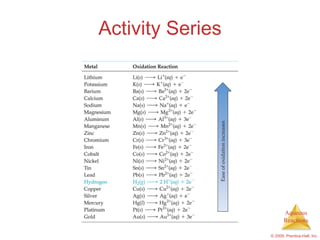
Activity Series
Molarity Two solutions can contain the same compounds but be quite different because the proportions of those compounds are different. Molarity is one way to measure the concentration of a solution. moles of solute volume of solution in liters Molarity ( M ) =
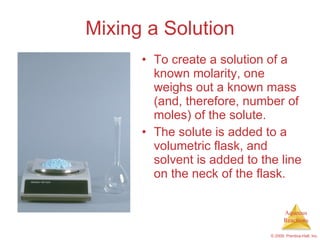
Mixing a Solution To create a solution of a known molarity, one weighs out a known mass (and, therefore, number of moles) of the solute. The solute is added to a volumetric flask, and solvent is added to the line on the neck of the flask.
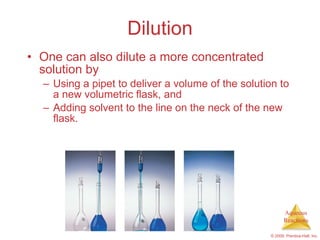
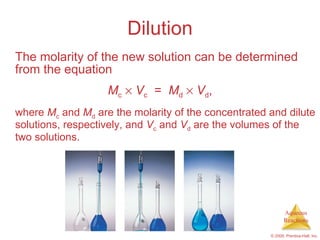
Dilution One can also dilute a more concentrated solution by Using a pipet to deliver a volume of the solution to a new volumetric flask, and Adding solvent to the line on the neck of the new flask.
Dilution The molarity of the new solution can be determined from the equation M c      V c   =  M d      V d , where  M c  and  M d  are the molarity of the concentrated and dilute solutions, respectively, and  V c  and  V d  are the volumes of the two solutions.
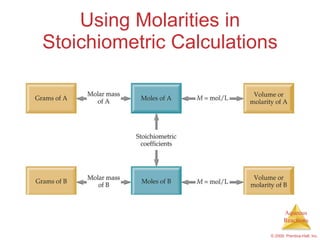
Using Molarities in Stoichiometric Calculations
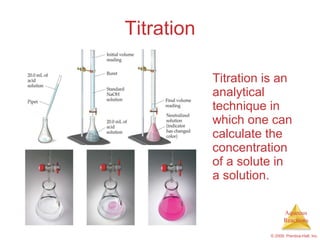
Titration Titration is an analytical technique in which one can calculate the concentration of a solute in a solution.

AP Chemistry Chapter 4 Outline

  • 1.
    Chapter 4 AqueousReactions and Solution Stoichiometry John D. Bookstaver St. Charles Community College Cottleville, MO Chemistry, The Central Science , 11th edition Theodore L. Brown; H. Eugene LeMay, Jr.; and Bruce E. Bursten
  • 2.
    Solutions Solutions aredefined as homogeneous mixtures of two or more pure substances. The solvent is present in greatest abundance. All other substances are solutes .
  • 3.
    Dissociation When anionic substance dissolves in water, the solvent pulls the individual ions from the crystal and solvates them. This process is called dissociation .
  • 4.
    Dissociation An electrolyte is a substances that dissociates into ions when dissolved in water.
  • 5.
    Electrolytes An electrolyte is a substances that dissociates into ions when dissolved in water. A nonelectrolyte may dissolve in water, but it does not dissociate into ions when it does so.
  • 6.
    Electrolytes and NonelectrolytesSoluble ionic compounds tend to be electrolytes.
  • 7.
    Electrolytes and NonelectrolytesMolecular compounds tend to be nonelectrolytes, except for acids and bases.
  • 8.
    Electrolytes A strong electrolyte dissociates completely when dissolved in water. A weak electrolyte only dissociates partially when dissolved in water.
  • 9.
    Strong Electrolytes Are…Strong acids Strong bases
  • 10.
    Strong Electrolytes Are…Strong acids Strong bases Soluble ionic salts
  • 11.
    Precipitation Reactions Whenone mixes ions that form compounds that are insoluble (as could be predicted by the solubility guidelines), a precipitate is formed.
  • 12.
    Metathesis (Exchange) ReactionsMetathesis comes from a Greek word that means “to transpose.” AgNO 3 ( aq ) + KCl ( aq )  AgCl ( s ) + KNO 3 ( aq )
  • 13.
    Metathesis (Exchange) ReactionsMetathesis comes from a Greek word that means “to transpose.” It appears the ions in the reactant compounds exchange, or transpose, ions. Ag NO 3 ( aq ) + K Cl ( aq )  AgCl ( s ) + KNO 3 ( aq )
  • 14.
    Solution Chemistry Itis helpful to pay attention to exactly what species are present in a reaction mixture (i.e., solid, liquid, gas, aqueous solution). If we are to understand reactivity, we must be aware of just what is changing during the course of a reaction.
  • 15.
    Molecular Equation Themolecular equation lists the reactants and products in their molecular form. AgNO 3 ( aq ) + KCl ( aq )  AgCl ( s ) + KNO 3 ( aq )
  • 16.
    Ionic Equation Inthe ionic equation all strong electrolytes (strong acids, strong bases, and soluble ionic salts) are dissociated into their ions. This more accurately reflects the species that are found in the reaction mixture. Ag + ( aq ) + NO 3 - ( aq ) + K + ( aq ) + Cl - ( aq )  AgCl ( s ) + K + ( aq ) + NO 3 - ( aq )
  • 17.
    Net Ionic EquationTo form the net ionic equation, cross out anything that does not change from the left side of the equation to the right. Ag + (aq) + NO 3 - ( aq ) + K + (aq) + Cl - ( aq )  AgCl ( s ) + K + (aq) + NO 3 - ( aq )
  • 18.
    Net Ionic EquationTo form the net ionic equation, cross out anything that does not change from the left side of the equation to the right. The only things left in the equation are those things that change (i.e., react) during the course of the reaction. Ag + (aq) + Cl - ( aq )  AgCl ( s )
  • 19.
    Net Ionic EquationTo form the net ionic equation, cross out anything that does not change from the left side of the equation to the right. The only things left in the equation are those things that change (i.e., react) during the course of the reaction. Those things that didn’t change (and were deleted from the net ionic equation) are called spectator ions . Ag + ( aq ) + NO 3 - ( aq ) + K + ( aq ) + Cl - ( aq )  AgCl ( s ) + K + ( aq ) + NO 3 - ( aq )
  • 20.
    Writing Net IonicEquations Write a balanced molecular equation. Dissociate all strong electrolytes. Cross out anything that remains unchanged from the left side to the right side of the equation. Write the net ionic equation with the species that remain.
  • 21.
    Acids Arrhenius definedacids as substances that increase the concentration of H + when dissolved in water. Brønsted and Lowry defined them as proton donors.
  • 22.
    Acids There areonly seven strong acids: Hydrochloric (HCl) Hydrobromic (HBr) Hydroiodic (HI) Nitric (HNO 3 ) Sulfuric (H 2 SO 4 ) Chloric (HClO 3 ) Perchloric (HClO 4 )
  • 23.
    Bases Arrhenius definedbases as substances that increase the concentration of OH − when dissolved in water. Brønsted and Lowry defined them as proton acceptors.
  • 24.
    Bases The strongbases are the soluble metal salts of hydroxide ion: Alkali metals Calcium Strontium Barium
  • 25.
    Acid-Base Reactions Inan acid-base reaction, the acid donates a proton (H + ) to the base.
  • 26.
    Neutralization Reactions Generally,when solutions of an acid and a base are combined, the products are a salt and water. CH 3 COOH ( aq ) + NaOH ( aq )  CH 3 COONa ( aq ) + H 2 O ( l )
  • 27.
    Neutralization Reactions Whena strong acid reacts with a strong base, the net ionic equation is… HCl ( aq ) + NaOH ( aq )  NaCl ( aq ) + H 2 O ( l )
  • 28.
    Neutralization Reactions Whena strong acid reacts with a strong base, the net ionic equation is… HCl ( aq ) + NaOH ( aq )  NaCl ( aq ) + H 2 O ( l ) H + ( aq ) + Cl - ( aq ) + Na + ( aq ) + OH - ( aq )  Na + ( aq ) + Cl - ( aq ) + H 2 O ( l )
  • 29.
    Neutralization Reactions Whena strong acid reacts with a strong base, the net ionic equation is… HCl ( aq ) + NaOH ( aq )  NaCl ( aq ) + H 2 O ( l ) H + ( aq ) + Cl - ( aq ) + Na + ( aq ) + OH - ( aq )  Na + ( aq ) + Cl - ( aq ) + H 2 O ( l ) H + ( aq ) + OH - ( aq )  H 2 O ( l )
  • 30.
    Gas-Forming Reactions Somemetathesis reactions do not give the product expected. In this reaction, the expected product (H 2 CO 3 ) decomposes to give a gaseous product (CO 2 ). CaCO 3 ( s ) + HCl ( aq )  CaCl 2 ( aq ) + CO 2 ( g ) + H 2 O ( l )
  • 31.
    Gas-Forming Reactions Whena carbonate or bicarbonate reacts with an acid, the products are a salt, carbon dioxide, and water. CaCO 3 ( s ) + HCl ( aq )  CaCl 2 ( aq ) + CO 2 ( g ) + H 2 O ( l ) NaHCO 3 ( aq ) + HBr ( aq )  NaBr ( aq ) + CO 2 ( g ) + H 2 O ( l )
  • 32.
    Gas-Forming Reactions Similarly,when a sulfite reacts with an acid, the products are a salt, sulfur dioxide, and water. SrSO 3 ( s ) + 2 HI ( aq )  SrI 2 ( aq ) + SO 2 ( g ) + H 2 O ( l )
  • 33.
    Gas-Forming Reactions Thisreaction gives the predicted product, but you had better carry it out in the hood, or you will be very unpopular! But just as in the previous examples, a gas is formed as a product of this reaction. Na 2 S ( aq ) + H 2 SO 4 ( aq )  Na 2 SO 4 ( aq ) + H 2 S ( g )
  • 34.
    Oxidation-Reduction Reactions An oxidation occurs when an atom or ion loses electrons. A reduction occurs when an atom or ion gains electrons. One cannot occur without the other.
  • 35.
    Oxidation Numbers Todetermine if an oxidation-reduction reaction has occurred, we assign an oxidation number to each element in a neutral compound or charged entity.
  • 36.
    Oxidation Numbers Elementsin their elemental form have an oxidation number of 0. The oxidation number of a monatomic ion is the same as its charge.
  • 37.
    Oxidation Numbers Nonmetalstend to have negative oxidation numbers, although some are positive in certain compounds or ions. Oxygen has an oxidation number of − 2, except in the peroxide ion in which it has an oxidation number of − 1. Hydrogen is − 1 when bonded to a metal, +1 when bonded to a nonmetal.
  • 38.
    Oxidation Numbers Nonmetalstend to have negative oxidation numbers, although some are positive in certain compounds or ions. Fluorine always has an oxidation number of − 1. The other halogens have an oxidation number of − 1 when they are negative; they can have positive oxidation numbers, however, most notably in oxyanions.
  • 39.
    Oxidation Numbers Thesum of the oxidation numbers in a neutral compound is 0. The sum of the oxidation numbers in a polyatomic ion is the charge on the ion.
  • 40.
    Displacement Reactions Indisplacement reactions, ions oxidize an element. The ions, then, are reduced.
  • 41.
    Displacement Reactions Inthis reaction, silver ions oxidize copper metal. Cu ( s ) + 2 Ag + ( aq )  Cu 2+ ( aq ) + 2 Ag ( s )
  • 42.
    Displacement Reactions Thereverse reaction, however, does not occur. Cu 2+ ( aq ) + 2 Ag ( s )  Cu ( s ) + 2 Ag + ( aq ) x
  • 43.
  • 44.
    Molarity Two solutionscan contain the same compounds but be quite different because the proportions of those compounds are different. Molarity is one way to measure the concentration of a solution. moles of solute volume of solution in liters Molarity ( M ) =
  • 45.
    Mixing a SolutionTo create a solution of a known molarity, one weighs out a known mass (and, therefore, number of moles) of the solute. The solute is added to a volumetric flask, and solvent is added to the line on the neck of the flask.
  • 46.
    Dilution One canalso dilute a more concentrated solution by Using a pipet to deliver a volume of the solution to a new volumetric flask, and Adding solvent to the line on the neck of the new flask.
  • 47.
    Dilution The molarityof the new solution can be determined from the equation M c  V c = M d  V d , where M c and M d are the molarity of the concentrated and dilute solutions, respectively, and V c and V d are the volumes of the two solutions.
  • 48.
    Using Molarities inStoichiometric Calculations
  • 49.
    Titration Titration isan analytical technique in which one can calculate the concentration of a solute in a solution.