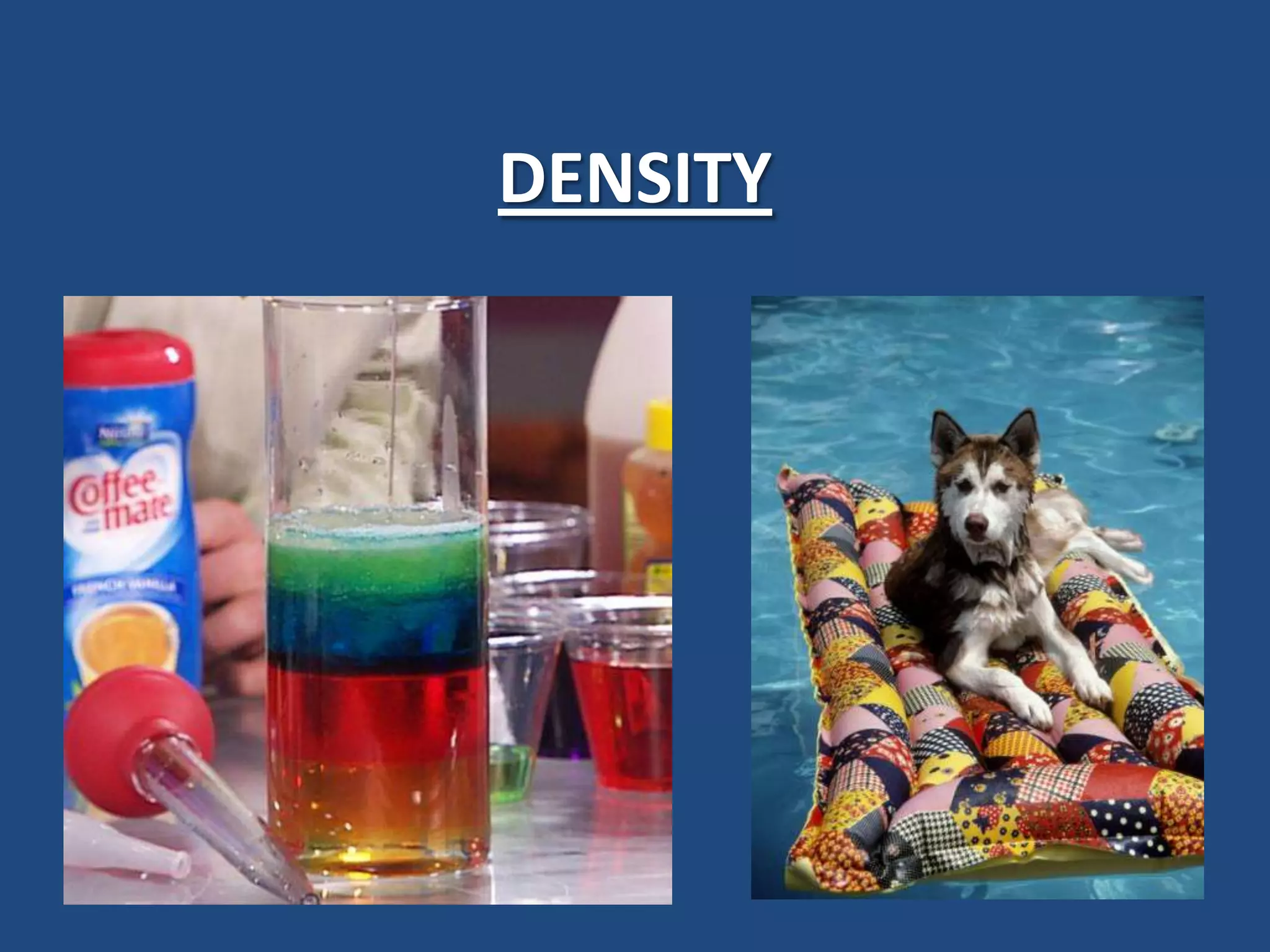
DENSITY
Warm-up:
Why is it easier for your body to float in the
ocean rather than in your swimming
pool?
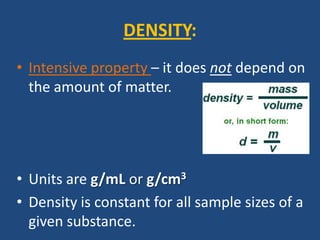
DENSITY:
• Intensive property – it does not depend on
the amount of matter.
• Units are g/mL or g/cm3
• Density is constant for all sample sizes of a
given substance.
Osmium is a very dense metal. What is its
density in g/cm3 if 50.00 g of the metal occupies
a volume of 2.22cm3?
1) 2.25 g/cm3
2) 22.5 g/cm3
3) 111 g/cm3
Practice Problem #1
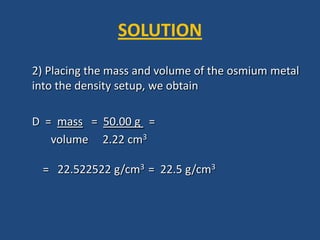
2) Placing the mass and volume of the osmium metal
into the density setup, we obtain
D = mass = 50.00 g =
volume 2.22 cm3
= 22.522522 g/cm3 = 22.5 g/cm3
SOLUTION
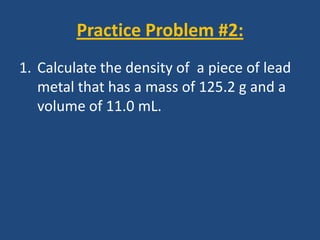
Practice Problem #2:
1. Calculate the density of a piece of lead
metal that has a mass of 125.2 g and a
volume of 11.0 mL.
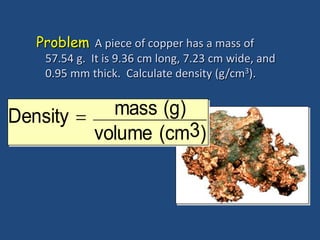
Problem A piece of copper has a mass of
57.54 g. It is 9.36 cm long, 7.23 cm wide, and
0.95 mm thick. Calculate density (g/cm3).
Density mass (g)
volume (cm3)
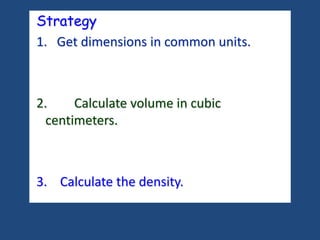
Strategy
1. Get dimensions in common units.
2. Calculate volume in cubic
centimeters.
3. Calculate the density.
SOLUTION
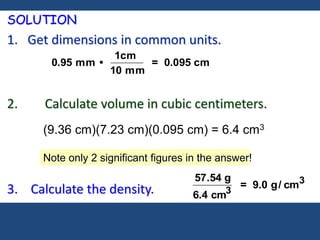
1. Get dimensions in common units.
2. Calculate volume in cubic centimeters.
3. Calculate the density.
0.95 mm •
1cm
10 mm
= 0.095 cm
57.54 g
6.4 cm3
= 9.0 g/ cm3
(9.36 cm)(7.23 cm)(0.095 cm) = 6.4 cm3
Note only 2 significant figures in the answer!
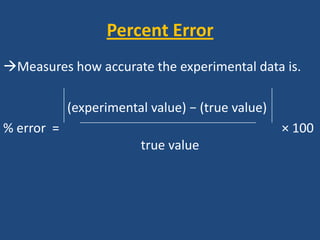
Percent Error
Measures how accurate the experimental data is.
(experimental value) − (true value)
% error = × 100
true value
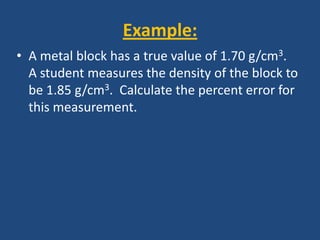
Example:
• A metal block has a true value of 1.70 g/cm3.
A student measures the density of the block to
be 1.85 g/cm3. Calculate the percent error for
this measurement.
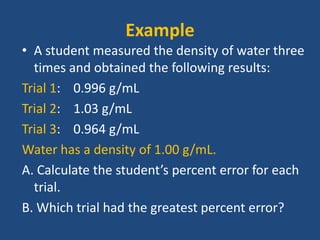
Example
• A student measured the density of water three
times and obtained the following results:
Trial 1: 0.996 g/mL
Trial 2: 1.03 g/mL
Trial 3: 0.964 g/mL
Water has a density of 1.00 g/mL.
A. Calculate the student’s percent error for each
trial.
B. Which trial had the greatest percent error?
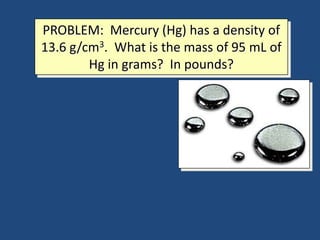
PROBLEM: Mercury (Hg) has a density of
13.6 g/cm3. What is the mass of 95 mL of
Hg in grams? In pounds?
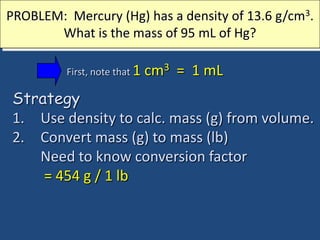
PROBLEM: Mercury (Hg) has a density of 13.6 g/cm3.
What is the mass of 95 mL of Hg?
Strategy
1. Use density to calc. mass (g) from volume.
2. Convert mass (g) to mass (lb)
Need to know conversion factor
= 454 g / 1 lb
First, note that 1 cm3 = 1 mL
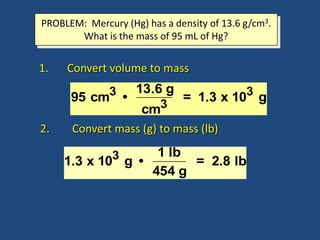
PROBLEM: Mercury (Hg) has a density of 13.6 g/cm3.
What is the mass of 95 mL of Hg?
1. Convert volume to mass
95 cm3 •
13.6 g
cm3
= 1.3 x 10³ g
1.3 x 10³ g •
1 lb
454 g
= 2.8 lb
2. Convert mass (g) to mass (lb)
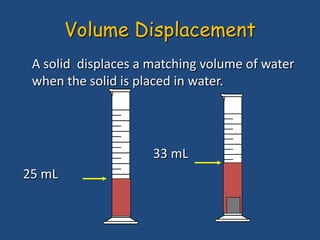
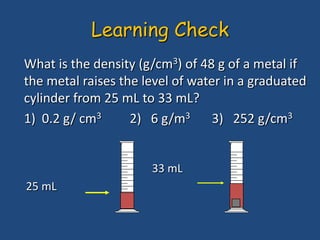
A solid displaces a matching volume of water
when the solid is placed in water.
33 mL
25 mL
Volume Displacement
What is the density (g/cm3) of 48 g of a metal if
the metal raises the level of water in a graduated
cylinder from 25 mL to 33 mL?
1) 0.2 g/ cm3 2) 6 g/m3 3) 252 g/cm3
33 mL
25 mL
Learning Check
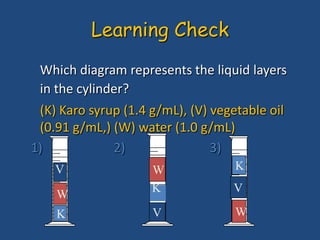
Which diagram represents the liquid layers
in the cylinder?
(K) Karo syrup (1.4 g/mL), (V) vegetable oil
(0.91 g/mL,) (W) water (1.0 g/mL)
1) 2) 3)
KW
W
V
VK
W
V
K
Learning Check
If blood has a density of 1.05 g/mL, how many
liters of blood are donated if 575 g of blood are
given?
1) 0.548 L
2) 1.25 L
3) 1.83 L
Learning Check
The density of octane, a component
of gasoline, is 0.702 g/mL. What is
the mass, in kg, of 875 mL of octane?
1) 0.614 kg
2) 614 kg
3) 1.25 kg
Learning Check
If blood has a density of 1.05 g/mL, how many
liters of blood are donated if 575 g of blood are
given?
1) 0.548 L
2) 1.25 L
3) 1.83 L
Learning Check
A group of students collected 125 empty
aluminum cans to take to the recycling center. If
21 cans make 1.0 pound of aluminum, how
many liters of aluminum (D=2.70 g/cm3) are
obtained from the cans?
1) 1.0 L 2) 2.0 L 3) 4.0 L
Learning Check

Density NOTES

  • 1.
  • 2.
    Warm-up: Why is iteasier for your body to float in the ocean rather than in your swimming pool?
  • 3.
    DENSITY: • Intensive property– it does not depend on the amount of matter. • Units are g/mL or g/cm3 • Density is constant for all sample sizes of a given substance.
  • 4.
    Osmium is avery dense metal. What is its density in g/cm3 if 50.00 g of the metal occupies a volume of 2.22cm3? 1) 2.25 g/cm3 2) 22.5 g/cm3 3) 111 g/cm3 Practice Problem #1
  • 5.
    2) Placing themass and volume of the osmium metal into the density setup, we obtain D = mass = 50.00 g = volume 2.22 cm3 = 22.522522 g/cm3 = 22.5 g/cm3 SOLUTION
  • 6.
    Practice Problem #2: 1.Calculate the density of a piece of lead metal that has a mass of 125.2 g and a volume of 11.0 mL.
  • 7.
    Problem A pieceof copper has a mass of 57.54 g. It is 9.36 cm long, 7.23 cm wide, and 0.95 mm thick. Calculate density (g/cm3). Density mass (g) volume (cm3)
  • 8.
    Strategy 1. Get dimensionsin common units. 2. Calculate volume in cubic centimeters. 3. Calculate the density.
  • 9.
    SOLUTION 1. Get dimensionsin common units. 2. Calculate volume in cubic centimeters. 3. Calculate the density. 0.95 mm • 1cm 10 mm = 0.095 cm 57.54 g 6.4 cm3 = 9.0 g/ cm3 (9.36 cm)(7.23 cm)(0.095 cm) = 6.4 cm3 Note only 2 significant figures in the answer!
  • 10.
    Percent Error Measures howaccurate the experimental data is. (experimental value) − (true value) % error = × 100 true value
  • 11.
    Example: • A metalblock has a true value of 1.70 g/cm3. A student measures the density of the block to be 1.85 g/cm3. Calculate the percent error for this measurement.
  • 12.
    Example • A studentmeasured the density of water three times and obtained the following results: Trial 1: 0.996 g/mL Trial 2: 1.03 g/mL Trial 3: 0.964 g/mL Water has a density of 1.00 g/mL. A. Calculate the student’s percent error for each trial. B. Which trial had the greatest percent error?
  • 13.
    PROBLEM: Mercury (Hg)has a density of 13.6 g/cm3. What is the mass of 95 mL of Hg in grams? In pounds?
  • 14.
    PROBLEM: Mercury (Hg)has a density of 13.6 g/cm3. What is the mass of 95 mL of Hg? Strategy 1. Use density to calc. mass (g) from volume. 2. Convert mass (g) to mass (lb) Need to know conversion factor = 454 g / 1 lb First, note that 1 cm3 = 1 mL
  • 15.
    PROBLEM: Mercury (Hg)has a density of 13.6 g/cm3. What is the mass of 95 mL of Hg? 1. Convert volume to mass 95 cm3 • 13.6 g cm3 = 1.3 x 10³ g 1.3 x 10³ g • 1 lb 454 g = 2.8 lb 2. Convert mass (g) to mass (lb)
  • 16.
    A solid displacesa matching volume of water when the solid is placed in water. 33 mL 25 mL Volume Displacement
  • 17.
    What is thedensity (g/cm3) of 48 g of a metal if the metal raises the level of water in a graduated cylinder from 25 mL to 33 mL? 1) 0.2 g/ cm3 2) 6 g/m3 3) 252 g/cm3 33 mL 25 mL Learning Check
  • 18.
    Which diagram representsthe liquid layers in the cylinder? (K) Karo syrup (1.4 g/mL), (V) vegetable oil (0.91 g/mL,) (W) water (1.0 g/mL) 1) 2) 3) KW W V VK W V K Learning Check
  • 19.
    If blood hasa density of 1.05 g/mL, how many liters of blood are donated if 575 g of blood are given? 1) 0.548 L 2) 1.25 L 3) 1.83 L Learning Check
  • 20.
    The density ofoctane, a component of gasoline, is 0.702 g/mL. What is the mass, in kg, of 875 mL of octane? 1) 0.614 kg 2) 614 kg 3) 1.25 kg Learning Check
  • 21.
    If blood hasa density of 1.05 g/mL, how many liters of blood are donated if 575 g of blood are given? 1) 0.548 L 2) 1.25 L 3) 1.83 L Learning Check
  • 22.
    A group ofstudents collected 125 empty aluminum cans to take to the recycling center. If 21 cans make 1.0 pound of aluminum, how many liters of aluminum (D=2.70 g/cm3) are obtained from the cans? 1) 1.0 L 2) 2.0 L 3) 4.0 L Learning Check