Ch 6 and 7 Review
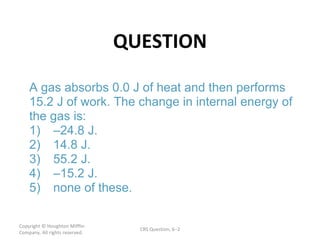
QUESTION Copyright  © Houghton Mifflin Company. All rights reserved. CRS Question, 6 –
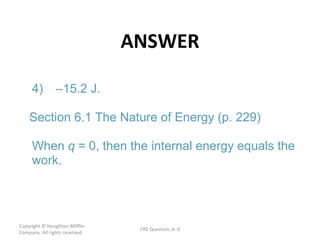
ANSWER Copyright  © Houghton Mifflin Company. All rights reserved. CRS Question, 6 – – q 4) 15.2 J. Section 6.1 The Nature of Energy (p. 229) When  = 0, then the internal energy equals the  work.
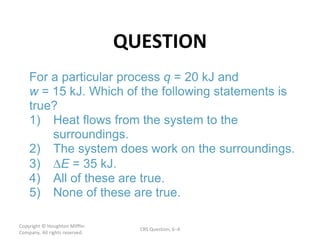
QUESTION Copyright  © Houghton Mifflin Company. All rights reserved. CRS Question, 6 –
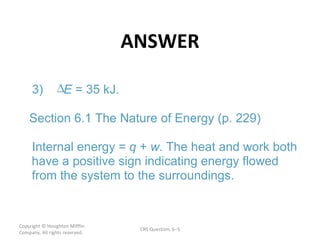
ANSWER Copyright  © Houghton Mifflin Company. All rights reserved. CRS Question, 6 – E q w 3)  = 35 kJ. Section 6.1 The Nature of Energy (p. 229) Internal energy =  +  . The heat and work both  have a positive sign indicating energy flowed  from the system to the surroundings.
QUESTION Copyright  © Houghton Mifflin Company. All rights reserved. CRS Question, 6 –
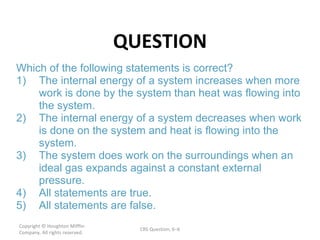
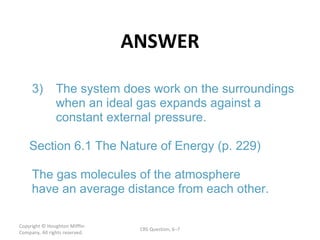
ANSWER Copyright  © Houghton Mifflin Company. All rights reserved. CRS Question, 6 – 3) The system does work on the surroundings  when an ideal gas expands against a  constant external pressure. Section 6.1 The Nature of Energy (p. 229) The gas molecules of the atmosphere  have an average distance from each other.
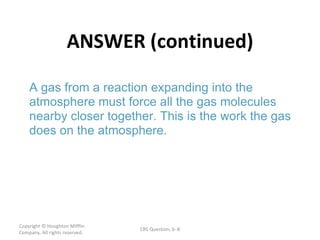
ANSWER (continued) Copyright  © Houghton Mifflin Company. All rights reserved. CRS Question, 6 –
QUESTION Copyright  © Houghton Mifflin Company. All rights reserved. CRS Question, 6 –
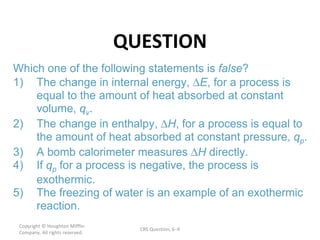
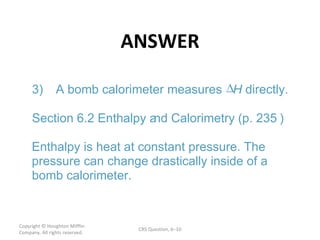
ANSWER Copyright  © Houghton Mifflin Company. All rights reserved. CRS Question, 6 –  ) 3) A bomb calorimeter measures  H directly. Section  6.2  Enthalpy a nd Calorimetry  (p. 235 Enthalpy is heat at constant pressure. The  pressure can change drastically inside of a  bomb calorimeter.
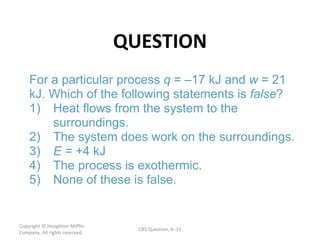
QUESTION Copyright  © Houghton Mifflin Company. All rights reserved. CRS Question, 6 –
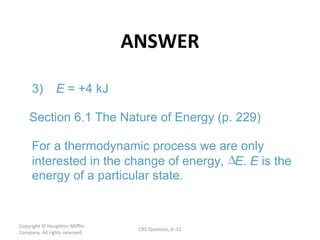
ANSWER Copyright  © Houghton Mifflin Company. All rights reserved. CRS Question, 6 – E  .  E 3) = +4 kJ Section 6.1 The Nature of Energy (p. 229) For a thermodynamic process we are only  interested in the change of energy,  E is the  energy of a particular state.
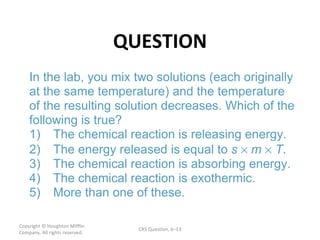
QUESTION Copyright  © Houghton Mifflin Company. All rights reserved. CRS Question, 6 –
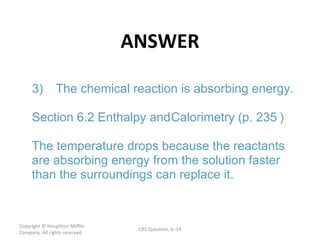
ANSWER Copyright  © Houghton Mifflin Company. All rights reserved. CRS Question, 6 – ) 3) The chemical reaction is absorbing energy. Section  6.2  Enthalpy and Calorimetry  (p. 235 The temperature drops because the reactants  are absorbing energy from the solution faster  than the surroundings can replace it.
QUESTION Copyright  © Houghton Mifflin Company. All rights reserved. CRS Question, 6 –
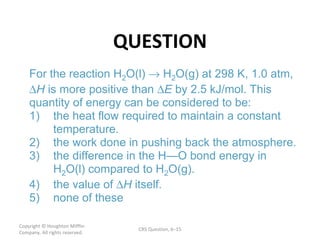
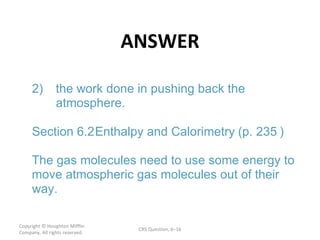
ANSWER Copyright  © Houghton Mifflin Company. All rights reserved. CRS Question, 6 – ) 2) the work done in pushing back the  atmosphere. Section  6.2  Enthalpy and Calorimetry  (p. 235 The gas molecules need to use some energy to  move atmospheric gas molecules out of their  way.
QUESTION Copyright  © Houghton Mifflin Company. All rights reserved. CRS Question, 6 –
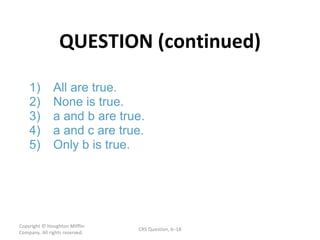
QUESTION (continued) Copyright  © Houghton Mifflin Company. All rights reserved. CRS Question, 6 –
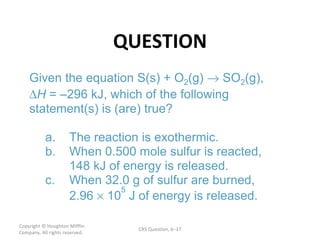
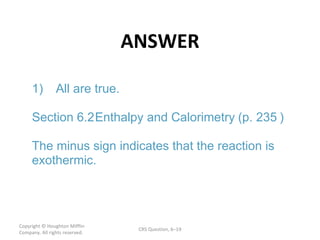
ANSWER Copyright  © Houghton Mifflin Company. All rights reserved. CRS Question, 6 – ) 1) All are true. Section  6.2  Enthalpy and Calorimetry  (p. 235 The minus sign indicates that the reaction is  exothermic.
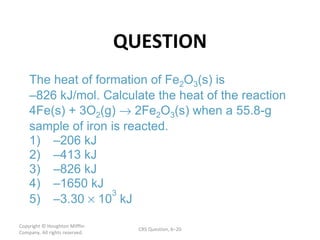
QUESTION Copyright  © Houghton Mifflin Company. All rights reserved. CRS Question, 6 –
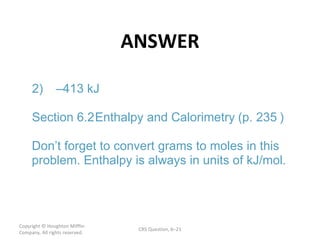
ANSWER Copyright  © Houghton Mifflin Company. All rights reserved. CRS Question, 6 – – ) 2) 413 kJ Section  6.2  Enthalpy and Calorimetry  (p. 235 Don’t forget to convert grams to moles in this  problem. Enthalpy is always in units of kJ/mol.
QUESTION Copyright  © Houghton Mifflin Company. All rights reserved. CRS Question, 6 –
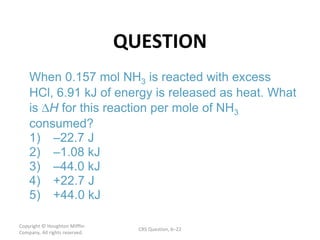
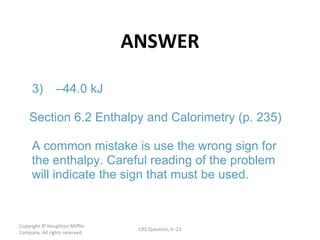
ANSWER Copyright  © Houghton Mifflin Company. All rights reserved. CRS Question, 6 – 3) – 44.0 kJ Section 6.2 Enthalpy and Calorimetry (p. 235) A common mistake is use the wrong sign for  the enthalpy. Careful reading of the problem  will indicate the sign that must be used.
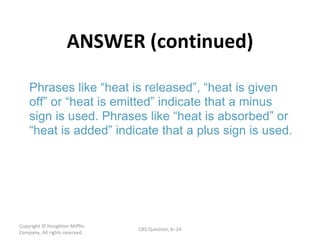
ANSWER (continued) Copyright  © Houghton Mifflin Company. All rights reserved. CRS Question, 6 –
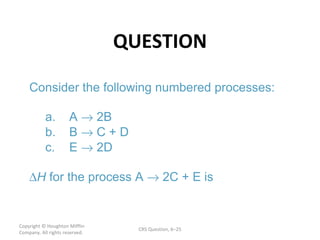
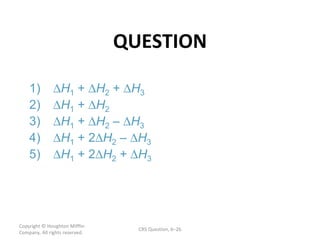
QUESTION Copyright  © Houghton Mifflin Company. All rights reserved. CRS Question, 6 –
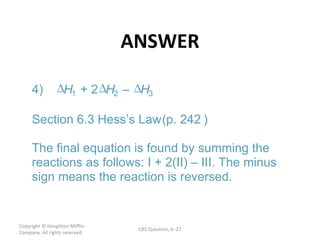
ANSWER Copyright  © Houghton Mifflin Company. All rights reserved. CRS Question, 6 – 1  –  3 ) – 4)  H + 2 H 2 H Section  6.3  Hess’s Law  (p. 242 The final equation is found by summing the  reactions as follows: I + 2(II)  III. The minus  sign means the reaction is reversed.
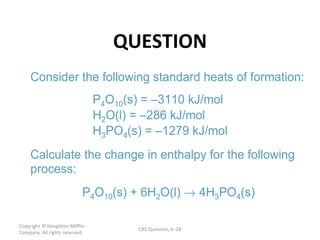
QUESTION Copyright  © Houghton Mifflin Company. All rights reserved. CRS Question, 6 –
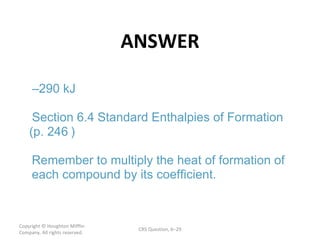
ANSWER Copyright  © Houghton Mifflin Company. All rights reserved. CRS Question, 6 – ) – 290 kJ Section  6.4  Standard Enthalpies of Formation (p. 246 Remember to multiply the heat of formation of  each compound by its coefficient.
QUESTION Copyright  © Houghton Mifflin Company. All rights reserved. CRS Question, 6 –
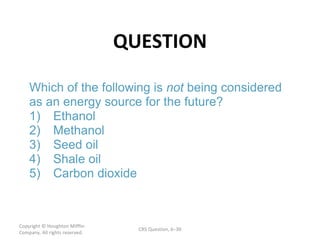
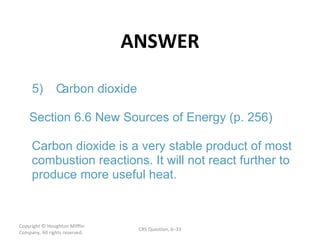
ANSWER Copyright  © Houghton Mifflin Company. All rights reserved. CRS Question, 6 – 5) C arbon dioxide Section 6.6 New Sources of Energy (p. 256) Carbon dioxide is a very stable product of most  combustion reactions. It will not react further to  produce more useful heat.
QUESTION Copyright  © Houghton Mifflin Company. All rights reserved. CRS Question, 7 –
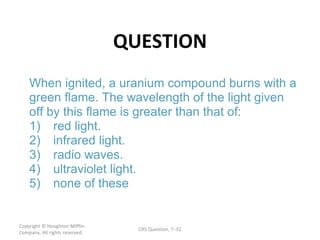
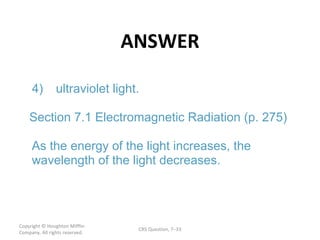
ANSWER Copyright  © Houghton Mifflin Company. All rights reserved. CRS Question, 7 – 4) ultraviolet light. Section 7.1 Electromagnetic Radiation (p. 275) As the energy of the light increases, the  wavelength of the light decreases.
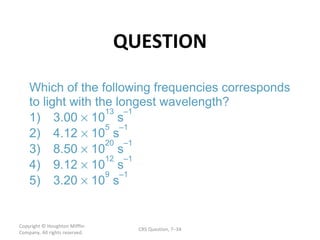
QUESTION Copyright  © Houghton Mifflin Company. All rights reserved. CRS Question, 7 –
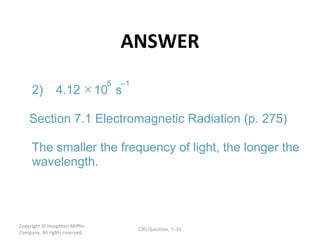
ANSWER Copyright  © Houghton Mifflin Company. All rights reserved. CRS Question, 7 –  5 – 2) 4.12  10 s 1 Section 7.1 Electromagnetic Radiation (p. 275) The smaller the frequency of light, the longer the  wavelength.
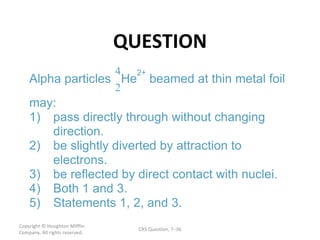
QUESTION Copyright  © Houghton Mifflin Company. All rights reserved. CRS Question, 7 –
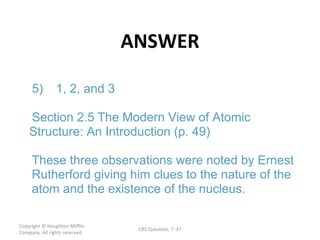
ANSWER Copyright  © Houghton Mifflin Company. All rights reserved. CRS Question, 7 – 5) 1, 2, and 3 Section 2.5 The Modern View of Atomic  Structure: An Introduction (p. 49) These three observations were noted by Ernest  Rutherford giving him clues to the nature of the  atom and the existence of the nucleus.
QUESTION Copyright  © Houghton Mifflin Company. All rights reserved. CRS Question, 7 –
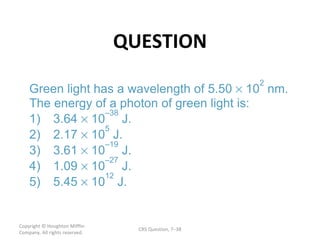
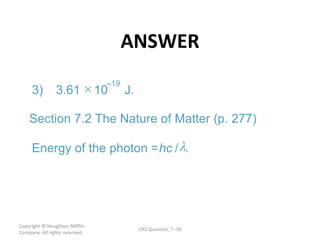
ANSWER Copyright  © Houghton Mifflin Company. All rights reserved. CRS Question, 7 –  19 hc  . 3) 3.61  10 – J. Section 7.2 The Nature of Matter (p. 277) Energy of the photon =  /
QUESTION Copyright  © Houghton Mifflin Company. All rights reserved. CRS Question, 7 –
QUESTION (continued) Copyright  © Houghton Mifflin Company. All rights reserved. CRS Question, 7 –
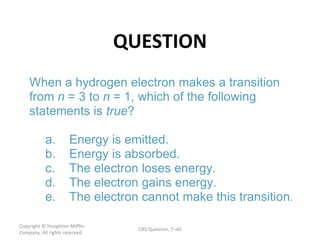
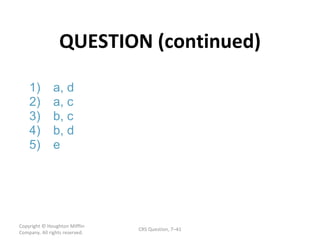
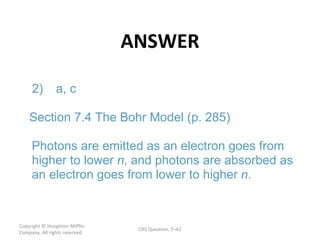
ANSWER Copyright  © Houghton Mifflin Company. All rights reserved. CRS Question, 7 – n n . 2) a, c Section 7.4 The Bohr Model (p. 285) Photons are emitted as an electron goes from  higher to lower  , and photons are absorbed as  an electron goes from lower to higher
QUESTION Copyright  © Houghton Mifflin Company. All rights reserved. CRS Question, 7 –
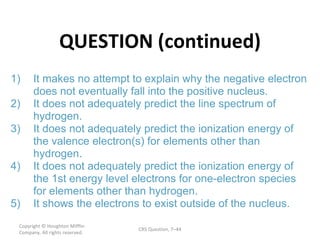
QUESTION (continued) Copyright  © Houghton Mifflin Company. All rights reserved. CRS Question, 7 –
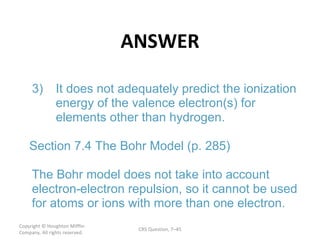
ANSWER Copyright  © Houghton Mifflin Company. All rights reserved. CRS Question, 7 – - 3) It does not adequately predict the ionization  energy of the valence electron(s) for  elements other than hydrogen. Section 7.4 The Bohr Model (p. 285) The Bohr model does not take into account  electron electron repulsion, so it cannot be used  for atoms or ions with more than on e electron.
QUESTION Copyright  © Houghton Mifflin Company. All rights reserved. CRS Question, 7 –
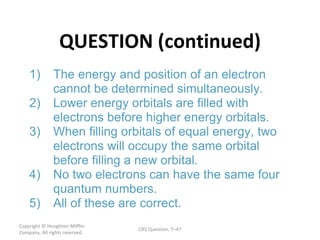
QUESTION (continued) Copyright  © Houghton Mifflin Company. All rights reserved. CRS Question, 7 –
ANSWER Copyright  © Houghton Mifflin Company. All rights reserved. CRS Question, 7 – – 3) When filling orbitals of equal energy, two  electrons will occupy the same orbital  before filling a new orbital. Section 7.5 The Quantum Mechanical Model of  the Atom (pp. 290 293) Electrons are charged and tend to keep as far  from each other as possible.
QUESTION Copyright  © Houghton Mifflin Company. All rights reserved. CRS Question, 7 –
ANSWER Copyright  © Houghton Mifflin Company. All rights reserved. CRS Question, 7 – l f l 1) 0 Section 7.7 Orbital Shapes and Energies (p. 295) For  n = 3,  can be 0, 1, or 2. An  orbital has an = 3.
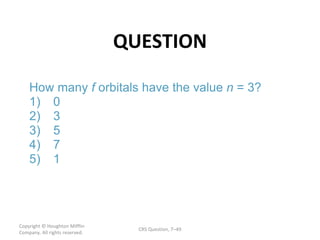
QUESTION Copyright  © Houghton Mifflin Company. All rights reserved. CRS Question, 7 –
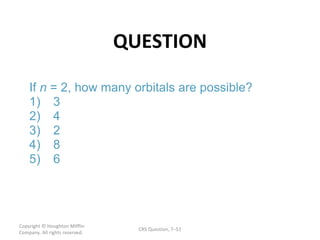
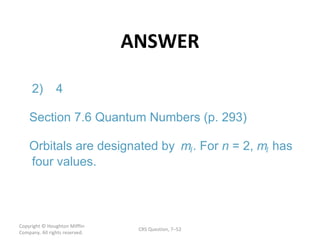
ANSWER Copyright  © Houghton Mifflin Company. All rights reserved. CRS Question, 7 – l n m l 2) 4 Section 7.6 Quantum Numbers (p. 293) Orbitals are designated by  m . For  = 2,  has  four values.
QUESTION Copyright  © Houghton Mifflin Company. All rights reserved. CRS Question, 7 –
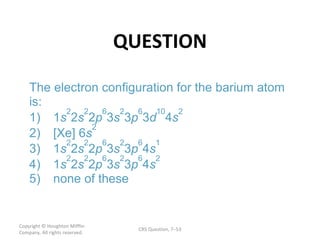
ANSWER Copyright  © Houghton Mifflin Company. All rights reserved. CRS Question, 7 – 2 - 2) [Xe] 6 s Section  7.11 The Aufbau Principle and the  Periodic Table (p. 302) [Xe] denotes a shorthand version of the electron  configuration for Xe. Noble gas configurations  are used to reduce writing time.
QUESTION Copyright  © Houghton Mifflin Company. All rights reserved. CRS Question, 7 –
QUESTION (continued) Copyright  © Houghton Mifflin Company. All rights reserved. CRS Question, 7 –
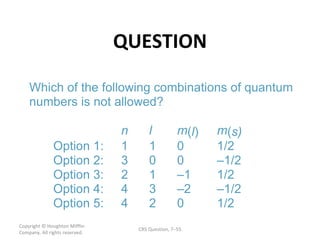
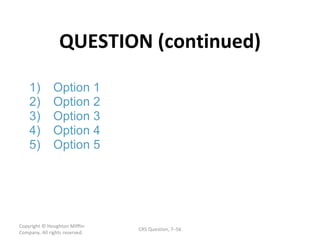
ANSWER Copyright  © Houghton Mifflin Company. All rights reserved. CRS Question, 7 – l n 1. 1) Option 1 Section 7.6 Quantum Numbers (p. 293) can have values of 0 to  –
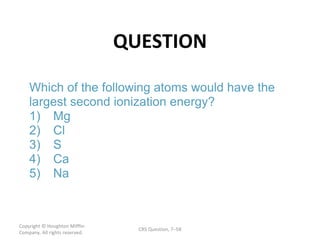
QUESTION Copyright  © Houghton Mifflin Company. All rights reserved. CRS Question, 7 –
ANSWER Copyright  © Houghton Mifflin Company. All rights reserved. CRS Question, 7 – 5) Na Section 7.12 Periodic Trends in Atomic  Properties (p. 309) Sodium has only one electron in its outer shell.  Once this has been removed the next electron  must come from the core electrons, requiring a  tremendous increase in energy.
QUESTION Copyright  © Houghton Mifflin Company. All rights reserved. CRS Question, 7 –
QUESTION (continued) Copyright  © Houghton Mifflin Company. All rights reserved. CRS Question, 7 –
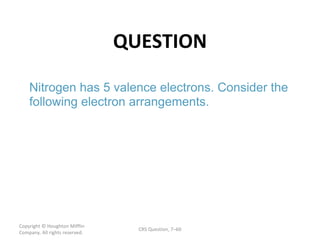
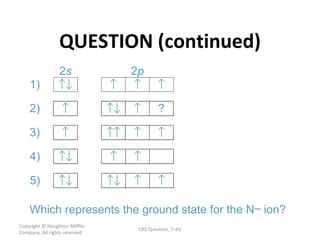
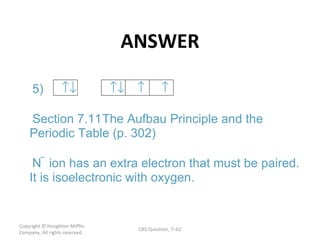
ANSWER Copyright  © Houghton Mifflin Company. All rights reserved. CRS Question, 7 –   – 5)     Section  7.11 The Aufbau Principle and the  Periodic Table (p. 302) N ion has an extra electron that must be paired.  It is isoelectronic with oxygen.
QUESTION Copyright  © Houghton Mifflin Company. All rights reserved. CRS Question, 7 –
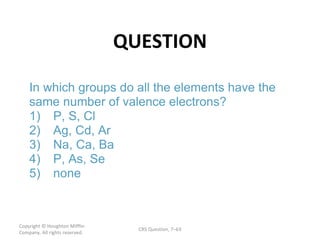
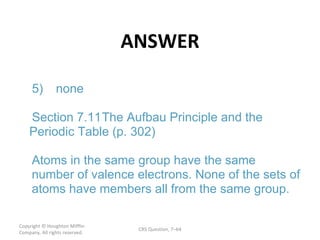
ANSWER Copyright  © Houghton Mifflin Company. All rights reserved. CRS Question, 7 – 5) none Section  7.11 The Aufbau Principle and the  Periodic Table (p. 302) Atoms in the same group have the same  number of valence electrons. None of the sets of  atoms have members all from the same group.
QUESTION Copyright  © Houghton Mifflin Company. All rights reserved. CRS Question, 7 –
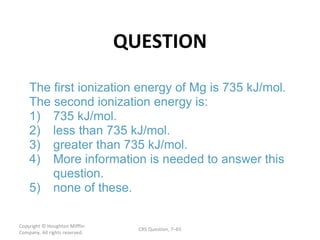
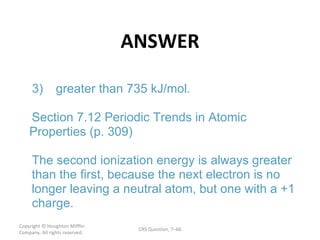
ANSWER Copyright  © Houghton Mifflin Company. All rights reserved. CRS Question, 7 – . 3) greater than 735 kJ/mol Section 7.12 Periodic Trends in Atomic  Properties (p. 309) The second ionization energy is always greater  than the first, because the next electron is no  longer leaving a neutral atom, but one with a +1  charge.

Ap Chem Chapters 6 And 7

  • 1.
    Ch 6 and7 Review
  • 2.
    QUESTION Copyright © Houghton Mifflin Company. All rights reserved. CRS Question, 6 –
  • 3.
    ANSWER Copyright © Houghton Mifflin Company. All rights reserved. CRS Question, 6 – – q 4) 15.2 J. Section 6.1 The Nature of Energy (p. 229) When = 0, then the internal energy equals the work.
  • 4.
    QUESTION Copyright © Houghton Mifflin Company. All rights reserved. CRS Question, 6 –
  • 5.
    ANSWER Copyright © Houghton Mifflin Company. All rights reserved. CRS Question, 6 – E q w 3)  = 35 kJ. Section 6.1 The Nature of Energy (p. 229) Internal energy = + . The heat and work both have a positive sign indicating energy flowed from the system to the surroundings.
  • 6.
    QUESTION Copyright © Houghton Mifflin Company. All rights reserved. CRS Question, 6 –
  • 7.
    ANSWER Copyright © Houghton Mifflin Company. All rights reserved. CRS Question, 6 – 3) The system does work on the surroundings when an ideal gas expands against a constant external pressure. Section 6.1 The Nature of Energy (p. 229) The gas molecules of the atmosphere have an average distance from each other.
  • 8.
    ANSWER (continued) Copyright © Houghton Mifflin Company. All rights reserved. CRS Question, 6 –
  • 9.
    QUESTION Copyright © Houghton Mifflin Company. All rights reserved. CRS Question, 6 –
  • 10.
    ANSWER Copyright © Houghton Mifflin Company. All rights reserved. CRS Question, 6 –  ) 3) A bomb calorimeter measures H directly. Section 6.2 Enthalpy a nd Calorimetry (p. 235 Enthalpy is heat at constant pressure. The pressure can change drastically inside of a bomb calorimeter.
  • 11.
    QUESTION Copyright © Houghton Mifflin Company. All rights reserved. CRS Question, 6 –
  • 12.
    ANSWER Copyright © Houghton Mifflin Company. All rights reserved. CRS Question, 6 – E  . E 3) = +4 kJ Section 6.1 The Nature of Energy (p. 229) For a thermodynamic process we are only interested in the change of energy, E is the energy of a particular state.
  • 13.
    QUESTION Copyright © Houghton Mifflin Company. All rights reserved. CRS Question, 6 –
  • 14.
    ANSWER Copyright © Houghton Mifflin Company. All rights reserved. CRS Question, 6 – ) 3) The chemical reaction is absorbing energy. Section 6.2 Enthalpy and Calorimetry (p. 235 The temperature drops because the reactants are absorbing energy from the solution faster than the surroundings can replace it.
  • 15.
    QUESTION Copyright © Houghton Mifflin Company. All rights reserved. CRS Question, 6 –
  • 16.
    ANSWER Copyright © Houghton Mifflin Company. All rights reserved. CRS Question, 6 – ) 2) the work done in pushing back the atmosphere. Section 6.2 Enthalpy and Calorimetry (p. 235 The gas molecules need to use some energy to move atmospheric gas molecules out of their way.
  • 17.
    QUESTION Copyright © Houghton Mifflin Company. All rights reserved. CRS Question, 6 –
  • 18.
    QUESTION (continued) Copyright © Houghton Mifflin Company. All rights reserved. CRS Question, 6 –
  • 19.
    ANSWER Copyright © Houghton Mifflin Company. All rights reserved. CRS Question, 6 – ) 1) All are true. Section 6.2 Enthalpy and Calorimetry (p. 235 The minus sign indicates that the reaction is exothermic.
  • 20.
    QUESTION Copyright © Houghton Mifflin Company. All rights reserved. CRS Question, 6 –
  • 21.
    ANSWER Copyright © Houghton Mifflin Company. All rights reserved. CRS Question, 6 – – ) 2) 413 kJ Section 6.2 Enthalpy and Calorimetry (p. 235 Don’t forget to convert grams to moles in this problem. Enthalpy is always in units of kJ/mol.
  • 22.
    QUESTION Copyright © Houghton Mifflin Company. All rights reserved. CRS Question, 6 –
  • 23.
    ANSWER Copyright © Houghton Mifflin Company. All rights reserved. CRS Question, 6 – 3) – 44.0 kJ Section 6.2 Enthalpy and Calorimetry (p. 235) A common mistake is use the wrong sign for the enthalpy. Careful reading of the problem will indicate the sign that must be used.
  • 24.
    ANSWER (continued) Copyright © Houghton Mifflin Company. All rights reserved. CRS Question, 6 –
  • 25.
    QUESTION Copyright © Houghton Mifflin Company. All rights reserved. CRS Question, 6 –
  • 26.
    QUESTION Copyright © Houghton Mifflin Company. All rights reserved. CRS Question, 6 –
  • 27.
    ANSWER Copyright © Houghton Mifflin Company. All rights reserved. CRS Question, 6 – 1  –  3 ) – 4)  H + 2 H 2 H Section 6.3 Hess’s Law (p. 242 The final equation is found by summing the reactions as follows: I + 2(II) III. The minus sign means the reaction is reversed.
  • 28.
    QUESTION Copyright © Houghton Mifflin Company. All rights reserved. CRS Question, 6 –
  • 29.
    ANSWER Copyright © Houghton Mifflin Company. All rights reserved. CRS Question, 6 – ) – 290 kJ Section 6.4 Standard Enthalpies of Formation (p. 246 Remember to multiply the heat of formation of each compound by its coefficient.
  • 30.
    QUESTION Copyright © Houghton Mifflin Company. All rights reserved. CRS Question, 6 –
  • 31.
    ANSWER Copyright © Houghton Mifflin Company. All rights reserved. CRS Question, 6 – 5) C arbon dioxide Section 6.6 New Sources of Energy (p. 256) Carbon dioxide is a very stable product of most combustion reactions. It will not react further to produce more useful heat.
  • 32.
    QUESTION Copyright © Houghton Mifflin Company. All rights reserved. CRS Question, 7 –
  • 33.
    ANSWER Copyright © Houghton Mifflin Company. All rights reserved. CRS Question, 7 – 4) ultraviolet light. Section 7.1 Electromagnetic Radiation (p. 275) As the energy of the light increases, the wavelength of the light decreases.
  • 34.
    QUESTION Copyright © Houghton Mifflin Company. All rights reserved. CRS Question, 7 –
  • 35.
    ANSWER Copyright © Houghton Mifflin Company. All rights reserved. CRS Question, 7 –  5 – 2) 4.12 10 s 1 Section 7.1 Electromagnetic Radiation (p. 275) The smaller the frequency of light, the longer the wavelength.
  • 36.
    QUESTION Copyright © Houghton Mifflin Company. All rights reserved. CRS Question, 7 –
  • 37.
    ANSWER Copyright © Houghton Mifflin Company. All rights reserved. CRS Question, 7 – 5) 1, 2, and 3 Section 2.5 The Modern View of Atomic Structure: An Introduction (p. 49) These three observations were noted by Ernest Rutherford giving him clues to the nature of the atom and the existence of the nucleus.
  • 38.
    QUESTION Copyright © Houghton Mifflin Company. All rights reserved. CRS Question, 7 –
  • 39.
    ANSWER Copyright © Houghton Mifflin Company. All rights reserved. CRS Question, 7 –  19 hc  . 3) 3.61 10 – J. Section 7.2 The Nature of Matter (p. 277) Energy of the photon = /
  • 40.
    QUESTION Copyright © Houghton Mifflin Company. All rights reserved. CRS Question, 7 –
  • 41.
    QUESTION (continued) Copyright © Houghton Mifflin Company. All rights reserved. CRS Question, 7 –
  • 42.
    ANSWER Copyright © Houghton Mifflin Company. All rights reserved. CRS Question, 7 – n n . 2) a, c Section 7.4 The Bohr Model (p. 285) Photons are emitted as an electron goes from higher to lower , and photons are absorbed as an electron goes from lower to higher
  • 43.
    QUESTION Copyright © Houghton Mifflin Company. All rights reserved. CRS Question, 7 –
  • 44.
    QUESTION (continued) Copyright © Houghton Mifflin Company. All rights reserved. CRS Question, 7 –
  • 45.
    ANSWER Copyright © Houghton Mifflin Company. All rights reserved. CRS Question, 7 – - 3) It does not adequately predict the ionization energy of the valence electron(s) for elements other than hydrogen. Section 7.4 The Bohr Model (p. 285) The Bohr model does not take into account electron electron repulsion, so it cannot be used for atoms or ions with more than on e electron.
  • 46.
    QUESTION Copyright © Houghton Mifflin Company. All rights reserved. CRS Question, 7 –
  • 47.
    QUESTION (continued) Copyright © Houghton Mifflin Company. All rights reserved. CRS Question, 7 –
  • 48.
    ANSWER Copyright © Houghton Mifflin Company. All rights reserved. CRS Question, 7 – – 3) When filling orbitals of equal energy, two electrons will occupy the same orbital before filling a new orbital. Section 7.5 The Quantum Mechanical Model of the Atom (pp. 290 293) Electrons are charged and tend to keep as far from each other as possible.
  • 49.
    QUESTION Copyright © Houghton Mifflin Company. All rights reserved. CRS Question, 7 –
  • 50.
    ANSWER Copyright © Houghton Mifflin Company. All rights reserved. CRS Question, 7 – l f l 1) 0 Section 7.7 Orbital Shapes and Energies (p. 295) For n = 3, can be 0, 1, or 2. An orbital has an = 3.
  • 51.
    QUESTION Copyright © Houghton Mifflin Company. All rights reserved. CRS Question, 7 –
  • 52.
    ANSWER Copyright © Houghton Mifflin Company. All rights reserved. CRS Question, 7 – l n m l 2) 4 Section 7.6 Quantum Numbers (p. 293) Orbitals are designated by m . For = 2, has four values.
  • 53.
    QUESTION Copyright © Houghton Mifflin Company. All rights reserved. CRS Question, 7 –
  • 54.
    ANSWER Copyright © Houghton Mifflin Company. All rights reserved. CRS Question, 7 – 2 - 2) [Xe] 6 s Section 7.11 The Aufbau Principle and the Periodic Table (p. 302) [Xe] denotes a shorthand version of the electron configuration for Xe. Noble gas configurations are used to reduce writing time.
  • 55.
    QUESTION Copyright © Houghton Mifflin Company. All rights reserved. CRS Question, 7 –
  • 56.
    QUESTION (continued) Copyright © Houghton Mifflin Company. All rights reserved. CRS Question, 7 –
  • 57.
    ANSWER Copyright © Houghton Mifflin Company. All rights reserved. CRS Question, 7 – l n 1. 1) Option 1 Section 7.6 Quantum Numbers (p. 293) can have values of 0 to –
  • 58.
    QUESTION Copyright © Houghton Mifflin Company. All rights reserved. CRS Question, 7 –
  • 59.
    ANSWER Copyright © Houghton Mifflin Company. All rights reserved. CRS Question, 7 – 5) Na Section 7.12 Periodic Trends in Atomic Properties (p. 309) Sodium has only one electron in its outer shell. Once this has been removed the next electron must come from the core electrons, requiring a tremendous increase in energy.
  • 60.
    QUESTION Copyright © Houghton Mifflin Company. All rights reserved. CRS Question, 7 –
  • 61.
    QUESTION (continued) Copyright © Houghton Mifflin Company. All rights reserved. CRS Question, 7 –
  • 62.
    ANSWER Copyright © Houghton Mifflin Company. All rights reserved. CRS Question, 7 –   – 5)     Section 7.11 The Aufbau Principle and the Periodic Table (p. 302) N ion has an extra electron that must be paired. It is isoelectronic with oxygen.
  • 63.
    QUESTION Copyright © Houghton Mifflin Company. All rights reserved. CRS Question, 7 –
  • 64.
    ANSWER Copyright © Houghton Mifflin Company. All rights reserved. CRS Question, 7 – 5) none Section 7.11 The Aufbau Principle and the Periodic Table (p. 302) Atoms in the same group have the same number of valence electrons. None of the sets of atoms have members all from the same group.
  • 65.
    QUESTION Copyright © Houghton Mifflin Company. All rights reserved. CRS Question, 7 –
  • 66.
    ANSWER Copyright © Houghton Mifflin Company. All rights reserved. CRS Question, 7 – . 3) greater than 735 kJ/mol Section 7.12 Periodic Trends in Atomic Properties (p. 309) The second ionization energy is always greater than the first, because the next electron is no longer leaving a neutral atom, but one with a +1 charge.

Editor's Notes

  • #6 HMCLASS PRESENT: Animation: Work vs. Energy Flow HMCLASS PREP: Figure 6.4
  • #15 HMCLASS PRESENT: Video: Ammonium Chloride and Barium Hydroxide
  • #28 HMCLASS PRESENT: Animation: Hess’s Law HMCLASS PREP: Figure 6.7
  • #34 HMCLASS PREP: Figure 7.2
  • #38 HMCLASS PREP: Figure 2.13 STUDENT CD: Visualization: Scattering of Alpha Particles by Gold Foil
  • #51 HMCLASS PREP: Figure 7.17
  • #53 HMCLASS PREP: Table 7.2
  • #60 HMCLASS PREP: Table 7.5
  • #67 HMCLASS PREP: Table 7.5