Chapter 14 Chemical  Kinetics John D. Bookstaver St. Charles Community College Cottleville, MO Chemistry, The Central Science , 11th edition Theodore L. Brown; H. Eugene LeMay, Jr.; and Bruce E. Bursten
Kinetics In kinetics we study the rate at which a chemical process occurs. Besides information about the speed at which reactions occur, kinetics also sheds light on the  reaction mechanism  (exactly  how  the reaction occurs).
Factors That Affect Reaction Rates Physical State of the Reactants In order to react, molecules must come in contact with each other. The more homogeneous the mixture of reactants, the faster the molecules can react.
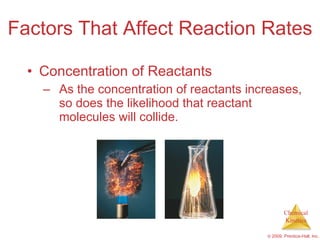
Factors That Affect Reaction Rates Concentration of Reactants As the concentration of reactants increases, so does the likelihood that reactant molecules will collide.
Factors That Affect Reaction Rates Temperature At higher temperatures, reactant molecules have more kinetic energy, move faster, and collide more often and with greater energy.
Factors That Affect Reaction Rates Presence of a Catalyst Catalysts speed up reactions by changing the mechanism of the reaction. Catalysts are not consumed during the course of the reaction.
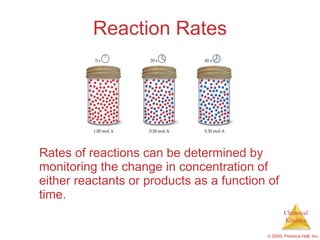
Reaction Rates Rates of reactions can be determined by monitoring the change in concentration of either reactants or products as a function of time.
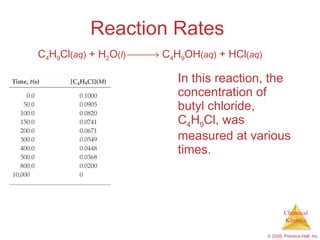
Reaction Rates  In this reaction, the concentration of butyl chloride, C 4 H 9 Cl, was measured at various times. C 4 H 9 Cl ( aq )  + H 2 O ( l )     C 4 H 9 OH ( aq )  + HCl ( aq )
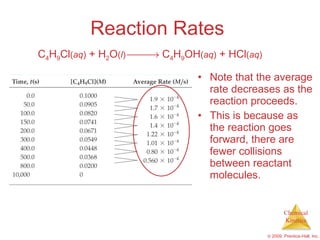
Reaction Rates  The average rate of the reaction over each interval is the change in concentration divided by the change in time: C 4 H 9 Cl ( aq )  + H 2 O ( l )     C 4 H 9 OH ( aq )  + HCl ( aq )   Average rate =  [C 4 H 9 Cl]  t
Reaction Rates  Note that the average rate decreases as the reaction proceeds. This is because as the reaction goes forward, there are fewer collisions between reactant molecules. C 4 H 9 Cl ( aq )  + H 2 O ( l )     C 4 H 9 OH ( aq )  + HCl ( aq )
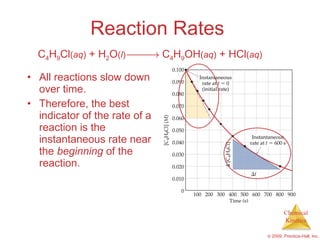
Reaction Rates  A plot of [C 4 H 9 Cl] vs. time for this reaction yields a curve like this. The slope of a line tangent to the curve at any point is the  instantaneous rate  at that time. C 4 H 9 Cl ( aq )  + H 2 O ( l )     C 4 H 9 OH ( aq )  + HCl ( aq )
Reaction Rates  All reactions slow down over time. Therefore, the best indicator of the rate of a reaction is the instantaneous rate near the  beginning  of the reaction. C 4 H 9 Cl ( aq )  + H 2 O ( l )     C 4 H 9 OH ( aq )  + HCl ( aq )
Reaction Rates and Stoichiometry  In this reaction, the ratio of C 4 H 9 Cl to C 4 H 9 OH is 1:1. Thus, the rate of disappearance of C 4 H 9 Cl is the same as the rate of appearance of C 4 H 9 OH. C 4 H 9 Cl ( aq )  + H 2 O ( l )     C 4 H 9 OH ( aq )  + HCl ( aq )   Rate = -  [C 4 H 9 Cl]  t =  [C 4 H 9 OH]  t
Reaction Rates and Stoichiometry What if the ratio is  not  1:1? 2 HI ( g )      H 2 ( g )  + I 2 ( g ) In such a case , Rate =  − 1 2  [HI]  t =  [I 2 ]  t
Reaction Rates and Stoichiometry To generalize, then, for the reaction a A +  b B  c C +  d D Rate =  − 1 a  [A]  t =  − 1 b  [B]  t = 1 c  [C]  t 1 d  [D]  t =
Concentration and Rate One can gain information about the rate of a reaction by seeing how the rate changes with changes in concentration.
Concentration and Rate If we compare Experiments 1 and 2, we see that when [NH 4 + ] doubles, the initial rate doubles. NH 4 + ( aq )  + NO 2 − ( aq ) N 2 ( g )  + 2 H 2 O ( l )
Concentration and Rate Likewise, when we compare Experiments 5 and 6, we see that when [NO 2 − ] doubles, the initial rate doubles. NH 4 + ( aq )  + NO 2 − ( aq ) N 2 ( g )  + 2 H 2 O ( l )
Concentration and Rate This means Rate    [NH 4 + ] Rate    [NO 2 − ] Rate    [NH 4 + ] [NO 2 − ] which, when written as an equation, becomes Rate =  k  [NH 4 + ] [NO 2 − ] This equation is called the  rate law , and  k  is the  rate constant . Therefore,
Rate Laws A rate law shows the relationship between the reaction rate and the concentrations of reactants. The exponents tell the  order  of the reaction with respect to each reactant. Since the rate law is Rate =  k  [NH 4 + ] [NO 2 − ]  the reaction is First-order in [NH 4 + ] and First-order in [NO 2 − ].
Rate Laws Rate =  k  [NH 4 + ] [NO 2 − ] The overall reaction order can be found by adding the exponents on the reactants in the rate law. This reaction is second-order overall.
Integrated Rate Laws Using calculus to integrate the rate law for a first-order process gives us Where [A] 0  is the initial concentration of A, and [A] t  is the concentration of A at some time,  t , during the course of the reaction. ln [A] t [A] 0 =  − k t
Integrated Rate Laws Manipulating this equation produces…  ln [A] t   −  ln [A] 0  =  −   k t ln [A] t  =  −   k t + ln [A] 0 … which is in the form y   =  mx  +  b ln [A] t [A] 0 =  − k t
First-Order Processes Therefore, if a reaction is first-order, a plot of ln [A] vs.  t  will yield a straight line, and the slope of the line will be - k . ln [A] t  =  - k t + ln [A] 0
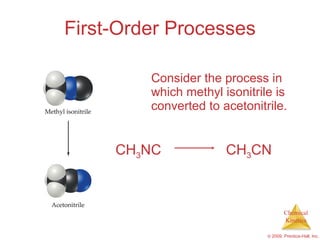
First-Order Processes Consider the process in which methyl isonitrile is converted to acetonitrile. CH 3 NC CH 3 CN
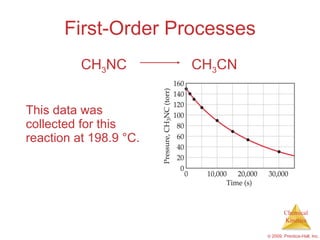
First-Order Processes This data was collected for this reaction at 198.9  ° C. CH 3 NC CH 3 CN
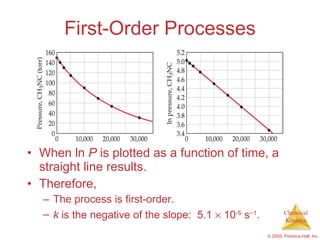
First-Order Processes When ln  P  is plotted as a function of time, a straight line results. Therefore, The process is first-order. k  is the negative of the slope:  5.1    10 -5  s − 1 .
Second-Order Processes Similarly, integrating the rate law for a process that is second-order in reactant A, we get also in the form y   =  mx +  b 1 [A] t =  kt  + 1 [A] 0
Second-Order Processes So if a process is second-order in A, a plot of  vs.  t  will yield a straight line, and the slope of that line is  k . 1 [A] t =  kt  + 1 [A] 0 1 [A]
Second-Order Processes The decomposition of NO 2  at 300 ° C is described by the equation and yields data comparable to this: NO 2   ( g ) NO  ( g )  +  O 2   ( g ) 0.00380 300.0 0.00481 200.0 0.00649 100.0 0.00787 50.0 0.01000 0.0 [NO 2 ],  M Time ( s ) 1 2
Second-Order Processes Plotting ln [NO 2 ] vs .   t  yields the graph at the right. The plot is  not  a straight line, so the process is  not  first-order in [A]. 0.00380 0.00481 0.00649 0.00787 0.01000 [NO 2 ],  M − 5.573 − 5.337 − 5.038 − 4.845 − 4.610 ln [NO 2 ] 300.0 200.0 100.0 50.0 0.0 Time ( s )
Second-Order Processes Graphing ln  vs.  t , however, gives this plot. Because this  is  a straight line, the process is second-order in [A]. 0.00380 0.00481 0.00649 0.00787 0.01000 [NO 2 ],  M 263 208 154 127 100 1/[NO 2 ] 300.0 200.0 100.0 50.0 0.0 Time ( s ) 1 [NO 2 ]
Half-Life Half-life is defined as the time required for one-half of a reactant to react. Because [A] at  t 1/2  is one-half of the original [A],  [A] t  = 0.5 [A] 0 .
Half-Life For a first-order process, this becomes ln 0.5 =  − kt 1/2 − 0.693 =  − kt 1/2 NOTE: For a first-order process, then, the half-life  does not  depend on [A] 0 . 0.5 [A] 0 [A] 0 ln =  − kt 1/2 =  t 1/2 0.693 k
Half-Life For a second-order process,  1 0.5 [A] 0 =  kt 1/2  +  1 [A] 0 2 [A] 0 =  kt 1/2  +  1 [A] 0 2  −  1 [A] 0 =  kt 1/2 1 [A] 0 = =  t 1/2 1 k [A] 0
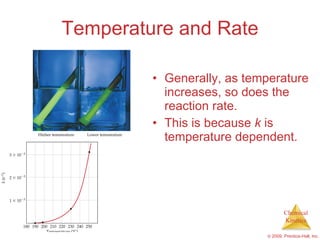
Temperature and Rate Generally, as temperature increases, so does the reaction rate. This is because  k  is temperature dependent.
The Collision Model In a chemical reaction, bonds are broken and new bonds are formed. Molecules can only react if they collide with each other.
The Collision Model Furthermore, molecules must collide with the correct  orientation  and with enough  energy  to cause bond breakage and formation.
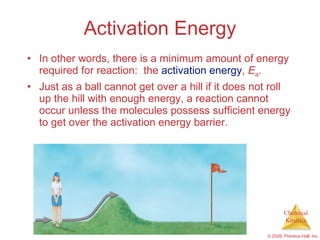
Activation Energy In other words, there is a minimum amount of energy required for reaction:  the  activation energy ,  E a . Just as a ball cannot get over a hill if it does not roll up the hill with enough energy, a reaction cannot occur unless the molecules possess sufficient energy to get over the activation energy barrier.
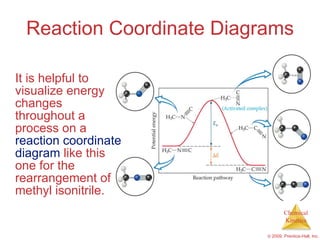
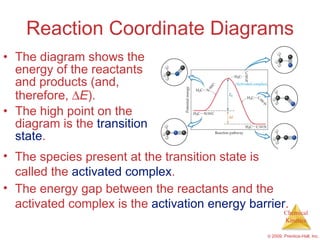
Reaction Coordinate Diagrams It is helpful to visualize energy changes throughout a process on a  reaction coordinate diagram  like this one for the rearrangement of methyl isonitrile.
Reaction Coordinate Diagrams The diagram shows the energy of the reactants and products (and, therefore,   E ). The high point on the diagram is the  transition state . The species present at the transition state is called the  activated complex . The energy gap between the reactants and the activated complex is the  activation energy barrier .
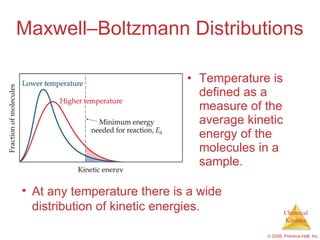
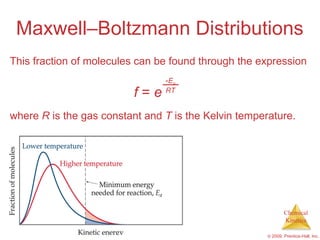
Maxwell – Boltzmann Distributions Temperature is defined as a measure of the average kinetic energy of the molecules in a sample. At any temperature there is a wide distribution of kinetic energies.
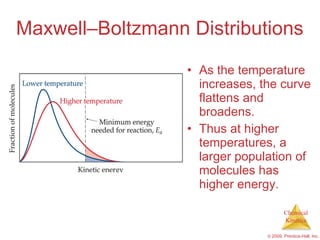
Maxwell – Boltzmann Distributions As the temperature increases, the curve flattens and broadens. Thus at higher temperatures, a larger population of molecules has higher energy.
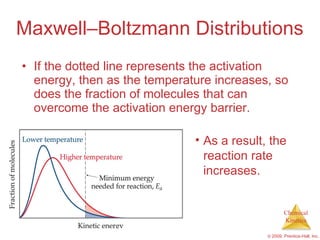
Maxwell – Boltzmann Distributions If the dotted line represents the activation energy, then as the temperature increases, so does the fraction of molecules that can overcome the activation energy barrier. As a result, the reaction rate increases.
Maxwell – Boltzmann Distributions This fraction of molecules can be found through the expression where  R  is the gas constant and  T  is the Kelvin temperature. f  =  e - E a RT
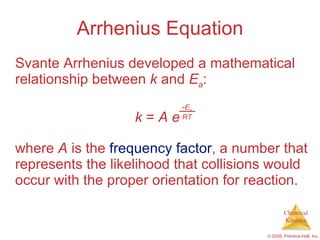
Arrhenius Equation Svante Arrhenius developed a mathematical relationship between  k  and  E a : k  =  A e where  A  is the  frequency factor , a number that represents the likelihood that collisions would occur with the proper orientation for reaction. - E a RT
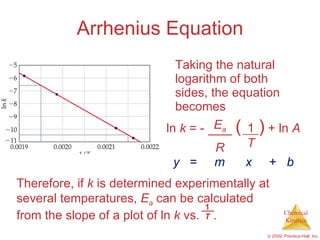
Arrhenius Equation Taking the natural logarithm of both sides, the equation becomes ln  k  = -  (   )  + ln  A y   =  m  x   +   b Therefore, if  k  is determined experimentally at several temperatures,  E a   can be calculated from the slope of a plot of ln  k  vs.  . 1 T E a R 1 T
Reaction Mechanisms The sequence of events that describes the actual process by which reactants become products is called the  reaction mechanism .
Reaction Mechanisms Reactions may occur all at once or through several discrete steps. Each of these processes is known as an  elementary reaction  or  elementary process .
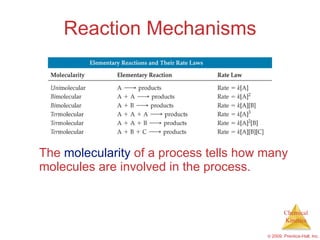
Reaction Mechanisms The  molecularity  of a process tells how many molecules are involved in the process.
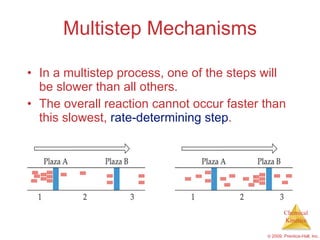
Multistep Mechanisms In a multistep process, one of the steps will be slower than all others. The overall reaction cannot occur faster than this slowest,  rate-determining step .
Slow Initial Step The rate law for this reaction is found experimentally to be Rate =  k  [NO 2 ] 2 CO is necessary for this reaction to occur, but the  rate  of the reaction does not depend on its concentration. This suggests the reaction occurs in two steps. NO 2   ( g )  + CO  ( g )     NO  ( g )  + CO 2   ( g )
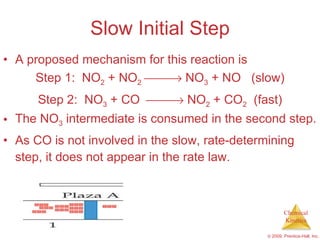
Slow Initial Step A proposed mechanism for this reaction is Step 1:  NO 2  + NO 2     NO 3  + NO  (slow) Step 2:  NO 3  + CO    NO 2  + CO 2   (fast) The NO 3  intermediate is consumed in the second step. As CO is not involved in the slow, rate-determining step, it does not appear in the rate law.
Fast Initial Step The rate law for this reaction is found to be Rate =  k  [NO] 2  [Br 2 ] Because termolecular processes are rare, this rate law suggests a two-step mechanism. 2 NO  ( g )  + Br 2   ( g )     2 NOBr  ( g )
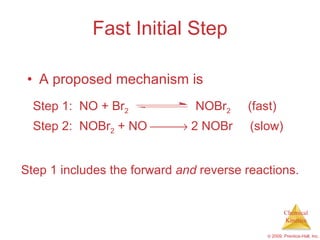
Fast Initial Step A proposed mechanism is Step 2:  NOBr 2  + NO    2 NOBr  (slow) Step 1 includes the forward  and  reverse reactions. Step 1:  NO + Br 2 NOBr 2   (fast)
Fast Initial Step The rate of the overall reaction depends upon the rate of the slow step. The rate law for that step would be Rate =  k 2  [NOBr 2 ] [NO] But how can we find [NOBr 2 ]?
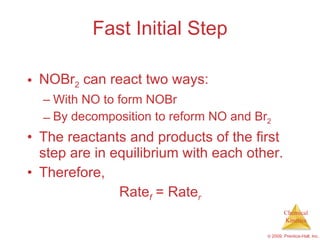
Fast Initial Step NOBr 2  can react two ways: With NO to form NOBr By decomposition to reform NO and Br 2 The reactants and products of the first step are in equilibrium with each other. Therefore, Rate f  = Rate r
Fast Initial Step Because Rate f  = Rate r  , k 1  [NO] [Br 2 ] =  k − 1  [NOBr 2 ] Solving for [NOBr 2 ] gives us k 1 k − 1 [NO] [Br 2 ] = [NOBr 2 ]
Fast Initial Step Substituting this expression for [NOBr 2 ] in the rate law for the rate-determining step gives =  k  [NO] 2  [Br 2 ] k 2 k 1 k − 1 Rate = [NO] [Br 2 ] [NO]
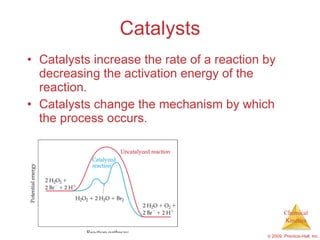
Catalysts Catalysts increase the rate of a reaction by decreasing the activation energy of the reaction. Catalysts change the mechanism by which the process occurs.
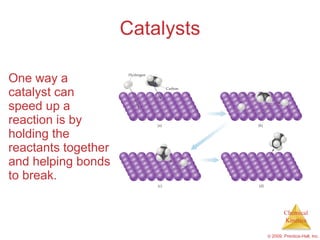
Catalysts One way a catalyst can speed up a reaction is by holding the reactants together and helping bonds to break.
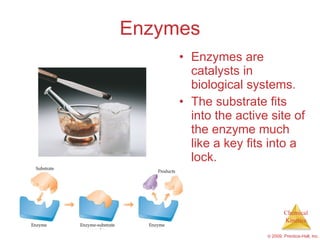
Enzymes Enzymes are catalysts in biological systems. The substrate fits into the active site of the enzyme much like a key fits into a lock.

AP Chemistry Chapter 14 Outline

  • 1.
    Chapter 14 Chemical Kinetics John D. Bookstaver St. Charles Community College Cottleville, MO Chemistry, The Central Science , 11th edition Theodore L. Brown; H. Eugene LeMay, Jr.; and Bruce E. Bursten
  • 2.
    Kinetics In kineticswe study the rate at which a chemical process occurs. Besides information about the speed at which reactions occur, kinetics also sheds light on the reaction mechanism (exactly how the reaction occurs).
  • 3.
    Factors That AffectReaction Rates Physical State of the Reactants In order to react, molecules must come in contact with each other. The more homogeneous the mixture of reactants, the faster the molecules can react.
  • 4.
    Factors That AffectReaction Rates Concentration of Reactants As the concentration of reactants increases, so does the likelihood that reactant molecules will collide.
  • 5.
    Factors That AffectReaction Rates Temperature At higher temperatures, reactant molecules have more kinetic energy, move faster, and collide more often and with greater energy.
  • 6.
    Factors That AffectReaction Rates Presence of a Catalyst Catalysts speed up reactions by changing the mechanism of the reaction. Catalysts are not consumed during the course of the reaction.
  • 7.
    Reaction Rates Ratesof reactions can be determined by monitoring the change in concentration of either reactants or products as a function of time.
  • 8.
    Reaction Rates In this reaction, the concentration of butyl chloride, C 4 H 9 Cl, was measured at various times. C 4 H 9 Cl ( aq ) + H 2 O ( l )  C 4 H 9 OH ( aq ) + HCl ( aq )
  • 9.
    Reaction Rates The average rate of the reaction over each interval is the change in concentration divided by the change in time: C 4 H 9 Cl ( aq ) + H 2 O ( l )  C 4 H 9 OH ( aq ) + HCl ( aq ) Average rate =  [C 4 H 9 Cl]  t
  • 10.
    Reaction Rates Note that the average rate decreases as the reaction proceeds. This is because as the reaction goes forward, there are fewer collisions between reactant molecules. C 4 H 9 Cl ( aq ) + H 2 O ( l )  C 4 H 9 OH ( aq ) + HCl ( aq )
  • 11.
    Reaction Rates A plot of [C 4 H 9 Cl] vs. time for this reaction yields a curve like this. The slope of a line tangent to the curve at any point is the instantaneous rate at that time. C 4 H 9 Cl ( aq ) + H 2 O ( l )  C 4 H 9 OH ( aq ) + HCl ( aq )
  • 12.
    Reaction Rates All reactions slow down over time. Therefore, the best indicator of the rate of a reaction is the instantaneous rate near the beginning of the reaction. C 4 H 9 Cl ( aq ) + H 2 O ( l )  C 4 H 9 OH ( aq ) + HCl ( aq )
  • 13.
    Reaction Rates andStoichiometry In this reaction, the ratio of C 4 H 9 Cl to C 4 H 9 OH is 1:1. Thus, the rate of disappearance of C 4 H 9 Cl is the same as the rate of appearance of C 4 H 9 OH. C 4 H 9 Cl ( aq ) + H 2 O ( l )  C 4 H 9 OH ( aq ) + HCl ( aq ) Rate = -  [C 4 H 9 Cl]  t =  [C 4 H 9 OH]  t
  • 14.
    Reaction Rates andStoichiometry What if the ratio is not 1:1? 2 HI ( g )  H 2 ( g ) + I 2 ( g ) In such a case , Rate = − 1 2  [HI]  t =  [I 2 ]  t
  • 15.
    Reaction Rates andStoichiometry To generalize, then, for the reaction a A + b B c C + d D Rate = − 1 a  [A]  t = − 1 b  [B]  t = 1 c  [C]  t 1 d  [D]  t =
  • 16.
    Concentration and RateOne can gain information about the rate of a reaction by seeing how the rate changes with changes in concentration.
  • 17.
    Concentration and RateIf we compare Experiments 1 and 2, we see that when [NH 4 + ] doubles, the initial rate doubles. NH 4 + ( aq ) + NO 2 − ( aq ) N 2 ( g ) + 2 H 2 O ( l )
  • 18.
    Concentration and RateLikewise, when we compare Experiments 5 and 6, we see that when [NO 2 − ] doubles, the initial rate doubles. NH 4 + ( aq ) + NO 2 − ( aq ) N 2 ( g ) + 2 H 2 O ( l )
  • 19.
    Concentration and RateThis means Rate  [NH 4 + ] Rate  [NO 2 − ] Rate  [NH 4 + ] [NO 2 − ] which, when written as an equation, becomes Rate = k [NH 4 + ] [NO 2 − ] This equation is called the rate law , and k is the rate constant . Therefore,
  • 20.
    Rate Laws Arate law shows the relationship between the reaction rate and the concentrations of reactants. The exponents tell the order of the reaction with respect to each reactant. Since the rate law is Rate = k [NH 4 + ] [NO 2 − ] the reaction is First-order in [NH 4 + ] and First-order in [NO 2 − ].
  • 21.
    Rate Laws Rate= k [NH 4 + ] [NO 2 − ] The overall reaction order can be found by adding the exponents on the reactants in the rate law. This reaction is second-order overall.
  • 22.
    Integrated Rate LawsUsing calculus to integrate the rate law for a first-order process gives us Where [A] 0 is the initial concentration of A, and [A] t is the concentration of A at some time, t , during the course of the reaction. ln [A] t [A] 0 = − k t
  • 23.
    Integrated Rate LawsManipulating this equation produces… ln [A] t − ln [A] 0 = − k t ln [A] t = − k t + ln [A] 0 … which is in the form y = mx + b ln [A] t [A] 0 = − k t
  • 24.
    First-Order Processes Therefore,if a reaction is first-order, a plot of ln [A] vs. t will yield a straight line, and the slope of the line will be - k . ln [A] t = - k t + ln [A] 0
  • 25.
    First-Order Processes Considerthe process in which methyl isonitrile is converted to acetonitrile. CH 3 NC CH 3 CN
  • 26.
    First-Order Processes Thisdata was collected for this reaction at 198.9 ° C. CH 3 NC CH 3 CN
  • 27.
    First-Order Processes Whenln P is plotted as a function of time, a straight line results. Therefore, The process is first-order. k is the negative of the slope: 5.1  10 -5 s − 1 .
  • 28.
    Second-Order Processes Similarly,integrating the rate law for a process that is second-order in reactant A, we get also in the form y = mx + b 1 [A] t = kt + 1 [A] 0
  • 29.
    Second-Order Processes Soif a process is second-order in A, a plot of vs. t will yield a straight line, and the slope of that line is k . 1 [A] t = kt + 1 [A] 0 1 [A]
  • 30.
    Second-Order Processes Thedecomposition of NO 2 at 300 ° C is described by the equation and yields data comparable to this: NO 2 ( g ) NO ( g ) + O 2 ( g ) 0.00380 300.0 0.00481 200.0 0.00649 100.0 0.00787 50.0 0.01000 0.0 [NO 2 ], M Time ( s ) 1 2
  • 31.
    Second-Order Processes Plottingln [NO 2 ] vs . t yields the graph at the right. The plot is not a straight line, so the process is not first-order in [A]. 0.00380 0.00481 0.00649 0.00787 0.01000 [NO 2 ], M − 5.573 − 5.337 − 5.038 − 4.845 − 4.610 ln [NO 2 ] 300.0 200.0 100.0 50.0 0.0 Time ( s )
  • 32.
    Second-Order Processes Graphingln vs. t , however, gives this plot. Because this is a straight line, the process is second-order in [A]. 0.00380 0.00481 0.00649 0.00787 0.01000 [NO 2 ], M 263 208 154 127 100 1/[NO 2 ] 300.0 200.0 100.0 50.0 0.0 Time ( s ) 1 [NO 2 ]
  • 33.
    Half-Life Half-life isdefined as the time required for one-half of a reactant to react. Because [A] at t 1/2 is one-half of the original [A], [A] t = 0.5 [A] 0 .
  • 34.
    Half-Life For afirst-order process, this becomes ln 0.5 = − kt 1/2 − 0.693 = − kt 1/2 NOTE: For a first-order process, then, the half-life does not depend on [A] 0 . 0.5 [A] 0 [A] 0 ln = − kt 1/2 = t 1/2 0.693 k
  • 35.
    Half-Life For asecond-order process, 1 0.5 [A] 0 = kt 1/2 + 1 [A] 0 2 [A] 0 = kt 1/2 + 1 [A] 0 2 − 1 [A] 0 = kt 1/2 1 [A] 0 = = t 1/2 1 k [A] 0
  • 36.
    Temperature and RateGenerally, as temperature increases, so does the reaction rate. This is because k is temperature dependent.
  • 37.
    The Collision ModelIn a chemical reaction, bonds are broken and new bonds are formed. Molecules can only react if they collide with each other.
  • 38.
    The Collision ModelFurthermore, molecules must collide with the correct orientation and with enough energy to cause bond breakage and formation.
  • 39.
    Activation Energy Inother words, there is a minimum amount of energy required for reaction: the activation energy , E a . Just as a ball cannot get over a hill if it does not roll up the hill with enough energy, a reaction cannot occur unless the molecules possess sufficient energy to get over the activation energy barrier.
  • 40.
    Reaction Coordinate DiagramsIt is helpful to visualize energy changes throughout a process on a reaction coordinate diagram like this one for the rearrangement of methyl isonitrile.
  • 41.
    Reaction Coordinate DiagramsThe diagram shows the energy of the reactants and products (and, therefore,  E ). The high point on the diagram is the transition state . The species present at the transition state is called the activated complex . The energy gap between the reactants and the activated complex is the activation energy barrier .
  • 42.
    Maxwell – BoltzmannDistributions Temperature is defined as a measure of the average kinetic energy of the molecules in a sample. At any temperature there is a wide distribution of kinetic energies.
  • 43.
    Maxwell – BoltzmannDistributions As the temperature increases, the curve flattens and broadens. Thus at higher temperatures, a larger population of molecules has higher energy.
  • 44.
    Maxwell – BoltzmannDistributions If the dotted line represents the activation energy, then as the temperature increases, so does the fraction of molecules that can overcome the activation energy barrier. As a result, the reaction rate increases.
  • 45.
    Maxwell – BoltzmannDistributions This fraction of molecules can be found through the expression where R is the gas constant and T is the Kelvin temperature. f = e - E a RT
  • 46.
    Arrhenius Equation SvanteArrhenius developed a mathematical relationship between k and E a : k = A e where A is the frequency factor , a number that represents the likelihood that collisions would occur with the proper orientation for reaction. - E a RT
  • 47.
    Arrhenius Equation Takingthe natural logarithm of both sides, the equation becomes ln k = - ( ) + ln A y = m x + b Therefore, if k is determined experimentally at several temperatures, E a can be calculated from the slope of a plot of ln k vs. . 1 T E a R 1 T
  • 48.
    Reaction Mechanisms Thesequence of events that describes the actual process by which reactants become products is called the reaction mechanism .
  • 49.
    Reaction Mechanisms Reactionsmay occur all at once or through several discrete steps. Each of these processes is known as an elementary reaction or elementary process .
  • 50.
    Reaction Mechanisms The molecularity of a process tells how many molecules are involved in the process.
  • 51.
    Multistep Mechanisms Ina multistep process, one of the steps will be slower than all others. The overall reaction cannot occur faster than this slowest, rate-determining step .
  • 52.
    Slow Initial StepThe rate law for this reaction is found experimentally to be Rate = k [NO 2 ] 2 CO is necessary for this reaction to occur, but the rate of the reaction does not depend on its concentration. This suggests the reaction occurs in two steps. NO 2 ( g ) + CO ( g )  NO ( g ) + CO 2 ( g )
  • 53.
    Slow Initial StepA proposed mechanism for this reaction is Step 1: NO 2 + NO 2  NO 3 + NO (slow) Step 2: NO 3 + CO  NO 2 + CO 2 (fast) The NO 3 intermediate is consumed in the second step. As CO is not involved in the slow, rate-determining step, it does not appear in the rate law.
  • 54.
    Fast Initial StepThe rate law for this reaction is found to be Rate = k [NO] 2 [Br 2 ] Because termolecular processes are rare, this rate law suggests a two-step mechanism. 2 NO ( g ) + Br 2 ( g )  2 NOBr ( g )
  • 55.
    Fast Initial StepA proposed mechanism is Step 2: NOBr 2 + NO  2 NOBr (slow) Step 1 includes the forward and reverse reactions. Step 1: NO + Br 2 NOBr 2 (fast)
  • 56.
    Fast Initial StepThe rate of the overall reaction depends upon the rate of the slow step. The rate law for that step would be Rate = k 2 [NOBr 2 ] [NO] But how can we find [NOBr 2 ]?
  • 57.
    Fast Initial StepNOBr 2 can react two ways: With NO to form NOBr By decomposition to reform NO and Br 2 The reactants and products of the first step are in equilibrium with each other. Therefore, Rate f = Rate r
  • 58.
    Fast Initial StepBecause Rate f = Rate r , k 1 [NO] [Br 2 ] = k − 1 [NOBr 2 ] Solving for [NOBr 2 ] gives us k 1 k − 1 [NO] [Br 2 ] = [NOBr 2 ]
  • 59.
    Fast Initial StepSubstituting this expression for [NOBr 2 ] in the rate law for the rate-determining step gives = k [NO] 2 [Br 2 ] k 2 k 1 k − 1 Rate = [NO] [Br 2 ] [NO]
  • 60.
    Catalysts Catalysts increasethe rate of a reaction by decreasing the activation energy of the reaction. Catalysts change the mechanism by which the process occurs.
  • 61.
    Catalysts One waya catalyst can speed up a reaction is by holding the reactants together and helping bonds to break.
  • 62.
    Enzymes Enzymes arecatalysts in biological systems. The substrate fits into the active site of the enzyme much like a key fits into a lock.