Dr Gaur
Assistant professor
Chemistry
THERMOCHEMISTRY
B.Sc Par t 2 Physical chemistr y
TOPICS COVERED
• Definition of Thermochemistry
• Types of Thermochemical Reactions
• Kirchoff’s Equation
• Calorimetry
• Laws of Thermodynamics
• Bond Enthalpy
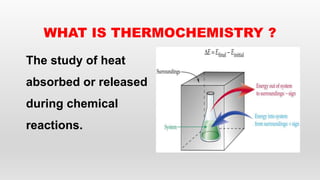
WHAT IS THERMOCHEMISTRY ?
The study of heat
absorbed or released
during chemical
reactions.
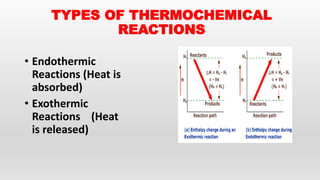
TYPES OF THERMOCHEMICAL
REACTIONS
• Endothermic
Reactions (Heat is
absorbed)
• Exothermic
Reactions (Heat
is released)
HEAT OF REACTION
Heat of reaction is the amount of heat absorbed or liberated when the
reactants are converted into products by the balanced chemical equation. If the
reaction takes place at constant pressure, heat of reaction is represented by ∆H
and if the reaction takes place at constant volume, it is represented by ∆E
H2(g) + Cl2(g) 2HCl (g) ∆H = -184.1 kilo joule
Standard Heat of Reaction (∆H0) is the change in enthalpy when reaction takes place under standard
conditions ie. at 25oC and 1 atm pressure.
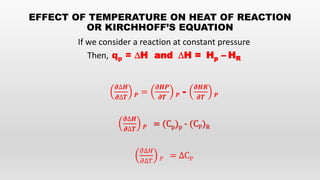
EFFECT OF TEMPERATURE ON HEAT OF REACTION
OR KIRCHHOFF’S EQUATION
If we consider a reaction at constant pressure
Then, qp = ∆H and ∆H = Hp – HR
𝝏∆𝑯
𝝏∆𝑻 𝑷 =
𝝏𝑯𝑷
𝝏𝑻 𝑷 -
𝝏𝑯𝑹
𝝏𝑻 𝑷
𝝏∆𝑯
𝝏∆𝑻 𝑷 = (Cp)p - (CP)R
𝜕∆𝐻
𝜕∆𝑇 𝑃 = ∆CP
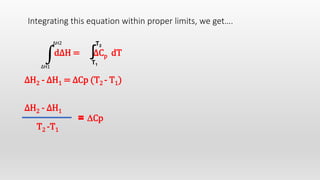
Integrating this equation within proper limits, we get….
d∆H = ∆Cp dT
∆H2 - ∆H1 = ∆Cp (T2 - T1)
∆H2 - ∆H1
∫∆H1
∆H2
∫T1
T2
T2 -T1
= ∆Cp
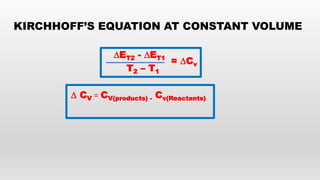
∆ET2 - ∆ET1
T2 – T1
∆ CV = CV(products) - Cv(Reactants)
KIRCHHOFF’S EQUATION AT CONSTANT VOLUME
= ∆Cv
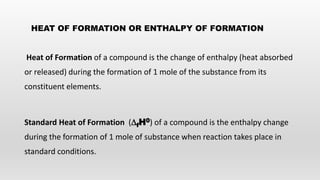
HEAT OF FORMATION OR ENTHALPY OF FORMATION
Heat of Formation of a compound is the change of enthalpy (heat absorbed
or released) during the formation of 1 mole of the substance from its
constituent elements.
Standard Heat of Formation (∆fH0) of a compound is the enthalpy change
during the formation of 1 mole of substance when reaction takes place in
standard conditions.
CALORIMETRY
Process of measuring the amount of heat released or absorbed
during a chemical reaction is called calorimetry.
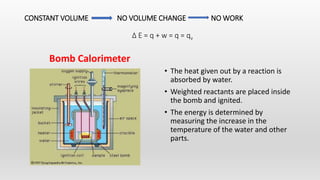
Bomb Calorimeter
CONSTANT VOLUME NO VOLUME CHANGE NO WORK
∆ E = q + w = q = qv
• The heat given out by a reaction is
absorbed by water.
• Weighted reactants are placed inside
the bomb and ignited.
• The energy is determined by
measuring the increase in the
temperature of the water and other
parts.
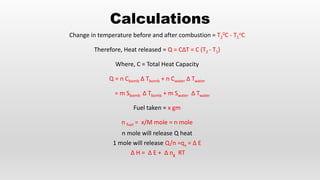
Calculations
Change in temperature before and after combustion = T2
0C - T1
oC
Therefore, Heat released = Q = C∆T = C (T2 - T1)
Where, C = Total Heat Capacity
Q = n Cbomb ∆ Tbomb + n Cwater ∆ Twater
= m Sbomb ∆ Tbomb + m Swater ∆ Twater
Fuel taken = x gm
n fuel = x/M mole = n mole
n mole will release Q heat
1 mole will release Q/n =qv = ∆ E
∆ H = ∆ E + ∆ ng RT
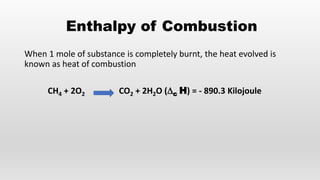
Enthalpy of Combustion
When 1 mole of substance is completely burnt, the heat evolved is
known as heat of combustion
CH4 + 2O2 CO2 + 2H2O (∆c H) = - 890.3 Kilojoule
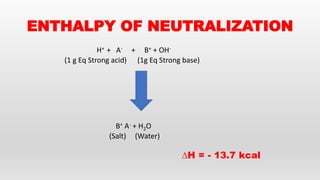
ENTHALPY OF NEUTRALIZATION
H+ + A- + B+ + OH-
(1 g Eq Strong acid) (1g Eq Strong base)
B+ A- + H2O
(Salt) (Water)
∆H = - 13.7 kcal
If weak acid and strong base or strong acid and
weak base or weak acid and weak base are
mixed then observed heat of neutralization is less
than 13.7 kcal.
The reason for this lower value is that some of the
heat released in the neutralization is also used in
the ionization of weak acid or weak base or both.
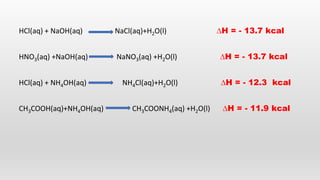
HCl(aq) + NaOH(aq) NaCl(aq)+H2O(l) ∆H = - 13.7 kcal
HNO3(aq) +NaOH(aq) NaNO3(aq) +H2O(l) ∆H = - 13.7 kcal
HCl(aq) + NH4OH(aq) NH4Cl(aq)+H2O(l) ∆H = - 12.3 kcal
CH3COOH(aq)+NH4OH(aq) CH3COONH4(aq) +H2O(l) ∆H = - 11.9 kcal
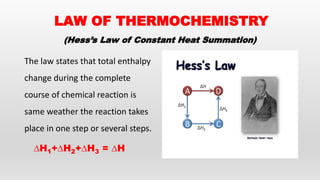
LAW OF THERMOCHEMISTRY
(Hess’s Law of Constant Heat Summation)
The law states that total enthalpy
change during the complete
course of chemical reaction is
same weather the reaction takes
place in one step or several steps.
∆H1+∆H2+∆H3 = ∆H
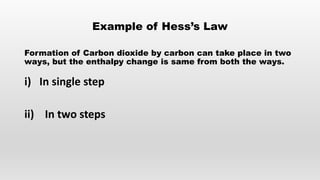
Example of Hess’s Law
Formation of Carbon dioxide by carbon can take place in two
ways, but the enthalpy change is same from both the ways.
i) In single step
ii) In two steps
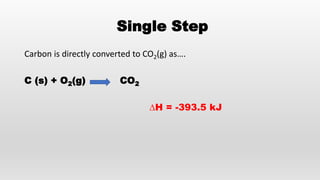
Single Step
Carbon is directly converted to CO2(g) as….
C (s) + O2(g) CO2
∆H = -393.5 kJ
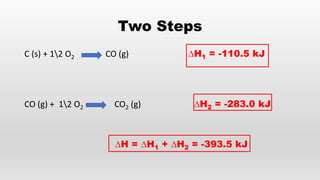
Two Steps
C (s) + 12 O2 CO (g) ∆H1 = -110.5 kJ
CO (g) + 12 O2 CO2 (g) ∆H2 = -283.0 kJ
∆H = ∆H1 + ∆H2 = -393.5 kJ
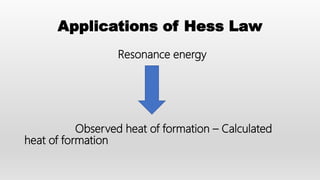
Applications of Hess Law
Resonance energy
Observed heat of formation – Calculated
heat of formation
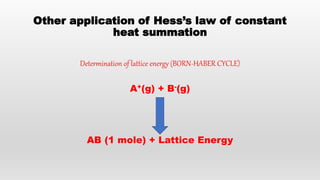
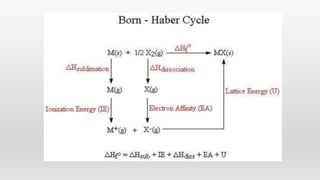
Other application of Hess’s law of constant
heat summation
Determination of lattice energy (BORN-HABER CYCLE)
A+(g) + B-(g)
AB (1 mole) + Lattice Energy
BOND ENERGY AND BOND
ENTHALPY
The amount of energy required to break 1 mole of bond of a
particular type between the atoms in the gaseous state under
1 atm pressure and the specified temperature is called bond
dissociation energy.
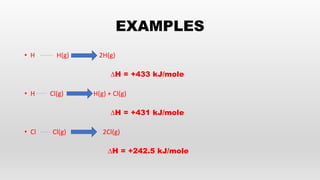
EXAMPLES
• H H(g) 2H(g)
∆H = +433 kJ/mole
• H Cl(g) H(g) + Cl(g)
∆H = +431 kJ/mole
• Cl Cl(g) 2Cl(g)
∆H = +242.5 kJ/mole
The bond dissociation energy also depends on the type of bond and on
the type of molecule in which the bond is present.
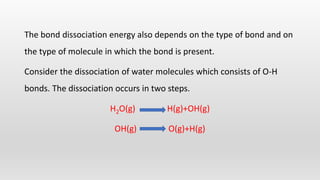
Consider the dissociation of water molecules which consists of O-H
bonds. The dissociation occurs in two steps.
H2O(g) H(g)+OH(g)
OH(g) O(g)+H(g)
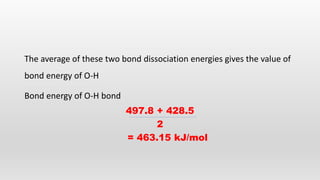
The average of these two bond dissociation energies gives the value of
bond energy of O-H
Bond energy of O-H bond
497.8 + 428.5
2
= 463.15 kJ/mol
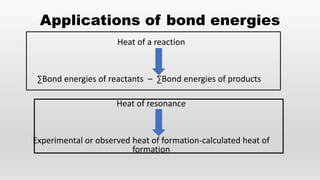
Applications of bond energies
Heat of a reaction
∑Bond energies of reactants – ∑Bond energies of products
Heat of resonance
Experimental or observed heat of formation-calculated heat of
formation
Thermochemistry

Thermochemistry

  • 1.
  • 2.
    TOPICS COVERED • Definitionof Thermochemistry • Types of Thermochemical Reactions • Kirchoff’s Equation • Calorimetry • Laws of Thermodynamics • Bond Enthalpy
  • 3.
    WHAT IS THERMOCHEMISTRY? The study of heat absorbed or released during chemical reactions.
  • 4.
    TYPES OF THERMOCHEMICAL REACTIONS •Endothermic Reactions (Heat is absorbed) • Exothermic Reactions (Heat is released)
  • 5.
    HEAT OF REACTION Heatof reaction is the amount of heat absorbed or liberated when the reactants are converted into products by the balanced chemical equation. If the reaction takes place at constant pressure, heat of reaction is represented by ∆H and if the reaction takes place at constant volume, it is represented by ∆E H2(g) + Cl2(g) 2HCl (g) ∆H = -184.1 kilo joule Standard Heat of Reaction (∆H0) is the change in enthalpy when reaction takes place under standard conditions ie. at 25oC and 1 atm pressure.
  • 6.
    EFFECT OF TEMPERATUREON HEAT OF REACTION OR KIRCHHOFF’S EQUATION If we consider a reaction at constant pressure Then, qp = ∆H and ∆H = Hp – HR 𝝏∆𝑯 𝝏∆𝑻 𝑷 = 𝝏𝑯𝑷 𝝏𝑻 𝑷 - 𝝏𝑯𝑹 𝝏𝑻 𝑷 𝝏∆𝑯 𝝏∆𝑻 𝑷 = (Cp)p - (CP)R 𝜕∆𝐻 𝜕∆𝑇 𝑃 = ∆CP
  • 7.
    Integrating this equationwithin proper limits, we get…. d∆H = ∆Cp dT ∆H2 - ∆H1 = ∆Cp (T2 - T1) ∆H2 - ∆H1 ∫∆H1 ∆H2 ∫T1 T2 T2 -T1 = ∆Cp
  • 8.
    ∆ET2 - ∆ET1 T2– T1 ∆ CV = CV(products) - Cv(Reactants) KIRCHHOFF’S EQUATION AT CONSTANT VOLUME = ∆Cv
  • 9.
    HEAT OF FORMATIONOR ENTHALPY OF FORMATION Heat of Formation of a compound is the change of enthalpy (heat absorbed or released) during the formation of 1 mole of the substance from its constituent elements. Standard Heat of Formation (∆fH0) of a compound is the enthalpy change during the formation of 1 mole of substance when reaction takes place in standard conditions.
  • 10.
    CALORIMETRY Process of measuringthe amount of heat released or absorbed during a chemical reaction is called calorimetry.
  • 11.
    Bomb Calorimeter CONSTANT VOLUMENO VOLUME CHANGE NO WORK ∆ E = q + w = q = qv • The heat given out by a reaction is absorbed by water. • Weighted reactants are placed inside the bomb and ignited. • The energy is determined by measuring the increase in the temperature of the water and other parts.
  • 12.
    Calculations Change in temperaturebefore and after combustion = T2 0C - T1 oC Therefore, Heat released = Q = C∆T = C (T2 - T1) Where, C = Total Heat Capacity Q = n Cbomb ∆ Tbomb + n Cwater ∆ Twater = m Sbomb ∆ Tbomb + m Swater ∆ Twater Fuel taken = x gm n fuel = x/M mole = n mole n mole will release Q heat 1 mole will release Q/n =qv = ∆ E ∆ H = ∆ E + ∆ ng RT
  • 13.
    Enthalpy of Combustion When1 mole of substance is completely burnt, the heat evolved is known as heat of combustion CH4 + 2O2 CO2 + 2H2O (∆c H) = - 890.3 Kilojoule
  • 14.
    ENTHALPY OF NEUTRALIZATION H++ A- + B+ + OH- (1 g Eq Strong acid) (1g Eq Strong base) B+ A- + H2O (Salt) (Water) ∆H = - 13.7 kcal
  • 15.
    If weak acidand strong base or strong acid and weak base or weak acid and weak base are mixed then observed heat of neutralization is less than 13.7 kcal. The reason for this lower value is that some of the heat released in the neutralization is also used in the ionization of weak acid or weak base or both.
  • 16.
    HCl(aq) + NaOH(aq)NaCl(aq)+H2O(l) ∆H = - 13.7 kcal HNO3(aq) +NaOH(aq) NaNO3(aq) +H2O(l) ∆H = - 13.7 kcal HCl(aq) + NH4OH(aq) NH4Cl(aq)+H2O(l) ∆H = - 12.3 kcal CH3COOH(aq)+NH4OH(aq) CH3COONH4(aq) +H2O(l) ∆H = - 11.9 kcal
  • 17.
    LAW OF THERMOCHEMISTRY (Hess’sLaw of Constant Heat Summation) The law states that total enthalpy change during the complete course of chemical reaction is same weather the reaction takes place in one step or several steps. ∆H1+∆H2+∆H3 = ∆H
  • 18.
    Example of Hess’sLaw Formation of Carbon dioxide by carbon can take place in two ways, but the enthalpy change is same from both the ways. i) In single step ii) In two steps
  • 19.
    Single Step Carbon isdirectly converted to CO2(g) as…. C (s) + O2(g) CO2 ∆H = -393.5 kJ
  • 20.
    Two Steps C (s)+ 12 O2 CO (g) ∆H1 = -110.5 kJ CO (g) + 12 O2 CO2 (g) ∆H2 = -283.0 kJ ∆H = ∆H1 + ∆H2 = -393.5 kJ
  • 21.
    Applications of HessLaw Resonance energy Observed heat of formation – Calculated heat of formation
  • 22.
    Other application ofHess’s law of constant heat summation Determination of lattice energy (BORN-HABER CYCLE) A+(g) + B-(g) AB (1 mole) + Lattice Energy
  • 24.
    BOND ENERGY ANDBOND ENTHALPY The amount of energy required to break 1 mole of bond of a particular type between the atoms in the gaseous state under 1 atm pressure and the specified temperature is called bond dissociation energy.
  • 25.
    EXAMPLES • H H(g)2H(g) ∆H = +433 kJ/mole • H Cl(g) H(g) + Cl(g) ∆H = +431 kJ/mole • Cl Cl(g) 2Cl(g) ∆H = +242.5 kJ/mole
  • 26.
    The bond dissociationenergy also depends on the type of bond and on the type of molecule in which the bond is present. Consider the dissociation of water molecules which consists of O-H bonds. The dissociation occurs in two steps. H2O(g) H(g)+OH(g) OH(g) O(g)+H(g)
  • 27.
    The average ofthese two bond dissociation energies gives the value of bond energy of O-H Bond energy of O-H bond 497.8 + 428.5 2 = 463.15 kJ/mol
  • 28.
    Applications of bondenergies Heat of a reaction ∑Bond energies of reactants – ∑Bond energies of products Heat of resonance Experimental or observed heat of formation-calculated heat of formation

Editor's Notes

  • #22 Applications of Hess Law Resonance energy