







Thermochemistry
Recall
Law of Conservation of Mass and Energy states that in a
chemical reaction mass is neither created nor destroyed
Energy in chemical reactions may be measured in
terms of the amount of heat involved.
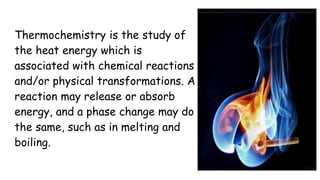
Thermochemistry is the study of
the heat energy which is
associated with chemical reactions
and/or physical transformations. A
reaction may release or absorb
energy, and a phase change may do
the same, such as in melting and
boiling.
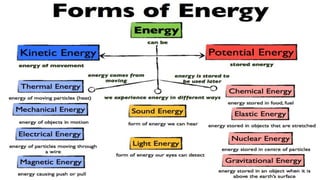
Energy
is the ability to do work, thus work may also be defined
as the process of expanding energy.
Energy is not only utilized in Physical activities, but
also in chemical reactions
Each chemical reactions require sometimes releases
energy for the reaction to proceed
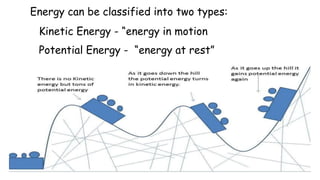
Energy can be classified into two types:
Kinetic Energy - “energy in motion
Potential Energy - “energy at rest”
Law of Conservation of Energy states that energy is
neither created nor destroyed, but it is converted from
another form of energy
Energy and Chemistry
Energy Changes in Chemical Reactions
Chemical reactions show conversion of reactants into products
In stoichiometry, reactants are related to product in terms of their
masses while the Law of Conservation of Mass states that the Mass
of the reactants is equal to the mass of the products
However, in some cases, there is a very small, hardly measurable
difference between the mass of the reactants and products when an
experiment is performed on chemical reactions
Energy Changes in Chemical Reactions
Most chemical reactions involved the absorption or release of energy
in the transfer of heat
Heat is define as the transfer of thermal energy
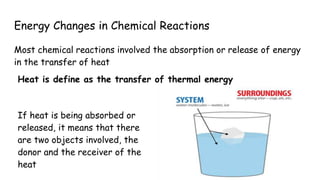
If heat is being absorbed or
released, it means that there
are two objects involved, the
donor and the receiver of the
heat
Energy Changes in Chemical Reactions
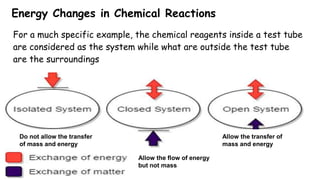
For a much specific example, the chemical reagents inside a test tube
are considered as the system while what are outside the test tube
are the surroundings
Allow the transfer of
mass and energy
Allow the flow of energy
but not mass
Do not allow the transfer
of mass and energy
Energy Changes in Chemical Reactions
The transfer of energy is either Exothermic or Endothermic
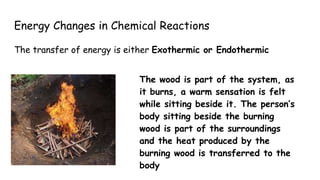
The wood is part of the system, as
it burns, a warm sensation is felt
while sitting beside it. The person’s
body sitting beside the burning
wood is part of the surroundings
and the heat produced by the
burning wood is transferred to the
body
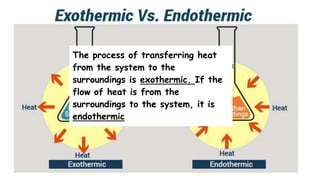
The process of transferring heat
from the system to the
surroundings is exothermic. If the
flow of heat is from the
surroundings to the system, it is
endothermic
Exothermic Vs. Endothermic
Task:
Classify the following processes as endothermic or exothermic
1. Melting of Rubber
2. Rubbing the hands with alcohol
3. Burning of Gasoline
4. Mixing HCL with water
5. Subliming napthalene
6. Perspiring
7. Making of ice
8. Ice or snow forming in clouds
9. Inflating a bicycle tire
10.Breaking down of food
Thermodynamics
Thermodynamics, science of the relationship between heat,
work, temperature and energy.
In broad terms, thermodynamics deals with the transfer of
energy from one place to another and from one form to
another. The key concept is that heat is a form of energy
corresponding to a definite amount of mechanical work.
Thermodynamics
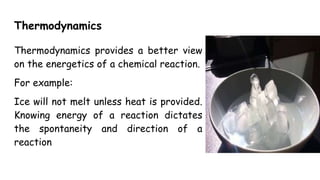
Thermodynamics provides a better view
on the energetics of a chemical reaction.
For example:
Ice will not melt unless heat is provided.
Knowing energy of a reaction dictates
the spontaneity and direction of a
reaction
Thermodynamics
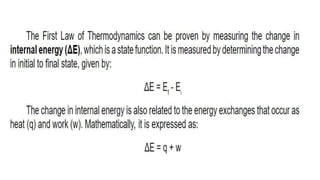
The study of thermodynamics also focuses on the changes in
the state of the system, which pertains to the total or over-
all properties of the system including temperature, pressure
and volume
Energy, such as gravitational potential is also a state function
State function the degree of their change depends only on
the initial and final states of the system
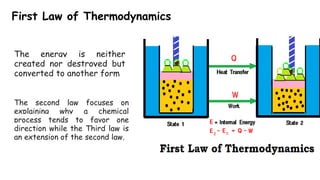
First Law of Thermodynamics
The energy is neither
created nor destroyed but
converted to another form
The second law focuses on
explaining why a chemical
process tends to favor one
direction while the Third law is
an extension of the second law.
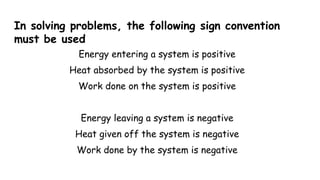
In solving problems, the following sign convention
must be used
Energy entering a system is positive
Heat absorbed by the system is positive
Work done on the system is positive
Energy leaving a system is negative
Heat given off the system is negative
Work done by the system is negative
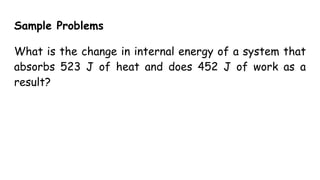
Sample Problems
What is the change in internal energy of a system that
absorbs 523 J of heat and does 452 J of work as a
result?
Sample Problems
The internal energy of a system increases by 20 J and
the quantity of work done on a system is 50 J. Is the
heat absorbed or given off? By how much?
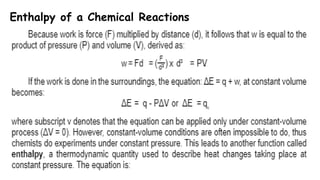
Enthalpy of a Chemical Reactions
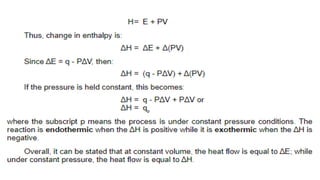
Enthalpy
Thermochemical Equations
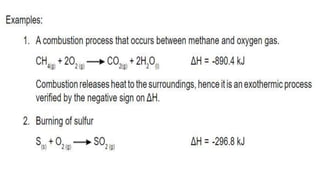
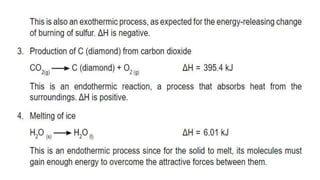
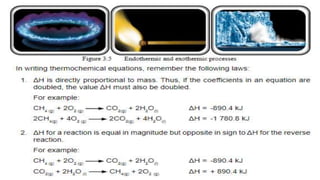
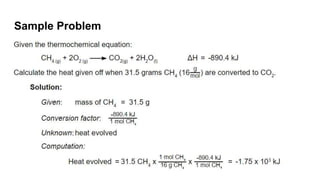
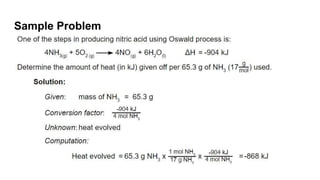
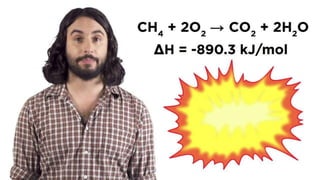
The heat of a reaction is the heat associated with the
transformation of the reactants to products. It is the
amount of heat or released or absorbed when specified
amounts of substances react. The balanced equation showing
the associated heat of reaction is called thermochemical
equation
Sample Problem
Sample Problem
Thermochemical Equations
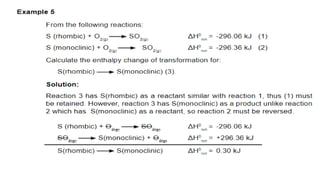
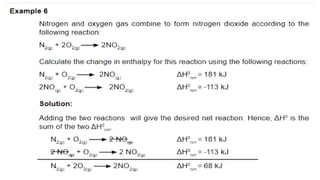
Hess’s Law and Heats of Reaction
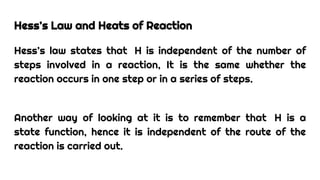
Hess’s law states that H is independent of the number of
steps involved in a reaction, It is the same whether the
reaction occurs in one step or in a series of steps.
Another way of looking at it is to remember that H is a
state function, hence it is independent of the route of the
reaction is carried out.
Thermochemistry
Thermochemistry
Thermochemistry
Thermochemistry
Thermochemistry
Thermochemistry
Thermochemistry

Thermochemistry

  • 1.
  • 2.
    Recall Law of Conservationof Mass and Energy states that in a chemical reaction mass is neither created nor destroyed Energy in chemical reactions may be measured in terms of the amount of heat involved.
  • 3.
    Thermochemistry is thestudy of the heat energy which is associated with chemical reactions and/or physical transformations. A reaction may release or absorb energy, and a phase change may do the same, such as in melting and boiling.
  • 4.
    Energy is the abilityto do work, thus work may also be defined as the process of expanding energy. Energy is not only utilized in Physical activities, but also in chemical reactions Each chemical reactions require sometimes releases energy for the reaction to proceed
  • 5.
    Energy can beclassified into two types: Kinetic Energy - “energy in motion Potential Energy - “energy at rest”
  • 6.
    Law of Conservationof Energy states that energy is neither created nor destroyed, but it is converted from another form of energy
  • 8.
  • 9.
    Energy Changes inChemical Reactions Chemical reactions show conversion of reactants into products In stoichiometry, reactants are related to product in terms of their masses while the Law of Conservation of Mass states that the Mass of the reactants is equal to the mass of the products However, in some cases, there is a very small, hardly measurable difference between the mass of the reactants and products when an experiment is performed on chemical reactions
  • 10.
    Energy Changes inChemical Reactions Most chemical reactions involved the absorption or release of energy in the transfer of heat Heat is define as the transfer of thermal energy If heat is being absorbed or released, it means that there are two objects involved, the donor and the receiver of the heat
  • 11.
    Energy Changes inChemical Reactions For a much specific example, the chemical reagents inside a test tube are considered as the system while what are outside the test tube are the surroundings Allow the transfer of mass and energy Allow the flow of energy but not mass Do not allow the transfer of mass and energy
  • 12.
    Energy Changes inChemical Reactions The transfer of energy is either Exothermic or Endothermic The wood is part of the system, as it burns, a warm sensation is felt while sitting beside it. The person’s body sitting beside the burning wood is part of the surroundings and the heat produced by the burning wood is transferred to the body
  • 13.
    The process oftransferring heat from the system to the surroundings is exothermic. If the flow of heat is from the surroundings to the system, it is endothermic
  • 14.
  • 15.
    Task: Classify the followingprocesses as endothermic or exothermic 1. Melting of Rubber 2. Rubbing the hands with alcohol 3. Burning of Gasoline 4. Mixing HCL with water 5. Subliming napthalene 6. Perspiring 7. Making of ice 8. Ice or snow forming in clouds 9. Inflating a bicycle tire 10.Breaking down of food
  • 16.
    Thermodynamics Thermodynamics, science ofthe relationship between heat, work, temperature and energy. In broad terms, thermodynamics deals with the transfer of energy from one place to another and from one form to another. The key concept is that heat is a form of energy corresponding to a definite amount of mechanical work.
  • 17.
    Thermodynamics Thermodynamics provides abetter view on the energetics of a chemical reaction. For example: Ice will not melt unless heat is provided. Knowing energy of a reaction dictates the spontaneity and direction of a reaction
  • 18.
    Thermodynamics The study ofthermodynamics also focuses on the changes in the state of the system, which pertains to the total or over- all properties of the system including temperature, pressure and volume Energy, such as gravitational potential is also a state function State function the degree of their change depends only on the initial and final states of the system
  • 19.
    First Law ofThermodynamics The energy is neither created nor destroyed but converted to another form The second law focuses on explaining why a chemical process tends to favor one direction while the Third law is an extension of the second law.
  • 21.
    In solving problems,the following sign convention must be used Energy entering a system is positive Heat absorbed by the system is positive Work done on the system is positive Energy leaving a system is negative Heat given off the system is negative Work done by the system is negative
  • 22.
    Sample Problems What isthe change in internal energy of a system that absorbs 523 J of heat and does 452 J of work as a result?
  • 23.
    Sample Problems The internalenergy of a system increases by 20 J and the quantity of work done on a system is 50 J. Is the heat absorbed or given off? By how much?
  • 24.
    Enthalpy of aChemical Reactions
  • 26.
  • 27.
    Thermochemical Equations The heatof a reaction is the heat associated with the transformation of the reactants to products. It is the amount of heat or released or absorbed when specified amounts of substances react. The balanced equation showing the associated heat of reaction is called thermochemical equation
  • 31.
  • 32.
  • 33.
  • 35.
    Hess’s Law andHeats of Reaction Hess’s law states that H is independent of the number of steps involved in a reaction, It is the same whether the reaction occurs in one step or in a series of steps. Another way of looking at it is to remember that H is a state function, hence it is independent of the route of the reaction is carried out.