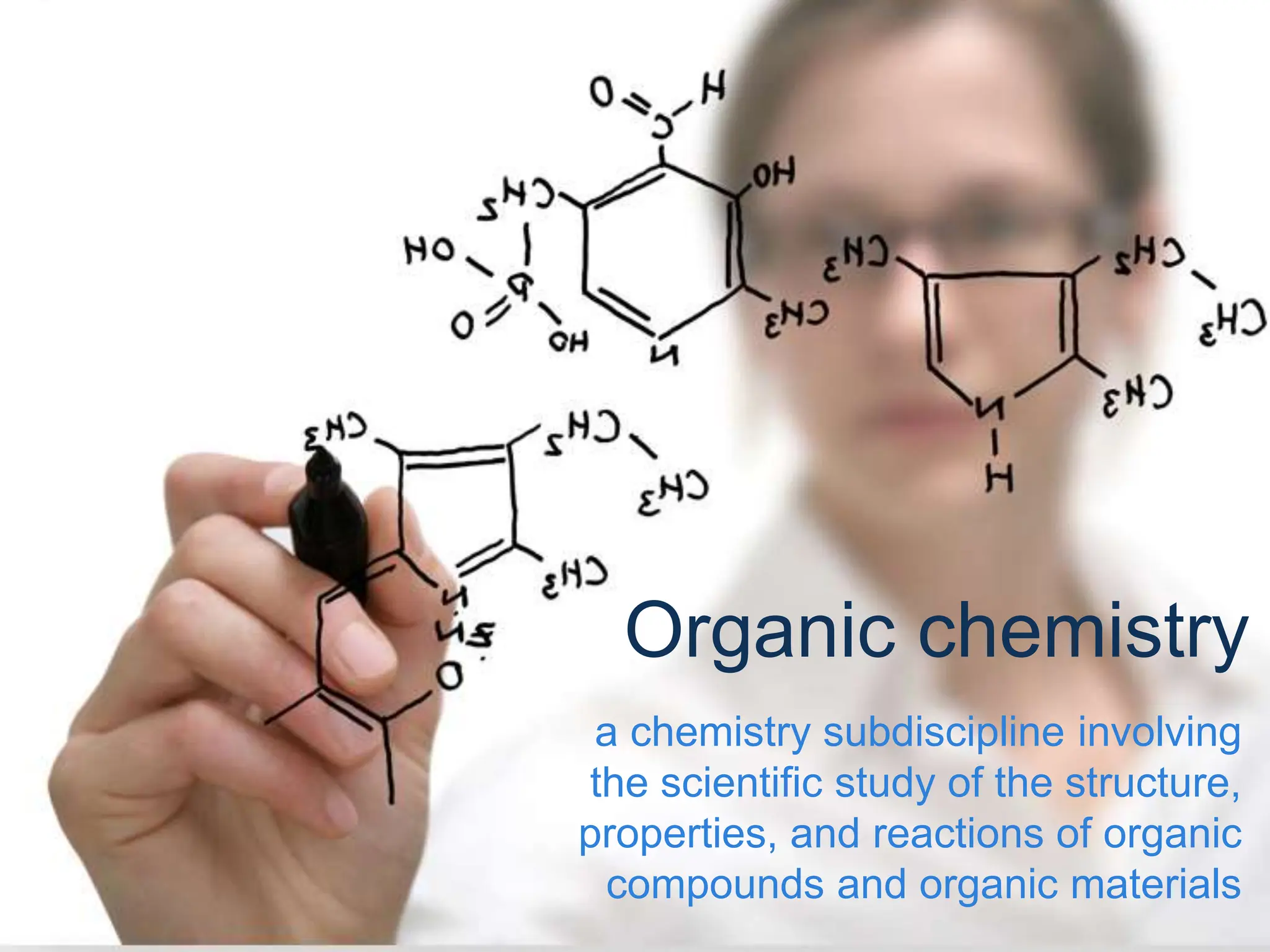
a chemistry subdiscipline involving
the scientific study of the structure,
properties, and reactions of organic
compounds and organic materials
Organic chemistry
Organic compounds: any member of a large class of gaseous, liquid,
or solid chemical compounds whose molecules contain carbon. For historical
reasons, a few types of carbon-containing compounds, such
as carbides, carbonates, simple oxides of carbon (such as CO and CO2),
and cyanides are considered inorganic.
Hydrocarbon organic compound consists entirely of hydrogen and
carbon
General formula The molecular formula of a class of compounds in
which actual numbers are represented by x, n etc.
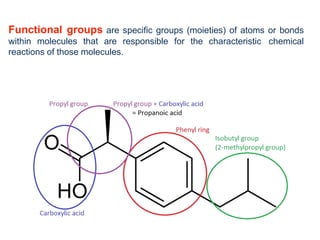
Functional groups are specific groups (moieties) of atoms or bonds
within molecules that are responsible for the characteristic chemical
reactions of those molecules.
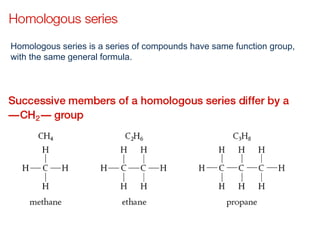
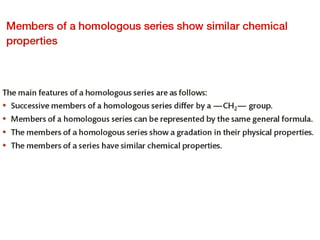
Homologous series is a series of compounds have same function group,
with the same general formula.
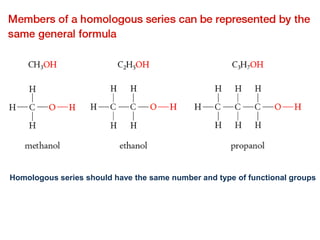
Homologous series should have the same number and type of functional groups
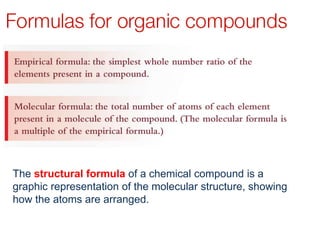
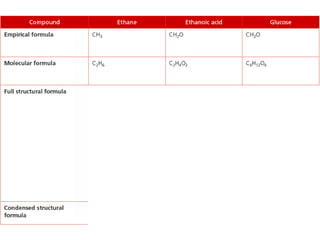
The structural formula of a chemical compound is a
graphic representation of the molecular structure, showing
how the atoms are arranged.
Structural formula
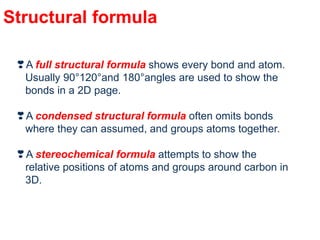
❣A full structural formula shows every bond and atom.
Usually 90°120°and 180°angles are used to show the
bonds in a 2D page.
❣A condensed structural formula often omits bonds
where they can assumed, and groups atoms together.
❣A stereochemical formula attempts to show the
relative positions of atoms and groups around carbon in
3D.
Name it
Draw it
Master it
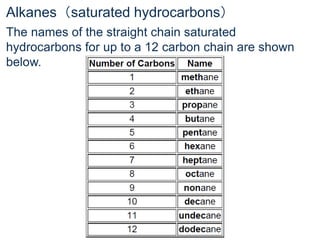
Alkanes(saturated hydrocarbons)
The names of the straight chain saturated
hydrocarbons for up to a 12 carbon chain are shown
below.
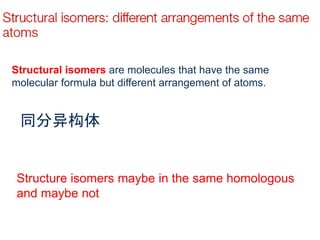
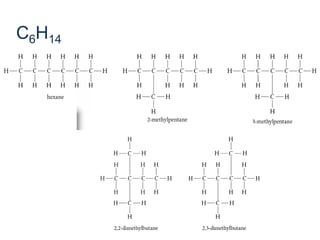
Structural isomers are molecules that have the same
molecular formula but different arrangement of atoms.
同分异构体
Structure isomers maybe in the same homologous
and maybe not
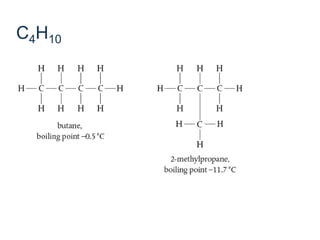
C4H10
C6H14
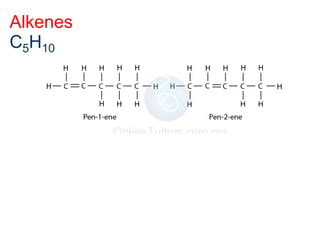
C5H10
Alkenes
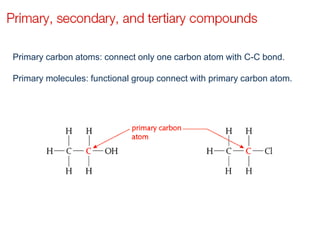
Primary carbon atoms: connect only one carbon atom with C-C bond.
Primary molecules: functional group connect with primary carbon atom.
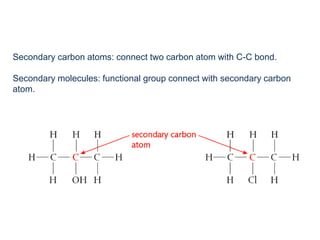
Secondary carbon atoms: connect two carbon atom with C-C bond.
Secondary molecules: functional group connect with secondary carbon
atom.
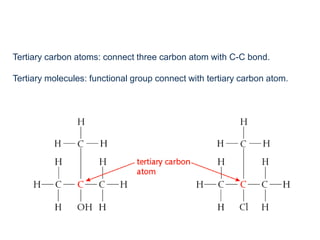
Tertiary carbon atoms: connect three carbon atom with C-C bond.
Tertiary molecules: functional group connect with tertiary carbon atom.
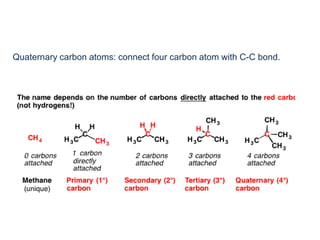
Quaternary carbon atoms: connect four carbon atom with C-C bond.
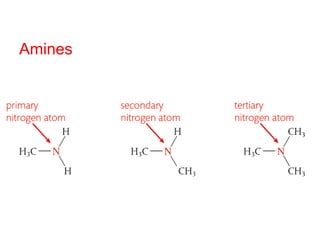
Amines
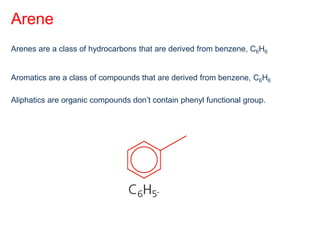
Arene
Arenes are a class of hydrocarbons that are derived from benzene, C6H6
Aromatics are a class of compounds that are derived from benzene, C6H6
Aliphatics are organic compounds don’t contain phenyl functional group.
Functional group chemistry
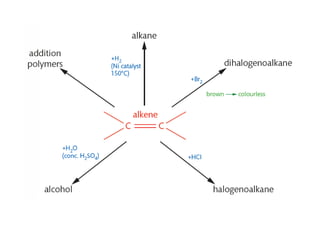
Alkane
Alkene
Halogenoalkane
Polymer
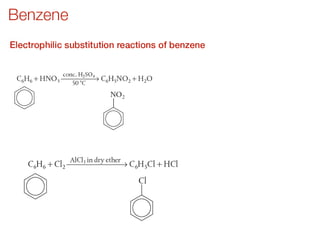
Benzene
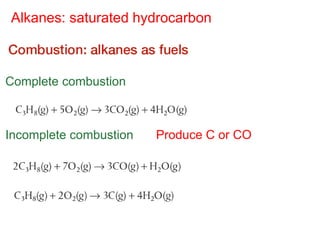
Alkanes: saturated hydrocarbon
Complete combustion
Incomplete combustion Produce C or CO
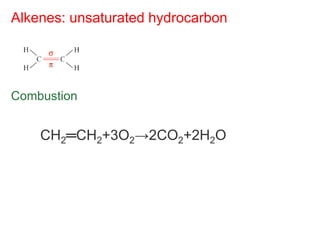
Alkenes: unsaturated hydrocarbon
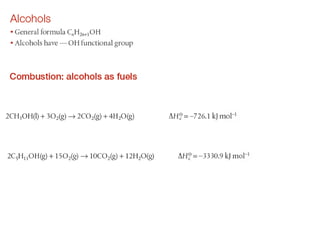
Combustion
CH2═CH2+3O2→2CO2+2H2O
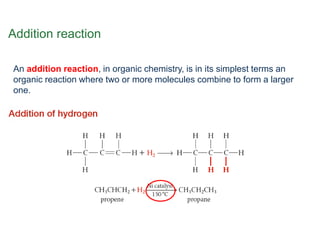
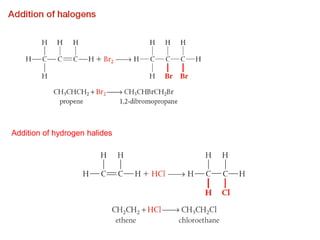
Addition reaction
An addition reaction, in organic chemistry, is in its simplest terms an
organic reaction where two or more molecules combine to form a larger
one.
Addition of hydrogen halides
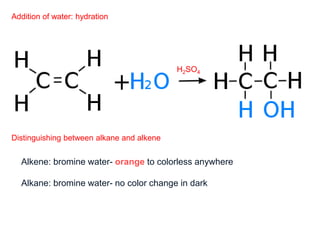
Addition of water: hydration
Distinguishing between alkane and alkene
Alkene: bromine water- orange to colorless anywhere
Alkane: bromine water- no color change in dark
H2SO4
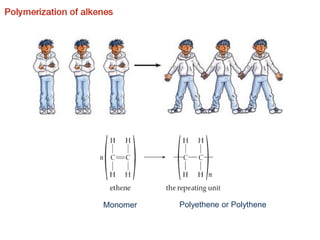
Monomer Polyethene or Polythene
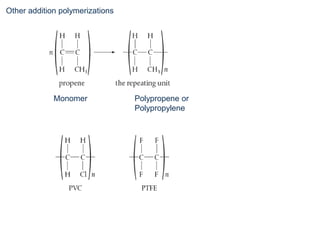
Other addition polymerizations
Monomer Polypropene or
Polypropylene
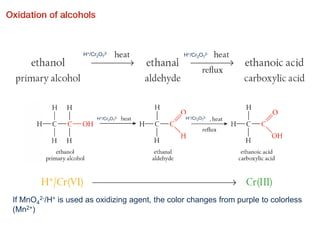
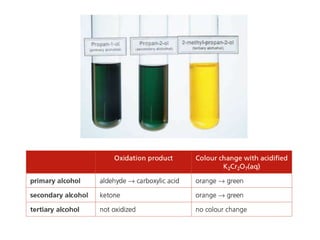
H+/Cr2O7
2-
H+/Cr2O7
2-
If MnO4
2-/H+ is used as oxidizing agent, the color changes from purple to colorless
(Mn2+)
H+/Cr2O7
2- H+/Cr2O7
2-
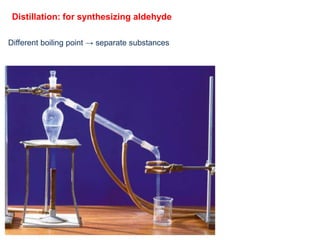
Distillation: for synthesizing aldehyde
Different boiling point → separate substances
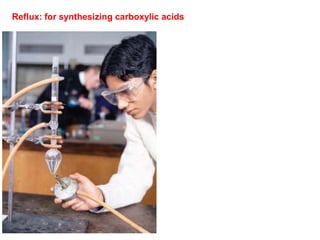
Reflux: for synthesizing carboxylic acids
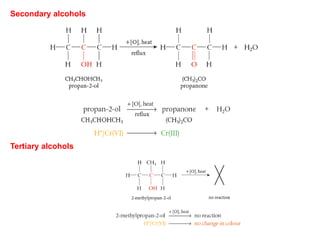
Secondary alcohols
Tertiary alcohols
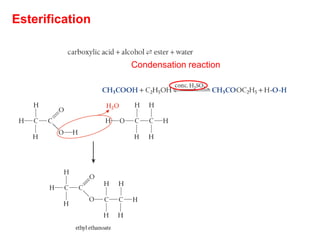
Esterification
Condensation reaction
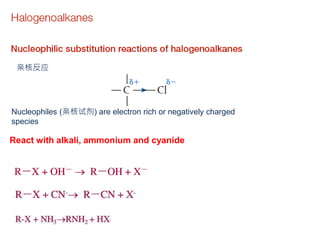
Nucleophiles (亲核试剂) are electron rich or negatively charged
species
亲核反应
React with alkali, ammonium and cyanide
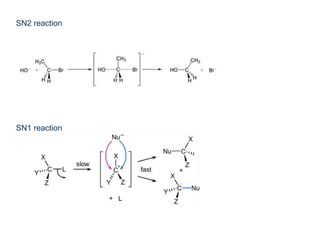
SN2 reaction
SN1 reaction
igcse ORGANIC CHEMISTRY PRESENTATION.pptx

igcse ORGANIC CHEMISTRY PRESENTATION.pptx